A most excellent evening with the South Shore Fly Casters (and bonus Q&A)

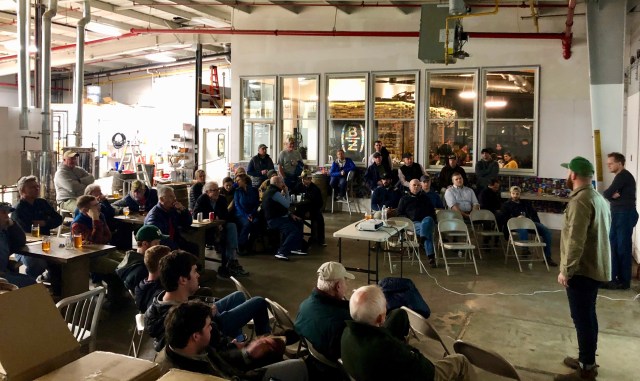
A hale and hearty shout out to the South Shore Fly Casters, who most graciously asked me to speak at their February meeting. The topic was “Trout Fishing for Striped Bass,” which focuses on traditional flies and presentation methods you can use to catch the stripers that everyone can’t. Let’s start with the venue. Any club that holds their meetings at a craft brewery gets bonus pints — er, points — from me. The turnout was strong (almost 50) and it was very passionate, interested group. I appreciated your welcoming nature and for all the kind things you had to say about me and my writing (and the SSFC club swag). Hoping to come back soon!

A very cool space for a meeting. In case you’re wondering, it’s Barrel House Z in Weymouth. That’s my double IPA near the projector. Yummy. (Photo Dan Wells.)

SShoreFlycasters 2

~

Three Q&A highlights: Q: What knot do you use to build your three-fly team? A: Triple surgeons. But you should use the knot with which you are most comfortable (a lot of people like the blood knot). I also mentioned that I never go below 20# mono for the rig, and that if bass over 15lbs are in the mix, I’ll typically fish only one fly.

Q: Do you ever tie droppers off the bend of the leading hook? A: Never for striper fishing. I don’t want anything getting in the way of a hookup, but most of all I want the dropper fly to able to swim freely on its own tag.

Q: How do you use a floating line to present an unweighted fly deep? A: I’ll either add a 3/0 shot (or two) to the leader (and I may also lengthen the leader from, say, 7 feet to 10 feet), but most often I’ll use of the following: 1) homemade T-11 sink tips (I carry a bunch from 2-8 feet long in 2-foot increments; or 2) I’ll use an integrated sink-tip line that has a floating running line. Of course, with either of these solutions, you must mend if there is current to help the fly sink. I’ll also shorten the leader to 3 feet.

Hope that helps!

When the stripers are eating small stuff…(raffle swag for tomorrow night’s presentation)

Tomorrow, February 19, I’ll be presenting “Trout Fishing For Striped Bass — How to catch the stripers that everyone can’t” to the South Shore Fly Casters. SSFC is a newly formed group, and they’ve done a terrific job of getting their club up and running in a short amount of time. The gig is from 6pm-9pm at Barrel House Z, Weymouth, MA. Come on down…or up…or across…and you might win this spiffy little collection in their raffle. As always, please come say hello!

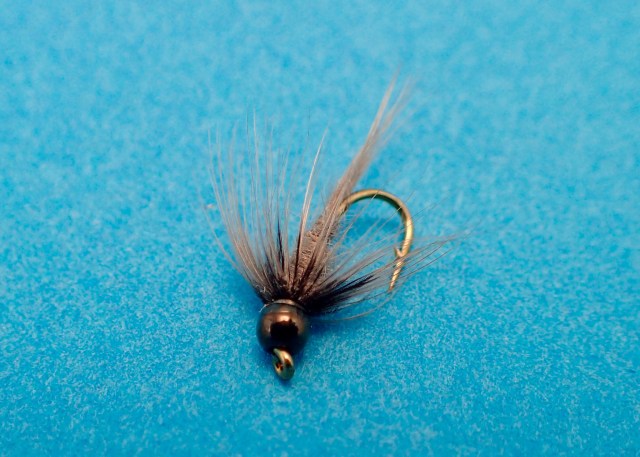
When the stripers are keyed on small stuff, it’s hard to go wrong with a well presented team of three. Four options here, clockwise from top: Deer Hair Grass Shrimp, Micro Shrimp Gurgler, Orange Ruthless Clamworm, Eelie. Good luck!

OLYMPUS DIGITAL CAMERA


Why New Jersey is called “The Garden State” (Warning: contains adult language to describe NJ’s striper management meeting procedures).

It’s easy to see why New Jersey is nicknamed “the Garden State:” It’s from all the bullshit.

The manure was flying even before Thursday night’s “public” comment (say the P-word with your tongue planted firmly in cheek) session for the New Jersey Marine Fisheries Council.

Tony Friedrich of the American Saltwater Guides Association wrote a scathing summary that outlines the (Corrupt? Rigged? Incompetent? All of the above?) outrageous behavior of the Council. You can read it here.

Fish are considered stupid because they have small brains. However, all stupidity is not limited to small-brained creatures.

Stewart’s Black Spider

W.C. Stewart was a Scottish lawyer and soft hackle aficionado. In 1857 he published the highly popular fly fishing book The Practical Angler. Though long out of print, you can easily find an archival copy online, or even a dog-eared used volume.

Today, Stewart is most remembered for his three spiders. These sparse, impressionistic soft-hackles wouldn’t get a second look in the modern fly shop’s bins. That these patterns would wantonly be ignored is, of course, a huge mistake. Let’s see if we can remedy that.

In a recent column, George Will referenced a line from an Alan Bennett play: “Standards are always out of date — that’s why we call them standards.” Don’t be dismayed by the absence of tungsten beads or UV mega-super-duper-sparkle flash. This pattern has been fooling trout for centuries. And the fish aren’t getting any smarter. Three cheers for James Baillie!

W.C. Stewart’s Black Spider

Hook: 14-15 (from Leisenring). I used a Partridge SUD2 #14.
Silk: Brown
Hackle: Cock starling
Body: Working silk
~
Tying Notes: This pattern is widely interpreted, as evidenced by an image search. The good news is that the design is so simple, it’s probably hard to tie one “wrong.” Let’s start here: I’ve always found it curious that a pattern titled “Black Spider” doesn’t contain anything purely black; I suppose “Dark Spider” doesn’t have the same swagger. The silk body should cover only the front half of the shank. Select a purplish-black hackle from a starling skin, fibers about as long as the shank. To make a more durable fly, Stewart suggested twisting the hackle around a silk tag before winding. Here’s how I did that: Start the silk at the head, winding rearward. Leave a 3″ tag about 3/4 of the way down the body. Continue winding the working silk. At the halfway point of the shank, proceed back toward the head. When you get to the silk tag, tie in the feather at its tip, and continue winding your working silk toward the head. Now, twist the feather around the silk tag, taking care not to break the spine (starling is fragile!). Wrap the feather toward the head, 3-4 turns, preening the fibers so they don’t get covered (a bodkin or needle may help). Tie down the feather and whip finish.
~
James Leisenring was a big fan of the style, writing, “I have found W.C.Stewart’s spiders to be a deadly combination on every stream I have ever fished.” Many iterations have the hackle wound along the length of the shaft, producing a hyper-sparse look, but as you can see from this drawing from The Practical Angler, the hackle is condensed and confined to the front half of the fly.


New Presentation Added: Wet Flies 2.0

Now available to your club or group! The long-awaited follow-up to Wet Flies 101, Wet Flies 2.0 takes a deeper dive into wet flies and wet fly fishing. Starting with the essential wet fly tackle and toolbox, Wet Flies 2.0 explores topics like matching hatches with wet flies (from caddis to mayflies to midges to stoneflies to terrestrials); searching tactics with wet flies; presentation and rigging options to match conditions and situations; fishing wet flies as nymphs or dry flies; wet flies on small streams; and much more. You can find my full presentation menu here.

By learning the mystical arts of the wet fly, you may, as Leisenring said, “soon acquire the reputation of a fish hog!”

Wet fly fishing questions answered

I had some excellent Q&A sessions about wet fly fishing at the Marlborough and Edison Fly Fishing shows (great job, people!) and I wanted to share some of what we discussed with you.

Q: What knot do you use when you build your wet fly team leader? A: I’ve been using a triple surgeon’s knot for years. It’s easy for me to tie, and it’s reliable — I don’t think I’ve ever had one fail. People also asked about the blood knot, and the answer is: use the knot you feel most confident about/is easiest for you to tie.

Q: Do you use tippet rings when you build your wet fly team leader? A: I don’t, mostly because I don’t see a need. The perceived need is that it would be easier to replace a dropper tag (rather than build a new leader) with a tippet ring and it’s hard to argue with that. This is a “what works best for you?” situation. I don’t use tippet rings because I rarely change flies on my leader system, and even when I do I’ve learned how to reattach a fly using a minimum of tag material. Speaking of attaching flies, here’s a nifty tutorial from my buddy Tim Flagler on the Davy Knot, which uses very little material.

Q: You say to pause before you set the hook. Aren’t you afraid the fish will spit the fly? A: No. I quote from The Book of Syl: “With the soft-hackled fly, the trout throws caution to the wind, because he’s not afraid to move under the water, and speeds to the fly with urgency.” The fish has made the decision to eat. He’s said “yes” to the fly. With an immediate hookset, you’re saying “no” to the fish. By pausing — asking, “Are you still there?” before you set the hook — you’re ensuring that the fish will turn away with the fly in his mouth, having neatly hooked himself.

This massive hen blasted the fly, an old English pattern called a Hackled March Brown. She hit so hard she ripped the line out of my hands. There was no need for me to set the hook.

Q: Is fishing wet flies a secondary tactic, or do you ever go to the river intending to fish wet flies? A: I frequently go to the river with the sole intent of fishing wet flies. In fact, I’d say wet flies account for the vast majority of my trout fishing — and catching — between late April and mid-summer.

Ask currentseamser Greg about how good the pre-hatch fishing can be with wet flies!

Q: You talked about using wet flies to catch trout feeding on emergers. Is there a point during the hatch, such as when you see duns on the surface, that you’ll switch to dry flies? A: What a great question! The answer is yes. If I am pounding up fish on wet flies and suddenly my hookups stop — but the river is still boiling with feeding fish — that’s my cue that they’ve either stopped eating what I’m throwing or may now be feeding on the surface. If I see the duns getting taken, and my wets aren’t catching, that is compelling evidence to switch to a dry fly. This scenario frequently plays out during the Hendrickson hatch. It’s wet fly gangbusters up until about 3pm, then suddenly the hookups slow to a crawl. Changing over to a dry usually solves the problem.

I hope that helps, and if you have questions, please don’t hesitate to ask.

The Edison Plan for Friday Jan 24

Tomorrow, Friday, January 24 is my only day at the Edison Fly Fishing Show. Here’s my plan:

Arrive noonish or a little before. Walk the floor, make the rounds, say hello. You can always text me if you’re looking for me — you can find my number here. I’m going to try to catch parts of a few presentations before my Seminar, which is 4:30pm in the Catch Room, Wet Flies 101. Of course, I’ll see you there. Right?

Thank you to everyone for your continued support.

Fly-Fishing-Logo-Largest


Marlborough 2020 Redux

Three busy days at Marlborough and I’m a tired but very happy angler. I think I had more fun at this show than any other. Five gigs, lots of hobnobbing, and a little buying. Here’s what went down.

I try to go to as many presentations as possible, and unfortunately I didn’t get to half of the ones I planned on. Here’s George Daniel doing his Streamers 2.0 presentation. If you’ve never seen him speak, you’re in for a treat.

GDPresenting

~

Fly Tyer’s Row is a always a wise use of time. Not only do I get to catch up with old friends (and make new ones) I also find inspiration and ideas. Top to bottom: salmon fly tier extraordinaire Lisa Weiner (thanks for the casting help!); saltwater whiz Captain Ray Stachelek of Cast A Fly Charters; maker of wonderful fly tying videos Tim Flagler of Tightline Productions. 

LisaW

CaptRay

TimFlags

~

Between socializing and gigs, I managed a little shopping time. The Keough booth had their usual massive selection of potential flatwing saddles (plan on spending the better part of an hour scouring the bins). If you’re a wet fly and soft hackle freak like me, the Badger Creek booth is a must. Saturday’s score included a full jackdaw skin, some woodcock wings, and that prized winging material, lemon wood duck. Owner/operator Mike Hogue told me that another company bought the rights to Pearsalls and their dying process, and is now offering tying silks. As you can see, we’re all a little excited about it.

MikeH

~

You are now at maximum expert casting density. Bill and Sheila Hassan are both gifted casters and really nice people. Always a pleasure paying them a visit. I didn’t get a chance to take photos at the Bear’s Den or Saltwater Edge booths, but likewise on the visit energy.

Hassans

~

Hanging with the boys at the author’s booth. From left: Ed Engle, your humble scribe, George Daniel, and Jason Randall. Check out my Instagram feed (stevecultonflyfishing) for a silly outtake!

Crew

~

Hey, I know that guy. Last but not least: thank you to everyone who took the time to see me speak, took my class, stopped to say hello, or just wanted to chat about fly fishing. I couldn’t do any of this without you. Thanks also to Chuck, Janet and Ben Furimsky for letting me be a part of their show. See you in Edison, NJ Friday, January 24, 4:30pm in the Catch Room for my Wet Flies 101 seminar.

ClassSign

“Wet Flies and Soft Hackles” at Legends new dates: March 13-15

It was my bad, folks, as the original date conflicted with the state hockey tournament. New dates for the Wet Flies and Soft Hackles weekend at Legends BNB on the Farmington are March 13-15. I’ll be there on Saturday March 14 to lead a day-long tying class and wet fly seminar. You get to stay at an amazing lodge on the banks of the Farmington and, weather permitting, get out and do a little fishing. Please note, you cannot book through me — you need to contact Legends directly. Last year’s event was a blast — hope to see you there!

CultonWetFlyLegendsPoster

CultonWetFlyLegendsPoster

Farmington River Report 1/10/19: Hook sets and the mystery salmo

I guided Rich yesterday from 10am-2pm. We fished three marks within the permanent TMA, with one of them producing four trout. As so often happens with winter fishing, find one trout and you’ll find another. Many thanks to Jerry for so graciously sharing the water! Since Rich is new to the river, we also spent some recon time at several other pools. The method was indicator nymphing with a drop-shot nymph rig. I didn’t get a water temp, but it was cold — I’ll guesstimate 36 degrees, 420cfs, and the air temp never got into the upper 40s as advertised. Four trout on a January outing is darn good, so well done, Rich!

Rich’s first ever Farmington brown, a lovely Survivor Strain (note clipped adipose). I wasn’t happy with Rich’s hook set motion, so after he struck I asked for his rod to re-demonstrate, not knowing that he had indeed hooked up. Too funny, my bad, good on you, Rich! We spent the rest of the day laughing about that one.

OLYMPUS DIGITAL CAMERA

~

Rich was on fire after the first trout. I had intended to bring the black latex gloves, but forgot. Folks, this water is unpleasantly cold. We caught fish on the soft-hackled pheasant tail (sz 18) dropper and Frenchy variant (size 14) point fly.

OLYMPUS DIGITAL CAMERA

~

The mystery Salmo. I had thought due to coloration, spotting, and tail fork that this was a beast of a juvenile salar, but the maxillary extends well past the eye, so that would point to trutta. A fisheries biologist once told me that there may be some cross-pollinating between browns and precocious young Atlantics — could this be the result of such a union? Either way, a lovely fish.

OLYMPUS DIGITAL CAMERA

~

Posterior of the mystery Salmo. 

OLYMPUS DIGITAL CAMERA