Much to do today, and in between projects and responsibilities I’m trying to make a dent in my 800 Followers contest winner swag. Here’s a Hackled March Brown in progress.
As you can see, my tying bench trends toward messy. There’s something mad scientist/struggling artist that I like about materials and tools scattered everywhere…
Another short and sweet (or bitter, depending on your POV) striper report: fished the mouth of the Housatonic today for two hours. We had a good tide, overcast skies, and a falling barometer, three elements that should have made for a terrific outing. Unfortunately, Mother Nature forgot to CC the bass on the memo. Not a touch for me, both deep and on the surface. In fact, I saw only three three teens-inch bass caught in two hours among ten or so anglers, and it was all two guys fishing one small pocket. Deciding that you cannot catch what isn’t there, and having had enough two-handed casting practice, I skedaddled just before low tide.
Not from today. In fact, it was as warm a November day as I can remember down there. The most excitement I had was when a bird went fishing for my fly. I was relieved that the pull produced no hookup.
I’ll make this short and sweet. I fished last night because I was foolish enough to believe that I had an accurate weather forecast. Moments before I walked out the door at 10:30pm, I re-checked the site. There it was: clear skies through dawn. About 15 minutes after I settled in, an ominous charcoal grey wall moved in from the eastern horizon. Soon, the mark was socked in. Thanks, weather.com (he said, dripping with sarcasm). When I got home, the site now warned of a “dense fog advisory.” Great.
It certainly felt fishy, and I had a waking follow before the fog settled in. But I’ve learned that fog kills the bite at this mark with a destitution of mercy. I dunno…call me crazy…but this don’t look like “Clear” conditions to me…
Happy Monday to everyone. Late start for me today. No big news or hot presentation tips or must-have fly patterns, so consider this a simple hello and let’s-catch-up missive. This is fish-related: as I write this, I have two salmon filets on the smoker, a present for my parents and my aunt. They (the filets, not my relations) spent two days pickling in the fridge, and now they’re taking a gentle bath of apple wood smoke.
Normally I’m steelheading this week, but low water and spotty reports have me at home playing the waiting game. I’m going to try to amuse myself with some other species instead.
800 Followers contest winners: I have one set of flies done, and I’ve started on another. Sloth is my flaw; patience is your virtue. I’ll notify you by email when I ship your goodies.
Wow, another birthday! Thanks so much to everyone who sent birthday wishes. I had a great day with my family, outside and socially distanced, and I made merry with some wine, whisky, and an absolutely delicious Cuban Romeo y Julieta Short Churchill.
Last year at this time it was Everest Base Camp-cold on the Salmon…and with quite a bit more water.
Many, if not most, modern fly lines come with a factory welded loop for an easy leader connection. The problem is that if you’re using a straight shot of leader material that’s under 40lb. test, the diameter of that leader can cut into the the welded loop while fighting a big fish, trying to free a snag, or inducing any other stress that puts extreme pressure on the connection.
Solution: create a short mono butt section to act as a buffer between your welded loop and leader. I’ve been using a foot-long length of 50lb. or 60 lb. mono. Just tie a perfection loop (here’s a great tutorial from Animated Knots) at both ends, and you’re good to go! I’ve been using this system with my two-handed shooting head for over a year.
The best colors for the Crystal Meth fly are the ones the steelhead want to eat…or the ones in which you have the most confidence.
Debates on the best color for Crystal Meths, egg patterns, and beads for steelhead and trout are never-ending. Everyone has their theories. Everyone has their favorite colors. Everyone can prove you wrong. So I stand by my opening statement. In case you don’t know what a Crystal Meth is (besides one of the best fly names ever, right?) it’s a sparkled-up version of a Sucker Spawn. You can tie them with or without a bead and a Krystal Flash tail. When the steelhead are feeding below salmon redds — and even when they’re not — the Crystal Meth can be a very productive fly. And since they’re firmly in the junk/guide fly category, you don’t fret when you lose one to the bottom gods.
Our Lady of Blessed Crystal Meth — chartreuse — accounted for my only fish on this painfully slow day.
So, what are my favorite colors for the Crystal Meth? Here’s a handy-dandy photo reference chart. I use them all, but if I had to choose a top three, I’d go chartreuse, fluorescent blue, and fluorescent fire orange. YMMV.
You’re now at Countermeasure Central on currentseams! Here you can watch the tying video (below); see the original post/recipe; and read the Guide Flies feature piece from On The Water magazine. In case you’re new to this pattern, the Countermeasure is a riff on several proven streamer designs (like the Zoo Cougar and Zonker). It’s loaded with bite triggers, and it’s one of my favorite smallmouth bass bugs. Oh! Big trout love it, too.
One of my goals with currentseams is to help you become a better angler — and hopefully catch more fish. So if I could somehow distill a “Top Ten Tips” out of my brain’s fly fishing storehouse, one of them would certainly be: Learn presentations other than cast and strip. Especially if you want to catch more stripers.
When I see questions like, “How fast do you retrieve the fly?” or “Do you strip with one or two hands?” — and I see these questions a lot — I despair. Rarely does anyone ask the question, “Does it have to be a retrieve?” The answer would open many doors to greater fish-catching glory.
Even if you were going to fish for stripers using only retrieves — and there are many outings over the course of a season where I do just that — there are an abundance of retrieve options that are rarely used or discussed. For example, for sand eels, I like a hyper short (1-2″) rapid pulsing strip. For a large squid fly like the Mutable Squid, I like a slow hand-twist retrieve. Last week I fished a large deer-hair head fly with a fast strip-strip-strip-strip….pause….wait for it….then strip action. And there’s always the surface popper trick of landing the fly with a splat….then doing nothing. Once the landing rings dissipate, give that bug a twitch. You could present in randomly timed, spaced, and distanced strips, creating the drunken action of wounded prey. The list goes on. And the stripers will always tell you when you get it right.
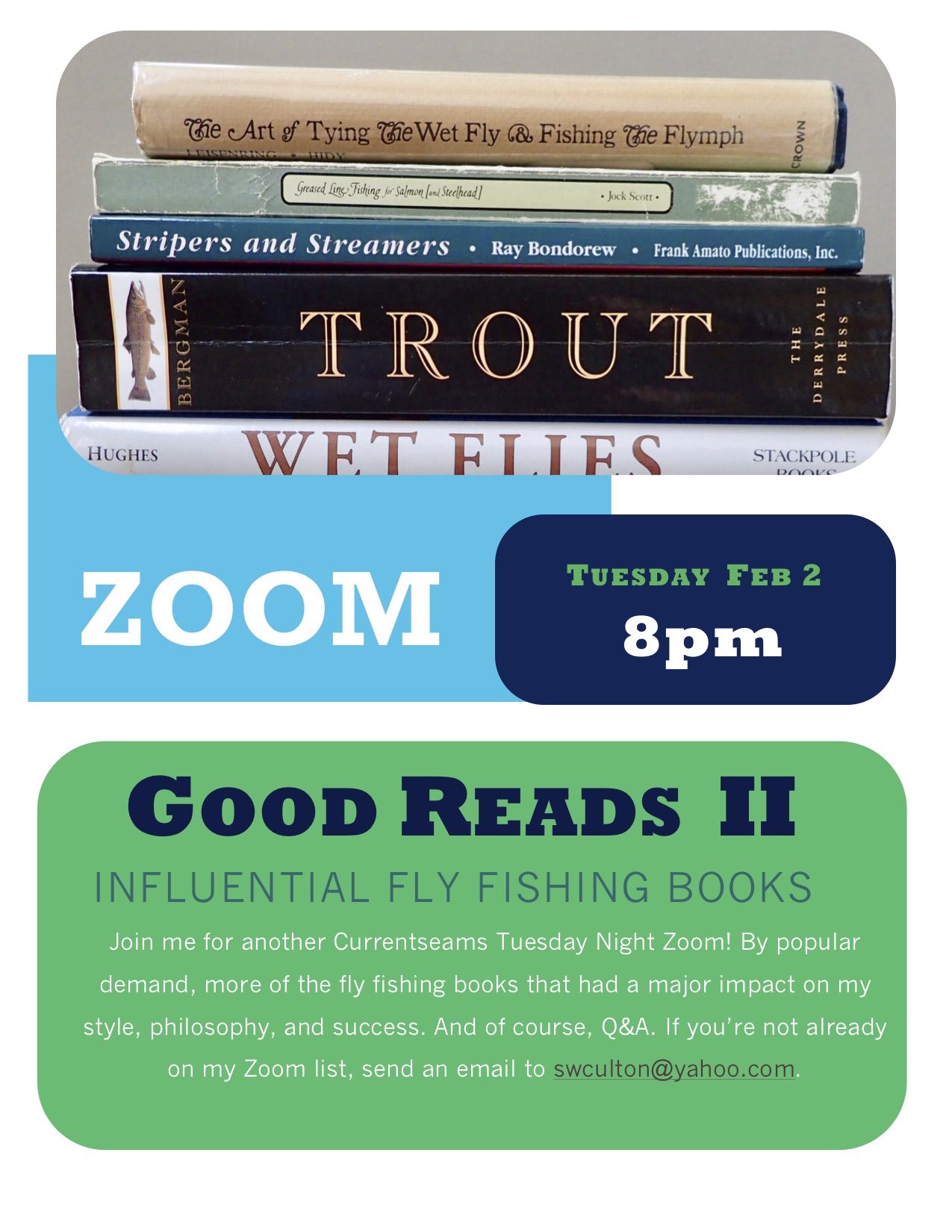
Ultimately, you’ll need to learn presentations other than cast-and-strip for those outings where the stripers will not chase. One of my recent trips included a puzzle where school bass were cruising and feeding, but would not move to a stripped fly. The answer was found within traditional salmon presentation tactics. Those willing to invest in the floating line — I’m not talking money, but rather in taking the time to learn how to harness its power and master a few basic presentations — will see their catch rates soar. And while you’re at it, pick up a used copy of “Greased Line Fishing for Salmon [and Steelhead] by Jock Scott.
Fly fishing is all about line control. So take charge. Presentation is not difficult to learn. Remember that a fly rod and line is only, as Ken Abrames once observed, “a stick and a string.”
Learn presentation and start bringing your fly to the fish — not vice versa.
You may have noticed this year that there weren’t many Housatonic River smallmouth reports on these pages. It wasn’t for a lack of effort from your humble scribe. I believe I fished more days this summer for smallmouth than I have since I started seriously pursuing them (in 2016). So why did I go dark? Part of it was people — and anglers — everywhere. And anywhere. I ran into anglers in places where I’ve never seen a soul. Finding a parking spot was, at times, impossible. Part of it was the drought, which made for challenging conditions. And part of it was that in terms of size and especially numbers, this was by far the worst year I’ve had fishing smallmouth on that river.
One late July night illustrates this last point. I fished a favorite mark that was, to my delight, devoid of other anglers. I hit the White Fly hatch perfectly — in fact, I’d rate this as one of the top three blizzards I’ve ever experienced. The surface should have been boiling with frantic rises — dozens per second. Instead, I could easily pick out an occasional lonesome rise ring here and there. The lack of bass on the bugs was both extraordinary and discouraging. What’s worse, what was rising was small. Not a bruiser in the bunch.
At least the dragonflies had a good meal.
Since the fishing was awful, and — this is important — every year is different — I decided that I would embrace different. So I explored. I fished new water. I tried new flies (like Wigglies and Barr’s Meat Whistle). And I tried new methods (like indicator nymphing and dead drifting crayfish patterns along the bottom). These efforts will pay off handsomely in the future. So, 2020 wasn’t the year we wanted it to be. But we can take comfort in the hope and promise of 2021.
To the Hous: I fished within the TMA yesterday, and my experience can best be summed up by one Mr. Robert Zimmerman, who said in his epic song “Highlands,” “you picked the wrong day to come.” Okay, the weather was magnificent. It was great to be out. But there were scores of anglers competing for the honey holes (more people yesterday than I’ve seen in the last 10 years in the fall combined — really) — the water was loaded with leaves and evergreen needles (beware the windy autumn day) — and the trout were most uncooperative (I hit five marks in two hours and saw one fish landed). The river height was an excellent 325cfs, but those looking for solitude and leaf-free waters should be advised to wait a bit. Rain’s coming as I write this, and that should spike the flow this weekend.
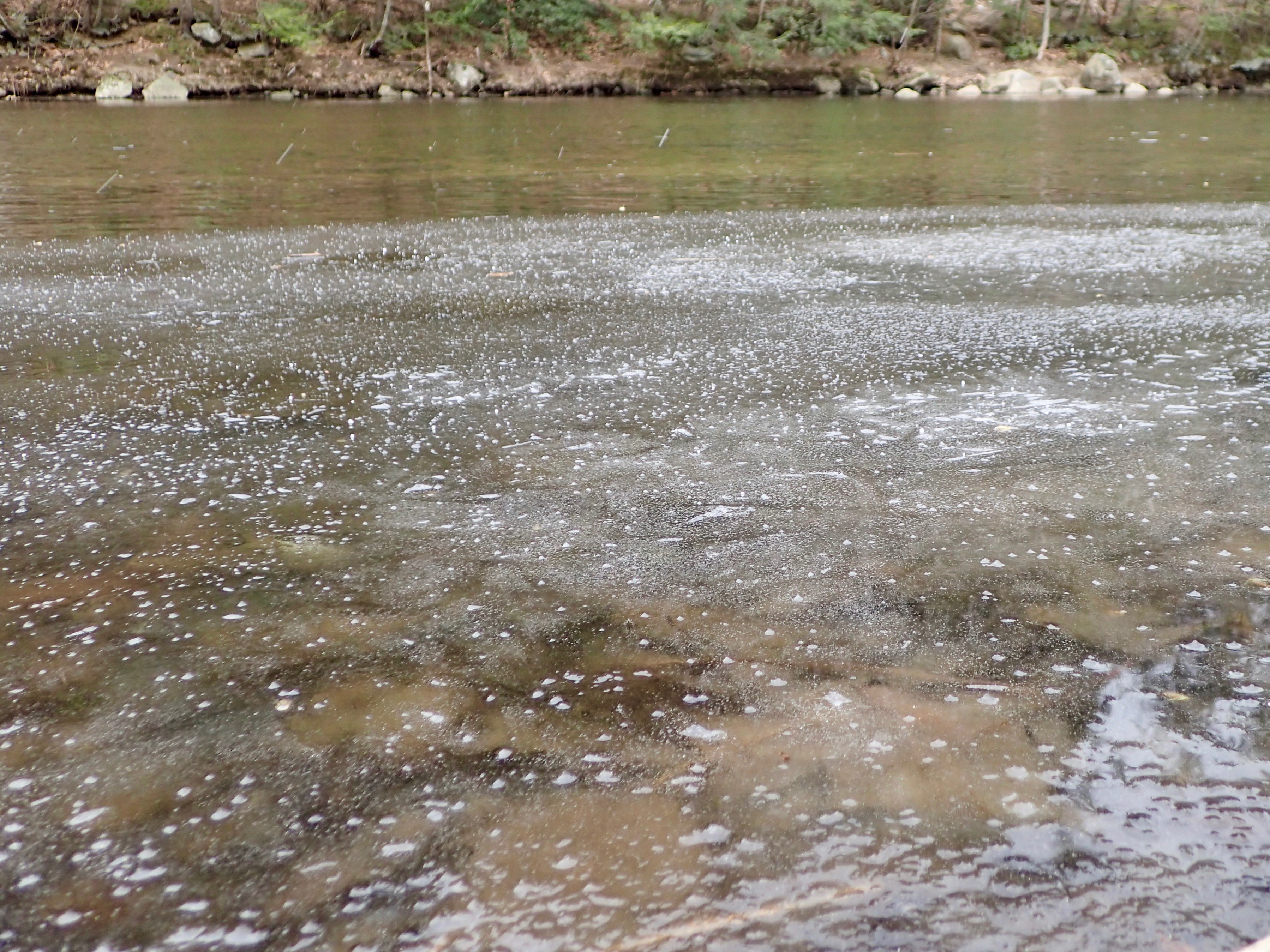
With all this flotsam, it was challenging to get an unmolested drift.