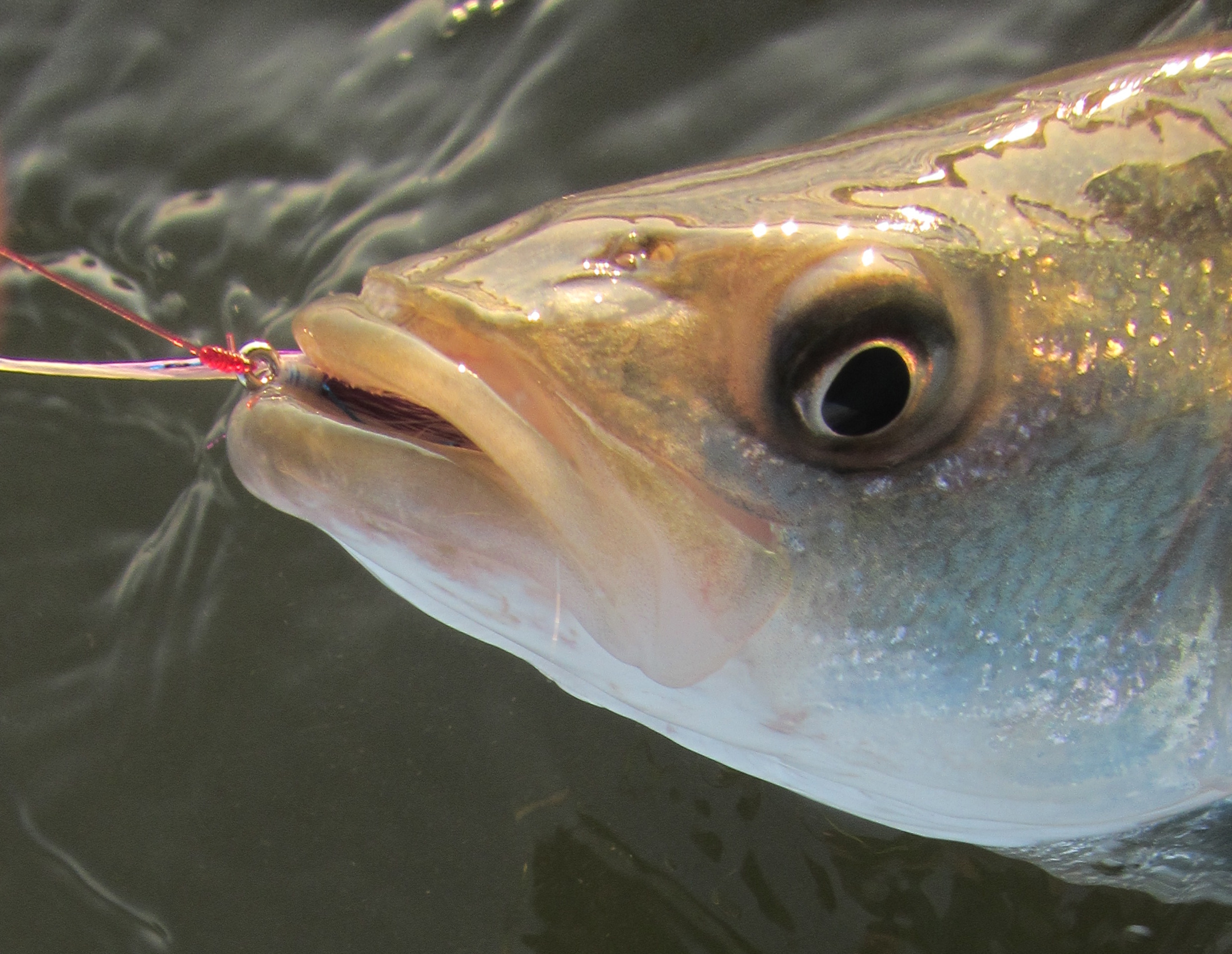
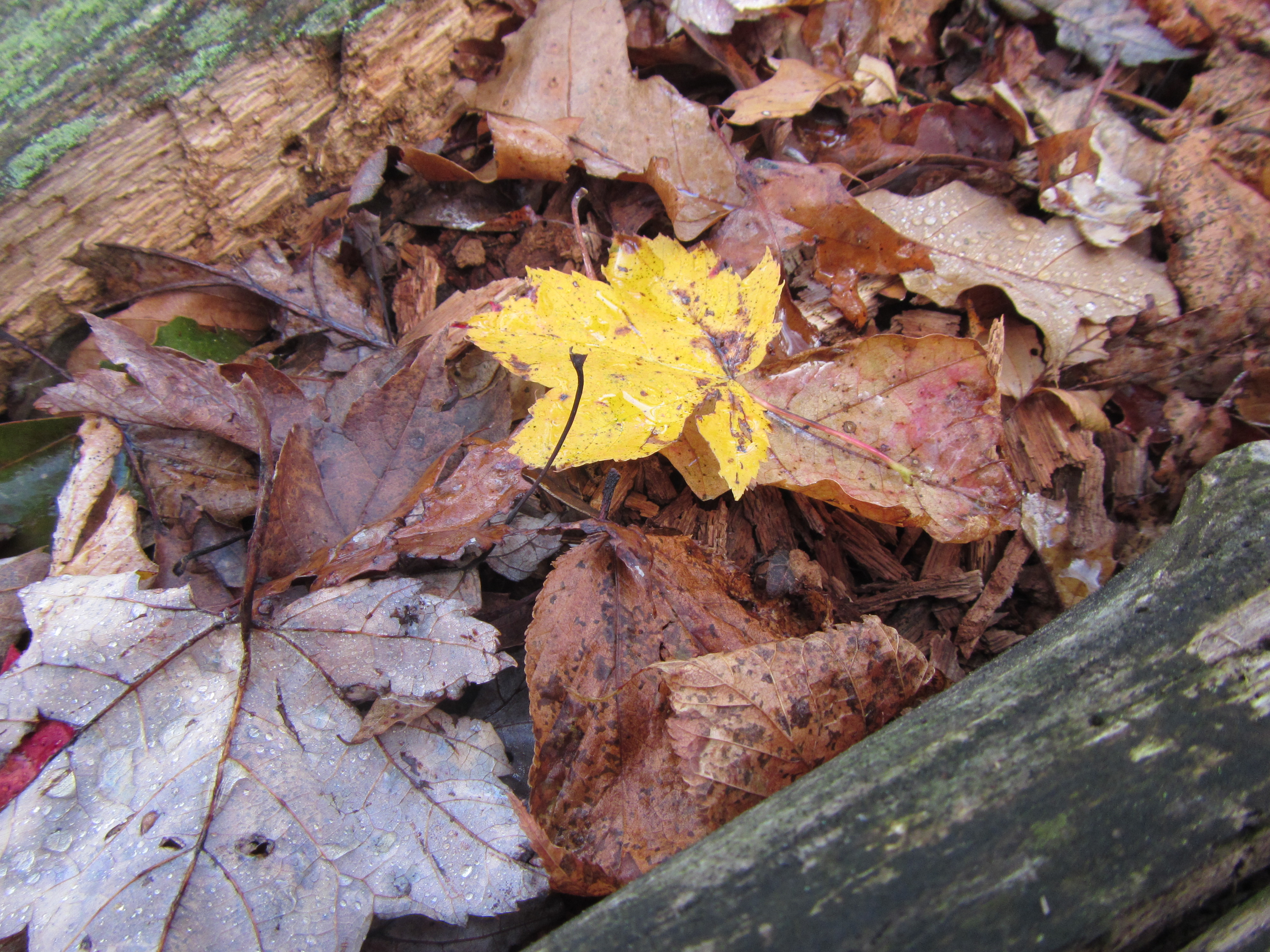
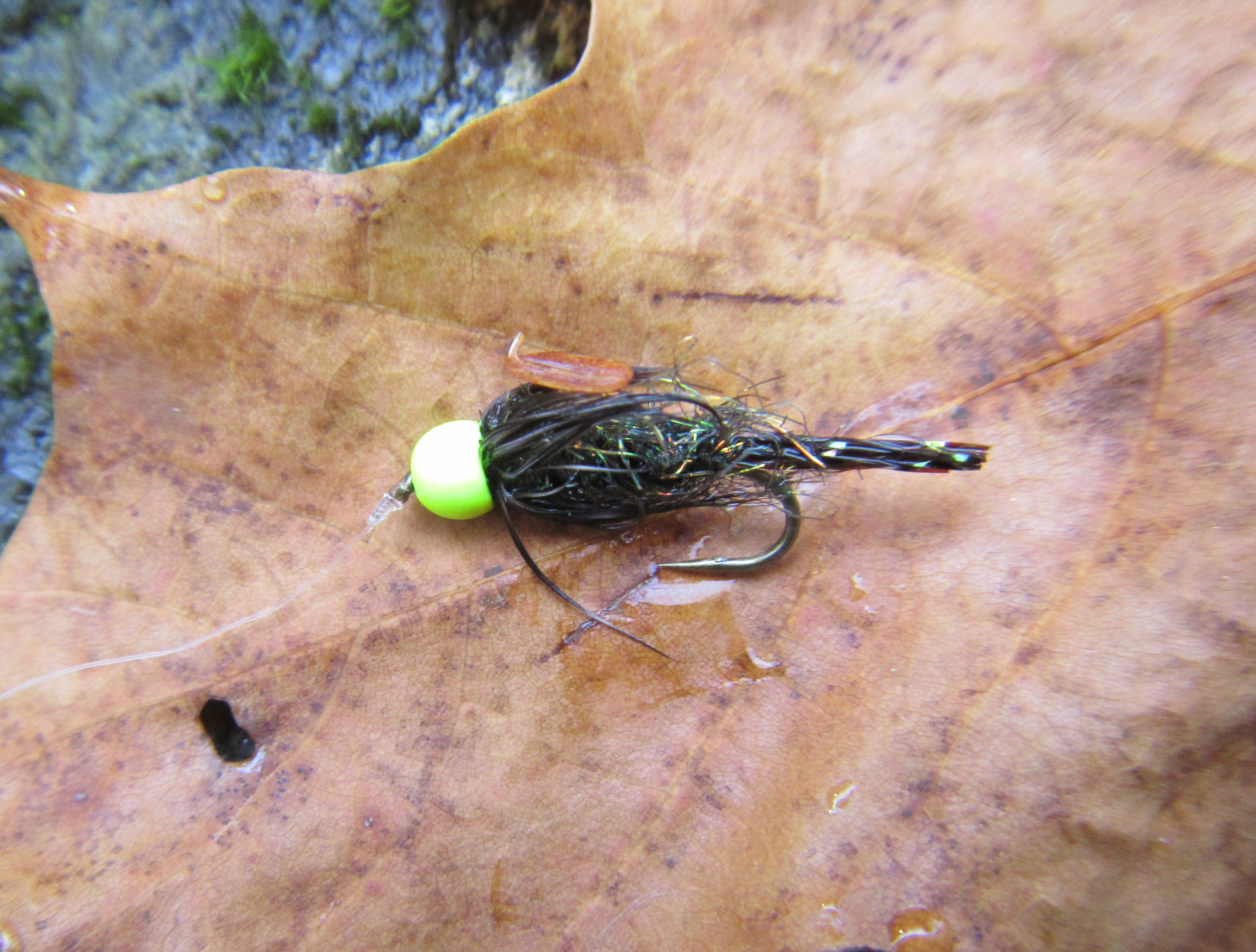
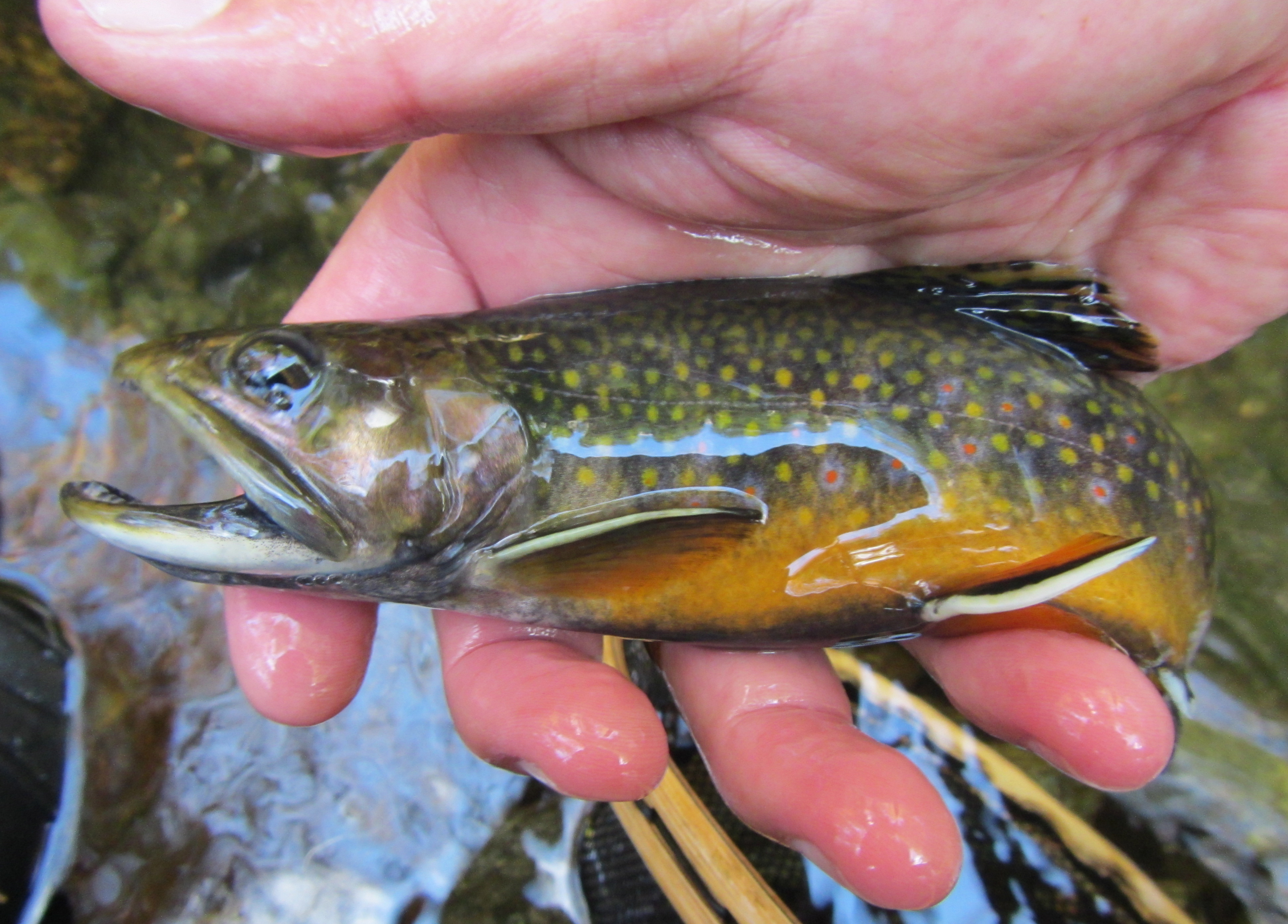
Check out the current (Nov/Dec) issue of American Angler for my latest article, “Wet Fly 101.” Wet flies have been fooling trout for centuries, and the fish aren’t getting any smarter. This piece serves as a broad introduction to wet flies. It covers basics like fly types; building a traditional three-fly team; what kind of water to target; and presentation. For those looking to take the ancient and traditional path to subsurface success, it’s a fine place to start.
Tag Archives: fly fishing
So, this guy walks into the woods carrying a fly rod…
We haven’t had rain in a while; the brook was low and the forest floor dry as tinder. Still, I found a spirited rivulet of groundwater that wended down the fall line before tumbling over a mossy ledge. When the water is this clear and low, the brookies tend to stay in the darker, deeper sections — or in the whitewater just below that miniature waterfall next to the moss-covered boulder.
~
Vibrant red spots ringed by blue halos adorn an eastern brook trout. Brookies are the only trout (technically, they are char) native to much of the eastern United States.
~
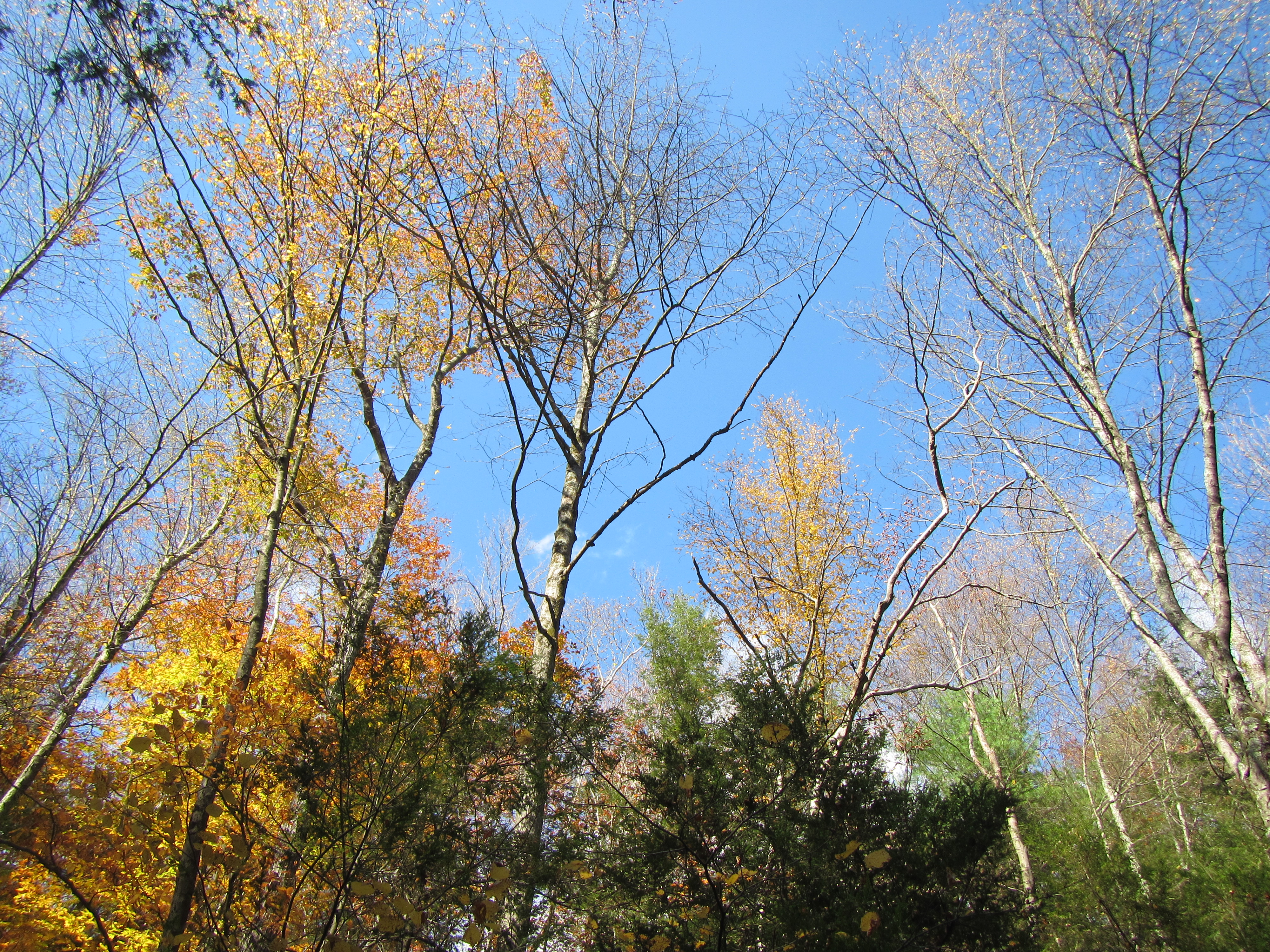
Fall is living up to its name. The deluge of soon-to-be-ex-flora has already begun in the hills. Fishing-wise, the leaves weren’t really an issue; I only hooked a few here and there. I was looking for photo ops when I glanced down at my feet. I was struck by contrast of these two leaves against the rock, but what really captured my fancy was how, in that swift current, did they manage to find a toehold — and how are they able to so stubbornly cling to their perch?
~
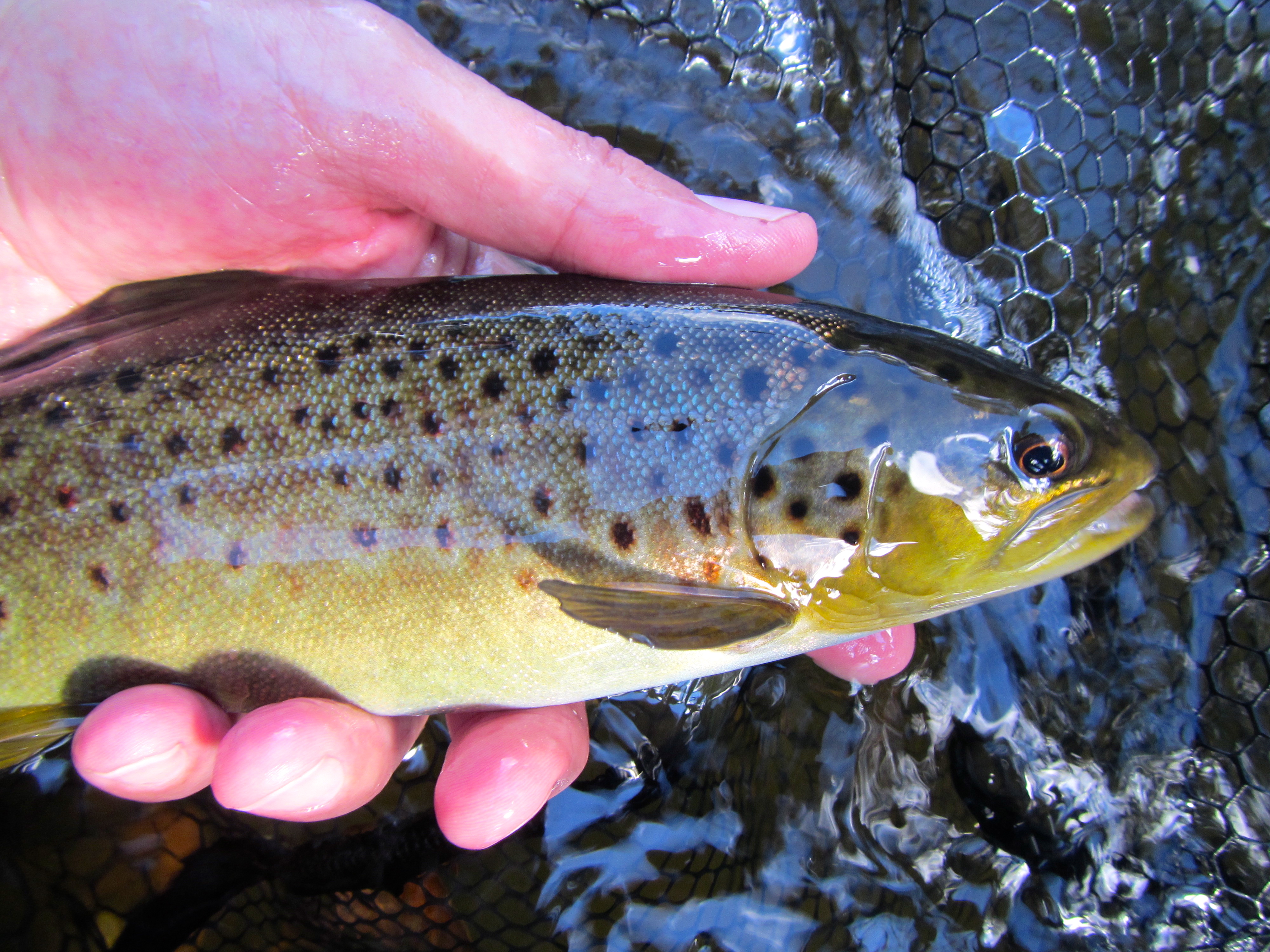
A lot of people don’t know this, but Vincent Van Gogh was an avid fly fisherman. He used to jet from his estate in Holland to his cabin in the Appalachian foothills, where he could pursue his passion: fishing for Salvelinus fontinalis. The flank of the brook trout is said to have been Vincent’s inspiration for his masterwork Starry Night.
Well, at least that’s what I heard.
Fishing notes: Water was 56 degrees. Not surprisingly, most of the fish I pricked came from deeper holes, dark runs, and plunge pools. I found one abyss where there was a bona fide lunker (for this size stream) of about 11-12 inches. Pricked him twice, but couldn’t get a good enough hookset to close the deal. I tried for over a half hour, and in the end decided that that fish might be responsible for populating hundreds of yards of brook — and with spawning season so close, would be better left uncaught. I fished mostly downstream. Dry fly was a size 16 Improved Sofa Pillow; wets were a cornucopia of bead head soft-hackles. Cigar was an Aroma de Cuba Reserve maduro Churchill.
Farmington River Report 9/29/13: Blue ribbons all around
First Place Winner: James. James is an experienced fly angler who wanted to learn the ancient and traditional ways of the wet fly. He aced Wet Flies 101, got into double digits of fish, and even had a double on a February Red and a Squirrel and Ginger. Good job wading, good job mending, good job presenting. If he keeps at it, James is going to be a dangerous machine. Trout, you’ve been warned.
Almost a grownup. The signature ink of youth has just about faded away from his flanks. A spirited fish, this one. I’m amazed he held still long enough for a photo.
First Place Winner: The weather. Cool air. Warm sun. Blazing, brilliant sunshine. All day long. Water temp 59. Whoever ordered this day, I’d like to buy you a drink. And a cigar.
First Place Winner: The bite. Thank you, trout, for making my job easy. Your recklessness creates the illusion of genius in the form of a fishing guide. I really appreciate it.
First Place Winner: The hatches. See “The bite.” Caddis (smaller creamy size 16 and big tan size 12s), midges, BWOs, and especially a bumper crop of Isonychia. All our trout came on the Squirrel and Ginger (caddis) size 14, size 12 February Red, and size 12 Hackled March Brown.
James’ brown. The hardest working trout in the Farmington River? Or simply one of the many fish James brought to net?
Farmington River Mini Report 9/27/13: Like going into Wisconsin
I had just over two hours on Friday afternoon to scout some locations for Sunday’s gig. So I zipped in and zipped right out again. Speed fishing, if you like. Four different spots, all of which held fish that were eager to jump on the wet fly.
I’ve been seeing some creamy mayflies on the river the last couple weeks. A good size, about a 12, late afternoon. Apparently this fellow has been seeing them, too.
As usual, I was fishing a three-fly team of wets. Today’s selection consisted of a size 10 Catskill on top dropper; a size 12 Pale Watery wingless wet in the middle; and a size 12 Hackled March Brown on point. I took trout on every fly. With the most recent stocking just weeks old, I was expecting to find plenty of newly released wards of the state. But no. It was all wild and holdover browns along with a few juvenile salmon sprinkled in.
I did have a curious catch, a silvery brown that looked unlike anything I’ve ever caught in the Farmington. At first its color suggested a juvenile salmon, but when I got it to net I saw that it had a flat tail and the eye/jaw placement of a trout. Few spots, but large and haloed like a brown. Could this be a sea-run trout? The sensible side of my brain said probably not. But the side that likes to dream swirled the notion around and tasted the possibility that it could be.
Notes: cloudy skies, air temps near 70. Water temp 60. A strong Isonychia showing. A few caddis, a few of those creamy mayflies, lots of midges. Little to no surface activity. The water levels are lower than normal; they’re drawing down the dam to complete an every-decade inspection of the pipes.
It’s getting to be peak color time on the Farmington.
Thank you to the Hammonasset Chapter TU for hosting me tonight
Tonight I kicked off my 2013-2014 speaking schedule with a presentation at the Hammonasset Chapter of TU: Wet Flies 101. I’d like to thank the group for being so welcoming (What? Food? Yes! Loved the pulled pork and the slaw and, oh, yes, the chocolate chip cookie) and for asking a lot of terrific questions. You made my night an enjoyable one.
Block Island Diary 2013: Hey! I Remember You. (Kindof.)
If you’ve followed my previous Block Island Diaries, you know that the last two years of fly fishing from the shore have been – ahem – underwhelming. Used to be, a good night on the Block was a dozen stripers. An off night, two or three, with an odd visit from the skunk tossed in to keep you honest. But in 2011, I took only six bass in seven nights. Last year, a measly four bass. Buoyed by a strong 2012 fall run in Rhode Island and an equally impressive 2013 spring migration here in Connecticut, I ventured once again to the magical land of the Manisses.
Saturday: Red Right Return
There’s a reason Luke Skywalker doesn’t blow up the Death Star at the beginning of Star Wars. Unfortunately, you don’t have the luxury of manufactured drama in non-fiction. You get what the fates throw at you. And what I got tonight was a good old-fashioned summer blockbuster climax. It was so humid it felt like you could grab handfuls of air. Low clouds and fog banks whipped past, accentuating an already mysterious setting. Five casts in, and I had my first bass of the trip, a porcine twenty-one-incher that went immediately on the reel. Twenty minutes later, I’d already caught more stripers here than I did all last year. Halleluiah! These bass were gathered for one purpose: to eat with extreme prejudice. Sand eels were the entree, and I could hear them plink-ploinking through the water as I waded. There were stripers everywhere, and they attacked my fly, a Big Eelie in a Crazy Menhaden color scheme, with undisciplined fury. Missed strikes were frequently followed by punishing returns. Without a sealed drag, the moisture in the air and an occasional dip in the water reduced my reel to a shadow of its locked-down-tight self. Once hooked, the bass were off to the races, and I did my best to palm the reel. My knuckles took a beating as the handle repeatedly whacked them, but it was a good hurt, and I laughed at my clumsiness. The commotion I created sent several spin and fly anglers scurrying over to join the fray. By some perverse twist they all caught few or no fish. Some muttered as they left, and others departed with a palpably grim silence. Twice I told myself I would give the spot a rest and seek my pleasures elsewhere. Twice a fifteen-pound fish talked me out of it. The action slowed only when Mr. Boating Dipstick 2013 set a course for the wrong side of the channel marker – despite his blazing, brilliant spotlight – and momentarily hit the sandbar. But that was the only wrinkle in an otherwise flawless night. When it was over, my thumb looked like a pound of ground chuck under cellophane. My fly had been surgically reduced to a couple hackles and some forlorn strands of bucktail. Even when I tried to stop fishing, I couldn’t. I caught a legal fish just reeling in my line. One of the stalwart souls still on the beach called out to me. “Are you leaving?” Yep, I’ve had enough. “How many did you get?” I don’t really know. I stopped counting after fifteen. “You had some big fish there.” At least a half dozen in the 15-pound range. “Can I see what fly you were using?” Absolutely. “Wow. That’s it? It doesn’t even have eyes” Nope. Here, take this fly, and this one too. Color doesn’t matter. Good luck to you! Then I began the long walk back to the truck. As I trudged through the sand, I switched on my headlamp, and basked in the warm red glow of an absolutely righteous return.
Any night filled with ten to fifteen pound stripers doesn’t suck. I know, I know, it’s not the most fish-friendly photo. If it makes anyone feel better, I lipped the rest.
That’s gonna leave a mark. The price of admission for a dozens-of-bass outing.
Sunday: The five most feared words in fly fishing
My friend Bill arrived on the Island today, and I’ve been regaling him with tales of gluttonous bass, buckets of bait and thumb-wrecking action. Word travels fast about a good bite, and the parking lot is mobbed. The weather and the wind are a carbon copy of last night. All we have to do is wait for dark and a little more of that flood tide. Unfortunately, there are more anglers than bait. Or stripers. Plenty of skates, though, in thick and beaching themselves, wings flailing away, frantically slapping against the sand. The wind picks up in intensity, and brings with it brief tropical downpours. I can see a light grey band in the skies over Block Island sound, then a foreboding line of India inkiness over the mainland. In the end, the bite never materialized. I managed a single bass by moving around and fan casting with a black, blue, and purple Big Eelie I call the Bruiser. I couldn’t blame Bill when he bailed after the second squall came through. As he walked off I called out to him, “You shoulda been here yesterday!”
Until someone brews up Silver Stoat Stout, Todd’s Norway Ale, or Flyrodder Lager, I’m still the only dude in my crew with his own label. (“The Fisherman” is my internet forum nom de voyage.)
Monday: Gettin’ jiggy wid it
The wind is banshee bitch, even more so than the previous two outings. The fishing’s about the same as last night, possibly a degree less of suckiness: three fluke in about 90 minutes of fan casting over an expansive flat. Einstein’s definition of insanity being what it is, I decided to go for a wade along some shallows that border rocky structure. I spooked a fluke, then saw some suspicious upheaval on the surface about 50 feet away. I climbed up onto a rock to investigate. Three casts and two bass later, I had my answer. The fish were standard-issue Block Island mid-twenties schoolies, which is to say that they were rotund, powerful swimmers that went on the reel. Not much else going on, and I was in bed by 2am. While I was sleeping, Ravi, who works at the Block Island Fishworks, was jigging for squid in New Harbor. At 3:30am, he hooked a squid, which moments later was swallowed by a 31-pound cow. He said her stomach was full of calamari, from 2” to over a foot long. Now, which box do I keep those Banana Squid flies in?
When the fishing’s slow, you look for ways to amuse yourself. Here’s my attempt at an abstract: a long exposure of boat masts swaying in the wind, accentuated by a rogue fireworks shell burst.
Tuesday: A very deep trough
Nothing. I fished the snot out this Island tonight, and nothing. Nothing at the Saturday night heroics spot. Nothing at my favorite jetty. Nothing at Charlestown Beach. (Not that five minutes of beleaguered casting in hellacious 20mph crosswinds counts for much.) Bill came back out tonight, and I talked him into trying a spot on the west side I’d never fished before. We were sheltered from the wind by a kindly bluff, but it’s generally a bad idea to wade out into unknown waters at night, even if you scouted them from the shore in the daylight hours. Bill gave it 15 minutes, but he just wasn’t feeling it, and after he left I got the standing-in-the-ocean-at-night-by-myself-catching-nothing blues. The visibility was so poor that I couldn’t even make out the horizon. All it took was one good gut-high wave to knock me off the rock I was standing on. Off to more clement waters, where, of course, I caught nothing. There was the mystery of the glow-in-the dark shooting basket to keep me entertained, though. I noticed that at odd intervals, the inside of my basket would glow a dull red. It was a puzzlement until I realized it coincided exactly with each draw I took on my cigar.
Yup. That about sums it up.
Follow the fish. If only finding stripers was this easy.
Wednesday: The natural
Tonight I’m taking my 10 year-old out with me. Last year was Cam’s first time night fishing for stripers, and although we didn’t catch any bass, he aced the outing. Whether it’s because I’m with my new fishing buddy or I’m attuned to some angling sixth-sense, I feel like we’re going to see some saxitillus tonight. Cam is fishing a 4” jig-head Sluggo, and lands a fluke in short order. We move to a different spot where Dad hooks a bass. It’s a standard-issue schoolie, but Cam is more than happy to land it on the fly rod in the misty twilight. Our last stop is the jetty. We experience our first double, although it is curiously strange that we have both hooked skates, Cam’s from the bottom and mine on the surface. We go out in a blaze of glory when I tie into a keeper bass about 70 feet away. I set the hook, and hand the rod over to Cam, who’s never fought a striper that large before, let alone on a fly rod. I take a quick picture, then clamor down the weed-covered rocks, telling Cam to let the fish run when it wants, reel it in when he doesn’t, and take his time until I can get down into the water. I’m standing at the bottom of the jetty, about to tell Cam to start getting the fish in, when I see a splash at my feet. Cam’s already beaten the striper, and there it is, waiting to be lipped. I got goose bumps when I realized that he’d landed his first keeper bass a lot quicker than his old man did.
A portrait of the artist as a young man, focusing on the job at hand and doing his father proud.
Thursday: Fireworks cancelled due to fog
And the bass followed suit. At least for me they did. We all put our waders on one leg at a time, and tonight I’m living proof. Everything that could go wrong did. Everyone caught a striper but me. It’s not much fun when you’re going through it. At least afterward you have the comfort of humorous remembrance. Things started poorly when I drove a spot on the east side that was on lockdown – and they were catching fish. No room at the inn, so I drove to the west side where my line repeatedly insisted on wrapping itself around my rod. Literally sprinted a hundred yards down the beach after an angler reported blitzing fish on a sand bar – and found nothing. To make matters worse, I was wearing my stubborn hat tonight. I stayed out way too late. At least the birds weren’t singing by the time I drifted off into the fog of sleep.
Fortunately, there’s nothing in Chapter 10, Section 9 about carrying a cold one out on a jetty.
Friday: Right where he’s supposed to be
It’s good practice for any serious striper angler to know a spot – and know it cold. I’ve fished the Island long enough now to have a certain level of competency. I have a mental index of where to fish at what tide, wind direction, moon, etc. Tonight I had my heart set on catching a striper at X. There were a few problems with my plan. X is generally a two-hours-either-side-of-the-flood spot. Tonight was fireworks night with the family. That would put me there well into the third hour of the dropping tide. The best I could do would be to have the truck pre-loaded so I could make tracks even as the finale’s last boom! was echoing across the hills. There was enough bait in the water to keep me hopeful, even after a fruitless fifteen minutes of casting. Then, bump! Missed him. Mortal depression. This being such a mercurial week, that might be my only touch of the night. But somewhere out there, in the rapidly fading twilight, I could hear the mischief of a bass feeding. I couldn’t quite place him; there was enough wind chop to make sighting the rise rings impossible. Bump! He hit it again. I let the fly sit there. Gave it a short strip. Bump! What gives? Must be a small fish. Another strip. Whack! Got him now, a silvery ten-pound striper that was the perfect fish in a perfect place at a perfect time. As I’ve gotten older, I’ve tried to embrace the concept of, “I don’t need to be right.” But oh my goodness, sometimes it feels so damn good when I am.
A perfect fish. Just what I needed to close out the week. As tradition dictates, taken on a Big Eelie in the original colors.
El Rey Del Mundo
I used to work at an advertising agency where the owner would go from floor to floor and ask each of us, “Is this the best job you’ve ever had?” At the time, for me, it was. But as it turns out, now I’ve got the best job I’ve ever had. I work for myself. There are multiple tradeoffs with any entrepreneurial venture, particularly in writing for a living. For example, I don’t get any paid vacations. But I do get to set my own schedule. And no. I’m not trading with you.
Because last Friday, I decided I needed some photos of small stream wild trout for an upcoming article. So while most of the rest of the world was working for someone else, I was heading out into to the woods on one of the Ten Best Days of the Year. You know the kind. Bluebird skies. Sun that coats your body with gratifying warmth. Cool, crisp air you can almost taste as you suck it into your lungs.
When this tree fell, it changed the whole structure of the pool. I don’t often use it for a bridge, but ants and squirrels do.
The brook was at an ideal height, 60 degrees, and running clear. While there wasn’t much in the way of hatch activity (impossibly small creamy midges and some size 16 tan caddis), the water was teeming with aggressive brook trout. I started working my way upstream on the surface with a size 16 Improved Sofa Pillow. (At first glance, you’d think the fly was a Stimulator, but among its differences are a tail made of soft fox squirrel. I like that material, as it makes it easier to get a hook set with smaller fish.) I pricked dozens of brookies, mostly in the four-to-six inch range. Some of them I could see as dark forms materializing from the mosaic of the streambed, lunging at the fly as it skittered along the surface before resigning themselves to defeat, or stubbornly refusing to relinquish pursuit until the prize was theirs. Others launched themselves clear of the water, cartwheeling across the surface once hooked. All of it made for magnificent sport, and if there’s such a thing as rapture while fly fishing, I do believe I have reached that state many times now on waters like this.
Clearly, Mother Nature needs to have her name added to the list of great impressionists.
Once I reached the top section of the brook, I switched to subsurface. I discovered a long time ago that wild brookies are of a curious mien; when you introduce an artificial fly into their world, they rush to examine it, and more often than not, try to eat it. Deeper holes that drew no rises to the dry were packed with trout that weren’t the slightest bit bashful about telling me they preferred their dinner wet. I was using some underweighted flies: a black and grizzly beadhead micro-bugger, and a beadhead version of the classic Gray Hackle Peacock wet. Both served me well in the more substantial plunge pools, where I could swing, jig, and strip them across the depths.
The Kate McLaren makes its small stream debut. Stonefly? Salamander? Sculpin? Clearly something that looks alive and good to eat.
Then it occurred to me. I’ve never fished that size 14 Kate McLaren I tied up last winter. It seemed like the perfect fly for dapping along the broken surface. On it went. Nothing at first, and I began to regret my decision. Surely there would be some takers. Yes? You betcha. There, in that shallower run. On the other side of that seam. Between those two boulders. Just past that undercut bank with the sapling ready to keel over during the next freshet. I was having so much fun, I almost forgot the reason I came out today.
Having a job like this makes me wonder whether, in fact, life actually is fair. I don’t know the answer. But I do spend a lot of time laughing while I’m working.
A picture perfect day. A small stream filled with hungry brook trout. And an El Rey Del Mundo Flor de Llaneza. Surely I must be the king of the world.
And you can put your weeds in it
One of the more agreeable aspects of fishing salt pond outflows on a dropping tide is the conveyor belt effect: everything that was inside comes rushing past you on its way to the sea. Bait. Stripers. And sometimes, sadly, weeds. Lord, did I have my weeds Saturday night. Two of them were quite pleasant, a Cabaiguan Guapos on the drive down, then a Saint Luis Rey Corona Gorda for the trip back. The middle, not so much.
From an old, not-so-famous poem: “But all the outgoing tide decreed, was piles and piles of stringy weed.”
Jon and I started out at dusk at Salt Pond A. We could see multitudes of bait in the water. But the only predators feeding on them were jellyfish, ranging in size from a salad plate to a more ominous-looking small platter. Off to Salt Pond B. Jammed with silversides, smaller unidentified baitfish, pods of worried mullet, needlefish, and — alas — precious few stripers. Jon managed a few small hickory shad, while I experienced a first: a mullet on a fly. I was fishing a team of three small bucktail baitfish patterns, ranging from two to three-and-a-half inches. Oh. I also caught weeds. Lots and lots of weeds. Dropper rigs excel at finding weeds. A 3/0 shot above the middle dropper provided a partial remedy, but I still got my limit of aquaflora.
On the way to Salt Pond C, disaster. Clumpthumplit! “What was that?” Jon asked, and immediately answered his question: he had left his rod on the roof of the car. A more fortuitous tumble might have kicked it into the breakdown lane, or even the grassy median. Positive waves were sent as Jon went off into the night to retrieve the fallen warrior. But no. DOA, including the reel. Last rites were given to both roadside, and Jon’s car, now playing the role of hearse, began the long, sorrowful journey back to Connecticut. But not without a detour. Salt Pond C still needed to be investigated. I made quick work of backing up the pool along a short channel. No fish. Several weeds. And lots of biolume.
So, it didn’t happen for us. Don’t bum out, man. Soon, those ponds will be holding.
“Wet Fly 101” at the October FRAA meeting
I’ll be the featured speaker at the Farmington River Anglers Association meeting, Wednesday, October 16, 7pm in Unionville, CT. My presentation will be Wet Fly 101, a basic overview of wet flies and wet fly fishing. Wet flies have been taking trout for centuries, and the fish haven’t gotten any smarter. If you can’t make the September Hammonasset presentation, hope to see you at this one. You can learn more about the FRAA at their website, fraa.org. As always, If you’re interested in having me speak at your club meetings, you can contact me through this site.
A Hackled March Brown
And a big Farmington brown who found it to her liking.
Farmington River Report 8/18/13: Crash, Bang, Wallop
If you put in enough time, eventually you’re going to cross paths with a big fish. Yesterday was my turn.
I’m in the middle of working on a wet fly piece for American Angler, and I wanted to try to get some photos of trout-with-soft-hackle-in-mouth. Right off the the bat, I was into a good brown. Then things slowed a bit.
Conditions were perfect: 75 degrees, overcast, showers, water running at 400cfs and a cool 65 degrees. What the bugs lacked in numbers, they made up for in variety: small BWOs, light-colored caddis, midges, and a few stray Isonychia. The bird were working industriously overhead. I was fishing a team of a March Brown soft-hackle as the top dropper, a Drowned Ant soft-hackle in the middle, and a bead head Squirrel and Ginger on point.
Near the end of a mended swing, she hit the fly with untamed ferocity. I’ve encountered enough of these larger trout now that I can tell immediately there’s a big’un at the end of my wet fly leader. The surface erupts in swirling upheaval, and line is bulled from the reel. That’s the last glimpse I’ll have of the trout for a while. Bigger fish almost always go deep, and this one was no exception.
Now, I was faced with the predicament of where to land her. I was surrounded by treacherous pockets and swift currents. I had to manage both wade and battle — this was the kind of fish you really wouldn’t mind falling in for — but I finally made it to a calmer section to claim my prize. And here she is.
What a gorgeous creature. It would have been nice to get a full-length shot, but I was flying solo, and I wanted her swimming freely in the water ASAP. A quick measurement against my rod placed her at just over 20″. Clearly this trout could also be tallied in pounds.
This was the kind of fish that, after you release it, compels you to sit on a rock mid-stream and contemplate your fine fortune in the scheme of the universe. So I did. And I smiled.
I took a few more fish, including one of the larger wild brookies I’ve caught on the Farmington this year, then headed to another spot. Juvenile salmon city, but at the end of the run I saw a splashy rise in the shallows. One cast, a partial swing, and whack! An eight-inch wild brown took the Squirrel and Ginger. I took a few more pictures, then headed home for dinner.
Nice work (if you can get it).
The winning fly, a Hackled March Brown. It comes from an English book published in the 1930s. Makes a fine Isonychia imitation.