Your official Get Your 2016 CT Fishing License reminder

I used to be so good about getting next year’s license the last week of December. Not so much in recent years. So, here’s a reminder for all of us. Talk about money well spent — a fishing license remains a tremendous value in Connecticut. Now, if we could only get the pols to stop futzing with the hatcheries…

Support your local trout.

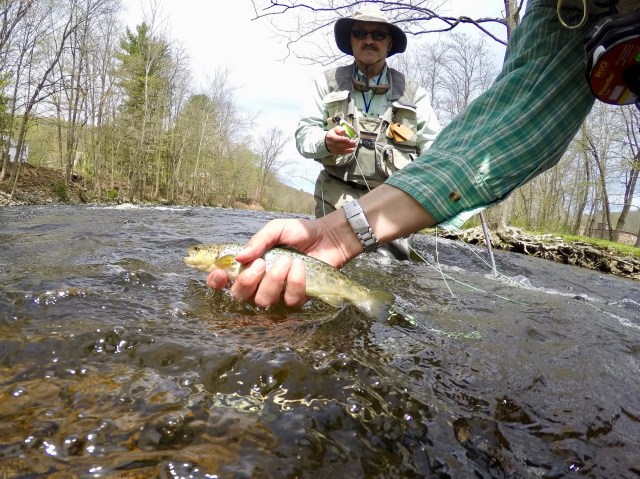
DCIM100GOPROG0020591.


Farmington River Report: A Steelhead Warm-Up

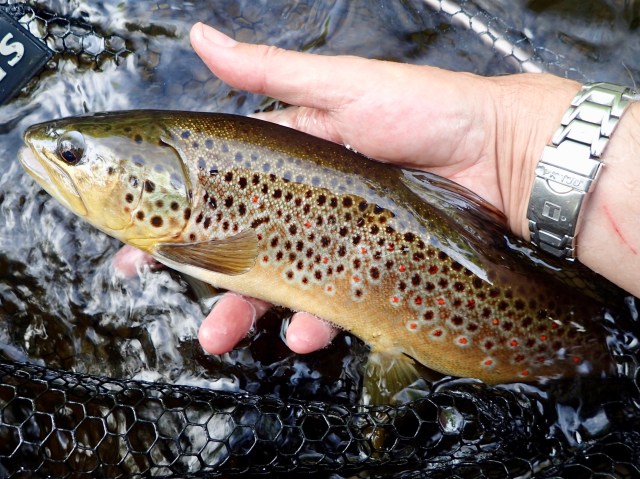
A quick session to tune up the old indicator nymphing skills. Water was 255cfs, low for this time of year, and leaves (mostly oak) were a factor. Only fished for 90 minutes, and managed a big, fat rainbow with a wide pink band that, in true steelhead fashion, refused to come quietly to net. Taken on a Hare’s Ear and SLF bead head fuzzy nymph, size 12.

Baron von Chunkenstein. The indicator goes down, the rod tip goes up, and madness ensues.

November Farmy Rainbow

Farmington River Report: still low and slow

Dave took my Wet Flies 101 class today in the form of a private lesson. We fished two runs in the permanent TMA (170 cfs) and then we bounced around above Riverton (110cfs). The TMA was a blank, but we found some fish willing to jump on after we headed north.

Dave did a great job moving around in an effort to find fish (something I can’t emphasize enough when wet fly fishing). We brought a gorgeous wild brookie to net, and played tug-of-war with something more substantial that decided to skedaddle before we could land it.

What great day to be fishing as we had vast stretches of water all to ourselves.

Heads up! Incoming char.

Dave S Brookie

~

Dave covering water with his team of three wets.

Dave S Swinging

Farmington River Report: A little bit of this, a little bit of that

Since I couldn’t make up my mind yesterday whether to stay home and work or go fishing, I decided to do both. Fishing first. A man must, after all, set his priorities.

The first hour I did a little exploring on the lower river. This was a section I’d never fished before. It was either impressively deep or painfully shallow. Lots of holes and oxygenated riffles and other things trout like. I’m filing this spot away for future reference.

In the course of my travels, I came across old friend BRK TRT. Alan was casting to some delicate risers in some slow-moving water. We chatted about small streams for a bit (if you haven’t, check out Alan’s site Smallstreamreflections), then I went off to swing some streamers and do a little nymphing. The sun was warm. The air crisp. The river cool.

It most definitely did not suck.

A recent ward of the state that found an olive Zoo Cougar (fished with a floating line and a BB shot at the head of the fly) to his liking. Not bad for a hatchery brown. His spots almost look airbrushed.

Stocked Farmy brown

~

Alan declares his passion in no uncertain terms.

BRK TRT

Tip of the week: black crickets

The last two times I’ve cut the lawn (today included) I’ve noticed an abundance of black crickets milling about. I would think a black cricket fished dry or wet would draw a lot of attention if it were drifted or swung along a grassy bank.

Something like this: braid or dubbed body. palmered soft hackle, deer hair wing/caddis-style head, only all black. Size 8-12.

BlackCaddis

Farmington River Report 7/16/15: It must be magic

I guided Jim yesterday afternoon into evening, and we started in some faster water in the permanent TMA with a little Wet Fly 101. While we found a few feeders, they were reluctant to jump on. So we headed up river to get situated for some topwater action during the evening rise.

A sulphur emergence of sorts. No editing legerdemain here; some funky macro setting on the camera did this. We had a nice assortment of bugs last night: Sulphurs (14-16), Summer Stenos (18-20), Isonychia (10-12), BWOs, (14, 18-20), and midges. However, the spinner fall was not what I had hoped for. Every day — or evening — is different. Cold again! Water temp in the permanent TMA was 58 degrees. Sulphur Emerger

~

A nice brown that absolutely hammered Jim’s size 20 BWO Comparadun. Terrific hook set by Jim on this fish. Jim BWO Brown

~

Same fish, moments before release. Jim's brown release

~

I waited until what I thought was the right moment during the hatch to introduce Jim to The Magic Fly. This is what happened on his second cast ever with that pattern. Another fat, beautiful wild Farmington brown to net. Jim did a great job, and was a pleasure to fish with.

Jim Magic Fly

~

After Jim left, I banged around the river in the dark from 9:30 to almost 1:00am. While I had plenty of action — close to ten bumps — most of them were smaller fish, with no resulting hookups. Here’s a fifteen-inch brown who did stick. I like the play of water and flash along his flanks.

A few odds and ends on a rainy Monday

Happy June. Although today feels more like early April. But we desperately needed this rain. Nature finds a way.

I have the cover story in the current issue of American Angler. The article is called The Little Things, and it’s about seemingly small adjustments, strategies, and practices that can have a significant impact on your fishing. When I get my copy, I’ll post some pictures and devote a post to it.

Come say hi. “Are you Steve Culton?” This has been happening more and more when I’m fishing, and I’m glad for it. People often follow it with something about not wanting to bother me, which is very polite, but unnecessary. You’re not bothering me. If we’re sharing the same water, please say hello. It’s always a treat to put faces to names.

Help me help you. I get a lot of requests like this: “Can you give me the recipe for (fly pattern name)?” I am always happy to help, but many of the flies I mention in my posts are already archived on this site. You can find them by using the currentseams search function on the right side of the page. It looks like this:

Screen Shot 2015-06-01 at 4.28.58 PM Just type what you’re looking for in the box, then hit enter or return. If it’s on currentseams, you’ll get a list of links.

Use email or phone to contact me. Many people try to contact me through the comments section of various posts. I respond, then often never hear from them again. If you’re interested in purchasing flies or booking a guide trip, please call me or send an email. You can find that information here.

Speaking of guiding, my schedule should start to open up some in June. June and July are great times to fish the Farmington. As always, I highly recommend weekdays over weekends for a more pleasant, less crowded angling experience.

Closing in on 300 followers. That means another fly giveaway. Of course, we need to hit the magic mark first. In the meantime, this is a good time to thank you for following, thank you for reading, thank you for your positive energy, and thank you for all your kind words. I truly appreciate them.

And, we’re underway

Kicked off my 2014 guiding season yesterday with Matt. Matt wanted to take my Wet Flies 101 half-day course, and we headed to the upper TMA in search of feeding fish. Two-thirds of nature cooperated; an absolutely glorious late April sunshine, and a snow flurries-like caddis hatch (with a few Quill-something mayflies and mounds of midges for good measure). Unfortunately, the third that really counts was in absentia. Not a damn riser anywhere. Nothing for the nymphers, and even the spin guy only managed one on his Rooster Tail. Off to below the upper TMA, where Matt rousted up a nice brown on a bead head soft-hackle Pheasant Tail. Speaking of Matt, it was gratifying to see how much he improved over the course of just a few hours. So often, you get out of something only what you put in, and he worked hard on his mending and wet fly presentations. By the end of the day, quality drifts were the rule rather than the exception. Well done, Matt!

Matt executing a mended swing, focused, intent, and best of all having fun.

Image


After our session ended, we headed downstream where we found some fish willing to jump on. I also saw the first Hendricksons of the year, although two doesn’t make me do handsprings — and there was nothing rising to them. Not to be a wet blanket, but my enthusiasm is also tempered by the fact that we’re in for some cold, wet weather over the next few days. But come, they will.

An intriguingly marked rainbow that took my BHSHPT. Love the colors on the gill plate. Landed a nice wild brown as well, and LDRed a third. A fun way to end the day.

Image


The Hackled March Brown Spider

“March Brown” is a name you see attached to a lot of different wet fly patterns. Some of them are caddis; others, mayflies. This spider is intended to represent the latter. I discovered it on page 116 of Sylvester Nemes’ Two Centuries of Soft-Hackled Flies. It was originally published in 1936 in an English book, Trout Fishing From All Angles.

The Farmington River is not known for its March Browns; while we do experience that hatch, it’s not on the level of, say, Hendricksons or Sulphurs. But we do have a good showing of Isonychia, and I have taken to fishing the Hackled March Brown spider in the late summer to represent those substantial mayflies.

Last August, I was fishing a snotty run that was studded with boulders and pockets. There wasn’t much going on hatch-wise, and I had the Hackled March Brown spider as the point fly on my team of three wets. The hit was one of unrestrained violence and brutality, such that it ripped the line from my hands. The trout went immediately on the reel; I never saw it until I was able to coax it into the shallows. Over twenty inches long, it was my biggest trout of 2013.

Image

Hook: Wet fly, size 12
Silk: Orange Pearsall’s Gossamer
Tail: Grey partridge fibers
Body: Hareline Dubbin Rust (HD23)
Hackle: Brown partidge

 Tying notes: A straightforward, simple fly to tie. The original calls for a body of “hare’s ear dyed red ant colour.” I have settled on “rust,” and the trout seem OK with it. You could make the body a little buggier than I have here, but I like this fly with a thin profile. There are a multitude of brown feathers on a standard partridge skin; they’re located along the back of the bird.

The Hackled March Brown Rogues’ Gallery:

Image

Book review: 50 Best Tailwaters To Fly Fish

So one day in October I got an email from Robert D. Clouse, Publisher at Stonefly Press. He wanted to know if I would review Terry and Wendy Gunn’s new book, 50 Best Tailwaters to Fly Fish, what with currentseams being a website Stonefly follows and enjoys. Well, heck, Robb, flattery will get you everywhere. Besides, it’s good for writers to make nice with editors and publishers.

After I thought about it, I said sure. On one condition: it would have to be a totally honest review. Happily, we can all breathe easy now, because I really liked this book.

Image

Despite its name, there are 56 tailwaters within its covers. Bonus rivers, if you like. Cool! In case you didn’t know, tailwaters are rivers that flow out of dams. The dam regulates the flow, and the benefit is a consistent year-round supply of trout-friendly water. The authors divvied up the country into four geographic regions: West, Rockies, South, and East. Very logical. Most rivers get four pages of attention, starting with an easy-to-read full-page map of the river with turnouts and access points. There’s a basic overview of the fishery, followed by hatches, regulations, and tackle. Each chapter concludes with a handy listing of where-tos, like fly shops, outfitters/guides, campgrounds, hotels, and superlatives like “Best place to get a cold, stiff drink.”

How could the authors possibly know enough about all these rivers to write intelligently about them? Well, they couldn’t. So they’ve wisely called upon local guides and outfitters to present a topline view of their home waters. (I’m still getting over the sting of not being asked to write the Farmington River section, but since my good friend Grady Allen, owner of UpCountry Sportfishing, did the honors, it eases the pain a bit. Although – ouch – I also didn’t get a mention as a local guide. All good-natured kidding aside, Robb, perhaps in the second edition?) Naturally, with so many authors, the writing is a bit of a mixed bag. But this isn’t high literature. It’s how-to/where-to reference. Most everyone brings something to the party with their writing, and there are plenty of insightful tidbits sprinkled throughout:

“A good rule of thumb: If it looks like you are going to die climbing down to the river, that is likely a good spot to fish!” (Deschutes River)

“If you give the river permission to intimidate you, it will.” (Upper Delaware River)

“Here are two helpful hints: Pick one section of the river and get to know it. Bring a reasonable expectation.” (Madison River)

There are the requisite ooh-ahh streamscape photos, enchanting those of us who’ve never been to River X. Among the many shots that captivated me is one of the Madison wending through a golden valley. Threatening clouds loom overhead, and mountains majesty stand watch from a safe distance. I am so there in my head right now. Truth be told, I’m a homebody, and I don’t do a lot of traveling to fish. But some of these chapters have gotten the ramblin’ fishing dudes in my brain working overtime. Western road trip, anyone?

A few quibbles. Too many chapters are dependent on fish porn for visual support. I get it, everyone wants to catch a big trout. But several pages into the book, I’m already overloaded by grin-and-grab lunker imagery. What’s more, each chapter ends with a quarter page devoted to the guide who wrote it, often accompanied by a photo of them brandishing a big fish. Too much for this reader. While I recognize that perhaps this was the price of admission for the contribution, might that real estate have been used to give us a few more words on the fishery?

In the end, though, 50 Best Tailwaters To Fly Fish proves to be a tremendous resource for the traveling angler. (Or the dreaming-of-traveling-angler, for those of us with kids.) Its greatest strength is that it gives you enough information about a river to whet your appetite – then leaves you wanting more. Or at least, wanting to make a pilgrimage there.

That’s a good destination fishing book by anyone’s standards.

Here’s the url to the promo video: https://vimeo.com/69999267