Last week’s ASMFC meetings: politics and striped bass

In case you missed it (I know I did), here are a couple good, quick reads on last week’s ASMFC striper meeting. First up is Captain John McMurray’s take. Next, Charles Witek warns of history repeating itself in this trenchant blog post.

I hope you’re all safe and well. These two fine pieces will keep you entertained as well as informed.

I’m going to be tying some of these (Crazy Menhaden flatwing/bucktail hybrid) soon.

Crazy CU

Thanks Zoomers and some yummy striper morsels

Many thanks to everyone who attended last night’s Zoom (Pro Tips and Q&A). We’ve been averaging around 50 people (which does not suck) and I’m grateful for the enthusiasm you’ve shown — love all the questions! Stay tuned for details on the next Currentseams Zoom.

Absent any striper fishing (what strange times we live in!) I’ve been striper tying. Tasty snacks abound: clam worms, mullet, silversides, sand eels, isopods and grass shrimp. Dig in!

OLYMPUS DIGITAL CAMERA

Tip of the Week: Fish are not smart. Stop treating them like they are.

Fish are not smart. They don’t get educated. They don’t think. They can’t reason or feel emotion. You are intellectually superior to a rainbow trout (brains shown to scale). True, this: once you stop treating fish like an intelligent adversary, you’ll start catching more of them.

The McMillan quote is one of my favorites.

Brains


Tuesday Night Zoom! “Pro Tips and Q&A” May 12, 8pm

It’s another Currentseams Tuesday Night Zoom. My “Pro Tips” part will be brief (and, I hope, highly informative) but the real focus will be you: I’ll be answering your questions on all things fly fishing. So get those topics ready. Note that if you’re already on the Zoom list, you don’t need to re-up. See you Tuesday!

ProTips_Poster


How To Catch The Stripers Feeding On The Surface That No One Else Can.

I get questions like this all the time: “Last night, I heard and saw a ton of surface activity, but didn’t have a single bite. I was using the usual suspects: Clouser, Deceiver, epoxy baitfish, using every retrieve I could think of — but not a single bump. Can you help me understand what was going on?”

When I’m giving my “Trout Fishing for Stripers” presentation, this is the point where I reference highly frustrated anglers like this one. Scenarios vary, but the solution remains the same: it can be found within traditional trout and salmon tactics and presentations.

Let’s break this down. First: the last fly I’d use for this situation would be a dumbbell eye-weighted pattern. Just as you wouldn’t cast a tungsten cone head bugger to trout that are sipping tiny BWOs on the surface — please tell me you wouldn’t — nor should you plumb the depths with Clousers when the striper action is clearly on top.

So which pattern(s) to use? Well, what are the bass eating? This time of year (May, northeast waters) I’ve got a 20-spot on grass shrimp or clam worms or tiny minnows…essentially something small. Most Deceivers I’ve seen are far bigger than 1-inch long, so that pattern’s not a good choice, either. If it were me I’d fish a team of three, and those small baits I mentioned would be a good place to start.

Droppers are the fastest way to find out what the fish want.

OLYMPUS DIGITAL CAMERA

Finally — and here’s where the treasure is buried — let’s talk about presentation. We have a pretty good idea of what’s being eaten, and how the stripers are eating it (holding on station, feeding in a specific area of the water column, not willing to chase). Now we need to give them the goods the same way the naturals are behaving: on a dead drift.

Think of the current as a conveyor belt. Food is being delivered into open mouths. To make that dead drift presentation, you need to be able to mend, and to be able to mend you need a floating line. Sinking lines will drag, and drag is a death sentence for the dead drift. Forget about “which retrieve?” Your only retrieve should be when you’re at the end of a drift and you’re gathering your line to make another cast. (An exception would be fishing on the dangle, but that’s a topic for another day.)

The stripers are eating. They’re sitting there just waiting to take your fly. Answer the big four questions correctly (What’s the food? How are they eating it? What do I have in my box that looks/acts like that food? How can I present it like the naturals?) and you’ll be turning frustration into exhilaration.

Just don’t forget your floating line.

Small Stream Report: Social distancing at its finest

I’m busy. Like, in the weeds busy. Writing, garden/yard projects, filling fly orders, content for this site, planning Zoom events…the list goes on. But every once in a while, you have to say screw responsibility. Yesterday was that day. So I loaded up the Jeep and drove many, many miles, far, far away, and enjoyed a thin blue line all by myself. Water was clear, cold, and high. Fished a dry/dropper to start, and it was all dropper. Once the sun came out and warmed things up, I had a few swipes at the dry. Micro streamers produced in the deeper plunges, as did heavily weighted wets. Non-biting midges were out in force. A couple of cigars took care of them. Pricked dozens, landed a bunch, drove home tired and happy.

(With apologies to Julie Andrews): Fiberglass blanks that flex down right to the grip. Silica powder that floats flies like a ship. Honduran puros gauged 52 ring. These are a few of my favorite things.

OLYMPUS DIGITAL CAMERA

Thanks to another good Zoom crowd. Next week: potpourri?

A hale and hearty thank you to everyone who attended last night’s Zoom on matching the hatch with wet flies. Next week I’m thinking about doing a little fly fishing randomness…a little bit of this…a little bit of that. Most of all, since Zoom held us to 40 minutes sharp, I want to do less talking and do more live Q&A about anything fly fishing. So get those questions ready! You’ve got a week…

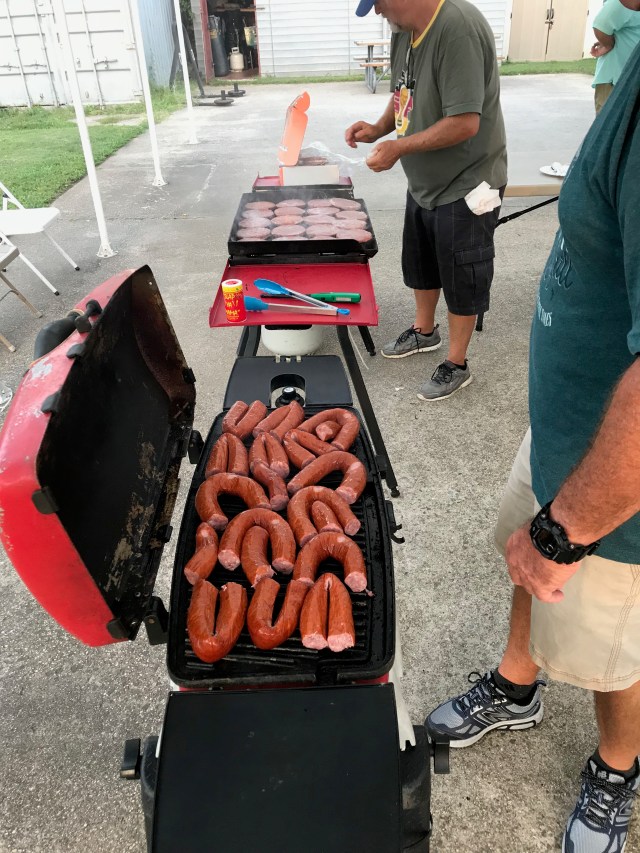
No meat shortage here. Like kielbasa, perhaps next week’s Zoom will have a little bit of everything.

LIFFGrill

ASMFC Striped Bass Update from ASGA

Good words from the ASGA: “We don’t want to be tone-deaf on the major issue at hand. However, life must go on and we still have to keep everyone informed on fisheries management issues.”

ASMFC is meeting today; striped bass management is scheduled from 3-4pm. For more details, click here.

OLYMPUS DIGITAL CAMERA


Tuesday Night Zoom! “Matching the Hatch with Wet Flies” May 5, 8pm

MatchWets_Poster

Thanks to everyone for all the excellent Zoom topic suggestions. This one showed up (in various iterations) multiple times — and so by popular demand, you shall have it.

Wet Fly Questions Answered

I’ve been getting a lot of wet fly questions, and I thought I’d share my answers with the group. I’m excited that so many of you are interested in this ancient and traditional art. So here we go:

Q: What size and length rod are you using on the Farmington? A: My dedicated wet fly stick is a 10-foot 5-weight Hardy Marksman II. I don’t hate it, I don’t love it. It’s got a good backbone for helping manage bigger trout in snotty currents, but I wish it were a bit softer in the flex. What’s important is that it’s a 10-footer, which I find useful for mending. Note: I still take the 7’9″ Tonka Queen out for an occasional wet fly jaunt, albeit in moderate/slow currents. That cane pole is a dream for mending.

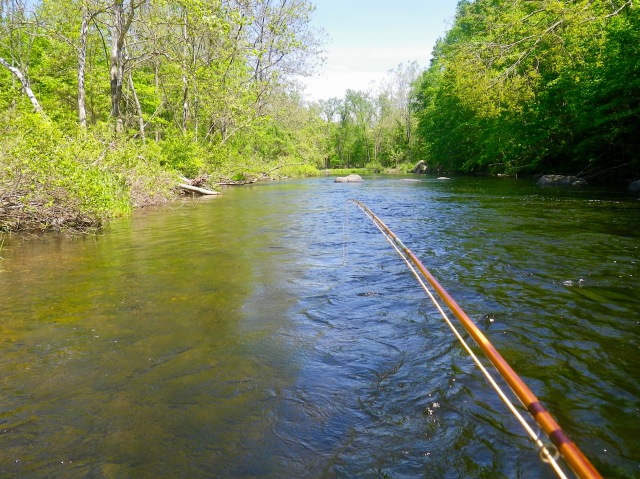
The Queen in action. This rod gives me an ultra-fine level of line control.
OptionsDangle

Q: Do you use an indicator? A: My joke answer is “yes” — the splash of the take, the spray of water, and the jolt of the rod tip all indicate a strike. The real answer is no, not in the traditional sense. The vast majority of time, you need no visual aid to tell you the fish has taken the fly. An exception would be when you’re fishing upstream, drawing the line toward you as the rig moves downstream. I’m watching the tip of the line like a hawk for stalls, shudders, or stoppage that would indicate a delicate strike well below the surface.

Q: Do you use a floating line? A: Yes. (I’m a line control freak.)

Q: When you’re casting and mending, is it basically a dead drift, then the flies start swinging and rising? A: Kindof. Unless you introduce slack into the presentation, you’ll never really have a true dead drift. So even when I’m doing a quartering down or straight across cast and mend, the flies are moving downstream and across, albeit in a slower manner than they would with a traditional wet fly swing.

Q: You’ve said that in spring, you focus more on pool-type water, and faster water in the summer. I’m having trouble finding the right type and depth of water. Any advice? A: Generally speaking, the colder it is, the greater the chance that trout will be in deeper pool-type water. That doesn’t mean you won’t find trout in 1-foot deep riffles in December. The bottom line is: there is no substitute for experience on the water. Get out and explore. Keep a log. Where and when did you fish? Were you catching? Were others catching?  What was the weather like? What was the water height? You can see where this is going. And finally, a wee plug for myself: take a lesson. I hear this a lot from clients: “I’ve driven past this spot a hundred times and never thought to fish it.”

Q: I fished wet flies and only had one bump. What was I doing wrong? A: (This person was out on the Farmington this week.) You’ve got a lot of elements working against you. For starters, I don’t like to fish wets in the Permanent TMA in any flow over 500cfs (it’s been 750cfs and higher). 250cfs-400cfs is the wheelhouse. Hatch windows also have a lot to do with the wet fly bite. For example, right now (Hendrickson and caddis hatches) you want to be swinging anywhere from 11am to 3pm-ish. You’re trying to entice the trout that are taking the emergers. And this cold, wet weather isn’t helping, either.

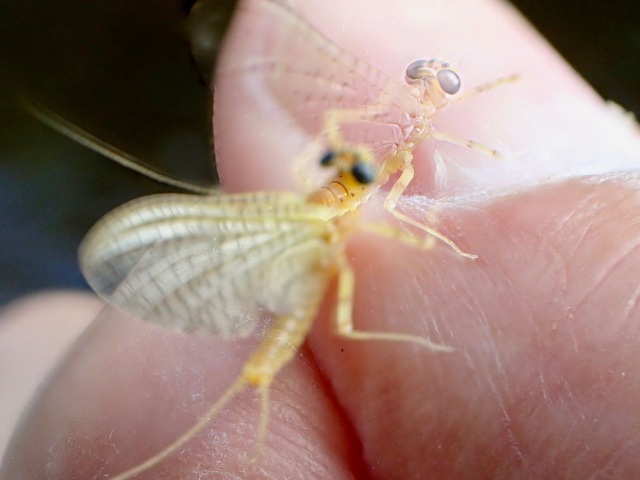
When you hit the emergence just right, the results can be magical.
OLYMPUS DIGITAL CAMERA

Keep on swinging.