Farmington River Report 7/19/20: So many bugs!

From the moment I arrived at the river — about 6:00pm — till the moment I left — about 9:20pm — the water and air above was crackling with mayflies and midges. After enduring several recent outings marked by poor hatches, this was Mother Nature’s make-good outing. As a bonus, this was a working session, as I’d planned to shoot video for a new wet fly presentation I’m building. Conditions could not have been better. First it was sulphurs, size 16-18, then an influx of olives, size 18. Micro midges were everywhere. The fish were still feeding when I left the water.

This is a video still, so the quality is not great, but splashy rises like this were everywhere for the first 90 minutes. I enjoyed some spectacular wet fly action, swinging a team of three (Squirrel and Ginger, Partridge and Light Cahill, and Light Cahill winged wet). I took numerous fish on all three patterns, presenting upstream, downstream, and across. There came a time when the fish no longer took the subsurface fly, about 8pm. That’s when I switched to dries.

Screen Shot 2020-07-19 at 11.15.14 PM

~

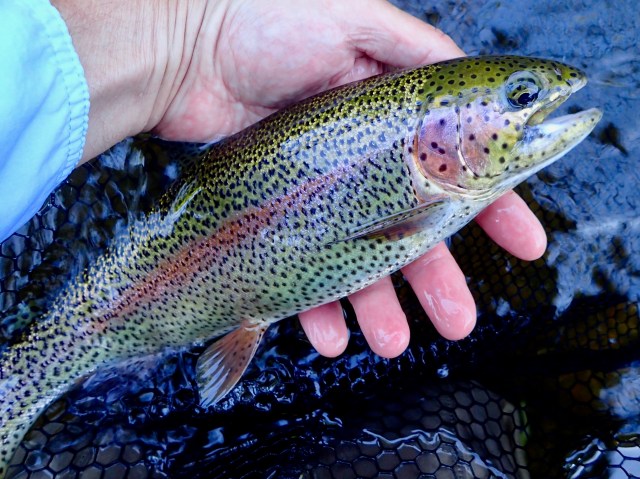
Another video still. I can’t say that I can get too excited about domestic rainbow trout, but the Farmington rainbows this year are in a new class of fun. They’re fat, they’re feisty, they’ll bulldog you the entire fight, and many of them are taking on holdover characteristics like intact scales, deep coloration/pink bands, and well-formed fins. Corpulent mid-teens inches rainbows like this one are in faster water everywhere. Most of the browns I took came after 8:30pm.

Screen Shot 2020-07-20 at 12.12.44 PM

Lemon alert: Naturalight Smart Lamp D20 (and some shoddy customer service to boot)

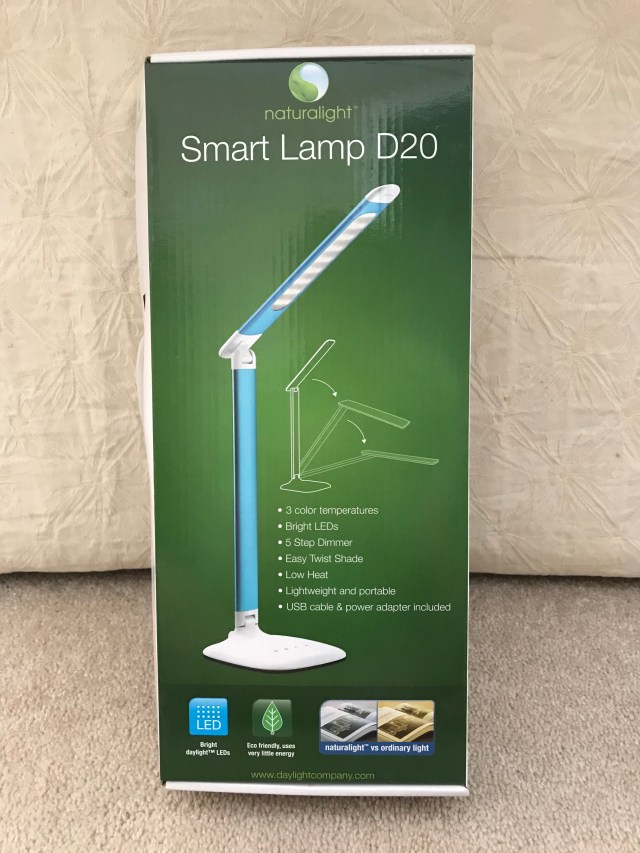
I really didn’t want to write this piece, but as you’ll soon see, The Daylight Company, maker of the Naturalight Smart Lamp D20, left me no choice. (Regal Engineering, the seller, also shares some of the responsibility. We’ll get to that in a bit.)

Several years ago I saw other fly tyers using the Smart Lamp D20 at the shows. I liked the way it looked, so in January 2016 I bought one through Regal Engineering. For two years it worked fine. Sometime in 2018 it began a pattern of sketchy behavior; some of the light colors (warm, cool, and daylight) would suddenly switch intensities, even though I had not touched a switch. By early 2019 the functionality was down to a single color and intensity, and in December 2019 it stopped working entirely. As in dead. No light. Nothing.

Call me old-fashioned, but I expected a heck of a lot more for a $100 lamp. What a lemon!
Lemon

So early this year I went to the Regal site, the place where I’d bought the lamp,  and filled out their customer service form, explaining the problem. I was thanked by the robot and was told that someone would get back to me soon.

Or not. No response. Nothing. So I contacted the manufacturer. I spoke with a very polite customer service agent who told me that since there was a two-year warranty, there was nothing she could do. She offered me the chance to speak to her supervisor. Yes, please, I said.

What ensued was a highly frustrating exercise in futility. I explained the situation, and stated my position: if you make a good product, you should stand by that product. $100 is a lot of money for a lamp, and it should work properly for more than two years, don’t you think?

(Lacking a recording, I will paraphrase the responses.) Well, if you had come to us earlier, we might have been able to do something, but now it’s four years later and the warranty is only for two years…

Wait a minute…it didn’t start to malfunction until after the warranty expired…so what does it matter that I’m coming to you now?

If you had come to us earlier, we might have been able to do something, but the two year warranty has expired…

Whoa. I just said that it didn’t start to crap out until the third year. You’re telling me two things that are contradictory.

You bought the lamp from Regal so you should have gone to them when the problem started…

So basically it’s my fault? You’ve made a substandard product and now you won’t stand behind it. You don’t know me, and that’s OK, I don’t expect you to, but you should know I have a website and Instagram and well over 1,000 readers. So I’m going to write a story about this, and you can choose one of two narratives: One, you made a crappy lamp, but you value your customers and want to do right by them, because customer satisfaction is your ultimate goal, so you fixed the problem. Or two, you made a crappy lamp, and the warranty has expired, and that’s tough noogies for the chump who bought it. I mean, I can’t believe you’re not even offering to replace it or look at it or give me another at a reduced rate…

The D20 is no longer made, so we can’t replace it…

~

There was more, but suffice to say you’ve got the gist. And so, with Option B being chosen, here we are.

I did a little research, and according to Amazon reviews, I’m not the only one with a bad D20 experience. If you take my review out the equation, half of the reviews are negative. I’d end it here, but Regal needs to take a little hit. Frustrated with the lack of action from the Daylight Company, I reached out again to Regal. Again, no response. Very disappointing.

So: don’t buy this lamp. Don’t buy anything from Naturalight or Daylight Company. Save your money for products made and sold by people who stand behind their work and value their customers’ satisfaction.

And now, I need a good, strong, portable, DURABLE fly tying lamp. Suggestions?


Farmington River Report 7/14/20: A learning experience (for me, too)

I guided Michael yesterday from 2pm-6pm. Michael is new to fly fishing, so we had a lot to work on. We stayed within the Permanent TMA, where conditions were excellent:  280cfs flow and water plenty cold. Hatch and feeding activity was again low, although we did experience a 15-minute window where there was something going on underwater and the feed was on. We spent the first half of the lesson on indicator drop-shot nymphing. Once Michael got used to the nuances of the rig, he stuck four fish. Great job, Michael, on a day when the bite was slow. (A seasoned angler remarked to us as we were gearing down that the fishing “stunk today.”) We finished up swinging wets and managed a juvenile Atlantic Salmon. So, while I was disappointed in the activity, I was excited to watch Michael’s skills develop in a matter of hours.

Hey, this indicator nymphing thing really works! Our first fish was a rainbow that treated us to a couple of aerials. 

OLYMPUS DIGITAL CAMERA

~

After our session I headed upriver where the water was even colder. The evening rise was OK — 5/10 for feeding and hatch activity. What was a learning experience for me was my success presenting a team of three wet flies upstream to feeding fish. I caught four of the six trout I took on wets this way. All the takers were in faster water with a broken, curling surface, all were active feeders, and all took my Light Cahill winged wet or Partridge and Light Cahill flies. Most success I’ve ever had fishing that way. At 8pm I switched over to dries and caught trout well into dark.

This chunky rainbow was slashing at emergers about 30 feet above me. First cast, upstream presentation, dead drift, bang! Light Cahill winged wet. As you can see, this guy’s been caught before. What a handsome fish! Love the spots and coloration.

OLYMPUS DIGITAL CAMERA

Farmington River Report 7/13/20: What hatch?

I guided Don yesterday for four hours mid-though-late afternoon. His goal was to work on wet fly fishing, and we had some great stretches of water to ourselves in and out of the Permanent TMA. Water was 225cfs, an excellent wet fly height, with a hint of stain, no doubt from storms upstream. Spot A produced two fish, a swing and a miss, and some finks that wouldn’t take. Spot B was a disappointing blank. Spot C held some players, and we had fun fooling them with the Hackled March Brown. While it was a very fishy feeling day, the hatches were terrible. I’m being generous by giving them a 1 on the 1-10 scale. Still, Don done good under some truly tough conditions. He’s going to be a dangerous wet fly machine.

Skunk’s off with this lovely rainbow. Check out that pink band! This fish was in great condition.

DonRainbow

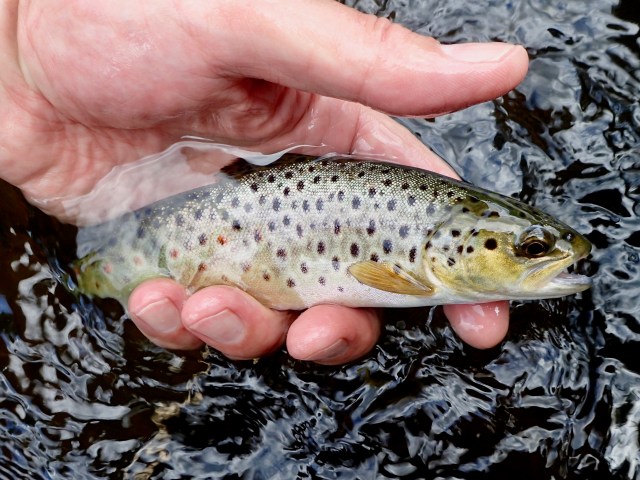
Gotcha. I love these smaller wild Farmy browns. See you in a couple years, OK?

OLYMPUS DIGITAL CAMERA


Re-Thinking the Gamakatsu SC15 for Striper Flies

For years, I’ve been using the Gamakatsu SC15 on smaller patterns like baitfish and clam worms. No issues until a couple weeks ago on Block. I was dead-drifting a team of three, when bang! It was an unusual hit for this type of fishing; the takes are usually a subtle pull or a building sensation of weight. When I retrieved the fly from mouth — the fish wasn’t that big, maybe 22″ — I was shocked to see the opening bend in the hook from that hit. I’m wondering if it’s one-off randomness or a recipe for disaster on a bigger fish. I’ll let you know…

I like the Gamakatsu SC15 size 2 for this smaller baitfish profile. The hooks are light, with a short shank, wide gap, tin plating, and they’re sticky, sticky sharp, critical for this type of light-take or quick-bump-and-set fishing. As you can see, the bottom hook experienced significant failure. I used the same hook in a 2/0 without incident.

OLYMPUS DIGITAL CAMERA

Farmington River Report 7/9/20: what a way to go!

I worked with Bill yesterday on his indicator nymphing and wet fly skills. Water conditions were perfect in the Permanent TMA: 325cfs, cold, clear. The trout and bugs were a wee bit more uncooperative. Hatches (sulphurs, caddis, olives) were spotty and the feeding was inconsistent at best. We fished two marks and saw four trout hooked all day, and since we had two of them, we declared victory. On the plus side, Bill landed his PB non-lake-run brown. He nailed it at high noon (we fished from 10am-2pm) while nymphing. I was observing from upstream, and when he set the hook it sure looked like a fish to me. Bill thought he was stuck on the bottom — that happens sometimes with larger Farmy trout — and then, gloriously, the bottom fought back. Sadly, Bill snapped his rod during the battle, but the fish was landed, much to his delight. To say nothing of mine!

Bill’s new personal best, a gorgeous high teens wild brown. Love those halos. He took the took dropper in our nymph rig, a size 18 soft-hackled pheasant tail. Since that hook was a 2x short, it’s effectively a size 22 fly. Do not underestimate the power of tiny soft hackles this time of year. I almost always make my top dropper on my drop-shot nymph rig a soft hackle. Congratulations, Bill!

DCIM100GOPROG0013941.


Block Island Report: If you can say, “It’s a braw bricht moonlicht nicht,” then you’re not catching stripers.

Those of us who grew up with off-the-boat Scots grandparents know the song “Wee Deoch an Doris” well. For the uninitiated, as you have not heard it, I shall proceed to translate and offer context. The song is about having one more drink before you head home. “If you can say it’s a braw bricht moonlicht nicht” (if you can say it’s a good bright moonlit night), then you’re a’ richt, ye ken (not nearly as intoxicated as you may think). So, have another.

That also made me think of Chip Diller getting his paddling in the Omega initiation scene from Animal House.  I might as well have been saying “Thank you sir, may I have another,” to the moon this past week, because when it was out and braw and bricht I took a right spanking.

To misquote Starbuck, moonlight feels wrong. I lost the moon lottery big time — quarter going into full is by far my least favorite time to fish for stripers at night.

OLYMPUS DIGITAL CAMERA

I won’t bore you with the minutia, but here’s the story in numbers: Seven nights. Three skunks, including two in a row. The last time I took such a beating was 2012 or 2013. For context, I had one skunk in my last 15 Block outings over the past two years. I ran into an angler — I’ll call him “J” — whose response to me telling him that I hated fishing under the full moon was, and I quote, “you’re crazy.” Now, I appreciate J’s enthusiasm and confidence. And I desperately wanted to be proven wrong. But the fact is, whether flat or surf or dredging deep bottom, I scored a big, fat zero — not even a courtesy tap — on every night the moon was out.

To continue the kvetching, size — or lack of it — continued to be an issue. Used to be that I could count on Block to produce a high percentage of legal fish. Heck, in 2018, a third of the bass I landed were over 28″. This year, not a one. OK, so there were no micros in the mix, and a 24″ Block bass battles like a 30″er from the Hous…but the continued lack of bigger striped bass from the shore is disturbing, although not surprising.

Was it all misery? Heck, no! I had four fun-filled nights, three with double-digit numbers. I played around with my fishing schedule and was able to beat the moonlight — even this old dog can adjust. One night the weather gods appointed a magnificent cloud bank to shroud the Island. The stripers said yes. And I got in some seriously wonderful trout fishing for stripers.

I’ll tell you more about it soon.

Mark Gustavson’s Squidsicle

If you fish for stripers and tie striper flies, and you don’t know about Mark Gustavson’s excellent website Fly Fishing For Moriches Bay Striped Bass, you should. It’s a hidden gem. I don’t think Mark actively posts anymore, but his fly patterns, heavily influenced by Ken Abrames, are lovely. They’re also effective. Here’s my take on his excellent Squidsicle, reminiscent of Ken’s Banana Squid. I used an Eagle Claw 253 size 4/0 instead of the Mustard 3407DT size 3/0.

Mark Gustavson’s Squidsicle, ready to swim. Try fishing a fly like this along shorelines, troughs and flats, using a gentle hand-twist retrieve. Beware of the tap! The tap isn’t the take; rather, it’s the striper flaring its gills and sucking the fly into its mouth. Wait for the pull and the weight of the fish, then set the hook. 

OLYMPUS DIGITAL CAMERA

Stripers Forever “Release A Breeder Club”

This just arrived in the mail and it seems like an artifact from another age. While I’m proud to say that I’m a three-time member (all on the fly while wading, which makes it even more of a challenge) it didn’t happen last year and I don’t see it going down this year, either. Of course, I’m quite willing to be proven wrong.

In case you’re unfamiliar, Stripers Forever is an organization whose mission is to make the striped bass a gamefish. The “Release A Breeder Club” was started years ago to encourage anglers to release stripers over 36″. In today’s climate, that’s a no-brainer. Plus, you get a spiffy certificate to display your worthiness. Keep the fight short, keep ’em wet, let them do their job to repopulate the East coast!

OLYMPUS DIGITAL CAMERA

Orvis PRO Wading Boot Review: Finally, a wading shoe that doesn’t suck!

Orvis PRO Wading Boots, where have you been? I’ve worn many different brands of wading boots over the years and disliked most of them. (Some I even hated — we’ll get to that shortly.) Even my all-time favorite boot, made by LLBean — I forget the model name and they are long since discontinued — had a tragic flaw: the rubber sole of the boot would come unglued after a season or two. I eventually got tired of returning them.

I only ask three things of boots: support, grip, and don’t be too heavy on my feet. My last two sets of boots have been the Simms G3 Guide Boots with Vibram Soles. Don’t ask me why I suffered through two pairs of those horrid creations. Yep, I hated them. They were very supportive, albeit a little heavy. But the traction — what a catastrophe. Without studs and star cleats, they were treacherous. With the added steel, they were only moderately dangerous. Good riddance, because my new Orvis PRO Wading Boots are everything the Simms are not.

Wow…slip the Orvis PRO Wading Boots on and walk around and they’re not only supportive, but light on the feet. So far, so good. But the real test is, if you’ll pardon the expression, where the rubber meets the road. Orvis claims their Michelin Outdoor extreme outsole offers “a resounding 43% improvement in wet rubber traction over the competition.” Still, I’m a skeptic, and I love me some carbide steel bite, so I ordered the Orvis Posigrip Studs along with the boots.

I’ve put these boots through some mission-critical paces: small streams, which involve wading and hiking on dry land; ocean wading, jetty rock-hopping, and saltwater marsh slogging; and, what I consider the ultimate test, wading in the Housatonic and the Farmington Rivers, both of which have their own unique (and potentially dastardly) rocky bottom structure.

The verdict? Sold! Traction, support, comfort. Highly recommended.

In the interest of fairness, I am not affiliated with Orvis, and I paid for the Orvis PRO Wading Boots with my own coin. Well done, Orvis.

2P9M9SF2