Director Matthew Vinick just released the third teaser for his upcoming film, “Summer on the Farmington.” You may recognize that almost-handsome face, and I’m pleased to note that no cameras were broken during the filming of my segments. Here it is:
You can also find the other teasers featuring Mark Swenson and Antoine Bissieux. The world premier is Wednesday, January 12, 2022, 7pm, at Brewery Legitimus in New Hartford. Tickets are $25 and are available online through the FRAA. Hope to see you there!
I really felt that I should go to the Farmington River and throw streamers. There was snow on the ground, courtesy of the previous night’s cold front dusting, and it was just around freezing. The trout would be holding deep, but they might not mind moving for the right protein payoff. What’s more, in my mind I could feel the dull thud of streamer hook point meeting kype, and the thought was gaining traction.
But, no. I’d also been picturing this lovely snow-covered woodland with a thin almost-black line snaking its way through. Here the char would also likely be deep, but I might find a player who wanted to come up for a dry. Cigar smoke drifting though the bare tree limbs, not another person in sight, gentle murmur of water flowing over rock…yes. This was where I was meant to be.
Hiking through the snowy woods will generate some body heat, but my extremities were cold for much of the outing. The scene was even prettier than I’d imagined, and although the action was slow, I knew I’d made the right decision. I was also hoping to shoot some footage for a small stream presentation I’m currently building — and I was pleased to come away with a few good shots. As I suspected, the fish have moved off the spawning beds and into their winter lies. Which brings us to this logjam hole. Now, doesn’t this mark scream ambush point? You’ve got a pooling of water, cover, current, and structure. The logjam is recent — maybe two or three years old — and although I hit it every time I’m here I’ve never caught anything. Not even a courtesy swipe. I’m trying hard not be bitter, but come on. Really?Make ’em come up! I started out dedicated to the dry fly cause, but as the minutes ticked by, I began to suspect that deep was the way to go. I tried jigging some tungsten bead-head soft hackles in the deeper plunges and runs, but no joy. Then I decided to go with a dry/dropper setup. The dropper was a G-R Blue Bead Midge. I was drifting the rig down a slow seam when the dry simply disappeared from the surface. The take was so subtle, I was a little late on the set. I needn’t have worried — the char was a good one and the barbless hook was impaled in its upper jaw. This was my only fish of the day; I had a smaller fish twice bump the dry a few hundred yards downstream but there was no tug forthcoming.
Last month, the Fisheries Division of the CT DEEP announced a new draft action plan for wild trout conservation. They recently held two online presentations with the opportunity for public comment, but you can still review the draft plan and tell them what you think. (For the record, I said that while I was all in favor of wild trout conservation and management, DEEP must be cautious about over-publicizing wild fish and revealing specific locations, especially those that aren’t currently “on the books.” It only takes one motivated poacher — or excess angling pressure — to irreparably damage or wipe out a stream.)
It’s no secret that wild, native char populations are under stress not only in Connecticut, but throughout the northeast. Climate change, pollution, angling pressure — the usual suspects are omnipresent. Wild trout and char need all the help they can get. Here’s to hoping that the CT DEEP does everything right.
As The Traveling Wilburys so eloquently sang, “handle me with care.”
I’m looking forward to presenting again at the 2022 Fly Fishing Show in Marlborough, MA, January 21-22-23! Here’s what I know so far about classes, demos, and seminars:
Friday, Jan 21, 2:30: Featured Fly Tier, Spiders, Winged, and Wingless Wets. This is a demo on the main show floor, covered by your general show admission.
Friday, Jan 21, 4:30pm, Release Room: Modern Wet Fly Strategies seminar. Again, included with your general show admission. This is a new presentation with plenty of never-seen-before material. If you’re interested in learning to wet fly fish, or want to up your wet fly game, this seminar is a must.
Saturday, Jan 22, 8:30-11am: Tying and Fishing Wet Flies with Steve Culton. Learn to tie and fish classic North Country spiders and other wet flies that trout can’t resist. The course also covers basics like leader construction, fly selection, where to fish wet flies, and how to fish them. Intermediate. NOTE: This is a paid class that requires pre-registration, which you can only do on the Fly Fishing Show site.
I don’t have my Destination Theater schedule yet, but I’ll post it when it comes in. (I’ll also be appearing in Edison, NJ. No schedule yet.) As usual, I’m hoping for another strong showing from you, my readers. Your turnout and support is always valued and appreciated, and it’s great to meet and put names to faces.
Leisenring’s Spider. Right now, at a secret location in the Nevada desert, top scientists, using only the most powerful mainframe computers, are attempting to calculate how many trout have been caught over the centuries on simple soft-hackled flies.
The pre-Thanksgiving Salmon River steelhead float trip is traditionally for myself and my middle son, Cam. But Cam was away at school. Gordo had school and hockey. Yup. Solo road trip! Coming off my Everglades experience, I was mentally prepared (but still dreading) the inclement weather I was sure to encounter. So, armed with my trusty Ken Abrames Salmo Sax #3, neoprene waders, and a pile of hand warmers, I headed northwest.
I have a knack — no, really, it’s a talent of mine — for picking days months in advance that are (ahem) un-ideal for fishing. This year I chose high water (1,500cfs out of the gate) and the coldest two days in the 10-day forecast. I can deal with both, but jeez Louise…again? The first day was the warmest, although it was mostly cloudy and we had long, frequent spells of “Salmon River Sunshine,” aka lake-effect snow. We did the Altmar-to-Pineville run both days, with the bulk of the fishing in the Altmar area. I would call the angler traffic moderately low, as higher water tends to keep the shore anglers away. Early on, we found an open hole that was deep, dark, and mysterious. My leader butt was 10 feet long, and I had four 3/0 shot on, but I still wasn’t getting down — I could tell by the lack of indicator chugging and dipping. So I asked my guide, Jim Kirtland, to build me a butt section of about four feet or so. That little adjustment was everything, as three casts later the indicator dipped, I set, and steelhead on hijinks ensued. It was a chrome skipper in the 16″18″ class, and I was thrilled to be on the board. My 1-for-1 was short-lived, though, as I dropped my next four touches. To be fair, I had no chance for a hook set on two of them as they occurred as I was lifting the rig at the end of very long drifts; one was totally operator error; and, maddeningly, one was a clean tippet break mid-battle. Not the best luck, but surely that can change.Persistence pays off. I tried not to let the previous misses get me down. We’d moved to a long, swift-flowing glide where I had the comfort of knowing that at 1.5K, any take would be amplified by the indicator. I’d been on my hook sets pretty good, and I tried to remain vigilant. I stuck this guy firmly, which was a good thing given his size, freshness, and propensity for hystrionics. One thing I haven’t mentioned yet was the unique problem we’d created by lengthening the leader. The position of the indicator on the leader system meant that I could only reel up so much line — not enough to lift the fish’s head to the net in a normal fashion. (I was using plastic Thingamabobber-type indicators because of the amount of weight, and those can be notoriously difficult to adjust, let alone in the middle of a battle with a steelhead.) To have a chance at landing the fish, I would need to navigate my way to the stern of the boat, reel the indicator to the rod tip, then lift the rod, arms completely extended over my head while trying to steer the fish to the front of the boat, where Jim would be waiting with the net. Easy enough with a skipper, but a challenge with a chrome buck like this. As you can see, we were successful! The first fish came on a Copperhead Stone. The second came on a small nymph called the Spider. Photo by James Kirtland.I wish I was signaling that I’m currently engaged with my fifth steelhead of the day, but it’s just a simple “Hi, Mom!” Tuesday was substantially colder than Monday — temperatures never got above freezing — and wind and iced-up guides were a constant scourge. Because of the cold front, the fishing was noticeable slower, and the only touch I had all morning was a certainly foul-hooked fish that began to roar upstream with unbridled speed before suddenly coming off. I also re-discovered that it’s a really good idea to crimp those shot down tight on the leader, as once they start wandering along its length, casting becomes a chuck-and-duck nightmare. On the positive side, I’d like you to notice the angle of attack of the rod. I’ve got the tip low to the water and the fish is being fought off the reel and the butt section. To be hyper-critical, I should probably have the cork of the rod pointed more upstream. Don’t let them breathe, put the screws to them, and you’ll get ’em in fast. Speaking of hyper-critical, we witnessed a steelhead being played to death. The battle lasted well over 15 minutes (not an exaggeration) and may have pushed past 20. You bet that it featured plenty of high sticking and long stretches of the steelhead holding in the current without reel handle being cranked. Inexcusable.Video still by James Kirtland.Victory is mine. After my success the day before with black and copper nymphs, and little to show for it today, I tied on a fluorescent chartreuse Crystal Meth, and boom! Sometimes you get lucky. I was right on this fish with my hook set, but I dropped one a few minutes later when I was slow on the draw. So, 1-for-3 on the day, which isn’t great, but all I need is one steelhead to make me happy. Photo by James Kirtland.
Just a friendly reminder that the Farmington River fishes 12 months a year, and December can be a good time to connect with some bigger fish. The browns are generally off the spawn, and looking to bulk up before things get really cold. I understand it’s a busy time of year, and short notice, but just sayin’ that I had a cancellation this Friday 12/3 in the 10am-2pm slot. First person to reach out gets it. Otherwise, I’ll go myself, so it’s a win either way. Note that this primarily a nymph/streamers time of year; if you’re looking to learn to swing wets, it would be best to wait until spring. Also, this is the time of year where people ask about buying a guide trip/lesson as a gift. I’ve already had some takers, but if you are looking to drop a hint to your best-beloved gift buyer, show them this post and they can take it from there. You can go fishing now or wait until spring/summer. Thanks, and you all know where to find me.
Nothing like a gorgeous winter Farmington River wild brown.
Before this trip, I’d had only one Everglades fishing experience. That was four years ago, and it was a single day excursion with my oldest son, Bill, who was graduating from law school. Our target on that May day was snook and tarpon, but I never even got a taste of a tug. Sure, the jacks and ladyfish and sea trout were fun, but I was disappointed. The highlight of the day was a fine snook Bill grabbed out of a shallow tidal flat.
And so it came to pass that Bill and I were heading out again. I’d already gotten my snook, and then some, and had an all-too-brief encounter with a tarpon, so in a sense this was a gravy day for me. Bill was getting married in three days, and at the very least we’d soak up some sunshine and enjoy some cigars.
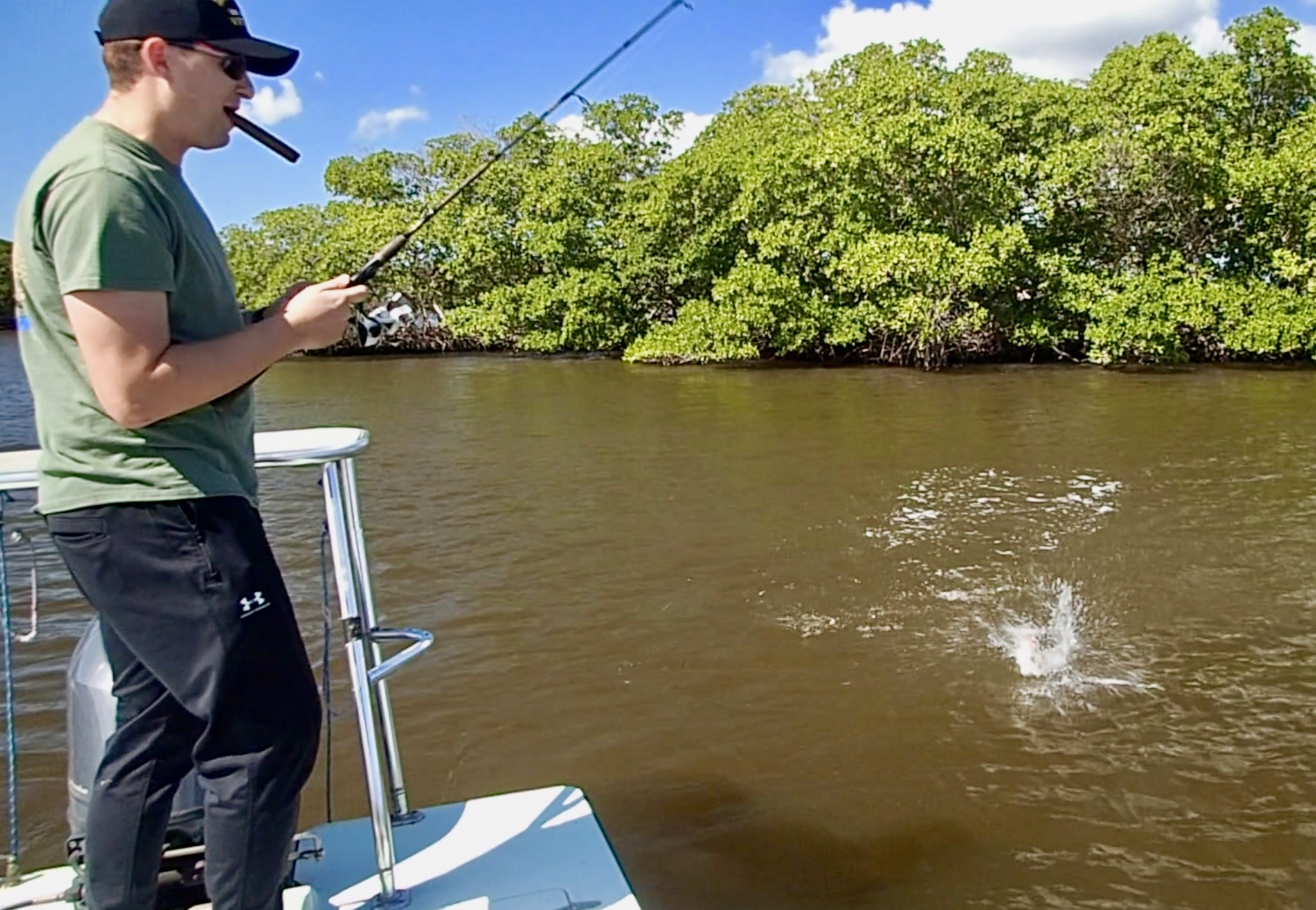
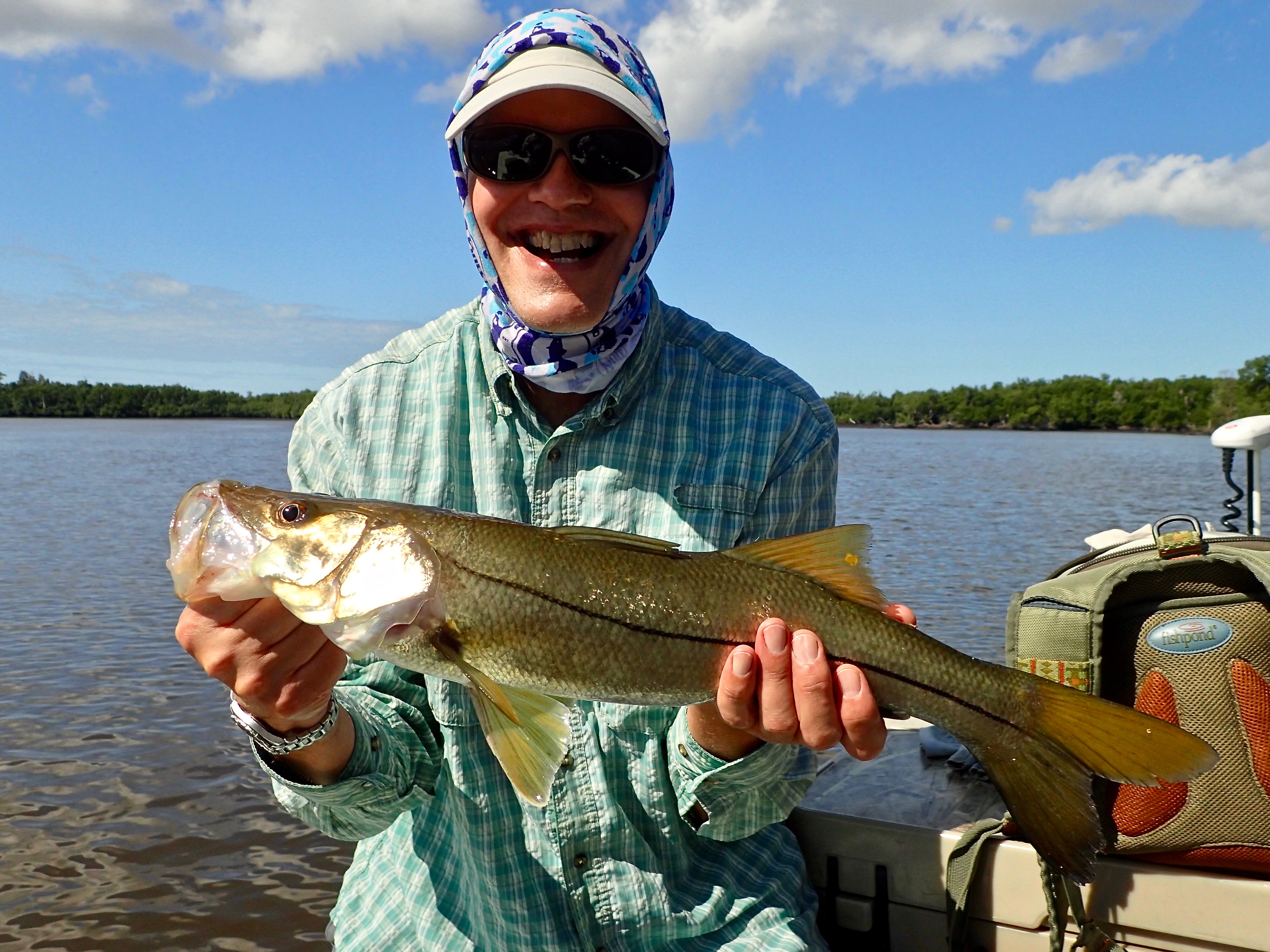
Wednesday turned out to be the warmest of the three days, but there was still an early morning chill that was amplified by the boat slicing through the pre-dawn canals. I wore fleece pants all three days — I’m generally always inclined to be cold — but later on this day I almost broke the shorts seal. I knew what was coming in a couple weeks, and I kept reminding myself that regardless of the action, this wasn’t steelheading — and I should enjoy the blessing of actually being able to feel my toes and fingers. A left-handed fly caster on the bow and a right-handed spin guy on the stern makes it easy to do double duty. However, as we drifted past this island, I wanted to get some footage of my Marine doing battle. Bill found a pod of sea trout and had at them. These are beautiful fish, and they can be highly aggressive with their follows and takes. We liked this spot so much that we asked Mark to do another pass around. we never saw another boat until the very end of the day.We made a run to where the Everglades dumps into the Gulf, and I loved this mark: current, loads of structure, and all kinds of birds and mammals and reptiles to eyeball. We actually fished hundreds of yards of shoreline. By now, I felt like my presentations and hook sets had come light years from my first trip. As we drifted past a downed tree within a pocket channel, I thought I saw a shadow. One cast, a couple strips, snook on! A decent fish for sure, but sight casting him in lightly stained water made me feel on top of my game. Bill and I each took multiple smaller snook at this mark. Of course, just when you think you’re all that, a baby tarpon in a cove near a creek mouth will remind you that you aren’t. And so, having touched two tarpon on the trip, I am resolved to get one on my next. Like Boss Rojack said in My Favorite Year, “The fighting is rounds…this is round one”
Much to do at Currentseams World Headquarters today, including: rest. I just got back from steelheading and the hours and cold weather really took it out of me. (Dehydration, anyone?) Naturally, there will be a report, but first I’ve got to finish my Everglades saga (one more day to talk about), so stay tuned.
Meanwhile, I have news from the wonderful world of fly fishing film. First, you can now buy tickets to Matthew Vinick’s film “Summer on the Farmington.” The photo below will tell you all you need to know.
Next, Ken Abrames recently posted that the Striper Moon: A Legacy film will be available on his Facebook page on Thanksgiving. I don’t know what that means in terms of access, nor do I know if it is on his personal Facebook page or his Striper Moon Blog page. I’m sorry that I don’t have more information.
Finally, I see that we’re now at 898 followers. So close to 900! Maybe there will be a holiday fly giveaway? That’s up to the potential audience. But, this seems like a natural segue into a very sincere thank you. Thank you for your readership. Thanks you for your support. Thanks you for all the questions you ask. I’m truly grateful that you consider Currentseams worthy of your time. Be safe, be well, and enjoy the Thanksgiving holiday.
The first time I fished the Everglades with Mark I was green. This is a specialized type of fly fishing, and by the time I felt like I was getting the hang of it, the day was over. What’s more, it was one of those days where the shots at fish weren’t plentiful. I’d gone down with the intention of catching snook and tarpon, but we had no opportunities at the latter and only a couple with the former.
So you can imagine that on this trip, I was raring to go. But, there’s always something conspiring against you, isn’t there? Wind, rain, cold fronts, pandemics…the list of potential villains is endless. Add to that that I have an uncanny talent for picking lousy fishing days months in advance. And so it was that Mark informed me that the Everglades bite had been slow. Very, very slow. But you go and you fish and you do your best, and that’s all any of us can ask.
A few hours in I’d landed ladyfish and sea trout and jacks, but no precious snook, let alone even a sighting of tarpon. Mark, being the guide extraordinaire that he is, thought we might have better luck in some of the more intimate creeks and ponds. Getting to some of these spots is an experience. You use the electric motor or the Evinrude on its lowest setting, and start down these labyrinthine waterways, some of which are not much wider than the boat. Mangrove branches and leaves try to smack you in face, and they’ll swat away anything on deck that isn’t lashed down.
Once inside the pond or cove, you assume a ready position on the bow. There’s no chatter, only hushed tones that are essentially a loud whisper. If we don’t see any cruisers, we systematically attack the mangrove-choked shoreline. In particular, you look for structure, like downed trees and especially little notches in the shoreline or micro-creek mouths. It’s a precision cast — the closer to the mangrove roots the better, and watch out for those overhanging branches that want to eat your fly — then short, fast strips the moment the fly touches water. I didn’t know it yet, but if there are snook or tarpon lying in wait, they will race to the fly with breathtaking speed.
I was working one of those little notches in a shaded corner when it happened. The water bulged, I felt a bump, and I saw a large shadow turn and melt away into the tobacco-stained water.
Snook. A good one.
There was no hook set, no point-finding-purchase, no sense that the fish was spooked. So I made the same cast.
The bulge re-appeared, moving at attack speed, and the snook slammed into the fly. I’ve screwed up plenty of hook sets in my life, but not this one. Rod tip down and dirty, hard strip back and to the right, and the Everglades exploded.
Right from the start, I felt like I had this fish. (A strong set and 20-pound test is good for confidence.) Still, when you’ve never caught a species before, you don’t know how it’s going to behave. This fish did everything in its power to screw me up, like repeatedly trying to find refuge in the submerged roots and sounding under the boat. I never put it on the reel; it was all hand stripping. “Don’t let him breathe!” was constantly running through my head, and Mark did a great job of kibitzing during the battle. Then, the inevitable. Snook landed.
Time for a victory cigar. My first striper on the fly went 30″. My first snook was in the same ballpark. What a magnificent beast! Snook will color to match their surroundings, and this one is perfectly camouflaged for the dark bottom of its home. Taken on Mark’s Blue Claw streamer. Photo by Mark Giacobba.
Most of the rest of the day was anti-climatic. We found another stretch of shoreline, this time in the sun, that was infested with smaller snook, 12″-16″. It was a great opportunity to observe how snook ambush feed. The speed with which they move to their target is impressive. We didn’t count, but it had to be at least a dozen more snook to hand.
While fun, these smaller fish can lull you into a false sense that you are infallible. I remember losing a pig of a striper on the Cape a few years ago. Dink after dink after dink — then when a really good bass hit, I was unprepared and dropped the fish. You can see where this is going. All of a sudden, I rolled a tarpon. I was so surprised that I was late on the set. I still thought I had him, but after a moment of wild spray and boiling water, it was gone. I stood alone on the front deck, the heat of regret and embarrassment crawling up the back of my neck. You gotta set the hook, Steven. You gotta set the hook.
Still, it was hard to let that moment trump the victory of the morning. I had my snook, and then some. And I also had tomorrow.
We interrupt our Everglades story — there are a couple more chapters to go — with breaking news. Director Matthew Vinick has just announced the premier date for his film, “Summer on the Farmington,” (featuring yours truly, among others)! It’s Wednesday, January 12, 2022, at the Legitimus Brewery in New Hartford. That’s all I have for now, other than we should have a trailer to share sometime in the next couple weeks. In the meantime, here’s a very low-res, ultra brief teaser.




 currentseams.com