Tip of the week: watercraft and wisdom, or: You’re smarter than the fish

Heed the sage advice of Harford Henry Edmonds and Norman Nellis Lee:

“The proficient wet fly angler is not disadvantaged at finding no rising trout at the surface, he will instead use his watercraft and wisdom to fish all the spots where he knows a trout will be.”

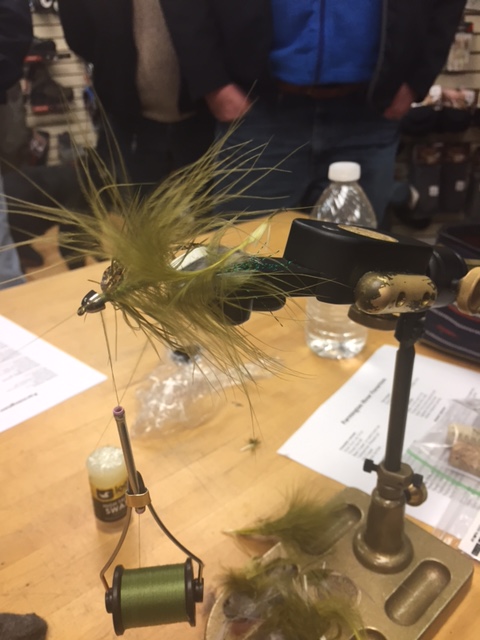
I tied up this Drowned Ant yesterday, thinking about the shady banks, grassy edges, and pocket water I will drift it through this summer.

drowned_ant

Works-in-progress: Hendrickson spiders

I don’t usually share patterns in the development stage, but the energy of these flies and the promise of spring has me feeling reckless. I’ve been prototyping some Hendrickson spiders, playing around with different colored threads and silks, hackles, and tailing materials. The one constant is the body fur, a moderate dusting of muskrat over the waxed thread or silk. These will get a test run this spring, and I’ll let you know what I — and the trout — think.

A nod to the tradition of North Country spiders and legacy American patterns like the Dark Hendrickson winged wet.

OLYMPUS DIGITAL CAMERA

Farmington River Report 2/15/17: Bottom return

There comes a point in the nymphing session — usually after I’ve been at it for a while with no touches, and especially if I’ve been losing a war of attrition with the bottom — when the indicator goes down, I set, and I cannot believe that I’m stuck again.

Depression sets it.

But sometimes the bottom moves. And despair turns into the delightful prospect of possessing that which we love and desire.

It’s a fish, and by the feel of things, a decent one.

Even after walking it down the run a ways, the trout still won’t come, and I wonder if it is fouled. No, it’s just a big ‘ol Farmington brown — nearly twenty inches worth — with my tiny midge lodged firmly inside the white of its mouth.

The prize for hiking a good distance to fish in solitude. Celebrated with the cigar gifted to me by Alton (thank you).

OLYMPUS DIGITAL CAMERA

River conditions: 140cfs, clear, 33 degrees. Not much hatch activity (a few W/S caddis and midges). Most of the pull offs and dirt roads were inaccessible due to snow pack/plowing piles. That may change with the warm weather this weekend. I managed a nice rainbow in another spot, then called it a day after three hours. Two BB shot on the drop shot rig today resulted in a lot of snags, but also produced the kind of slower drift that I think catches more fish in water that’s barely above freezing.

The winning fly, Glenn Weisner’s blue bead head midge. You can read more about on Ed Engle’s Lone Angler Journal.

weisnerbluemidge

I know you’ll ask, so here’s the recipe:

Impressions from a tying demo

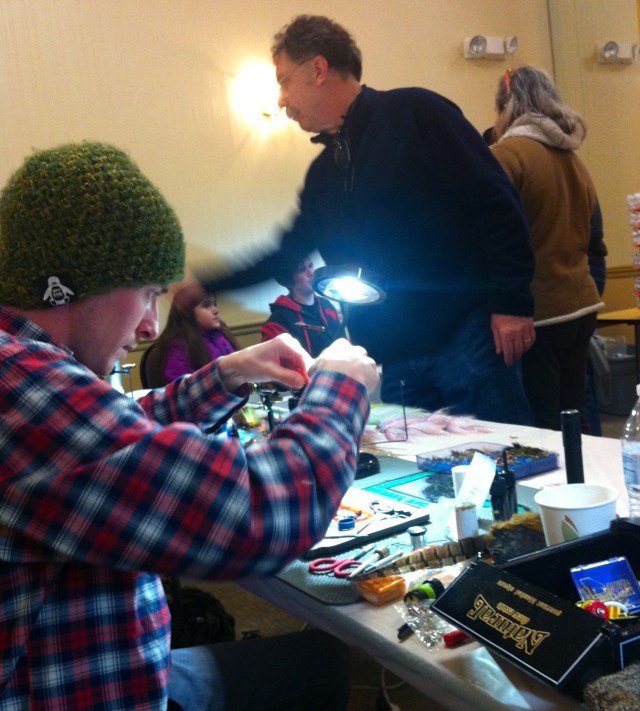
Here are a few things from yesterday’s tying demo at the Compleat Angler that are top of mind with me this snowy afternoon:

Wet flies tied in the North Country style are admired both for their simplicity and bugginess. (And trout like them, too.) By the way, group, I was wrong about the Snipe and Purple: the feather in the hackle is not an under covert, it’s from the top of the wing. Nonetheless, I’ll fish that fly with its horrible botched head and catch a trout.

It’s amazing how you can change the energy of a fly simply by altering the color of the hackle. Two Partridge and Light Cahills, the same but different.

plcs

The more I use the rotodubber, the more I like it for fur hackles. Like the NoCo spiders, people gravitate toward the Squirrel and Ginger, and with good reason. It’s one of my most consistent producers.

No two Usuals I tie seem to come out the same.

Confidence catches fish.

I really enjoy the questions and discussions during a demo, both fishing and tying related. I’m humbled — and grateful — that people take the time to come out and connect with me. Thanks to everyone who showed up, and thanks to the Compleat Angler for being such swell hosts.

By the way, I was impressed by the shop’s selection of hackles — and fly tying materials in general. Lots of wonderful wet fly capes in stock, and I left with a lovely Light Ginger hen neck. Check them out at 541 Post Road in Darien, CT.

Marabou adds a little magic to any fly. All that’s missing on this Deep Threat is the Ice Dub collar. Thanks for the photo, Mina.

deepthreatprogress

Pre-storm small stream and thanks, EJTU

Busy day yesterday at currentseams. We started at 10:30am on a small stream. In terms of snow and ice, the northwest part of the state is very different from the central, particularly in the woods and the ravines carved out by small streams. I was truly surprised by the amount of white stuff.

Intricately laced ice shelves lined the edge of the stream. I took this photo first thing before I started fishing. As I was packing up the camera, I happened to look down into the shallow riffle you see here. Not six feet away, a good sized brookie was taking nymphs and emergers, maneuvering laterally in the current to pick off each tasty morsel. Wild trout are usually super-spooky, but obviously the feeding instinct overcame the flight reflex.

OLYMPUS DIGITAL CAMERA

~

Water temp was low 30s, air temp 40s and climbing. That made for an ethereal sunlit fog effect. There were some decent sized (16-18) midges, and the trout were eager to feed despite the near-freezing water that was entering the system. I saw several brookies hanging out in sunlit shallows, where the water was no doubt warmer. OLYMPUS DIGITAL CAMERA

~

The fishing was good, and surprisingly, so was the catching. (The cigar was swell, too, a Nat Sherman Explorer maduro gifted to me last month at the TVTU meeting.) I presented a size 16 Improved Sofa Pillow dry with a 2x short size 18 Frenchie variant dropped off the hook bend. I pricked a dozen or so and probably landed 2/3 of them. They were fairly split among the two flies. This one liked the nymph.

OLYMPUS DIGITAL CAMERA

~

All good things must end. Or should I say, end one good thing, then begin another?  Off I went to New Jersey for my Farmington River presentation to the EJTU chapter. We had a sizable crowd, a good energy, and some excellent post-presentation questions. Thanks so much for having me.

And a final shout out to Zinburger. Spicy green chili fries, an El Diablo burger, and a yummy glass of zin made for a most excellent pre-game meal. We need a Zinburger in the Hartford area!

Show and Tell

It’s no secret that I love the CFFA Show. Saturday reminded me why it’s the best little fly fishing show around.

The Baranowski boys, Tommy and Matt (two very talented tyers and anglers) were seated to my left on tyer’s row. After watching me painstakingly create a dubbing loop of squirrel fur, Matt asked if I’d ever used a rotodubber. No, so I borrowed his. Ka-ching! Never mind that crap about old dogs and new tricks. I now own one. So thanks, dude. I also left with some ringtail, a few beads, and Robert Smith’s book The North Country Fly. Many thanks to the CFFA for inviting me to tie (and thanks, Dick, for the flies and the feathers, and Alton for the cigar).

Most of all, thanks to everyone who took the time to stop by and chat and ask questions. I appreciate your loyalty and your readership.

Matty at the vise. That’s steelheader extraordinaire Stan Otlowski in the background.

mattb

~

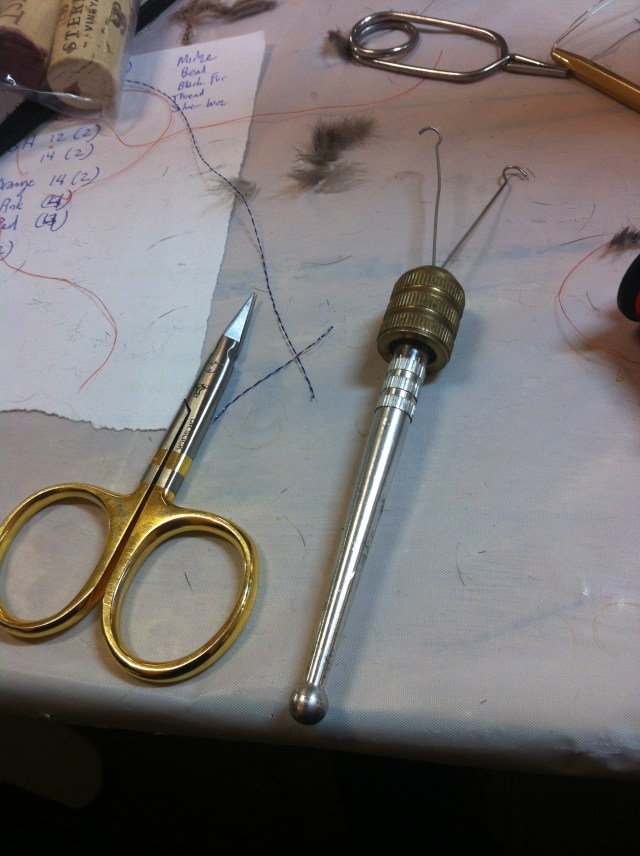
So much depends upon a gold and silver rotodubbing tool…

dubbingtool

~

Sunday was my tying class, “Farmington River Favorites,” at UpCountry Sportfishing in New Hartford. A very enthusiastic group came armed with good questions and nimble fingers. We covered a broad range of patterns and techniques, and I want to thank the class for making my job as an instructor easy.

The sign could say, “Men and Women Working.” Thanks to Torrey Collins for the photo.

upc2017

Coming up this week:

“The West Branch of the Farmington River,” Wednesday, February 8, at East Jersey TU, Rochelle Park, NJ. Have Farmington River enthusiasm, will travel. For more information, visit the EJTU website.

“Farmington River Favorites” Tying Demo, Saturday, February 11, 10am-2pm at The Compleat Angler, Darien, CT.  At this demo, I’ll be tying some of my favorite patterns for the Farmington River. There will be a little bit of everything: wets, dries, nymphs, and streamers, from traditional classics to new designs. These are all high-confidence, proven patterns, and I’ll also discuss how and when I like to fish them. For directions and stuff, visit the CA website.

Robert Smith on tying North Country spiders

Since we’re in fly-tying mode, I wanted to share this. It’s written by Robert Smith, a new friend and fellow aficionado of the soft-hackled fly.

“As some of you will may know, I am a descendant of a famous North Country angler/author. And this simple quirk of fate has in many respects dictated my views in regards to tying the patterns. (Best not mention number of hackle wraps!)

But for the most part, it is the beauty of the materials we use in dressing spiders that has always driven me. I revel in using hackles from antique and obscure sources from the likes of Fieldfare, Owl and Wren. Each hackle has its own individual quality, both from a tying point of view and an aesthetic point of view. As you change individual hackles, the individual barb count changes, and as a result your tying technique changes to compliment these barb counts. (One of the reason why I don’t prescribe to the two turns of hackle mantra!) On some of the denser hackles I strip on side off, on others I wrap with a full hackle. Stripping one side of the hackle allows me more control of the barb count and also produces a neater fly, providing you strip the leading edge of course!

The subtle colouration and shading found in many of the birds we use in dressing spiders is to me at times breath-taking. Simple things such as a Magpie tail or Starling skin, shimmer and radiate an amazing spectrum of colours. Others such as the brown speckle of a Partridge hackle, just seems born to compliment orange silk and bright gold wire! Last year, a friend sent me a Lapwing that he picked up from the field. I was stunned at the beauty of the plumage when I opened the Tupperware box, so much so, that even now utilising its hackles within a simple fly has become a reverential act. The bird and plumage was beautiful, and to my mind, it is only right that the fly I fashion matches this. For me, there is something spiritual about using a fly constructed in some part, from materials obtained from the very landscape that surrounds me.

Though dubbings are often rather overlooked when discussing spiders, I love using old standards such as Fox ear and yes Water-rat. Though modern synthetics have their place, and we have to give Davy Wotton a big thank you in regards to the quality of modern synthetic dubbings. Nothing beats natural dubbings. Years ago after buying a collection of tying materials, I came across an old dried small tin of Crawshaw’s Red Spinner dye, the same used in the dressing of Edmonds & Lee’s March Brown. I’m not afraid to admit that I had tears rolling down my face, as mixed up enough to dye a rabbit skin so I could follow the original tying recipe. And even more so when the fly landed a 12” brownie from the same pool illustrated in their book.

Though the techniques involved in dressing spiders is somewhat simple compared to the complexity of other fly types. They are nevertheless, in many ways harder to master. Simply put, when dressing spiders, you have nowhere to hide! Each wrap of silk has to be deliberate and precise, because a poorly placed wrap of silk has a habit of becoming obvious on a finished fly. The hackle fibres that slant backwards because the first binding wrap of silk is crouching in and collapsing the desired umbrella spread. Peacock herl heads that show tying silk in front. All these things are easy to avoid, but surprisingly often go un-noticed until we hold up the finished fly.

Unlike other fly types, tradition dictates that I can’t even hide my deficiencies under a bulky fur coat of dubbing. Because I’ve taken the words of Pritt, Edmonds & Lee, Leisenring and Hidy to heart, and cover my silks with only a sparse misting of dubbing.
To sum up, there is a quiet confidence exhibited in a well tied spider or soft-hackled fly. They don’t need to scream out with the use of modern materials or convoluted tying techniques. They simply need to be dressed neatly and proportionally, and with a sympathetic understanding of the materials involved.”

One of Robert’s lovely ties, the Black Snipe, No. 62 from Pritt’s book.

rsmithblacksnipe

Tie Food

‘Tis the season to be busy at the vise. I’ve also been sequestered in my lonely writer’s garret, churning out new material for your favorite publications, and buffing up some old presentations — not to mention outlining some new ones for 2017.

So, no fishing for me for two weeks now. (I know. That’s just plain wrong.)

A couple reminders:

I will be tying at the CFFA Fly Fishing Expo & Banquet, Saturday, February 4, Maneely’s, South Windsor, CT. Come see why the Expo is the best little fly fishing show going. I’ll be there from the morning thru early afternoon. If you’re there, be sure to say hello. For more information, click here.

There’s still space in my “Farmington River Favorites” Tying Class, Sunday, February 5, 9am-1pm at UpCountry Sportfishing.  There will be a little bit of everything: wets, dries, nymphs, and streamers, from traditional classics to new designs. These are all high-confidence, proven patterns, and I’ll also discuss how and when I like to fish them. If you’ve taken my wets and fuzzy nymphs class before, most of these patterns will be new. Sign up through UpCountry Sportfishing.

We’re getting close to the magic number of 500 followers. Of course, we’ll have a giveaway to celebrate.

Last week’s worth. Some of these are for customers, some for future guide trips, and some for me. 

OLYMPUS DIGITAL CAMERA

Come to where the fly fishing flavor is

Come to Marlborough country.

The 2017 Marlborough edition of The Fly Fishing Show has come and gone. I attended and presented two of the three days. Here’s my take on the action.

Friday was seminar day. I checked in around 11am and walked the show floor for an hour. I had two goals: reconnect with some old acquaintances (Joe Cordiero, Shawn Britton, Ray Stachelek, Armand Courchaine, Bob Popovics, Roger Plourde) and score some feathers. I found two flatwing-worthy saddles and a reddish-brown hen cape for wets. Off to the big room.

I also wanted to meet a few people I didn’t really know. One of them was Jason Randall. It seems like every time I have a piece in American Angler, Jason has one, too. I like his writing and his scientific approach (check out his pocket water piece in the current issue). I caught the tail end of his “Where Trout Are” seminar, introduced myself, and we got in some quality hobnobbing over the next day. I encourage everyone to do likewise. There’s a tremendous amount of knowledge and experience at these shows. Don’t let the fact that someone is well-known intimidate you — people are here to meet, talk, and share information. It’s a real positive energy.

On the board. I got the chance to meet and talk with Ed Engle on Saturday. He’s quiet, thoughtful, and knows much about fly fishing for trout. I wish we’d had more time to chat.

marl-2017-seminar

If you’re a seminar presenter, you get a badge that says “Celebrity” under your name. While I appreciated the title, I was mindful that I’m still just a guy who loves fly fishing. Good crowd — I was a little nervous that there was only one person in the room 15 minutes before show time, but we ended up with a very strong turnout. If you were among them, thanks for coming to see Wet Flies 101!

Saturday I was first up in Room A of the Destination Theater. Another impressive crowd, and we had to take our Q&A out into the hallway (you have a 45-minute hard stop in the DT). Again, thanks for coming, and thanks for laughing at all my jokes.

Tim Flagler from Tightline Productions (really high-end fly tying videos — I covet his editing equipment and skills) was another person I wanted to meet. I’d only spoken with Tim on the phone, so I caught most of his presentation (excellent!), then bent his ear on cameras and shooting out in the hallway. Tim’s a class act.

marl-2017-dt

I zipped over to Jason Randall’s “Advanced Nymph Fishing” seminar. More good stuff. Jason’s a knowledgeable presenter with a very friendly style. Like Tim, he has some seriously good footage to draw from. Both Tim and Jason made me want to get out on a river post haste. One final lap around the main show floor, and I headed back to Connecticut.

Last but not least, I’d like to thank Chuck and Ben Furimsky for inviting me to play.

Flatwing saddle swag. I’ve got some plans and schemes for these babies (hint: trout).

OLYMPUS DIGITAL CAMERA

~

I ran into Charles McCaughtry at one of the feather booths. Charles is a Connecticut artist and a currentseams follower. He gifted me two sets of notecards featuring his work. What a thoughtful gesture. Love his impressionistic style.

OLYMPUS DIGITAL CAMERA


Thanks TVTU and on to Marlborough

The threat of freezing rain couldn’t dampen the spirits of the members of the Thames Valley Chapter of TU. We had a great crowd for “The Little Things,” and some intriguing post-presentation discussions. This is a group that is passionate about fly fishing. A thousand apologies for forgetting your name, but I’ll balance that with a thousand thank yous to the gentleman who gave me the Nat Sherman Metropolitan Selection Explorer. I’ll be enjoying that on a future Farmington River outing.

On to Marlborough! Hard to believe that The Fly Fishing Show is already here.

“Wet Flies 101,” at the Fly Fishing Show, Marlborough, MA, Friday, January 20, 1pm, Catch Room. We’re in the big room for this one, so come out and support your friendly local fly fishing writer guy! For more information, visit the Fly Fishing Show website.

“Wet Flies 101,” at the Fly Fishing Show, Marlborough, MA, Saturday, January 21, 10am, Destination Theater, Room A. Smaller room, same energy and information. I may be tying after the presentation and will let you know if that’s the case. For more information, visit the Fly Fishing Show website.

Wet Flies 101