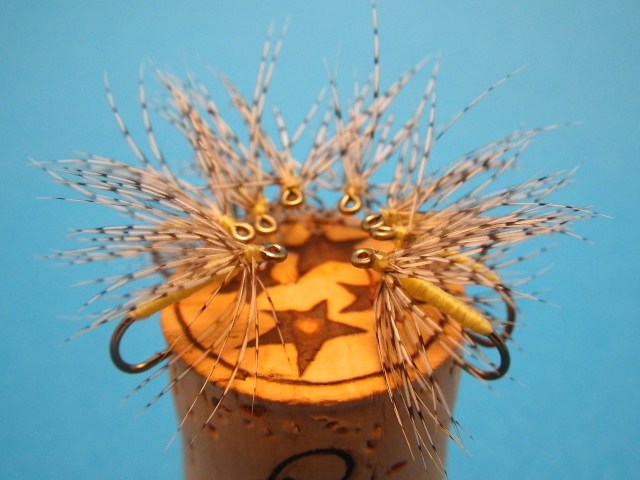
“Farmington River Favorites” fly tying class at UpCountry Sunday, Feb 5

I’ll be leading a fly tying class at UpCountry Sportfishing in New Hartford on Sunday, February 5. Here’s the class description from the UpCountry site:

Join outdoor writer and Farmington River guide Steve Culton as he explores some of his favorite patterns for the Farmington River. There will be a little bit of everything: wets, dries, nymphs, and streamers, from traditional classics to new designs. These are all high-confidence, proven patterns, and Steve will also discuss how and when he likes to fish them. Participants will need a vise, thread and tools. All other materials will be provided, including a pattern recipe list. The class starts at 9am and will run about four hours, giving you plenty of time to get home for the big game. Space is limited to six people. Tuition is $75, paid in advance and non-refundable.

Please do not contact me to register. You must sign up through the shop, and you can find them here.

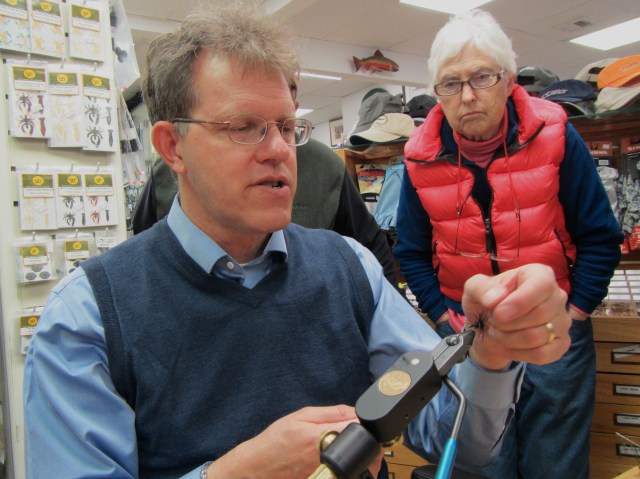
From a class a few years ago, very serious-like. But we like to have fun, too.

IMG_9906

Farmington River Report 1/12/17: Of flows and floes

I expected to blank yesterday. Rain, snowmelt, and ice would surely make for some challenging conditions, 56 degree air temps be damned. I fished two spots within the permanent TMA, and the first was that dreaded blank. The second, much to my surprise and delight, produced three trout (three more than the guys fishing corn, he said smugly). Over the course of the day, I left my rod on top of my Jeep and drove a quarter mile before I realized my idiocy. Then I rescued someone’s landing net as it floated by. So much excitement! Here are some details.

The river was running at 300cfs, a (finally) proper level. But the water was staggeringly cold — my analog thermometer only managed 32 degrees at 1pm. Water was off-color at the first spot, and less stained at the second. What really surprised me was the amount of ice still on the surface. A day later I’m sure some of it has flushed, but many of the hero dry fly pools were better suited for skating than fishing. Ice floes were also a problem as the day progressed. It’s unnerving to feel that dull thud against your leg while you’re focusing on your drift.

Lots of this going on. Be wary of shelf ice — plant an imaginary “Keep Off!” sign and do so.  January is a bad time to go swimming on the Farmington.

OLYMPUS DIGITAL CAMERA

I did a little short-line nymphing, but with the water back at a near-normal level, I returned to the indicator for most of the day. I prefer indicator nymphing in conditions like these because I can cover a lot more water. I also like the indicator for the more subtle takes you sometimes get with winter fishing. (However, that wasn’t the case today. All three fish struck hard.) Two came on a Frenchie variant (black bead, UV Red Ice Dub), size 12 scud hook. I also went with 2 BB shot to slow my drift. It made for an abundance of false positives, but I think slower was the way to go.

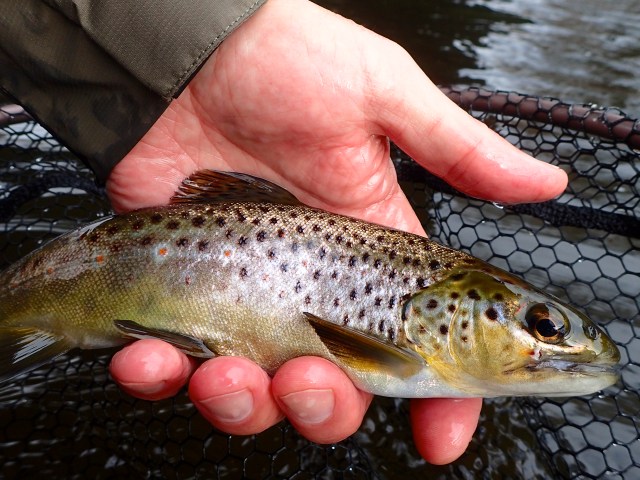
Pure parr pulchritude. Alliteration aside (alas), this is one gorgeous creature. Check out the halos along the lateral line, and the old mouth wounds. He fought like a tiger, and I had a hard time getting him to sit still for a portrait. I will never tire of catching wild Farmington browns. 

OLYMPUS DIGITAL CAMERA

I find the concept of dark flies on dark days agreeable, so I made my top dropper a Starling and Herl, standard hook size 16. I love fishing soft-hackled flies like nymphs or deep emergers.

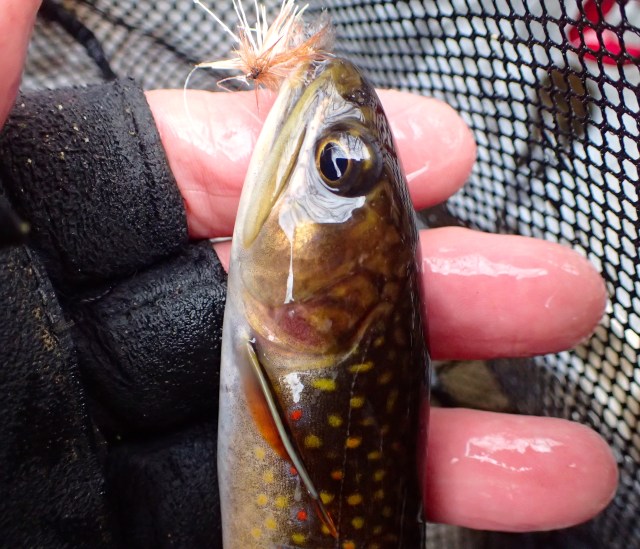
This was my biggest fish of the day. Starling and Herl.

OLYMPUS DIGITAL CAMERA

Thank you, CVTU (and a couple more small items)

Many thanks to the Candlewood Valley Trout Unlimited chapter for being most excellent hosts last night. The presentation was “The Little Things,” and I couldn’t have asked for a better audience (especially the gentleman in the front row who laughed at all my jokes). Thanks also for the pizza — a fed presenter is a happy presenter — and I’m looking forward to “The Little Things 2.0” with you all in the future.

I have a really fun job. Much better than desk work.

img_3075

~

Next up: “The Little Things,” Tuesday, January 17, 7pm, at Thames Valley TU, Bozrah, CT. Like above, this is the original Little Things. From the TVTU website: Fly tying starts at 6:00 p.m. and the meeting begins at 7:00 p.m. Meetings are open to the public and there is no charge so come and join us. For directions and stuff, visit thamesvalleytu.org.

And I see currentseams.com is edging its way toward 500 followers. We will, of course, be giving away some goodies to celebrate!

Ten Things You Should Know About Nighttime Fly Fishing For Big Trout

“Ten Things You Should Know About Nighttime Fly Fishing For Big Trout” first appeared in the August/September 2016 issue of Mid Atlantic Fly Fishing Guide. It’s part how-to, part humor, and I think you’ll like it. Even though they are no more, many thanks to MAFFG for allowing me to share it on currentseams.

The time between dusk and dawn has always inspired musicians. George Benson stated his affinity for it. Ray Charles declared its righteousness. Beyond poetic musings, nighttime also happens to be an excellent time to go trout fishing. So if, like Bob Seger, the night moves you, here are ten things to consider before you head out into the darkness.

Nighttime is prime time. Anglers who are serious about catching trophy trout know that nighttime is when the big boys and girls come out to play. Archetypical nocturnal creatures, lunker browns go on the prowl once the last light fades. They’ll venture into shallows where you’d never find them at high noon. Their targets include late-falling spinners, rodents going for an unexpected dip, and smaller fish foolish enough to swim in harm’s way. Bonus point: 95% of all other anglers are home in bed.

Someone’s been eating well. This chubby hen clobbered a mouse fly as it swung across the current. Every year, my biggest trout come subsurface – or at night.
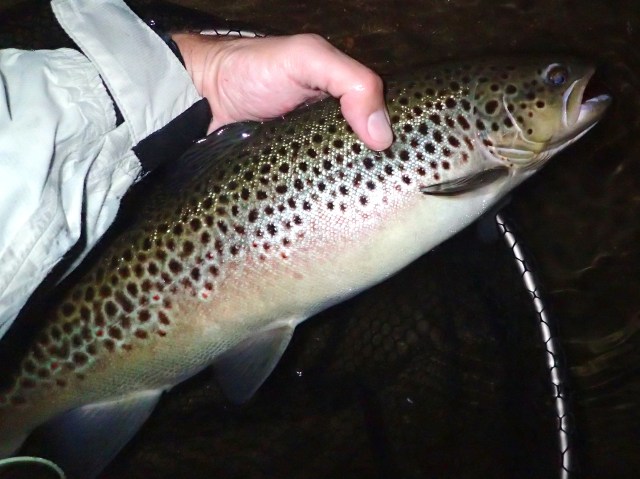
Big wild brown hen 8-2015

Know the rules and regulations. Not all states or fishing areas allow night fishing. Be sure to check the regs before you head out.

Safety first! Never, ever fish previously unexplored water at night. I cannot emphasize this point enough. Many locations are a challenging wade in daylight. They’re going to be exponentially harder at night. Avoid them, and stick to areas with moderate-to-easy bottom structure and currents that you know well. Wear a personal floatation device. Tell someone where you’re going to be and when you plan to return. Wear safety glasses. Carry a wading staff, and use it. A smart phone with a compass app is always a good idea. If you’re fishing a tailwater, know the water release schedules and weather reports. And above all, use common sense.

Scout the area you’re going to fish in daylight. Make note of submerged logs, overhanging branches, tall grasses – anything that will eat your fly on your back cast, forward cast, or retrieve. Getting your fly out of a tree in daylight is difficult. At night, it’s nearly impossible. Wade the path you’ll likely be taking and make note of any rocks or structure that could possibly trip you up – as well as ledges that drop off into deep holes.

Nighttime is also the right time for articulated streamers, waking deer hair-head patterns such as Galloup’s Zoo Cougar, or impressionistic creations like this Deep Threat. While black is the most popular color at night, I have had success on olive, white, yellow, and many other colors and combinations.

Deep Threat

Learn how to cast at night. One of the most intimidating aspects of getting into the night fly game is that you generally can’t see what your line is doing. But I believe that casting should be mostly done by feel. So, practice your casting on dry land with your eyes shut or while wearing a blindfold. Feel how – and when – the rod loads. Before long, you’ll develop what athletic trainers call muscle memory. And when you hit the water, you won’t give your casting a second thought.

Night fishing can be unnerving. There’s a reason some people are terrified by dark rooms. Robbed of sight, our other senses – especially touch and hearing – go on high alert. Every noise is amplified. Our audio-fueled imaginations can’t help but generate worst-case scenarios. I still laugh at the time I thought I heard a noise in the woods behind me and turned around to see the glow of another angler’s headlamp. “Wow,” I said. “I didn’t even see you standing there.” It was then that I realized I was talking to a very large firefly hovering in the darkness. After a time, though, you get used to – and even relish – being alone in the dark. You hear nature’s night symphony in magnificent high fidelity. And on cloudless nights on the dark of the moon, the shooting stars are an ethereal treat. One night on a wooded river in eastern Connecticut, I had the strange sensation that I was not alone. I turned upstream. There, just 30 feet away from me, a doe and her three fawns were drinking from the cool, clear waters under the light of the waxing moon.

Beavers are not your friends. If you fish at night as often as I do, you will come to fear and loathe beavers. These highly territorial creatures inform you in no uncertain terms that you are not welcome. Their intimidation game begins with a mighty smack of tail on water. Next comes a warning swim around – or straight at you. Sometimes they submerge mid-swim, initiating a test of wills where you die a thousand deaths while trying to guess their present course. Healthy beavers are merely bullies; generally, if you don’t confront them, they won’t attack. But rabid ones are known to, and if you’ve ever seen what a beaver’s teeth can do to a tree trunk, you know an encounter with a rabid beaver must be avoided at all costs. Give all beavers a wide berth.

Get a headlamp with a red light. Bright white lights with hundreds of candlepower have little place in night fishing. The time it takes for the human eye to adjust from white light to complete darkness is much longer than the period going from red to dark. Then there’s the spook factor. If you were a fish feeding at night, wouldn’t sudden, bright beams of light be cause for alarm? Stay under cover of the night with a red beam.

Find a good mouse pattern and learn how to fish it. Originally popular on bass ponds and western rivers, the mouse fly has now become a staple of night fishing for trout from coast to coast. You don’t need an ultra-realistic pattern with ears and eyes and cute little whiskers – those accoutrements are solely for the benefit of humans. All you need is a pattern that rides on the surface and provides an attractive silhouette to predators. My current favorite mouse fly is Joe Cermele’s Master Splinter. It’s simple to tie (you can find the recipe through an internet search), it floats like a cork, and best of all, trout love it. Trout will take mice on the dead drift, the swing, the dangle, and the strip. Try all of them until you find some customers.

The pitted, scarred foam back of a Master Splinter mouse fly offers mute testimony to the savage nature of large browns.
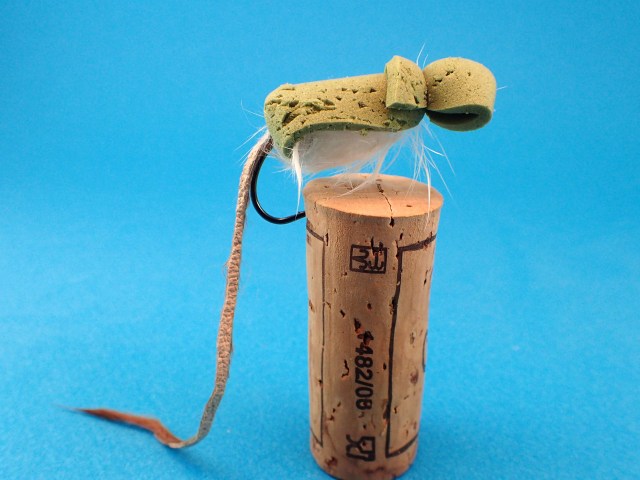
Chewed Mouse

Know how big trout like to feed. The alpha fish of the pool, large brown trout will often stun their prey before administering the coup de grace. So when you feel that first whack, don’t set the hook. Because it’s counterintuitive, it’s a difficult concept to master. But it’s critical if you want that precious hookup. I’ve had big browns bump the fly a half-dozen times before finally striking with intent to eat. Don’t say no to a trout that has already said yes to your fly. The time to set the hook is when you feel the full weight of the fish on the end of your line. If you’re getting multiple taps and no hookups, it’s probably a more modestly sized trout. Big fish simply don’t miss.
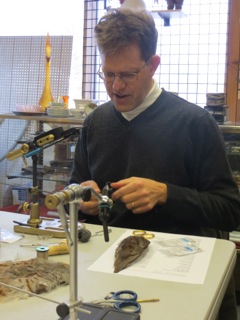
New event added: “Farmington River Favorites” Tying Demo at The Compleat Angler, 2/11/17.

My friends at The Compleat Angler in Darien, CT, have invited me back for their winter tying series. (I must be doing something right. Or at least not sucking at it.) I added the information to the appearances post I made the other day. You can read all about it here.

Tying up a storm at a previous Compleat Angler event.

Tying Black Crawler

Farmington River Report 1/5/17: Ice cold (the weather, too)

In my experience, sudden changes in temperature — especially a drop — are usually bad for business. So it went today. I fished three spots within the permanent TMA, nymphs and streamers, and blanked. Okay, I did have a firm tug on a streamer (solid enough to make me wonder why hook point never found mouth) but that was it. Hatches were virtually nonexistent, and ice was a problem all day. It’s not supposed to get much warmer for a while, and today was my day to get out, so I can live with the skunk.

Note: as I drove past the entrance to Greenwoods/Boneyard, I noticed the dirt road is not plowed and is covered with ice. I wouldn’t plan on trying to navigate it unless you’ve got really good tires and a reliable 4WD. Good luck if you head out, and remember: the fish don’t know that it’s cold.

Shaving cream — be nice and clean — shave every day and you’ll always look keen. Actually, this stuff was frozen solid. It also reminded me of baked Alaska.

OLYMPUS DIGITAL CAMERA

Small stream report: First wild brookies of 2017

The older I get, the more I embrace the philosophy of, “I don’t need to be right.” But boy, did I make a good call about fishing a small stream today.

I thought there would be enough water for the fish to be comfortable in. Yes, there’d be more tomorrow, but with a cold front approaching — and plenty of cloud cover — today would be the better mid-day option. So I visited an old friend from 11am-1:30pm. There are three things I want to tell you about.

Nature finds a way. This particular brook was disastrously low  when I visited it in August (not to fish, just to look). Yet somehow the brookies made it through the stress of a scorching summer that reduced their home to a trickle. Today, I pricked ten, landed six. Jeez, I’d sign up for that in May. In January it comes off as an unimaginable bounty. I’ve never done this well on this stream in winter.

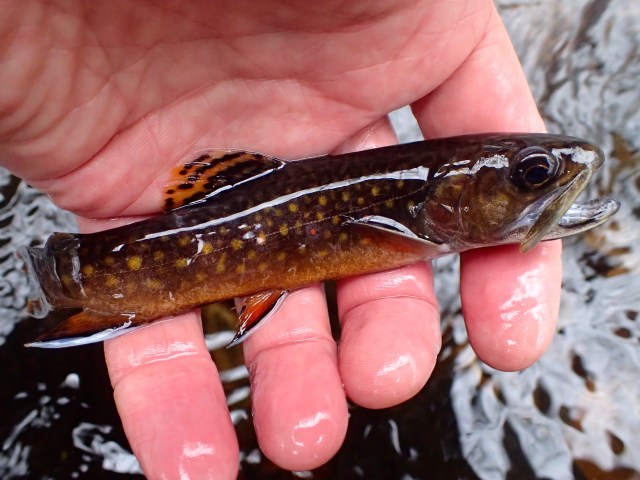
The first salmonid of 2017. I don’t usually handle fish this small, but this gorgeous creature made my heart leap up in my chest. Happy New Year!

OLYMPUS DIGITAL CAMERA

Droppers are the quickest way to find out what the fish want. You may be bored with me saying this, but I will continue to shout it from the rooftops. I started the day with a size 16 Improved Sofa Pillow dry. After 15 minutes of no luck, I added a 2x short size 18 SHBHPT dropper. While most of my fish — particularly in the deeper pools — feasted on the dropper, the dry took the largest char of the day.

One swing and a miss — then on the next cast, the kill shot delivered. 

OLYMPUS DIGITAL CAMERA

Small streams in winter are places of unparalleled tranquility. It rained the entire time I fished. My left boot foot leaked. My fingertips were frozen. Funny thing! I looked at my watch and realized I’d been fishing for two hours. Sure, it helped that the catching was good. But watching the smoke from my Punch Gran Puro Robusto curl into the mist didn’t suck either.

Looks cold. Was cold. And wonderful. 

OLYMPUS DIGITAL CAMERA

~

How my fingers got so numb. But the Fontinalis fins were worth the price of admission.

OLYMPUS DIGITAL CAMERA

Winter 2017 Appearances and Presentations

There’s still fishing, but winter is prime presentation season. Hope to see you on the river, at a club meeting, fly shop, or a show. There may be more additions to this list, so stay tuned. (Like right now. I’m adding a date on January 17th.)

“The Little Things,” Wednesday, January 11, 7pm, at Candlewood Valley TU, Bethel, CT. This is the original Little Things (there are currently two with a third on the way) presentation. From the CVTU website: Our meetings are free and open to members, guests and the general public. They are held at Stony Hill Fire Department, 59 Stony Hill Road, Bethel and start at 7:30 p.m. but doors open at 7 p.m. for pizza, soda and some good conversation with fellow anglers. For more information, visit cvtu.org.

“The Little Things,” Tuesday, January 17, 7pm, at Thames Valley TU, Bozrah, CT. Like above, this is the original Little Things. From the TVTU website: Fly tying starts at 6:00 p.m. and the meeting begins at 7:00 p.m. Meetings are open to the public and there is no charge so come and join us. For directions and stuff, visit thamesvalleytu.org.

“Wet Flies 101,” at the Fly Fishing Show, Marlborough, MA, Friday, January 20, 1pm, Catch Room. We’re in the big room for this one, so come out and support your friendly local fly fishing writer guy! I may be tying after the presentation. I’ll let you know if that’s so. For more information, visit the Fly Fishing Show website.

“Wet Flies 101,” at the Fly Fishing Show, Marlborough, MA, Saturday, January 21, 10am, Destination Theater, Room A. Smaller room, same energy and information. Ditto maybe tying after the presentation. For more information, visit the Fly Fishing Show website.

Tying at the CFFA Fly Fishing Expo & Banquet, Saturday, February 4, Maneely’s, South Windsor, CT. Come see why the Expo is the best little fly fishing show going. I’ll be there from the morning thru early afternoon. For more information, click here.

“The West Branch of the Farmington River,” Wednesday, February 8, at East Jersey TU, Rochelle Park, NJ. Have Farmington River enthusiasm, will travel. For more information, visit the EJTU website.

“Farmington River Favorites” Tying Demo, Saturday, February 11, 10am-2pm at The Compleat Angler, Darien, CT.  At this demo, I’ll be tying some of my favorite patterns for the Farmington River. There will be a little bit of everything: wets, dries, nymphs, and streamers, from traditional classics to new designs. These are all high-confidence, proven patterns, and I’ll also discuss how and when I like to fish them. For directions and stuff, visit the CA website.

“The Little Things 2.0,” Thursday, March 16, 6:30pm, at Farmington Valley TU, New Britain, CT. This is the followup to the original Little Things, and it’s currently one of my most popular presentations. For more information, visit the fvtu website.

Whew! That should keep me busy. I’m still trying to finalize some tying classes/demos as scheduling permits. Thanks for your support, and as always, if you come out to see me, please be sure to say hi.

Moving up to the big room in Marlborough, Friday, January 20, at 1pm.

Wet Flies 101

The Partridge Family

Surely any aficionado of the soft-hackled fly knows the value of the partridge. Although James Leisenring committed the act of understatement when he said, “The English or Hungarian partridge provides the flytier with some valuable gray and brown speckled feathers.” Some? There are enough glorious feathers on a full partridge skin to keep you in soft hackles for decades. I know, because I just bought my second skin. I still have the first one, purchased a decade ago, and it still has many seasons of flies left in it.

Forget the packaged bags of partridge feathers. Then listen to Dave Hughes, who said, “I cannot urge you strongly enough to purchase an entire skin, wings and all.” This one came from UpCountry Sportfishing. I like to buy hackle in person so I can eyeball the skin. And of course, it’s a good idea to support your local fly shop.

partridgeskin1

~

I use feathers from all over the skin — for saltwater flies, too — but the hackles I value most are the silver-grey and brownish feathers that line the neck, shoulders, and back. These are the feathers that are used in the North-Country spiders and dozens of other traditional patterns. The closer you go to the neck of the bird, the smaller the feathers. Look for a skin that is densely packed with these smaller feathers.

OLYMPUS DIGITAL CAMERA

~

A hook, a partridge feather, and some thread. Simple, buggy spiders like these have been fooling fish for centuries.

Partridge and Light Cahills

Farmington River Report 12/28/16: Lockjaw

That was the general consensus up and down the river. Theories abounded, from snowmelt lowering the water temps to a grey, blustery day where the air temperatures never really spiked. I’ll throw in a pitiful amount of bugs and be done with it. I nymphed within and above the permanent TMA from 9:30am-2:30pm. Water was a cold 34 degrees, there were a few minor snow showers, and the river was running at the princely sum of 175cfs. Lots of folks out fishing today. Many thanks to those who kindly shared water.

There was a 15-minute window of consistent sunshine in the early afternoon — enough to get a few bugs going — and that’s when I had my only touch of the day. I often tell people that I’ll always sign up for one fish in the winter, and when it’s a tank of a high-teens brown, all the better.

The winning fly, a Frenchie variant, on the day-saving fish.

OLYMPUS DIGITAL CAMERA