Back from a weekend trip to the Windy City. I was able to write up a storm in my down time, and today’s a day for other projects. While I was away, this came in the mailbox, and I thought I would share my answer with the group.
Q: Steve, I currently only have an Air Flo intertmediate line …but I want to fish a 2 or 3 fly set up (with) an Orange Ruthless in the marsh …how would you set that up? A: The dropper rig (leader/tippet) portion of the setup would remain the same. You can read about dropper rigs for stripers here. (Note that the tag length in the diagram is probably too short; I’d recommend 6-8″ for the tags.) The elephant in the room is the intermediate line. Since it’s a sinking line, you cannot mend it. And mending is at the core of traditional presentations with a three fly team . (Here’s a good article on the shortcomings of intermediate lines.) Using an intermediate line doesn’t mean that you’re doomed to failure; it just means that you’re going to have limited control over your presentation. Once the current grabs the line, the flies will move at an unnatural speed. But there’s a village idiot in every pool (or marsh, as it were). If you’re fishing the setup on the dangle, in the current straight below you, the intermediate line will not hurt your cause. I’m simply excited that you want to fish the Orange Ruthless, and that you want to try fishing droppers! Good luck, and let us know how you do.
A nice double caught by someone who took my class at the Fly Fishing Show a few years back. He used a floating line, a three fly team, and some small, marshy bait fly patterns. I believe that’s a Grass Shrimp Solution in the mouth on the right.
I got this question when I spoke earlier this month the EJTU meeting. It’s a good one. I’d just shown the group a video of trout taking sulphur emergers. The rises were regularly timed and showy/splashy. You could also see the bugs in the air.
The question was: When you get to the river and you see a scene like that, do you automatically go to a a dry/dropper? A: No. I will start with a wet fly team of three, and two of them will likely be sulphur patterns. There’s a lot to unpack here in terms of that decision. In this particular video, it was late afternoon in June. The rise forms clearly said the fish were on emergers. The time of year, time of day, rise forms, and visible bugs (sulphurs, whose nymphs are in the drift a good long time before emergence) indicated that the trout were taking their food just below the surface. A dry/dropper might get you some takes, but why not feed the fish like they’re already eating? Which is, subsurface, just below the film. A wet fly team of three fits that bill perfectly.
A splashy, emerger rise form (upper left) still taken from the video. You can also confirm that the trout are taking the emerger by the lack of duns on the surface. This doesn’t mean you can’t catch fish on the surface. It just means the dry fly may not be the most efficient method.
Note that a dry-dropper may be a better method for presenting just under the surface with different hatches. A midge pupa in winter would be a good example of that.
Today’s question comes from Jim B., who asks. “How about a greased line swing with a 4 foot Airflo fast sink leader? Would there be any advantage to this? “
The shortest answer is, “Sure.”
The more complete answer is, “Yes… No… Maybe.”
And my best answer comes in the form of a follow-up question, which is: “What do you want the fly to do?”
When it comes to solving some of fly fishing’s thorniest problems, “What do you want the fly to do?” is about as close as it gets to a universal solution. It’s especially applicable in this case. If you want to fish a shorter tippet and give the fly some depth — you’ll achieve depth on the mends because the sinking leader will act as split shot — then have the fly rise toward the surface as tension is introduced — then yes, you have an advantageous situation.
You could fish a neutrally buoyant fly on a longer leader, and have the fly present somewhere between the film and a greater depth. (If that’s what you want the fly to do.)
If you want the fly to sink just below the film and fish it at a depth of 1 foot, then no, it’s probably not advantageous.
You can see where this is going. There are multiple answers because there are multiple possible situations. Which line? Which leader? Which leader material? Which leader length? Which presentation? You can answer them all by determining what you want the fly to do. Hope that helps!
We were fishing in a canal with current. I told the guide that I wanted the fly to sink a bit, then rise as it moved past a likely ambush point. I used a floating line and about a nine-foot leader. A cast upstream, 2-3 big mends, then come tight so the current grabs the line, introduces tension, makes the fly rise up, and WHACK! What do you want the fly to do? Photo by Capt. Mark Giacobba.
Q: Do you ever use the Rio Versileaders with differing sink rates when fishing wets? I have used the 1.5 inches per second w some success but wanted to get your thoughts. Am I better off just adjusting sink rate by the size of the point fly? A: I do not. I adjust my sink rate and depth by adding weight to the point fly in the form of a brass or, most frequently, a tungsten bead. (Of course, strategic mends with a floating line are an important part of the process.) Sometimes I add weight, usually a single split shot, to the leader. That’s simply how I do it, and it works for me. I don’t know if you’re better off using my system — if you’re fishing happy with your Versileader, and your flies are where you want them, and the fish are eating them, that’s what I’d recommend. Confidence catches fish.
This is nymphing, but as with wet flies, if you’re hooking up, you’re fishing at the right depth.
Q: If you are on an a new stream with no intel, what is your go-to 3 fly set up? (Do you look under rocks first and just match size of nymphs?) I know where he’s going with this. Is there a default wet fly setup that works everywhere? Maybe, but that’s not how I would approach the problem. My go-to wet fly setup would be three bugs that I think are most likely to be hatching or present in the current system. This would vary from season to season, time of day, and certainly by geographical region. For example, if it’s summer in southern New England at noon, I might go with a caddis, a terrestrial, and an Isonychia-type on point. If it were the same region in the evening, I might switch out the terrestrial for a creamy mayfly. And of course, I would be watching for any kind of hatch or rise activity for clues. Then I’d have intel, plus whatever the fish were telling me. Remember, droppers are the fastest way to find out what the fish want. The looking under the rocks solution is also a good one.
Q: I don’t tie. Recommendations for high quality wets? I wish I could give you a name or a place, but sadly I don’t have one. A good wet fly selection is hard to find these days, which is why I always recommend that wet fly aficionados learn to tie. I sometimes do custom orders, but right now I am not taking any orders for a few months. Your best bet is to do an internet search and see what you can find. Good luck!
Chances are slim that you’ll find LaFontaine’s Diving Caddis in tan, size 14, at your local fly shop. If you learn to tie your own, you’ll have a constant supply.
Happy Monday. We’re back and at it, and it feels good! This question comes from new subscriber Travis. It’s a good one, and since the answer is not simple, I thought I’d share it. Question:After listening to your Saltwater Edge podcast episode, you’ve motivated me to start trying out greased line swings and other similar presentations for stripers in my local estuary. This article brought up similar concerns I have about this tactic where I fish because the water is quite stained while still being mostly salt. How do the stripers’ lateral lines function in regards to a dead drift or swing presentation? Does this method require the fly to be that close that it goes by their face like a trout, is there vision better than we give them credit for in murk or are their lateral lines more sensitive than always needing a strip retrieve? Still trying to get one on the swing.
Answer: I could write a lengthy chapter to answer. But rather than over-complicate, let’s simplify. The conditions are stained water with poor visibility. The first question is how do the striper’s lateral lines function in regards to a dead drift or swing presentation? My reaction response is, danged if I know. My second response, while sounding facetious, is actually an attempt at serious: probably the way they always do. But I know where Travis is going with this. What’s he’s asking is, how do stripers find a fly in murky water? Do they see it? Do they rely on their lateral line? Does the fly need to be moving for them to find it?
Here’s what I can tell you. I fish a couple estuaries where the water, at best, is the color of tea, and perhaps most of the time is more like tea and milk. That is, lousy visibility. The bait is grass shrimp about an inch-and-a-half long. Every time I go, I hear the pops of bass feeding. So, I know they’re finding the naturals in stained water in the dark. Now, I don’t know if they’re finding the bait through vision or their lateral line or a combination of the two. But I do know that they can and will find my grass shrimp flies, which could hardly be described as patterns that — and I’ll use a phrase that generally drives me bonkers — “push water.” These flies are swung or dangling in the current. Sometimes the hits come when I ‘m pulling in over a hundred feet of line and backing. But mostly it’s on the swing and dangle.
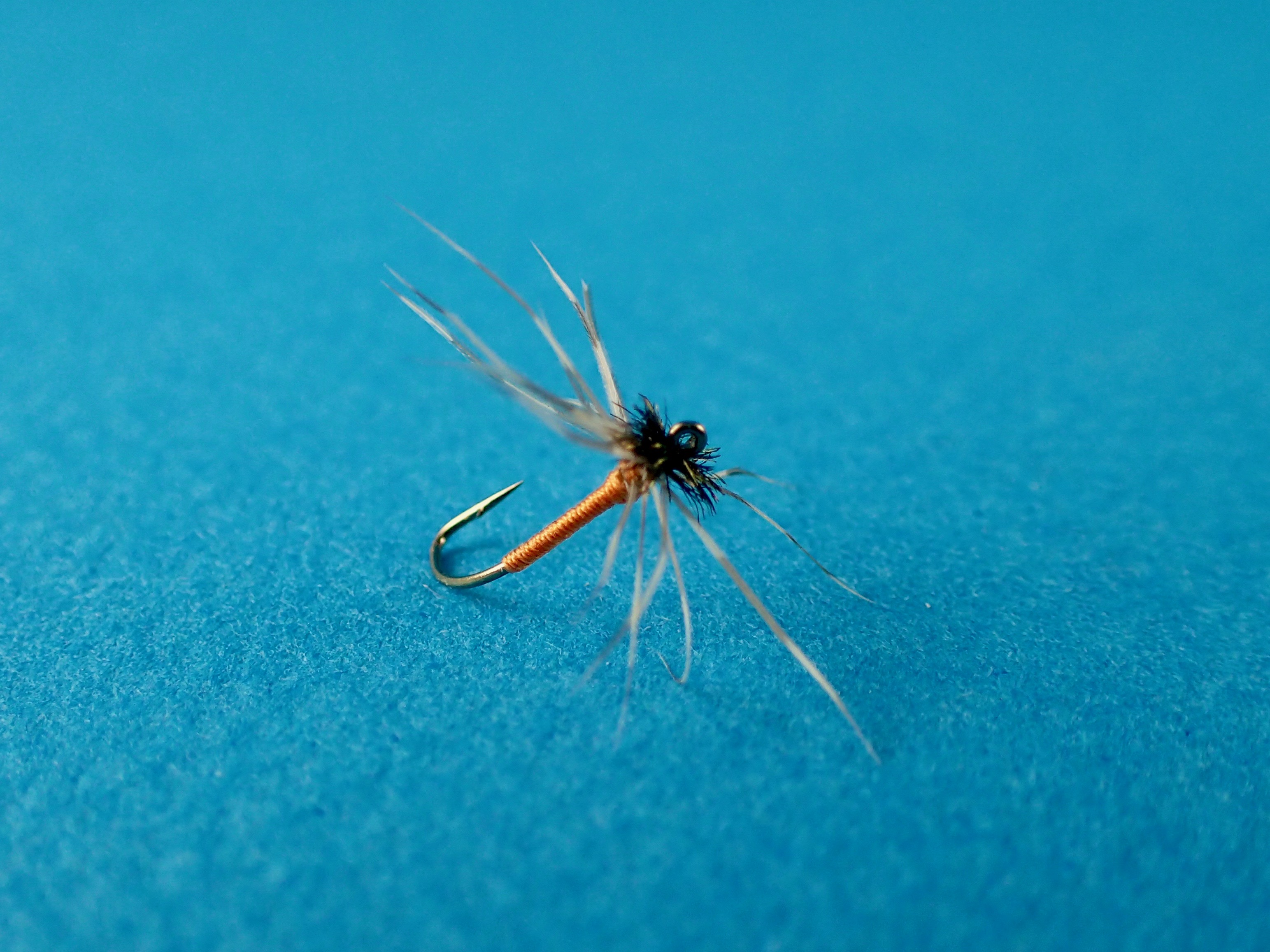
Exhibit A: All of these flies are small. All of them have produced stripers, on static presentations, even in stained water. I fish them with confidence on the swing or dangle with a floating line because I know they work, and I know I am presenting the flies in a manner in which the naturals are being eaten.
I don’t know how the bass are finding my flies; I might even suggest that it doesn’t matter, because they are finding my flies, just as they find my skinny sand eel flies at night on the dark of the moon in the whitewater wash of a pounding surf. I fish bigger flatwings in the spring in a different estuary system where the water is frequently stained. Granted, those are much bigger patterns, but the presentation is still a natural drift, swing, or static dangle; regardless, the bass find those flies.
What Travis is really asking for, I believe, is permission to believe that the bass will find his flies in murky water. Permission granted. But ultimately, the permission has to come from you, Travis — and the only way to obtain it is to get out there and fish. Hope that helps!
Exhibit B: flatwing found in lightly stained water.
Here’s a great question from Will: When you are running your gurgler/eel dropper setup, how are you setting the hook on a dropper take? Trout land tells me to set down and across the direction of the drift, but saltwater land is telling me to strip set. He’s referring to my suspension dropper rig where I’ve got a floating fly on point and two smaller flies on dropper tags.
This is a question to which there is no simple answer. My best attempt at a distilled response would be: Strip set. (Kindof.)
Here’s why it’s a little complicated. There are multiple factors to consider, such as conditions; current; the type of take (feeding frenzy slam, gentle sipping take, greased line swing inhale?); the position of the rig relative to you, etc.
When I’m fishing a suspension dropper ring, I am rarely using a stripped presentation (the closest I’m getting to stripping is something akin to a slow gathering of slack line) — so I’m not doing a traditional strip set. Instead, when I need to set the hook, I most often hold the line against the cork and thrust the rod back toward my hips, essentially mimicking a strip set. Depending on the ferocity of the take and the size of the fish, I may set the hook in this manner multiple times. I always set and reset multiple times with a large bass. Even if I am doing a static presentation like a straight dangle, I have the line in one hand and am ready to spring into action.
Sometimes the striper eats the fly, turns and swims away, thus setting the hook himself. (This is why I preach sticky sharp hooks, and checking your hook points often.) You may need to reset; wait until the fish stops moving, then point the rod at the bass, and set as outlined above.
And sometimes you feel the pressure of the fly being sucked in, or maybe a just a small tap. You should wait to feel the weight of the fish before you do any setting — otherwise you may come up with nothing. This is especially true during a greased line swing or when you’re on the dangle.
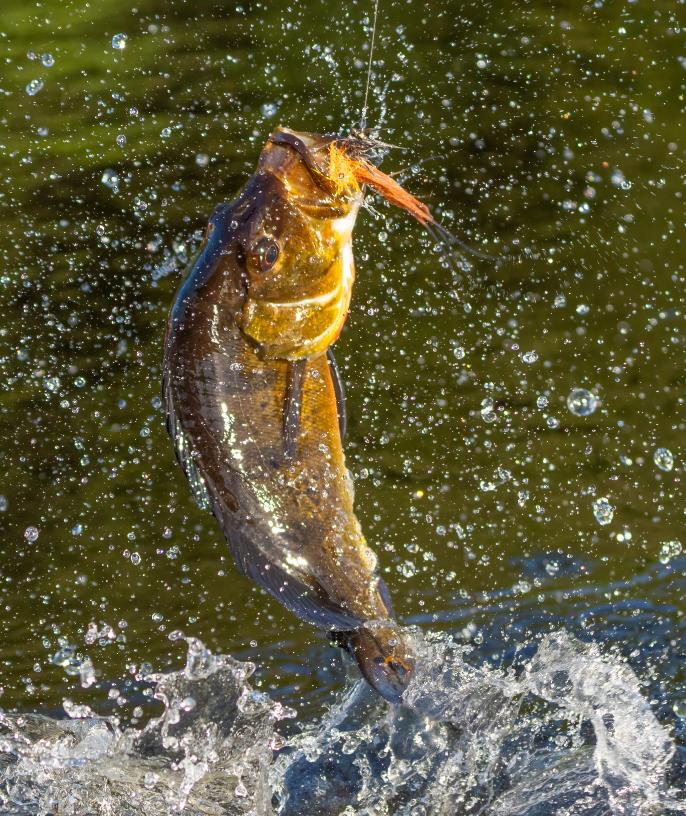
A near-slot bass taken this summer on an Orange Ruthless, part of a three-fly team. The strike came just as the presentation transitioned from swing to dangle, about 50 feet below my position in a moderate current. In this case, she was feeding with confidence and blasted the fly, setting herself. I executed a thrust set to drive the hook further home, and a couple minutes later I was taking this photo.
I get lots of questions about tying wet flies, and Jim B. recently sent me this one: Do you use hen saddle or hen cape feathers for your wet fly ties? My answer: hen cape feathers, primarily Whiting or Hebert Miner.
Then it occurred to me that some of you may be wondering, what’s the difference? For starters, capes and saddles come from different areas of the bird. The saddle is located on the lower back just in front of the tail. You’ll find the cape on the back of the neck. Both produce useful soft hackles with varied degrees of webbing. For me, the difference maker in favor of capes is their shape, and most importantly, the range of sizes of the feathers. For the sake of simplicity, I’m going to limit this discussion to the Whiting and Hebert Miner (not “Herbert”, as I often see them mistakenly called) genetic lines of wet fly hackle.
Whiting (left) and Hebert Miner genetic hen capes. The Hebert Miner cape is specifically marketed as “wet fly hackle,” and as you can see it’s a little longer than the standard Whiting cape. Like the Miner, the Whiting genetic packaging says “hen cape” at the bottom; that graphic is obscured by the feathers. Both capes come stapled to the thin cardboard sheet; if you remove the staple, do it carefully. Otherwise you’ll rip the skin patch if you try to pull the cape off the sheet. The Whiting cape is white dyed dark dun; this is the color I use for the Dark Hendrickson winged wet. The HM cape is a natural medium brown dun.
Capes give you the widest choice in feather size and colors. The feathers tend to be longer and narrower than saddles. But where capes really shine is that they give you feathers to tie bigger soft hackles (8 and larger) as well as the smaller ones you’d need for patterns like tiny BWOs and midges. (For one of my favorite tiny soft hackles, Smut Number 1, I use a Whiting cape for hackle; likewise with Pat Torrey’s Tiny BWO Soft Hackle.) That’s a huge range of sizes, and those tyers who value both extremes will be in hackle heaven. Even if you’re never going to tie size 6 steelhead or bass soft hackles, you can use the larger feathers for tailing material.
A tale of two feathers. Both of these hackles came from the same cape. Both have their uses. You can see that I’ve already begun taking some of the fibers from the larger feather for tailing material. Once removed from the patch, I keep these feathers in a ziplock baggie and store it in the back of the original packaging for easy access. Note that the larger feather has a generous amount of webbing; typically, the webbing becomes less prevalent as you work your way down the patch toward the smaller feathers. This is why I always recommend buying capes in person; you’ll want to rummage through the bags and find the capes with the webbiest feathers throughout. The smaller feather would make a fine hackle for a midge or a tiny BWO soft hackle.
I’m not going to get into the multitude of other hen soft hackle options that are available to you, like India Hen, Bantam Hen, Coq de Leon, and American Hen. I own several of these types of feather patches, both saddle and cape, and while they all have their uses, the vast majority of my wet fly tying with hen involves Whiting or Hebert Miner capes. It should also be mentioned that I primarily use genetic hen hackle for winged and wingless wets. (Most of the North Country Spiders I like to tie use game bird or starling hackle.)
It would be nice if money were no object, but the current going rate for these hen capes is about $30. Still, that represents a tremendous value since you’re getting hundreds of usable feathers. (I have some capes that are almost 20 years old and still have many flies left in them.) If I had to start with only three colors, I would choose, from left to right, light dun, brown, and light ginger. You can expand your collection as you get more into the wonderful world of soft-hackled flies.
If you’ve read James Leisenring’s book The Art of Tying The Wet Fly, you know that he was quite particular about hackle. (Cockerel, anyone? In case you didn’t know, cockerel is a young-of-year rooster.) He even suggests making friends with poultry farmers so you can pluck their birds, preferably in February or March. A fine pro tip, but certainly not as convenient as buying a patch of good genetic hackle. Fortunately for us, modern wet fly hackle is pretty darn good in terms of color options, feather size range, and availability.
One of Leisenring’s favorite wingless wets, the Brown or Red Hackle, tied with a furnace hen hackle. Interestingly, “furnace” isn’t what the package is labelled — it’s simply called “brown” — but this particular cape was a variant with many feathers that were close the classic furnace pattern, which Leisenring describes as a dark list near the stem and on the tips of the fibers, with a lighter color in between. Grab one if you see it, or I will!
I get this question all the time. As with many fly fishing questions, the answers can be simple and complex. This post is designed to be a mini-article rather than a treatise, so I’ll keep it simple.
If you’re asking “How do I know what bait is in the water?” you’re probably trying to match the hatch. That’s rarely a bad idea, especially if the stripers are keyed on a specific bait. Just be aware that while stripers can be selective feeders, they aren’t always selective feeders. So a generic baitfish pattern like my Soft-Hackled Flatwing may work just fine even when there’s nothing like it swimming around. Still, you want to know what’s for dinner, so…
Get a large fine mesh dip net and go fishing. Or, if you have a drag net and a partner, use that. You can do this on a beach, or off a well-lit dock and night, or in an outflow or an estuary. Sometimes you don’t need to get wet: get a bright light and shine it in the water at night. If the water goes nuts, it’s probably silversides. This first step is obvious, but many anglers are either too lazy or oblivious to do it. I’ll tell you in advance that you may surprised at the volume of small stuff that’s in the water.
Research the bait in your area. Get a field guide, or use the web for research. You should know what the resident baits are, and be able to ID them. A mummichog is not a silverside is not a peanut bunker.
Know what bait is likely to be when and where. Again: do your homework. Discover the patterns. Know when herring come up the rivers off Long Island Sound to spawn. Know when the sand eels show up in Newport, RI. Know when the cinder worms are swarming in the salt ponds of SoCo. Every year is different, but nature is always right on time.
Not a silverside. Sometimes, when the bait is in thick, you’ll accidentally snag one of the critters. That was the case with this peanut bunker several years ago.
Most of you know me as a teaching guide. But fishing education is not just limited to time spent on the water. I received this question via email last week, and I thought it was such good one that I decided to share it here and expand on my answer. As always, no such thing as a dumb question!
Q: Do you usually grease your soft hackles to sink or do you just use a slow sink leader?
A: I don’t, and I do not.
Ixnay on the easegray.
Let’s start with the term “grease.” In wet fly fishing (or any fishing with mended swings) “grease” conjures up images of high-floating elements. Back in the day, a line was greased to make it float, therefore making it possible to mend. You can grease a fly, too, to help it float, and sometimes I do. Example: small stream fishing with a Stimulator. I’ll dust the hackles with silica powder, but I’ll use Gehrke’s Gink gel floatant on the elk hair wing.
But there are also gels that help stuff sink (like Gehrke’s Xink.) Here’s why I would never use something like that on a soft hackle: the last thing I want is to put any kind of coating on those precious, fine-stemmed barbules. I want them moving and quivering and creating the illusion that the fly is alive. What’s more, I mostly fish my soft hackles just beneath the surface film or perhaps a foot below; this is the place after all, where so many emergers get eaten. You do your best business on Main Street, right?
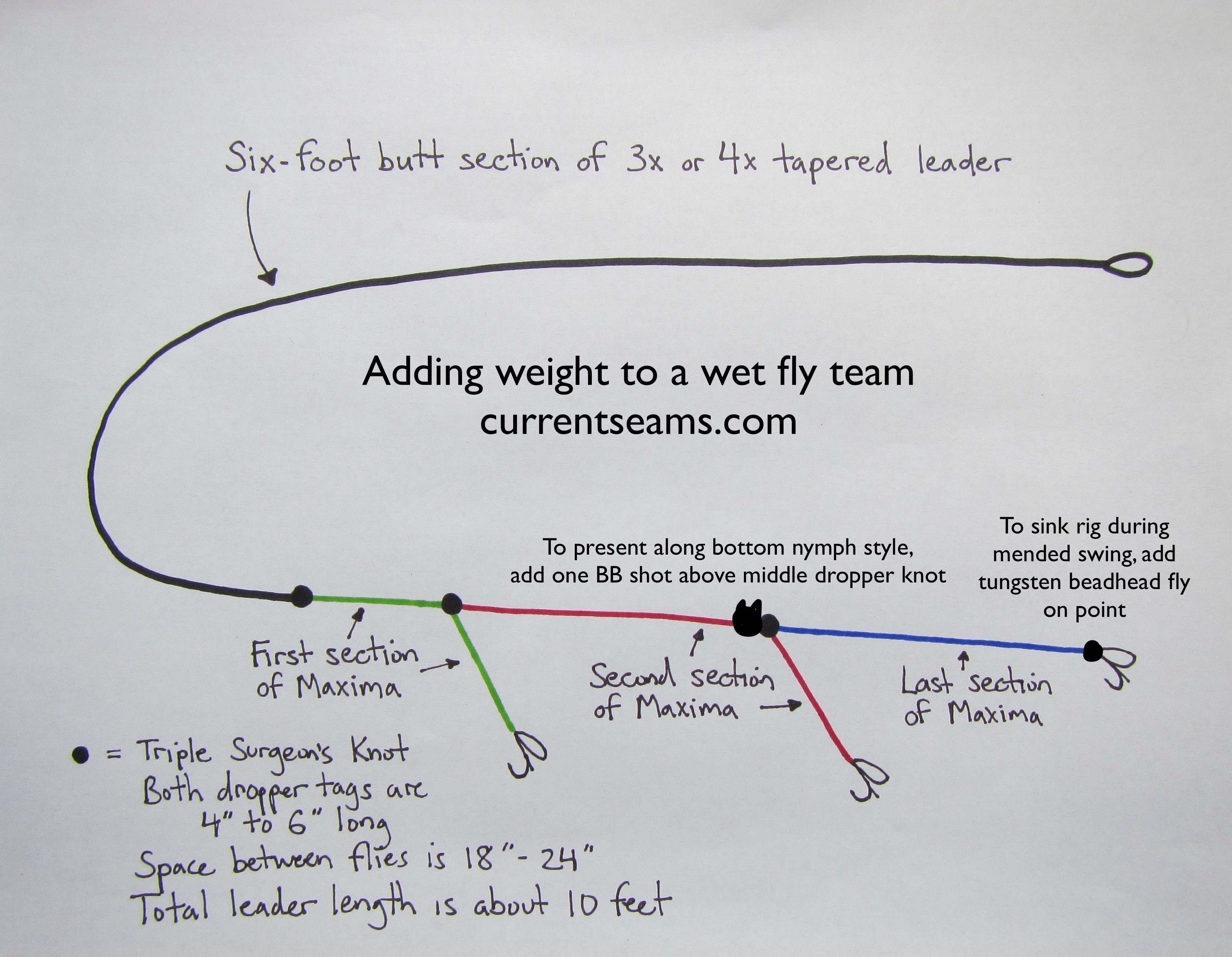
When it comes to lines, I only use floaters for wet fly fishing. My leaders (droppers) are constructed of Maxima. If I want to help sink the rig, I’ll use a brass or tungsten bead head fly on point. Mending — doable only with a floating line — helps introduce the slack required to let gravity do its thing. If I want to get the team deep for a nymph-like presentation along the bottom, I’ll attach a split shot to the leader just above the knot that forms the middle dropper. This will create a seat for the shot so it won’t slip down the leader. You can read more about the black arts of sinking your wet flies here.
Hope that helps, and thanks for the excellent question.
I had some excellent Q&A sessions about wet fly fishing at the Marlborough and Edison Fly Fishing shows (great job, people!) and I wanted to share some of what we discussed with you.
Q: What knot do you use when you build your wet fly team leader? A: I’ve been using a triple surgeon’s knot for years. It’s easy for me to tie, and it’s reliable — I don’t think I’ve ever had one fail. People also asked about the blood knot, and the answer is: use the knot you feel most confident about/is easiest for you to tie.
Q: Do you use tippet rings when you build your wet fly team leader? A: I don’t, mostly because I don’t see a need. The perceived need is that it would be easier to replace a dropper tag (rather than build a new leader) with a tippet ring and it’s hard to argue with that. This is a “what works best for you?” situation. I don’t use tippet rings because I rarely change flies on my leader system, and even when I do I’ve learned how to reattach a fly using a minimum of tag material. Speaking of attaching flies, here’s a nifty tutorial from my buddy Tim Flagler on the Davy Knot, which uses very little material.
Q: You say to pause before you set the hook. Aren’t you afraid the fish will spit the fly? A: No. I quote from The Book of Syl: “With the soft-hackled fly, the trout throws caution to the wind, because he’s not afraid to move under the water, and speeds to the fly with urgency.” The fish has made the decision to eat. He’s said “yes” to the fly. With an immediate hookset, you’re saying “no” to the fish. By pausing — asking, “Are you still there?” before you set the hook — you’re ensuring that the fish will turn away with the fly in his mouth, having neatly hooked himself.
This massive hen blasted the fly, an old English pattern called a Hackled March Brown. She hit so hard she ripped the line out of my hands. There was no need for me to set the hook.
Q: Is fishing wet flies a secondary tactic, or do you ever go to the river intending to fish wet flies? A: I frequently go to the river with the sole intent of fishing wet flies. In fact, I’d say wet flies account for the vast majority of my trout fishing — and catching — between late April and mid-summer.
Ask currentseamser Greg about how good the pre-hatch fishing can be with wet flies!
Q: You talked about using wet flies to catch trout feeding on emergers. Is there a point during the hatch, such as when you see duns on the surface, that you’ll switch to dry flies? A: What a great question! The answer is yes. If I am pounding up fish on wet flies and suddenly my hookups stop — but the river is still boiling with feeding fish — that’s my cue that they’ve either stopped eating what I’m throwing or may now be feeding on the surface. If I see the duns getting taken, and my wets aren’t catching, that is compelling evidence to switch to a dry fly. This scenario frequently plays out during the Hendrickson hatch. It’s wet fly gangbusters up until about 3pm, then suddenly the hookups slow to a crawl. Changing over to a dry usually solves the problem.
I hope that helps, and if you have questions, please don’t hesitate to ask.