Farmington River Report 7/9/17: Swell fishing. Catching? Ummmm….

My Wet Flies 101 class won the weather lottery yesterday. Sadly, the price of the ticket was one of the worst bites I’ve seen all season on the Farmy. (I’m going with the cold front coming through the night before theory.) There was enough hatch activity (Isos and caddis) to keep our hopes up, and a few splashy risers here and there, but folks, it was tough sledding. The guys did a most excellent job of staying positive and refining their newly learned craft. Keep at it, gents, and you’ll have enough days that will make you chuckle when you think of yesterday. (Really.)

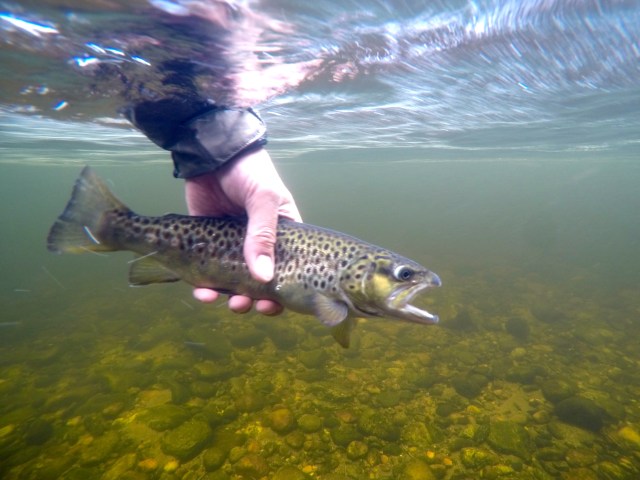
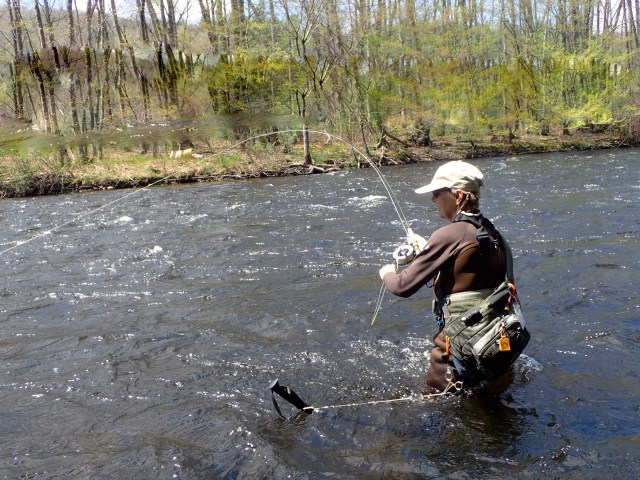
As an instructor, I find sessions where everyone blanks as frustrating as the students. So I fished the lower river on the way home. The run I targeted was located in a section that got annihilated by last summer’s drought. Yet, I took two beautiful wild browns in 30 minutes. The water was swift and snotty (not well-suited for a class) so maybe that was the difference.

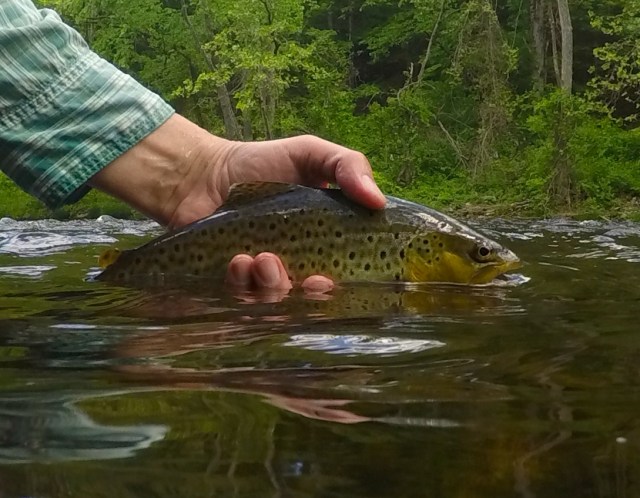
Nature finds a way. This is the first fish. He clobbered the Squirrel and Ginger on the dead drift in a deep pocket. Love the way the wild ones hit and battle, and you just don’t get coloration like this at the factory.

OLYMPUS DIGITAL CAMERA

Farmington River Report 6/21/17: A strange start to summer

The official start of summer isn’t beholden to calendars or warmth or maximum daylight. For me, it begins with liberating my cane rod from the confines of its storage tube and tying a Magic Fly to the end of a 12-foot leader. That this all happened on the 21st of June was a happy coincidence.

Monday’s storm left a swath of destruction in the People’s Forest area. Downed trees and limbs everywhere. The river soared a few hundred cfs, and Grady Allen told me the action Tuesday night was not so good. When I drove through New Hartford yesterday, the roads were wet and steaming from a late afternoon squall. Random piles of hailstones in the woods made me glad that I missed it. The river was down to 450cfs, but still carried a stain and some debris.

Not a lot in the way of catching for me, but I did get a low teens wild brown to hand on a size 18 Usual. I also rose fish to the Magic Fly size 18, Catskill Light Cahill size 14 and 16, and size 10 Convertible (look it up).

To the strangeness. Nothing so odd about the hatches proper: Sulphurs came off like clockwork and 5:30 and 7:30, first the bigger size 16 mayflies, the size 18s following, with the usual 6:45-7:00 lull. A few caddis and Isos here and there. The hatch strength was average. Normally this time of year, the Farmington lights up from 8pm to dark. Last night it was a dimpled surface wasteland. No spinner fall, no straggler hatch, no water boiling with feeding trout. How bad was it? I counted seven total rises during the witching hour (I might expect to see that many in 30 seconds on a good night).

I finished the evening by tossing a size 4 Olive Zoo Cougar into the gloaming. A few bumps and one stuck fish, but that’s not a fly made for cane.

Welcome, summer, even if your entrance was a little oddball.

And the heavens parted and a light shone from above, and a voice seemed to say. “Cast thy flies to the bank, Steve, where the current is softer and many trout are lying in wait.”

OLYMPUS DIGITAL CAMERA

Farmington River Report 6/14/17: Confidence catches fish, Sulphur City

I guided Keith on Thursday and his goal was to leave the river with more confidence than when he arrived. I think we accomplished that. Where to fish, how to fish, which flies to use — keeping it simple is usually a good place to start. So we headed of to a spot below the permanent TMA for some nymphing basics. Spring mornings are almost always a good time to nymph. We did both short line and indicator, and on this day indicator was the more successful method. We took fish on both the dropper (size 18 2x short Starling and Herl) and the point fly (BH Squirrel and Ginger).

Next up: Wet Flies 101. I was disappointed with this second location, downriver from the first. Our drifts were good and we covered some fishy water, but you can’t catch what doesn’t want to eat — or what isn’t there — so we headed off to trout central, AKA the permanent TMA.

Good call. As we worked our way downstream into some slower water, we saw active feeders. Even though the water was better suited for dries, properly presented soft hackles can be deadly during a hatch. Caddis was the bug, and we had two caddis patterns on our team of three (S&G top dropper and Winter Brown on point) with a dark fly (Drowned Ant) in the middle.  It wasn’t long before Keith’s line came tight to beautiful brown.

Keith shows us how it’s done, much to the delight of his instructor.

OLYMPUS DIGITAL CAMERA

~

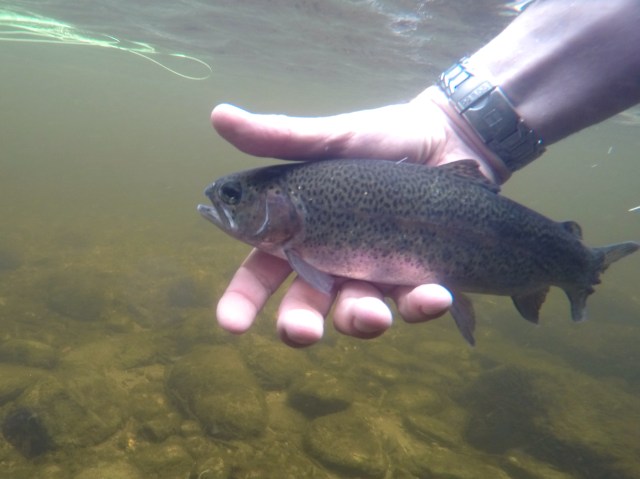
We took fish on all three flies, but only one on the dark middle fly. We got nearly into double-digit numbers, a mix of stocked browns, rainbows, a Survivor Strain brown and a few wild ones. I was intrigued by the parr marks on this rainbow. He wasn’t all that delicate, though, putting on an impressive aerial display during the fight.

DCIM100GOPROG0024412.

~

Finally, I fished from 5pm-7:15pm way downstream in an area that got torched by last summer’s drought. I wanted to see what the Sulphur hatch was like, and, more important, was anything taking advantage of it? Good news, bad news: tremendous sulphur hatch (I’d give it an 8 out of 10) with swarms of yellow bugs everywhere. Bad news: like my experience in April in the same area with Hendrickson, precious little surface activity. Sure, there were a few trout that were feeding, but the rises were infrequent and seemingly random. I rose three trout but failed to get a hookset. Also witnessed were caddis, tiny BWOs, and a few Isonychia. I think we’ll have to wait another year or two for the trout to re-establish.

Hello, old friend. Always happy to see your face.

OLYMPUS DIGITAL CAMERA


The Staccato Symphony, performed by an Acre of Feeding Bass

Another late (or early) bedtime Sunday morning — 3:15am if you’re keeping score — but well worth it. I arrived at the mark with the tide still motoring in, and amused myself by sitting on a rock in the dark, absorbing the sights and the sounds of an estuary at night, with a Gispert Churchill to keep me company. I wasn’t hearing the sounds of feeding bass, but I could see plenty of bait meandering along the shoreline. So I tossed my three fly rig (soft-hackled shrimp on top dropper, Orange Ruthless in the middle, foam-back floating shrimp pattern on point) into the flow and managed a scrappy schoolie.

Ten minutes after the turn of the tide, I began to think that maybe I had made a mistake. Or that that cold front had knocked the feed off. Or the fish were simply elsewhere. Wrong, wrong, and wrong. Moments later, the salt pond was lit up like night sky on the Fourth of July. Pop! Pop! Pop! There were bass everywhere, and the sharp reports of their feeding made it sound like I was at a rifle range. This went on for the better part of an hour.

These fish weren’t easy to catch, but that’s what made it so enjoyable — kind of like when you finally figure out that hatch and you fool that brown who’s been refusing your best efforts. I got them on the swing, the dangle, and especially by sight casting to the rise rings of active feeders.

Trout fishing for stripers with small flies and a floating line? Yes, please.

It would be safe to say that this fly was a popular choice that night. A re-palmer and it will be good to ride again. Tied on a #8 Atlantic salmon hook.

OLYMPUS DIGITAL CAMERA

Farmington River Report 6/1/17: Heavy water experiments

The rains that came through last night boosted the flows in the permanent TMA to over 500cfs. But I wasn’t going to pass up my first good opportunity in weeks to fish the Farmington.

I was dismayed to see four cars in the lot, then delighted when I walked through the woods and there was no one in the main pool. So I waded in and had at it. Nymphing was the method, 54 was the water temp, caddis was the hero hatch, and the weather was New England crazy. I fished in brilliant sunshine, mixed clouds, dead calm, gusty wind, and a couple of steady downpours — all from 11:15am to 2:30pm. While I had to work for them, I got into a double-digit number of trout. Here are some particulars.

Things started slowly. My fish came in bunches, leading me to believe that their feeding activity was matching the hatch cycle. Some dry fly guys told me later that they had the same experience.

I found all my fish in the hot water, mostly at the heads of pools. If it was raging and boiling, it was good. No luck along the softer edges, which surprised me in this many cfs. Shows you what I know.

Intriguing markings and dramatic dots on this one.

OLYMPUS DIGITAL CAMERA

The rigging was drop shot with two BB shot, two fly system. Fished three patterns: a size 14 Squirrel and Ginger nymph on point, and a size 18 Starling and Herl or a size 14 Hare and Copper on the dropper.  All caught fish.

I did some indicator nymphing (and caught fish), but the rest of the time I went with the short line/tight line approach. I felt the indicator was moving along too quickly in the heavier flows, and the wind was affecting its drift as well. That being said, the indicator did me proud when I had to reach some far-off currents I couldn’t wade close to.

Almost all my tight line hooksets today were tactile; that is, I felt the strike before I saw the sighter lag behind vertical. Still trying to dial in to the straight line presentation and strike detection thing. More experiments necessary. (Dang.)

Fish don’t lie. They’ll always tell you when you get it right.

DCIM100GOPROG0014267.

Cape Stripahs

Up at the Cape this weekend for my son’s soccer tournament, but they don’t play at night…so I did.

Saturday I hit two spots. The tides weren’t ideal, but I wanted to see how one in particular looked on the incoming (I’ve only fished it on the outgoing). Last year, same time, it was lit up like a Christmas tree. This year it was dead as Julius Caesar. I gave it 45 minutes of due diligence, then headed to a second mark. First cast, my line got all discombobulated. After I straighten things out, I pulled it in for a re-cast. Wait. Was that pressure a fish or some weeds? The answer was fish. I proceeded to get into a batch of micro bass, and one of their bigger brothers. Fished a three fly team and took fish on all three flies. Both the air and the water on the incoming tide were cold! I wished I’d brought my neoprenes.

Sunday met old UK pal Mike who got the outing off to a proper start by taking a bass on his first cast. We had schools of stripers, mostly 1-2 year-olds, come through in waves, so the action was either red hot or non-existent. There were a few larger — by that I mean sub-20″ers — in the mix. To cull these pipsqueaks, I tied on a 7″ Eel Punt on a 3/0 hook. (I should mention at this point that I’d forgotten my headlamp, so I did all this dancing in the dark). So while I still had bumps, I was spared the tedium of stripping in trout-sized bass. Meantime, the Meatballs showed up with their 40,000 watt headlamps lighting up the ocean, and — my personal favorite — into my face when I was playing a fish. I’d like to tell you I was sorry when they left, but that would be a lie.

I finally connected with a sub-legal fish that had aspirations of going on the reel, but I had other plans. A catch, a photo, a release, and a good way to end the festivities.

I haven’t fished an Eel Punt in years. This striper reminded me why it’s such a good fly, especially on the swing on a dark, mysterious night.

OLYMPUS DIGITAL CAMERA

Small Stream Color, or: A little something to get us through today’s gray

Snuck out for a couple hours the other day on Ye Olde Brook Trout Emporium. The catching was a bit on the slow side, but the fishing was tremendous. At last! Freedom!  I took them on the dry (size 16 Improved Sofa Pillow) and the wet (size 20 Snipe and Purple) dropper. Water was 56 degrees and medium low. Bugs everywhere: midges, some large dark un-IDed mayfly spinners (mahogany duns?), caddis, and my first confirmed sulphur sightings of 2017.

Sky of blue, sea of green. The canopy is filling in, and the wooded wetlands are in their glory. 

OLYMPUS DIGITAL CAMERA

~

While I was disappointed in the number of fish that wanted to play, I did see more actively feeding char on this stream — especially in slower, deeper water — than ever before. Those that were coming up for the naturals were also quite willing to inspect my dry, even though it was substantially larger than what was hatching. This fellow pounced when the opportunity presented itself. You can see the beginnings of a kype.

OLYMPUS DIGITAL CAMERA

~

Ray Bergman, you magnificent bastard, I read your book! This brookie was quietly sipping, forming delicate rise rings in some glassy water. I approached from upstream, made a long cast, and got him on the wet dropper by raising the rod tip and doing a hand-twist retrieve. By far the hardest hit of the day.

OLYMPUS DIGITAL CAMERA

Everglades Report: Absolutely, positively, definitely not in Kansas anymore

I fished in Everglades National Park on Wednesday and it was — well, like nothing I’ve experienced before with a fly rod. I’m not sure what I expected, but like any fishing trip, the day had its highs and lows. I can tell you this: it was never boring.

Let’s start with the mosquitos. There were more per cubic foot of space than I’ve ever seen. Ravenous little suckers, too. The most remarkable thing about them was how quickly they descended upon you the moment you opened the car door — or stopped the boat in a cove. Unlike some of the noseeums I’ve encountered, these could be kept at bay with standard-issue bug spray. Still…wow.
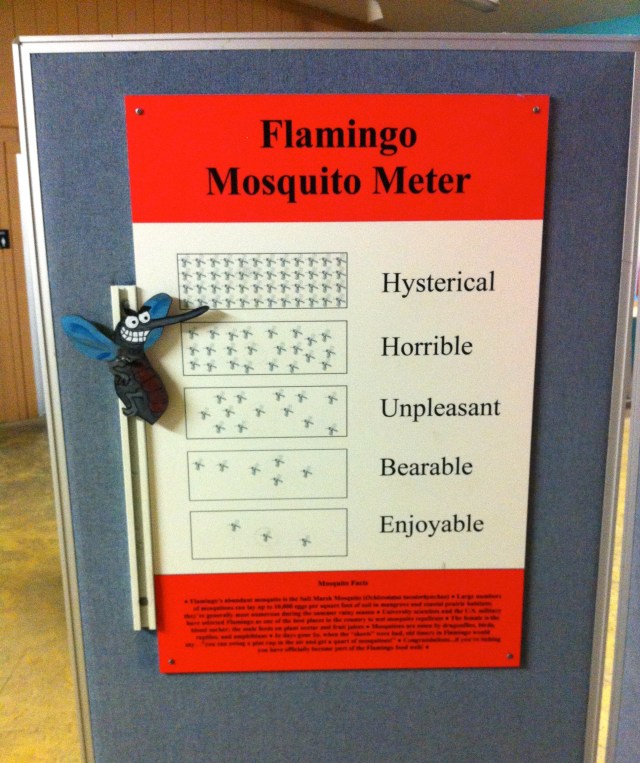
SkeeterMeter

~

This outing was part of Number One Son Bill’s UMiami Law School graduation present. He was spinning, I was fly rodding. We murdered them at our first stop (technically accessory-to-murdered them). To wit: one of the ladyfish Bill caught got whacked by a shark after he released it. The fish floated away about 30 feet when the shark came back and rolled over on it. It gave me a new appreciation for watching trout take spinners. Bill had an Everglades hat trick of ladyfish, sea trout, and reef snapper within 30 minutes. He outcaught me about three-to-one.

OLYMPUS DIGITAL CAMERA

~

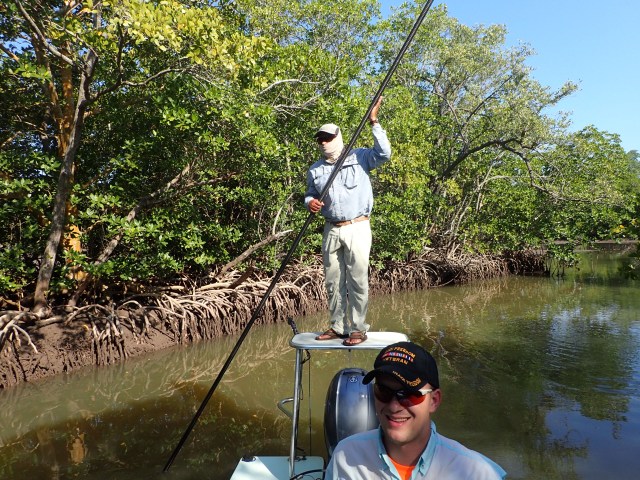
The Everglades is an intimidating place. The wildlife ranges from the innocuous (butterflies) to the annoying (mosquitoes, snook, tarpon — we’ll get to those last two in a bit) to the potentially deadly (sharks, crocs.) I was amazed that they let people canoe in a canal where we spotted three crocs in the space of 50 yards. The heat and sun can get to you, too, especially if your last outing was in neoprene waders. Then, there’s the structure of the place. From the point-of-view of a boat in a watery expanse, it looks like any big lake. But its creeks and diversions and coves are labyrinthine, mysterious, and untamed. Our guide, Capt. Mark Giacobba, did a great job getting us in and out of some very fishy looking water. As you can see, he knows how to dress for his job.
OLYMPUS DIGITAL CAMERA

~

We spent most of the day working the mangrove-layered shorelines, but my favorite spot was the tidal pond — I dubbed it “Dead Mangrove Cove” — we poled into. You can’t see from the photo, but in many places the water is only 1-2 foot deep. The snook were not in thick, but there were enough over the course of 90 minutes to keep us on high alert. Now, if you’ve never sight-fished for snook in shallow water under bright sun, you don’t know from spooky fish. I was wholly unprepared for this. We spooked one by pointing at it — and it was 50 feet away. I spooked several starting my first false cast. Hell, I think we spooked a few by just thinking about them. They say that wild brown trout are wary. My new perspective is that that’s just about laughable.  

OLYMPUS DIGITAL CAMERA

~

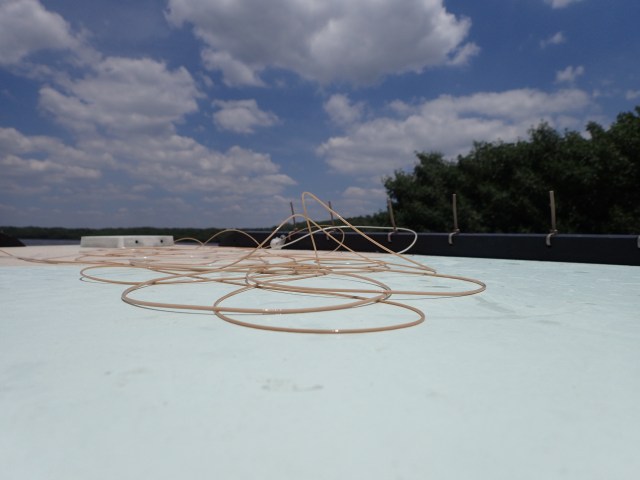
It took me a good hour to remember not to step on my line — using a shooting basket in perpetuity will do that to you — while I was casting. The zip ties along the edge of the deck are a brilliant idea when there’s a breeze. So here it is: I blanked on snook. I had one good presentation and follow, but the fish turned away at the last moment. I would have loved a second day to redeem myself, but that will have to wait. The tarpon were even more bashful than the snook. We finally found a diversion where a couple rolled, but by the time we poled over they’d either vanished or been spooked. As the final insult, a school of seven tarpon swam purposefully past the boat as we prepared to leave. They wanted nothing to do with my fly. Bastards.
OLYMPUS DIGITAL CAMERA

~

Objection! Bill outfished his old man! Overruled, and that’s not a bad first snook. Bill just about dropped his cast in the fish’s mouth. Bill confirmed that this certainly made up for those three miserable snowy days in Pulaski a few years ago when he didn’t get a touch. Great job, kid.

OLYMPUS DIGITAL CAMERA

Farmington River Report 5/1/17: No bugs? No rises? No problem.

I guided Mina yesterday — a cool, dreary day for most of it. We headed to the permanent TMA and for the first hour we had the place all to ourselves. Mina wanted to delve into the black arts of wet fly fishing. Water was a little higher than I like for wets (440cfs — they’ve since (of course) dropped the flow — and it was cold! 45 degrees made for some chilly legs and feet. Bug activity was also low — some micro midges and a couple caddis, and no H-bombs, at least not while we were there. We covered lots of water before we found some customers. A couple bumps, a couple dropped fish, and a couple to net, but that was more action than I saw elsewhere. Ya done good, Mina, under some tough conditions.

Mina is a thoughtful angler who came armed with loads of questions and a strong desire to learn. Here she is, acing a pop quiz. I have to give props to my last two clients. Both Mina and Vicky were confident waders who weren’t afraid to venture into some more challenging water to get their flies in front of fish. Sometimes the angler that covers more water is the angler who catches more fish.

DCIM100GOPROG0033987.

~

We used a bead head soft hackle of Mina’s creation on point to help get the flies down in the higher flows. This guy (who’s beginning to sport a kype) took that fly on the dead drift. Note the cool cirrus cloud effect on the surface.

DCIM100GOPROG0034182.

Farmington River Report 4/28/17: To the Vicky belongs the spoils

I guided Vicky today and she did a bang-up job banging up some trout under the trusty yarn indicator. Vicky vastly undersold her fishing capabilities to me. She did a great job casting, mending, managing her drifts, keeping a positive vibe, and wading into some challenging water (750cfs, 50 degrees below the permanent TMA). Vicky told me she’d only caught five fish on the fly before today; we managed to hook nearly twice that many and land a bunch, all fat, healthy rainbows. We fished a size 14 Rainbow Warrior on top dropper and a size 14 Frenchy variant on point and took fish on both flies.  Our action picked up once the sun warmed the water (weather lottery winners, us) and a few Hendricksons started popping, but persistence and covering water paid off the most.

The skunk is off. We didn’t see a lot of fish caught, but we sure did see a ton of anglers for a weekday. Thanks to everyone who said hi.

OLYMPUS DIGITAL CAMERA

This got to be a familiar sight. Way to go, Vicky!

OLYMPUS DIGITAL CAMERA