Currentseams Best of 2023: #10-#8

Once again, we find ourselves asking, “Where did the year go?!?” This was a tough year locally; it was one of the wettest on record, and in the midst of all the water the Farmington River was maddeningly low and warm. I hope you got the chance to get out and fish. It never seems like enough, does it? Sometimes the fishing’s good, and sometimes it isn’t, but getting out there is 80% of success. Looking back at the year, I found more than enough high points for my annual best of list.

#10: Currentseams.com Reaches 1,000 Followers! The good news is, an important milestone has been reached. The bad news is, if you won flies in my 1,000 Followers drawing, I still haven’t tied them. Well, that’s not entirely true. I have some flies tied. Don’t think a day goes by where I don’t feel massively guilty about not having them in your hot little hands. So: thank you, winners, for your patience. Thank you, readers, for your loyalty and enthusiasm. This is true: I couldn’t have done it without you.

If I were doing this now, I might be done by the time you read this…I know. I Gotta do better.

~

#9: A Banner Year Speaking To Fly Fishing Clubs. I spoke to eight different clubs and organizations this year, some of them old friends, some new to my presentations, some TU chapters, some independents, some college clubs. Whatever the legacy or organizational level, speaking in front of a group about something I’m passionate about is probably my favorite part of this job. Thanks so much for having me. Keep those questions coming. And if you’re in charge of booking speakers for your group, you can find one of the best fly fishing speakers around (he said modestly) here.

Find a job you love and you’ll never work a day in your life.

~

#8: Salvaging a High Water Smallmouth Season. Stripers aren’t the only bass that are struggling in Connecticut. Between flood and drought and heat and poachers, it’s been a very difficult three years on our state’s waters. This year was both difficult and weird. The smallie fishing was generally slow…except when it wasn’t. I’m comfortable enough fishing in high water, and I had some off-the-charts days, numbers-wise, like I haven’t had in years. And some of those days, I hooked up with a very high percentage of quality bronze that put a burn in my forearms that I’m still feeling. OK, the topwater bite stunk — when the white flies came off, virtually nothing was feeding on the surface. (I caught one bass on a dry fly this year.) But when you’re landing fish that can be measured in pounds, you smile a certain sort of smile. Make sure you come to my smallmouth Seminar “Hot Bronze — Wade Fishing for Summer Smallmouth” at the Marlborough Fly Fishing Show, Friday, January 5, in the Release Room at 4:30pm.

This slob was taken on a Crayfish Jig Streamer fished under an indicator in some high, stained water.

“Should I Stay or Should I Go?” in Surfcasters Journal 81

I don’t know if The Clash ever fished for striped bass, but they might as well have been singing about it in their early 80s hit. So, when do you admit defeat and leave a mark? When do you stick it out? These questions and more are addressed in “Should I Stay or Should I Go?” written by yours truly. You can read it in the current issue #81 of Surfcasters Journal. This e-zine is available by online subscription only, and its written by some of the best surf anglers in the Northeast. Oh! it’s only 20 bucks a year! You can subscribe here.

If you’re not reading Surfcasters Journal, you should be. Even if you’re a fly-only angler like me, there is an insane amount of useful intel contained within. $20 for one year.

Save our Stripers! ASMFC CT Public Hearing This Thursday 11/30, Public Comment until Dec 22

It’s time once again to make our voices heard for the conservation and preservation of striped bass. There are two ways you can help.

Go to the Connecticut public hearing this Thursday, Nov. 30. CT DEEP has now scheduled an additional in-person hearing on Draft Addendum 2 on Thursday November 30, 2023, from 6:00 – 8:00 PM in Milford, CT. The hearing will be held at the Connecticut Audubon Society Coastal Center at Milford Point, 1 Milford Point Road, Milford, CT 06460. The November 30th hearing in Milford will provide identical information as that presented at the November 16th hearing in Old Lyme and is intended to provide an additional opportunity for the public to comment on Draft Addendum 2.

Send email comments to ASMFC by December 23: Public comment will be accepted until 11:59 PM (EST) on December 22, 2023 and should be sent to comments@asmfc.org (Subject line: Striped Bass Draft Addendum II).

What to say. The draft is a ponderous document. No need to wade through it! Here are the American Saltwater Guides Association’s positions: 3.1.1 Ocean Recreational Options: Option B—1-fish at 28-31″ with 2022 seasons (all modes); 3.1.2 Chesapeake Bay Recreational Options: Option B1—1 fish at 19-23” across all CBAY jurisdictions with the same 2022 seasons; 3.2.1 Commercial Quota Reduction Options: Option B with a 14.5% reduction to both the Ocean and Chesapeake Bay Quotas; 3.3 Response to Stock Assessment: Option B—Board Action. 

To get more in-depth information on the ASGA’s positions, click here.

A little lovin’, please.

Vandals trash fishing area, law-abiding anglers punished, or: state government at its most ridiculous

You gotta love the jolly old yo-ho-ho State of Connecticut.

Seems that there was all kinds of after-hours nonsense, vandalism, law-breaking and other nefarious acts involving human waste going on this summer, at and near the parking area on Comstock Bridge Road in Colchester. The lot happens to be a popular access point for anglers on the Salmon River. The neighbors were unhappy, and justifiably so. The State DEEP Parks Division — this is taking place in Salmon River State Forest — decided to take action.

Did they dispatch ENCON officers to arrest the perps at the next sign of trouble? Did they plan a stakeout to catch the offenders in the act? Were the scofflaws arrested and prosecuted to the full extent of the law? No, no, and no.

In its infinite wisdom and sagacity, the state decided to — wait for it — punish the innocent! Yes, by jove, we’ve got it! Let’s block off the entire parking area so no one can access it. Law-abiding anglers be damned. License-buying anglers be damned. Tax-paying public be damned. Up went some gleaming new guardrails, because, you know, shiny aluminum is a known deterrent to criminals and people who play with their poo. Nature abhors a vacuum. The Connecticut State DEEP Parks Division shares a similar aversion to fair-minded thinking.

Photo by Rick Liegl.

I asked Connecticut Fish and Wildlife via their Facebook page for a reason behind their decision. Their response was, and I quote: “The DEEP Parks Division determined that steps needed to be taken to address ongoing issues involving illegal parking, littering, noise, illegal camping, groundfires, and after hours use. During summer months daily complaints have been received from neighbors and Parks Division staff had to visit the site daily to pick up and remove large amounts trash, including human waste.”

So, let’s get this straight: you have the time and the resources to visit the site daily to clean up after the slobs — but not to be there nightly — presumably when this ruckus is going on — to arrest them? There must be a well-known witticism about enabling, but at the moment it escapes me. I’ll have to settle for Schiller’s classic, “Against stupidity, even the gods contend in vain.”

As you can tell, I’m a wee bit pissed off. The Salmon River is sacred water to me. My father taught me to trout fish there. I’ve been fishing it for over a half-century. Putting on our cooler heads, I think we can all agree that the crimes against nature and disrespect for residents and users of state land are appalling. But there has to be a better solution than punishing the innocent.

How about it, Connecticut?

The lost hat disaster

I lost my fishing hat. I’ve no idea where, but it’s gone. And it’s not coming back.

Okay. So, it was on its last legs. So, it was decades old. So, it’s been fraying and worn and even threadbare in a couple places for years. But it was a constant companion from shoreline to mountain stream to steelhead alley and back. It fit just right. It worked in the summer and it worked in the winter. And now I don’t have it. Which makes me very sad.

Sure, I was going to replace it soon. But I would have liked to have archived it. L.L.Bean no longer makes that hat, so I can’t even replace it with something similar. It was lightweight and supremely comfortable. It was a wonderful understated earth tone color combination. I’ve got a ton of other hats, but none of them are MY hat, and I’m very particular about what I put on my head. What shall I do?

An exhaustive search lead me here. It’s an Orvis Battenkill cap, and it has a lot going for it. It’s a good earthy color. It’s simple. It’s not an obnoxious branding billboard. And what’s that fly?!? A bead head soft-hackled Pheasant Tail? I love that fly. I tie that fly. I fish that fly.

Hello, new friend. Let’s go on an adventure.

Official custom Currentseams hats, anyone? Because I’ve been thinking about it for a while now…

Three Small Stream/Wild Trout Best Practices for Fall 2023

As the weather turns cooler, small stream anglers begin dreaming about their favorite thin blue lines. It should be a great fall season — we had a very wet summer and the natives and other wild fish are in great shape. But along with fishing for wild trout and char comes great responsibility, to both the fish and the resource. Here are three things you can do preserve and protect wild fish.

Minimize fish photos. Anglers with cameras have needlessly killed more small stream wild trout — intentionally or not — in the last 10 years than in the previous 100. You can blame it on the convenience and portability of digital devices. You can blame it on social media. Or angler narcissism. Or all of the above. One solutions is: take no photos, or Take The Wild Trout One Photo Challenge.

Accordingly, do you really think we need a photo of every wild fish you caught on your last outing? Dr. Rick gives the same answer: no.

Be on the lookout for redds. Fall is spawning time for wild brookies and brown trout. Learn how to identify a redd, the nesting area for spawning fish. And please, stay out of the water. The eggs you don’t crush will be the trout you’re catching in a couple years.

Keep Fish Wet. Catch-and-release is useless if you’re ignoring its fundamental best practices. Learn to do it right, and you’ll have more wild fish to catch on your next outing.

Thank you and tightest of lines.

What a shock! The ASMFC fiddles while Rome burns…

My deepest apologies for being Debbie Downer — if you’ve been following the Farmington River situation, you know it’s been a constant stream of un-good news — but the bureaucrats at the ASMFC are at it again. Instead of moving forward with Addendum II (the next step would be to release it for public comment) they’ve chosen to delay the process at this critical juncture.

Here are two resources to get you better better informed. The first is from our friends at the American Saltwater Guides Association. I encourage you to read Striped Bass Board Delays Addendum II in its entirety. Especially if you’re in a good mood and need a reason to get mad.

For a briefer summary, read this blog post from Stripers Forever.

Dear ASMFC: Stop dragging your feet! Now there’s an idea…

Salty waders, spare that horseshoe crab!

I’ve always liked horseshoe crabs. Not because they are living fossils that pre-date dinosaurs (the species is roughly 445 million years old). Not because they aren’t really crabs (they are in the spider and scorpion family). Not because their unique blue blood is used in critical biomedical testing. No, horseshoe crabs are just so gol’ dang awesome to look at.

Not that anyone reading this would, but it’s now illegal to harvest horseshoe crabs in Connecticut waters. They’ve been declared “functionally extinct” in Long Island Sound. You still see them — at least I do — so take care where you walk and wade. If they’re mating — you’ll see several males latched on to a female — let them do their thing.

Image courtesy of the National Wildlife Federation.

Most of all, if you see anyone harvesting horseshoe crabs in CT waters, it’s illegal. There is no longer a special license. Call EnCon Police at 860-424-3333. If you see a stranded horseshoe crab, you can gently lift it by its shell and return it to the water. Thank you.

Of high water, lemonade, and filthy lucre

Yeah, I thought that headline would suck you in.

If you woke up this morning and checked the Riverton gauge, you were greeted to the incredible sight of 1070cfs (now 1240cfs). This, of course, is due to the MDC, under the direction of the Army Corps of Engineers, needing to bleed water from an overfilled reservoir. We’ve been pounded with excessive rain in the last week, which is a good thing. Or is it?

It’s tricky. On the lemonade side, we have water volume just at the right time. 68cfs and an oppressive heat wave do not make a good mix for the survival of trout. From that perspective, this is a good thing. On the lemon side, we have an unusually high water dump that cannot be sustained. Those of us familiar with the total disregard the water gatekeepers have for the natural resource can easily imagine a sudden, catastrophic drop in water levels that will no doubt do damage to trout and invertebrates. The question must be asked: Could you not have released a steady 250cfs, the average release, for the entire month of June, with your already near-full reservoir, thereby avoiding this wasteful dump? (We’ll get to that answer in a moment.)

One thing is certain: a sustained 1K+ water dump is going to hemorrhage irreplaceable stores of cold water. In just one week, we’ve gained 5 degrees of released water temperature:

That sub-50 degree water isn’t coming back until we get some very cool fall nights. The reservoir simply cannot re-stratify in the heat of summer. It’s happened in recent years: the flow from the dam is robust, but it’s coming out at temperatures that are close or at the stressful threshhold for trout.

Never was this resource so ridiculously managed, and it’s all because of money. In what has to be one of the most absurd contracts in the history of water management, the MDC actually saves money by ignoring requests from downstream stakeholders for increased flow. At a recent meeting, the MDC head stated that they currently have no mechanism for releasing more water than the legal minimum or what the Army Corps orders for flood control. That’s not entirely true. They can release water called for for power generation downstream — and pay a fee of $1 million to do so — or ignore such requests and pay a fee of $250K. So MDC has decided to keep their $750K and screw everyone else who uses the river for recreation, screw the wildlife, and screw those of us who depend on the river for income.

To that last point: I should be on my way to the river right now to give a wet fly lesson, but I’m not. I had to cancel. So, I’m out a guide fee today. It’s not that big a deal to me. Because unlike the MDC, I’m not completely beholden to profit.

Once again, the MDC takes its ball from the Farmington River and goes home

Spoiled, selfish children have a habit of poor behavior when the game isn’t going their way. Their frustration reaches a boiling point. Then they grab their ball and storm off in a petulant frenzy. The result is that the game is over and ruined for everyone. The spoiled child in this case is the person (or people) in charge of making the flow decisions for the West Branch of the Farmington River. And once again, they’ve decided that if they’re miserable, everyone who uses the river for recreation should be miserable.

For years, it’s been no secret that the MDC doesn’t care about managing the West Branch as a viable tailwater fishery and recreational resource. For over a year now, their unconscionably selfish reaction to not wanting any further financial responsibility for Hogback Dam has been to release only the minimum flow as-required-by-law. Anglers be damned. Canoeists, kayakers and tubers be damned. Business who depend on robust river flows be damned. Fish and wildlife be damned. It’s their ball, and they’re taking it away in the name of corporate greed.

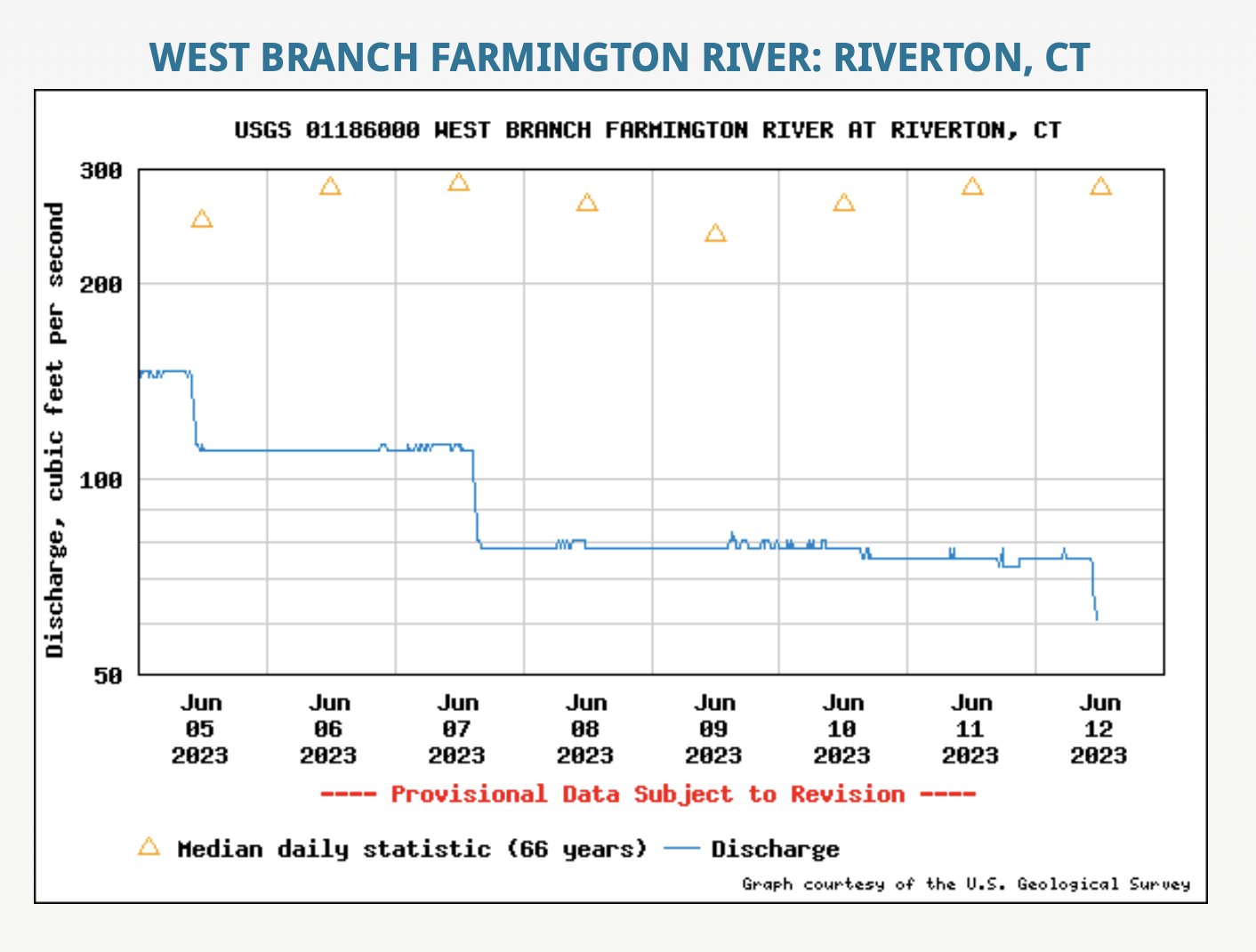
What’s wrong with this picture? As the flow drops like a stone toward the bare minimum — and let’s note that the reservoir is nearly full — you can see that the dicks at the MDC are releasing nearly 200cfs less than they normally do. Score one for corporate weasels!

If it’s all too confusing, this one-page, one-side sheet explains the legal flow requirements for both Colebrook and Goodwin dams. We thank the Farmington River Watershed Association for providing it. And we damn the MDC for reducing flows and damaging our river, simply because they can.

In the meantime, we can only hope for rain up north, which would require the MDC to release more water — and more rain locally, which would bump up the Still River.