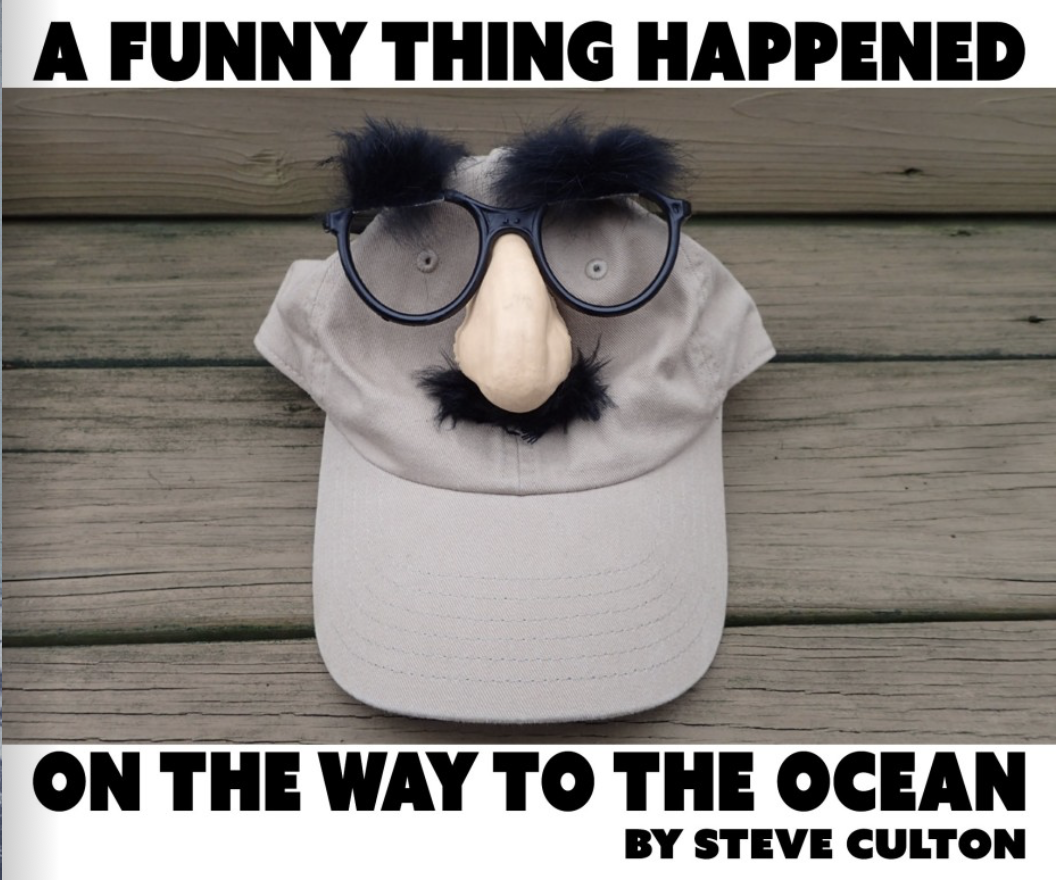
Fly fishing for striped bass isn’t all steely eyes, fierce focus, and grim countenance. Sometimes the jester shows up, and hilarity ensues. You can read all about it in the newest issue of Surfcaster’s Journal, number 83 to be exact. SJ is an e-zine and you need a subscription, but it’s only 20 bucks for a year. This one’s a good one, folks — cue the laugh track!
With all this high water, and some warmer temperatures, it seems like a good time for a refresher course on streamers. I wrote this after interviewing George Daniel, Chad Johnson, and Tommy Lynch, but really, they’re the ones doing the talking. I just showed up and asked good questions!
It’s no secret that striped bass love to eat river herring. So it should come as no surprise to anyone that rivers that once attracted prodigious numbers of river herring are seeing fewer stripers as well. I could tell about places I used to fish where an — ahem — average night was 5-6 bass, many of them 10 pounds or better. (And sometimes, much, much better.) Those days are long gone, mostly because so are the river herring.
Here’s where you come in. Please send an email to the New England Fishery Management Council and tell them you value river herring populations, and support enhancing river herring and shad avoidance and catch reduction in the Atlantic herring fishery. Your email is due by 8am, Tuesday April 30, but why wait? Bang out that email now, and make your voice heard! You can find all the details in the infographic below.
Graphic from the April 2024 issue of The Fisherman. Article by Kevin Job.
Looking back at this post, I can happily say that I’ve given many of these patterns far more than a test drive. I find it highly satisfying that the flies that Leisenring fished with confidence on his beloved Pennsylvania streams work just as well on the Farmington River. The post is formatted so that if you click on a pattern title, you’ll be taken to the recipe, along with a little blurb about the fly.
Hot tip: try Liesenring’s Old Blue Dun in a size 12 during the Hendrickson hatch. The original works, but if you want to make it a little truer to the natural, use dark dun for the tail and hackle.
When I went back to this oldie-but-goodie article, I was struck by two things. First, I love how Leisenring incorporated the soft hackle into these nymph patters. And second, I have not fished these patterns nearly enough, whether on a dead drift near the bottom or as a swung wet fly. None of them have beads or UV dubbing or special sparkle flash, but they all look like they’re alive and something fish would like to eat. To the vise (again)!
Anyone can luck into a big fish. Way back when, when I was just starting out, I wanted no part of that. I wanted to be able to consistently catch big stripers.
If you want to catch big bass — and make it repeatable — you don’t need a casting lesson. You don’t need to be able to reach 90 feet. You don’t need the latest in intermediate line technology. You don’t need a huge monstrosity that looks more like a plug than a fly.
You need to study. And ask questions. Why would there be a big striped bass where I’m fishing? Is there current, cover, and food? Is it pre-spawn? Is it migration time? Is the bait spawning (and therefore gathering in large numbers)? Is it dark, so the fish feels comfortable coming in close? What’s the barometer doing? Which way is the wind blowing? What’s the tide, and how is it moving? These are all part of the equation.
Then, you need the right fly. Something that looks like the bait, or what the bait should be at this time and place. Does the fly look alive and like something good to eat, even when at rest?
Don’t forget presentation. You need to learn that, too. Big fish are lazy, and frequently unwilling to chase. How can you present the fly in a way that makes it easy for the striper to eat?
Last but not least, you need to put in your time. There is no substitute for time on the water. You can do all of the above, check all the boxes, and still blank. (Ask me how I know.) Nevermind, I’ll just tell you. Last year, I fished the mark I fished last week six times and had only two tiny bass nibbles and no bass to hand for my efforts. But every year is different, and this is what I found on a greased line swing with an 11″ Bombardier flatwing in March of 2024:
Miss Piggy went 25 pounds and taped 39 inches. This was one of the best fights I’ve ever had with a bass, and I hope to write about it sometime soon. I am humbled and grateful for the chance to hook, land, and release this fish. I’ve been doing this for years, folks, and I was so pumped with adrenaline that my hand was shaking as I took this photo.
I received a message last week from a fan of Stewart’s Spiders. He was delighted to find them so lovingly rendered on this site by yours truly, so I thought it might be a good time and place to revisit them. (Yup, I’m still encumbered with house stuff and other projects.) If you haven’t seen them, you’ll like. This is simplicity, elegance, and deadly rolled into a single pattern format. Here’s the article link.
When I was a kid, I counted every fish. That continued for a few decades, along with a resurgence when I started fly fishing. Numbers was how I measured success.
As I’ve gotten older and more experienced, I find the energy has drifted away from “how many? and moved toward other questions. Were the people nice? Were there any people at all? Did I enjoy myself? Did I fish well? I think on a subconscious level, I still track numbers. Everyone likes catching a lot of fish, right? In the case of a dwindling supply of stripers, numbers tell a story outside of personal pride. But if it’s just about numbers, sooner or later you’ll be disappointed. If there is a state of Nirvana to be reached in fly fishing, surely it cannot be connected to volume.
Steelhead are different.
They can be maddeningly difficult to hook and land. One day they’re eating, the next day they’re not. You can do everything right during a battle and lose the fish (and that may be your only hookup of the day). The conditions under which you fish for them can be downright unpleasant, if not brutal. And, more often than not, you’re jockeying for position and territory, first finding it, then maintaining it, something that I do not enjoy.
It took me 40 hours of fishing time to land my first steelhead. Then it took me about 13 years to land the next 99. Astonishingly — at least to me — it took me just 2 and 1/2 years to get to 200.
Part of it was good fortune — being able to find and fish water that held a lot of willing steelhead. Part of it was a renewed commitment to steelheading, due to some very good runs in recent years. Part of it was branching out to new waters. A lot of it was newfound skill and acumen and careful observation and study, thanks to guide friends Bob Packey and Row Jimmy, who present a master course in steelhead fishing every time I head out with them. Gentlemen, I have learned so much from you!
And so, dear reader, you’ll forgive me for counting each and every steelhead. In fact, I hope you’ll celebrate along with me. 200 in the hoop!
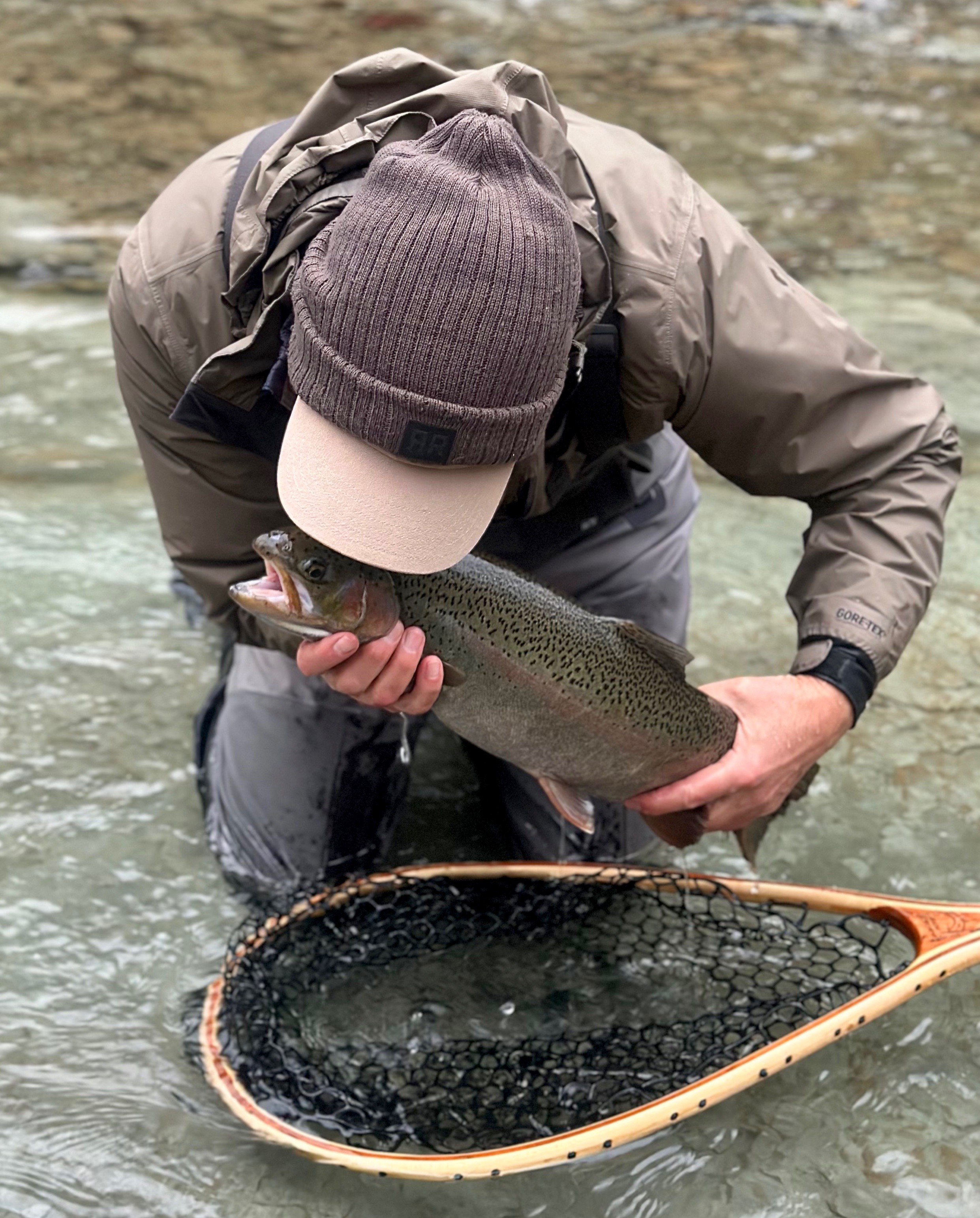
“He gave her three kisses and great was the smack.” — nearly the lyrics from an old folk song. Number 200, the second fish of the morning, gets the now traditional buss. It felt good to get it done early. How could I know there would be 19 more to come that day? What an embarrassment of riches!
~
On that grey, damp day, the steelhead ranged from dime-bright freshies from the lake……to the darkest horse I believe I’ve ever seen, courtesy of Cam. What a fantastic job he did. For someone who doesn’t fly fish all that much, he turned in an impressive performance. Yup, we’re as happy as we look. The number sits today at 219. And April is coming.
Many thanks to you, my readers, for subscribing, reading, asking questions, and, most of all, for your support, kind words, and enthusiasm. I wish you a happy and prosperous new year, and the tightest of lines in 2024.
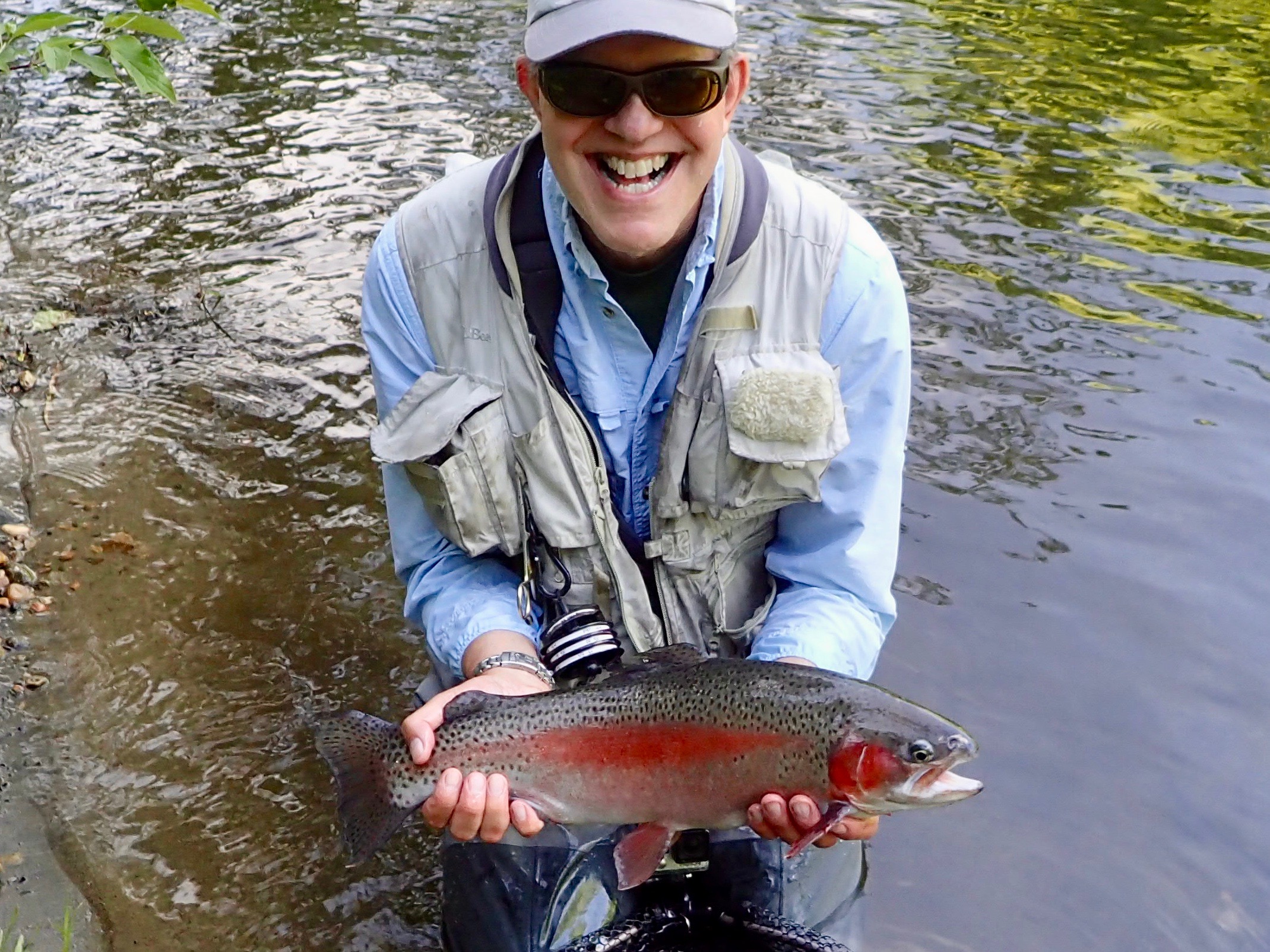
#4: Wesley’s First Trout on the Fly. Helping someone learn how to catch more fish is the non-monetary reward for being a guide. Helping someone catch their first trout on the fly, doubly so. But when it’s an eight-year-old kid doing it in front of his father, well, that’s something special. Wesley, who just about came up to my chest, was an unsure wader, and who can blame him on a big river like the Farmington? But once he found his “happy feet” place, he took direction supremely well, especially the part — we were indicator nymphing — about looking for a reason to set the hook on every drift. Suddenly, it wasn’t the bottom, and next thing you know, the rainbow is in the hoop. Fantastic job, Wesley!
One rainbow trout, two very big smiles.
~
#3: Guiding Members of Project Healing Waters. When PHW — here’s their website if you want to learn more or donate — reached out to book me for a large group outing over several days, I said yes. But I wasn’t sure how it would all go down. I wanted it to be good for everyone, and for everyone to feel like they got something out of it. And then, there was the weather and the flows to worry about. As it turns out, much fretting over nothing. What a great group of enthusiastic anglers. The energy was: we are happy just to be here, standing in a river, learning from you. Any fish hooked and landed are gravy. Well, we did some campsite picnic table classroom stuff. We did on-the-water lessons. We did small talk and life stories and fishing stories. And yes, we caught some fish. Thank you, PHW, for making my job not only easy, but also enjoyable. And thank you for your service.
Me and some of the gang. The fish were more cooperative later on this day, but we had a few players during out morning session.
~
#2: Appearing on the Orvis Podcast. It’s the gold standard of fly fishing podcasts. So when Tom Rosenbauer called me to set up a recording date, I was only slightly delirious. We recorded “How To Swing Soft Hackle Wet Flies with Steve Culton” one day, and a week later it was live on the air. In case you missed it, you can find it somewhere here. It’s the next best thing to taking a wet fly lesson on the river with me. And right now, a heckuva lot warmer. If you like it, send Tom and email and tell him.
#7: Marlborough and Edison Fly Fishing Shows and another International Fly Tying Symposium. You already know that I’m a big fan of The Fly Fishing Show. Where else can you meet and talk to some of the best fly fishers and tyers in the world, find all kinds of cool gear, and get those hard-to-find tying treasures — all under one roof? When I’m not speaking or teaching or tying, I’m walking the show floor, shopping, meeting and greeting, and sitting in on as many seminars and classes as possible. You should be, too. My 2024 Marlborough Schedule for January 5-6-7, is here, and here — now just over a week away!
Hey! I know that guy.
~
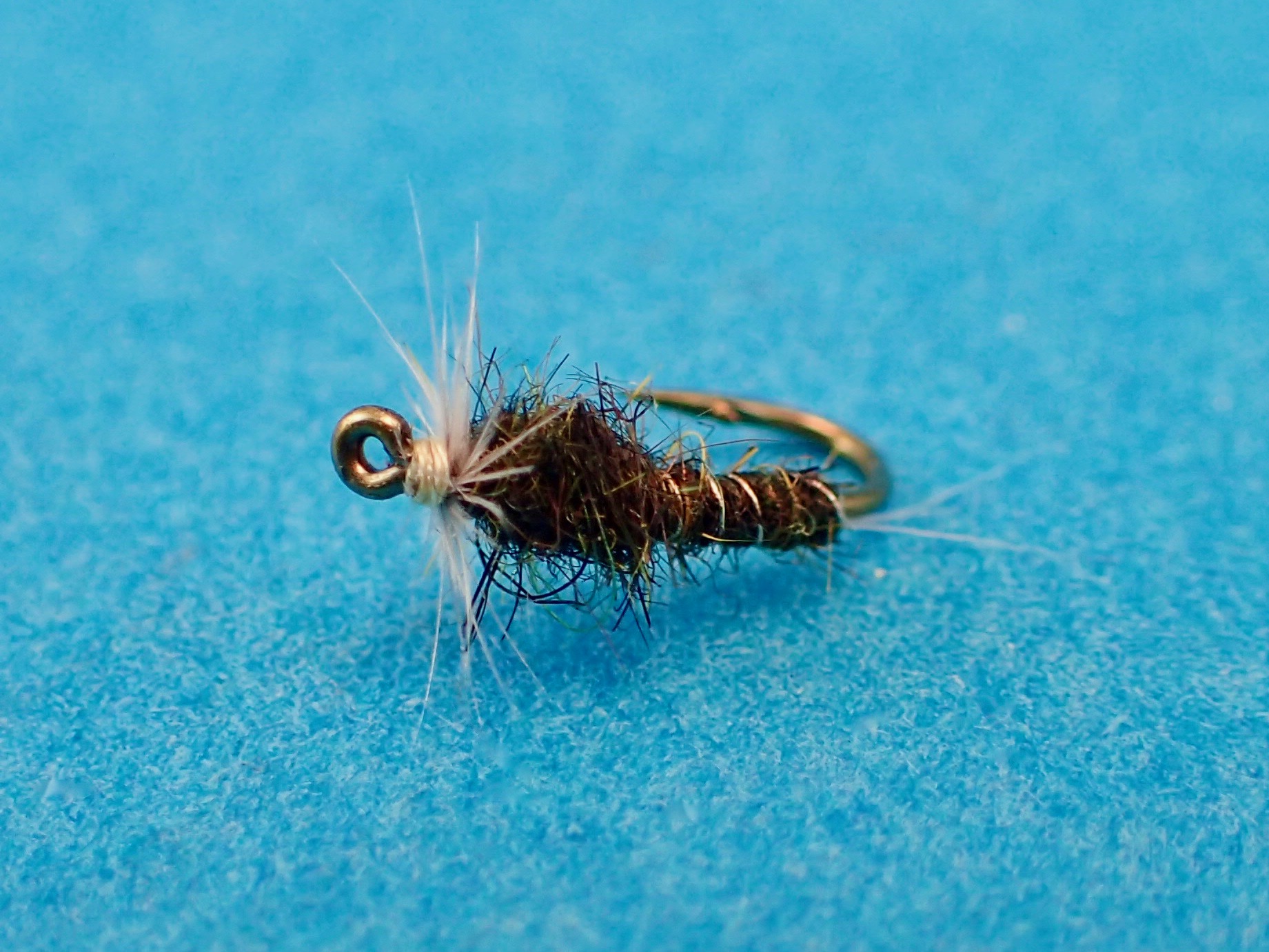
#6: The Great Diving Caddis Wet Fly Revelation. I’m a professional fly tier, guide, instructor, speaker, and all-around fly fishing nerd. Still, I don’t know it all. Far from it. And thank goodness! Learning new things and making new discoveries one of the things that makes fly fishing continuously thrilling. As evidence, I offer LaFontaine’s Diving Caddis wet fly. I read about it last winter, tied and fished it in the spring, and wow, did it ever produce. The first evening I fished it, positioned as my middle dropper, it accounted for two-thirds of the two dozen trout I landed. It produced untold numbers for my clients. It’s now a seasonal staple on my team of three. Brilliant!
All kinds of sizes and color combinations are possible. This is a size 14 in tan. You can find the recipe here.
~
#5: Completing My First Book Outline and Sample Chapter Draft. For years, people have been asking me, “When are you going to write a book?” Okay…how about now? The first pass stuff is off with a publisher, and I’m waiting to hear back from them. Fingers crossed. Oh! You’ll want to know what it’s about. The West Branch of the Farmington River.






 currentseams.com