If you’re looking for a gift for the fly fisher in your life — even if that’s you! — look no further. Whether you’re buying for yourself (or showing this post to your significant other — hint hint) I got you covered.
A Half-Day Guide Trip/Lesson with Steve Culton. If you’re planning on heading out with me next year, this locks you in at the 2022 rate. I highly recommend the four-hour slot. To purchase, please call 860-918-0228 or email me at swculton@yahoo.com.
My client Jake with a lovely wild Farmington River brown from last April.
Classes with the Experts at the January 2023 Marlborough Fly Fishing Show. There are two options. The first is Saturday, January 21 8:30am-11am, Tying and Fishing Wet Flies with Steve Culton. This is mostly a tying class, but we will also cover some fishing aspects. You must pre-register with the Fly Fishing Show. Here’s the link. The second is Sunday, January 22, 8:30am-11am, Presentation Flies For Striped Bass with Steve Culton. This is mostly a tying class, but we will also cover some fishing aspects. You must pre-register with the Fly Fishing Show. Here’s the link. The cost is $90 per session.
Or, for a great stocking stuffer, you can buy Marlborough show tickets in advance direct from the show. Here’s that link. Note that I will also be appearing in Edison, NJ, the last weekend in January on Friday and Saturday, but I do not yet have my schedule.
Happy gift giving, and have a safe and wonderful holiday season.
I just received my schedule for the Fly Fishing Show in Marlborough, MA, and it looks like I’m going to be busy! Seminars, presentations, tying demo, tying classes — covering both fresh and saltwater. The show is Friday, January 20, Saturday, January 21, and Sunday, January 22. I’ll be appearing all three days. As always, I’m counting on a good currentseams turnout! All seminars and Destination Theater talks are included in your admission price; the classes require pre-registration and an additional fee. Here’s my schedule:
Friday, January 20: 11am, Destination Theater Room A, Finding Small Stream Nirvana. 1pm, main show floor, Featured Fly Tier,Presentation Flies for Striped Bass. 4:30pm, Seminar, Release Room, Beyond Cast & Strip: Presentation Flies for Striped Bass.
Saturday, January 21: Classes With The Experts, 8:30am-11am, Tying and Fishing Wet Flies. You must pre-register for this class. 2pm, Destination Theater Room A, Modern Wet Fly Strategies.
Sunday, January 22: Classes With The Experts, 8:30am-11am, Presentation Flies for Striped Bass. You must pre-register for this class. 1pm, Destination Theater Room A, Hot Bronze: Wade Fishing for Summer Smallmouth.
Mark your calendars! I’ll be telling you more about my programs in the coming weeks.
Earlier this month, I had the pleasure of attending my first International Fly Tying Symposium. I’d always wanted to go, but my annual steelheading trip with Cam got in the way — until this year, when they moved the Symposium to a different weekend. So off to Somerset I went, vise and scissors and other implements of destruction in tow.
Getting there wasn’t without its challenges. That Friday night, we had a major rainstorm in the tri-state area. At one point my nav app said a four hour drive. Not fancying the idea of slogging through Manhattan at rush hour, I delayed. I didn’t get to my hotel room until shortly before midnight.
I’d been invited as a celebrity tier and presenter, so no pressure…no, really, it was all good, and it was wonderful to be wanted. I found my tying space first thing Saturday morning, sharing the table with Chester Rosocha. I’d never met Chester before, but I won the table-mate lottery as he was as nice and matey and friendly a soul as you could hope for. Tim Flagler and and Tim Cammisa were the next table down, but you can’t win them all…of course I’m joking. Tim and Tim are both swell guys, not to mention exceptional tiers, and we shared plenty of laughs over the course of two days.
Every show, I tell myself, “This time I’m going to take more photos and some videos of me and others in action to share on my website.” Then stuff gets in the way. And it doesn’t get done. But here are a few shots from the weekend.
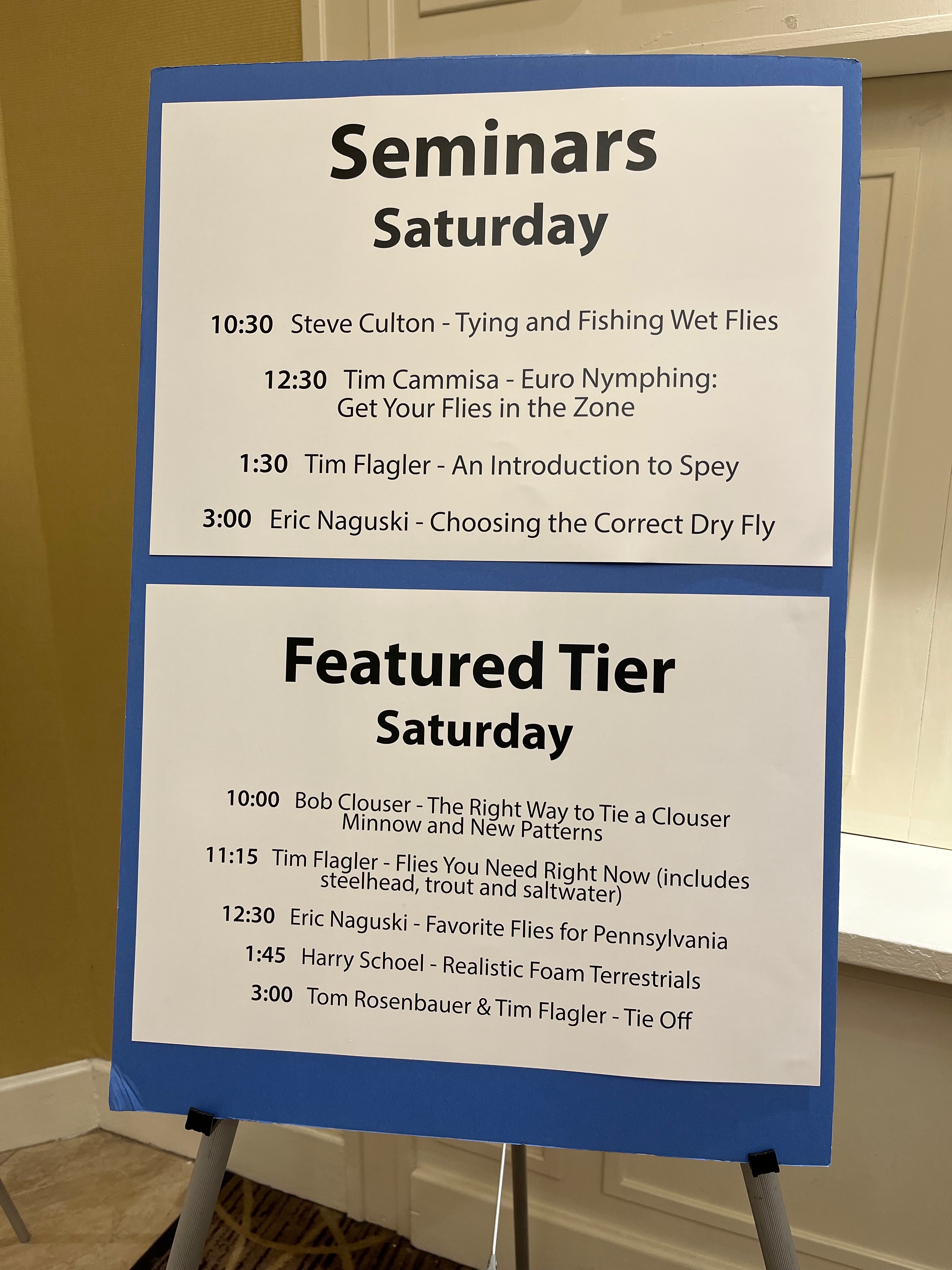
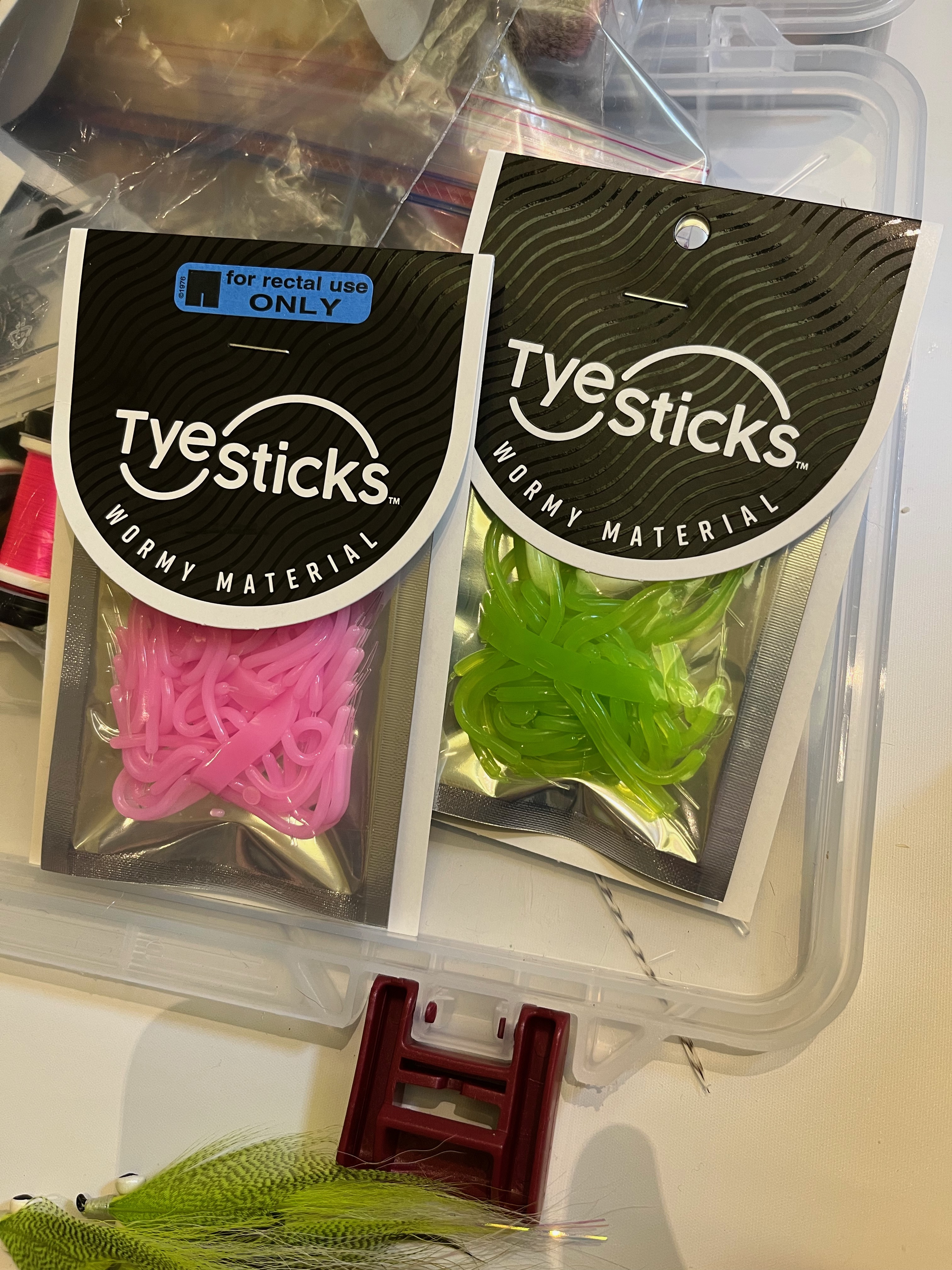
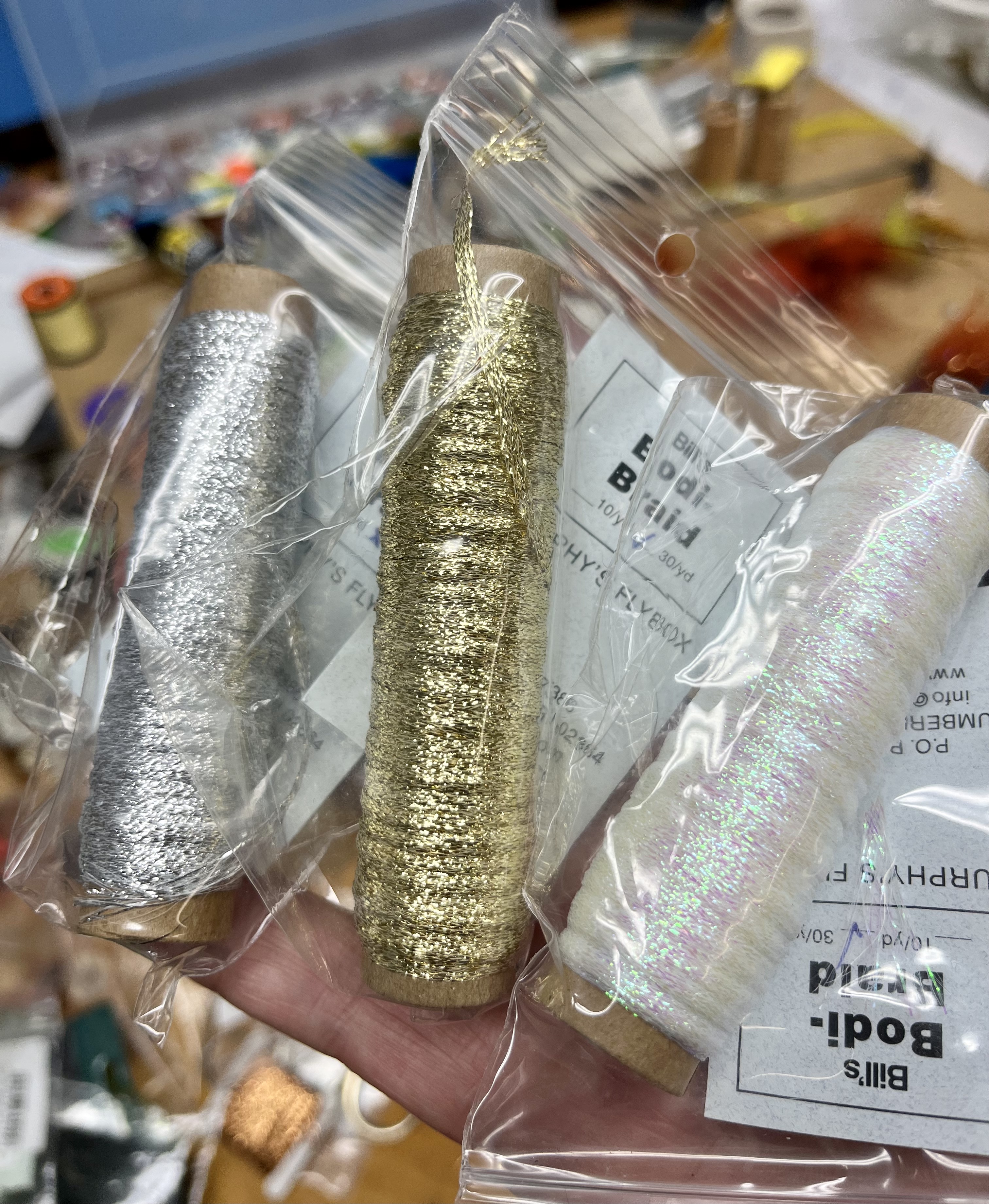
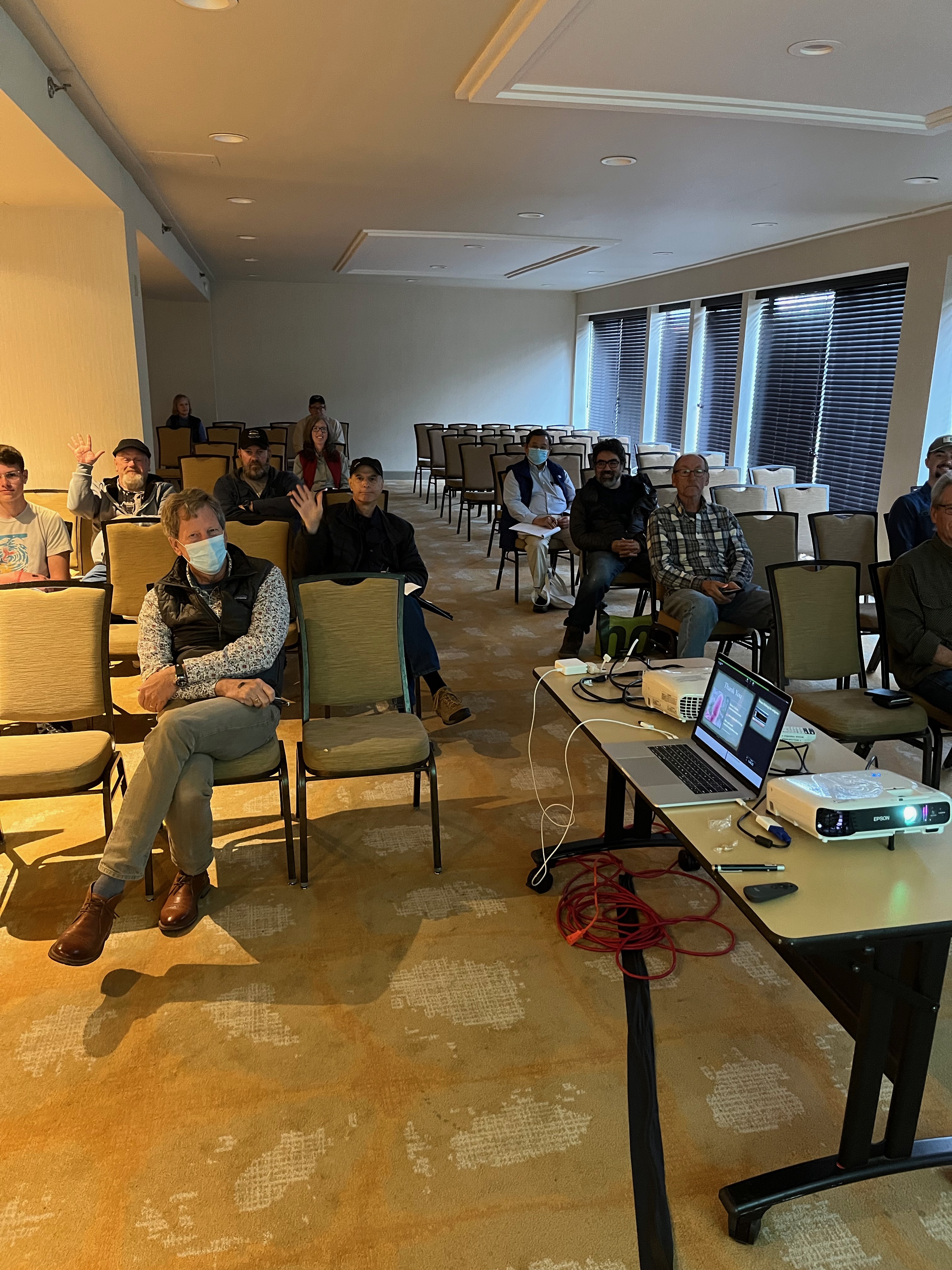
So much to do and see, so little time! And this is just Saturday. Plus classes, plus the show floor (tiers and marketplace) — it all makes for a busy weekend. This was a new wet fly presentation, which drew an excellent crowd for its debut. In the afternoon, I conducted a wet fly tying class which also went very well. Six very enthusiastic students who made their instructor’s job easy. We covered the basics of soft hackles, wingless, and winged wets. One of the best parts about big shows like this is the possibility that you’ll run across some new materials you didn’t know you needed. I saw these at Tim Flagler’s table and had to have some.Look closely at the packaging and you can see that someone has a potty mind (albeit in good fun). The USP of Tye Sticks is that they have a monofilament core that extends past the material butt end, making them a breeze to attach to a hook. You can find these online using the company name. (I have no affiliation with the brand.) I also scored some nice bucktails from Brad Buzzi, and some 30-yard spools of Bill’s Bodi Braid. I’ve had enough of buying those cards with a measly 3 or 4 yards of material, so I stocked up on these three staple colors and left happy.My Sunday seminar, Beyond Cast & Strip: Presentation Flies for Striped Bass, starting to fill up. This was another great group, and we stayed out past curfew for a long and engaging Q&A session. Another debut presentation. I want to thank everyone who took the time to come hear me speak, attended my class, or just say hello. You made my first IFTS highly enjoyable!My crowning achievement of the weekend took place Saturday night at the banquet. (Did I mention that if you attended the banquet, you received a gift bag loaded with fly tying materials, tools, hooks, beads…all good quality, highly useful stuff. I’ll try to remember to take a photo of the bounty for a future post.) I sat at the table with the Italian contingent– this was, after all, the International Fly Tying Symposium — who spoke varying degrees of English ranging from a little to virtually none. They had brought along a couple bottles from the old country, and were eager to share. My kind of crowd! Then, a gentleman from the hotel materialized and tried to explain that we could not bring our own booze and open it in the dining room. Seizing the opportunity, I explained the situation, focusing mostly on the fact that this wine came special all the way from Italy, and our colleagues were most eager to share in the spirit of international goodwill, and that if you, Mr. Hotel Man, can figure out how to tell them in Italian — OK, so maybe I exaggerated a wee bit on their total lack of command of the English language — that they can’t have their wine, please do so. Next thing I know, he’s saying never mind, and he’ll be right back with some wine glasses for the table. Salute!
Happy Monday. We’re back and at it, and it feels good! This question comes from new subscriber Travis. It’s a good one, and since the answer is not simple, I thought I’d share it. Question:After listening to your Saltwater Edge podcast episode, you’ve motivated me to start trying out greased line swings and other similar presentations for stripers in my local estuary. This article brought up similar concerns I have about this tactic where I fish because the water is quite stained while still being mostly salt. How do the stripers’ lateral lines function in regards to a dead drift or swing presentation? Does this method require the fly to be that close that it goes by their face like a trout, is there vision better than we give them credit for in murk or are their lateral lines more sensitive than always needing a strip retrieve? Still trying to get one on the swing.
Answer: I could write a lengthy chapter to answer. But rather than over-complicate, let’s simplify. The conditions are stained water with poor visibility. The first question is how do the striper’s lateral lines function in regards to a dead drift or swing presentation? My reaction response is, danged if I know. My second response, while sounding facetious, is actually an attempt at serious: probably the way they always do. But I know where Travis is going with this. What’s he’s asking is, how do stripers find a fly in murky water? Do they see it? Do they rely on their lateral line? Does the fly need to be moving for them to find it?
Here’s what I can tell you. I fish a couple estuaries where the water, at best, is the color of tea, and perhaps most of the time is more like tea and milk. That is, lousy visibility. The bait is grass shrimp about an inch-and-a-half long. Every time I go, I hear the pops of bass feeding. So, I know they’re finding the naturals in stained water in the dark. Now, I don’t know if they’re finding the bait through vision or their lateral line or a combination of the two. But I do know that they can and will find my grass shrimp flies, which could hardly be described as patterns that — and I’ll use a phrase that generally drives me bonkers — “push water.” These flies are swung or dangling in the current. Sometimes the hits come when I ‘m pulling in over a hundred feet of line and backing. But mostly it’s on the swing and dangle.
Exhibit A: All of these flies are small. All of them have produced stripers, on static presentations, even in stained water. I fish them with confidence on the swing or dangle with a floating line because I know they work, and I know I am presenting the flies in a manner in which the naturals are being eaten.
I don’t know how the bass are finding my flies; I might even suggest that it doesn’t matter, because they are finding my flies, just as they find my skinny sand eel flies at night on the dark of the moon in the whitewater wash of a pounding surf. I fish bigger flatwings in the spring in a different estuary system where the water is frequently stained. Granted, those are much bigger patterns, but the presentation is still a natural drift, swing, or static dangle; regardless, the bass find those flies.
What Travis is really asking for, I believe, is permission to believe that the bass will find his flies in murky water. Permission granted. But ultimately, the permission has to come from you, Travis — and the only way to obtain it is to get out there and fish. Hope that helps!
Exhibit B: flatwing found in lightly stained water.
Thank you everyone for being so patient with me during a very busy time. My readers and followers — that’s you! — are something for which I am truly thankful.
I’m looking forward to getting back to giving you the kind of content you’re used to seeing here. And I’ve got a lot to write about: the International Fly Tying Symposium, my recent steelheading trip, some new materials I’m using for fly tying…just to name a few. Speaking of steelheading, it seems like every time I go, come what may, it only serves to fuel the addiction. I’ve been falling asleep visualizing strike indicators dipping below the surface. Really. Sweet dreams, indeed.
Neither Kansas nor Connecticut, but rather a little Salmon River sunshine of a wakeup call.
Last night I did my second international Zoom presentation with the Ottawa Fly Fishers. They are a small but very enthusiastic group, and it’s been a pleasure getting to know them. The subject was “Wet Flies 101.” I don’t need to tell you about my passion for tying and fishing wet flies, so spreading the word is kind of like getting extra frosting with your cake. Thank you again, Ottawa Fly Fishers, for being such swell hosts!
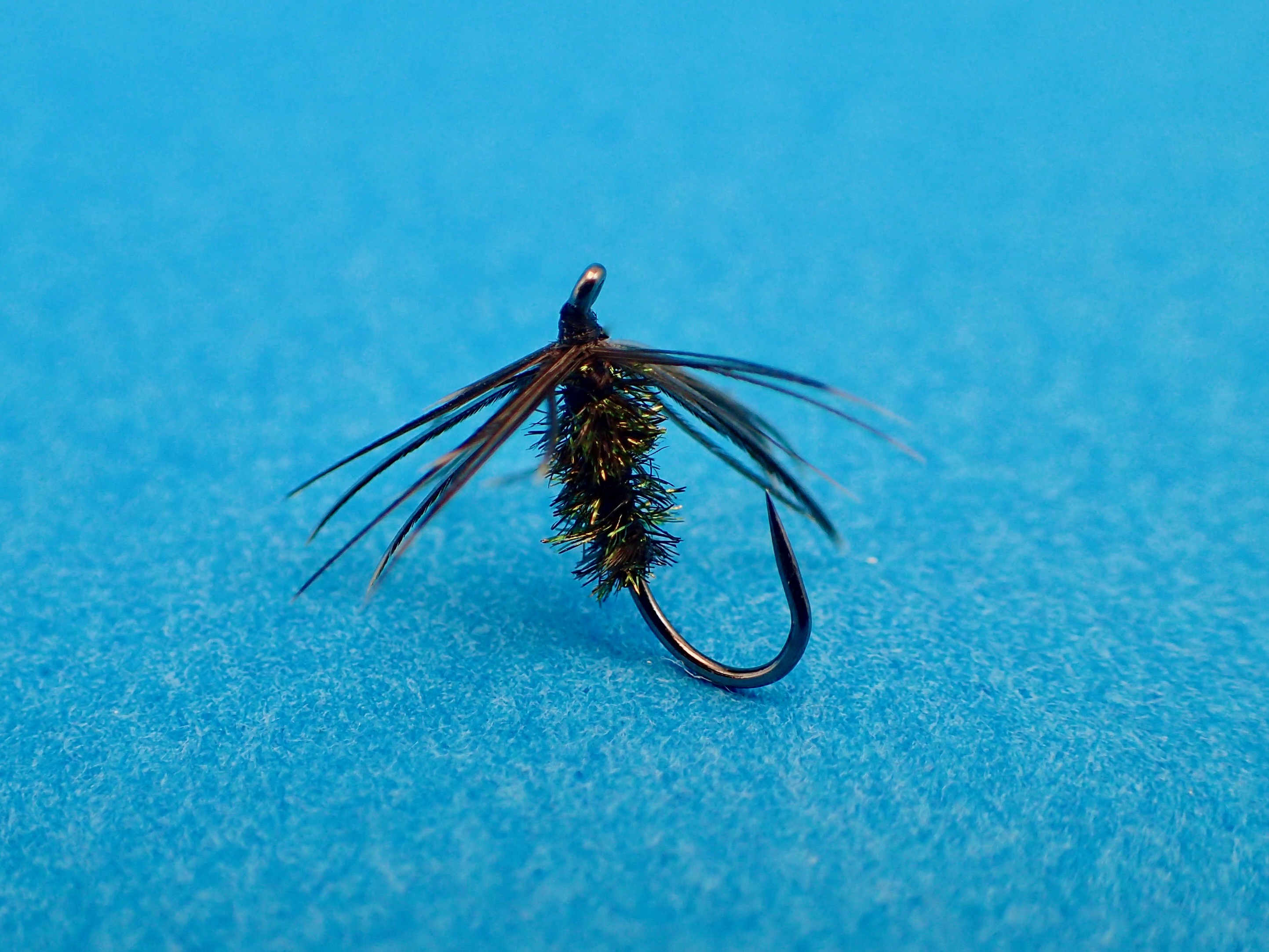
One afternoon, many years ago, this fly saved my bacon. I was guiding Matt, and it had been a slow, disappointing day. All of sudden, for no apparent reason, trout started eating the middle dropper, a size 16 Starling and Herl. Whatever was hatching unseen underwater, it was small and dark and the fish wanted it. Remember Ken’s sage advice: droppers are the fastest way to find out what the fish want.
I’m back from the International Fly Tying Symposium, where I had a fantastic time. Normally, I’d be writing about that today. But sadly, my wife’s sister passed away unexpectedly over the weekend, and right now I need to focus on family rather than fishing.
It’s always my goal every week to try to give you 2-3 bits of meaningful new content on Currentseams. I appreciate your loyalty and your readership. Please bear with me and we’ll get back on track soon. Lots to talk about! In the meantime, tight lines, good tides, perfect flows, lots of bait, and abundant hatches to all. Thank you.
In case you’ve been wondering where currentseams has been, I’ve been working on the presentation railroad, and getting ready for this weekend’s International Fly Tying Symposium in Somerset, NJ. Just finished: Tying and Fishing Wet Flies: A Modern Take On The Ancient And Traditional Methods. This is a brand new look at tying and fishing wet flies, with an emphasis on the tying aspect. You can be one of the first to see it at the International Fly Tying Symposium, this Saturday, Nov 12 at 10:30am. Still need more wet flies stuff? Join me for my tying class at 1pm, Tying Soft Hackles, Winged and Wingless Wets. Sunday, Nov 13 at 11am is another brand new presentation called Beyond Cast & Strip: Presentation Flies For Striped Bass. Both seminars are included in the price of admission to the Symposium(the class is extra). Holy smokes, I still gotta pack. See you there!
I’m putting the finishing touches on a brand new presentation called Beyond Cast & Strip: Presentation Flies For Striped Bass, and you can be one of the first to see it at the International Fly Tying Symposium, Sunday, Nov 13 at 11am. It’s one of two seminars I’ll be doing — the other is Tying and Fishing Wet Flies, also brand new. You can see that one on Saturday, Nov. 12 at 10:30. Both seminars are included in the price of admission to the Symposium. Beyond Cast & Strip is all about tying flies that create the illusion of life, even when at rest — flatwings, bucktails, soft hackles — all proven patterns that I use every season. I’ll also be sharing some insights on how and where to fish presentation flies. I’m excited about this one, folks. See you there!
The International Fly Tying Symposium is happening this November 12-13 in Somerset, NJ. When I’m not doing my seminars, I’ll be at my tying table, or teaching a class, Tying Soft Hackles, Winged, and Wingless Wets.
I wanted to briefly make another point about using floating lines for stripers. If I could change minds on one aspect of using a floating line for stripers from the shore, it might be the notion that one must have weight (fast sink tips, etc.) incorporated into the system — and/or that you’ve somehow got to get the fly down into some imaginary strike zone. Certainly, there are times when stripers are grubbing. But bass are usually looking straight ahead or up. I rarely use sink tips or weighted flies with the floater. That 20-pounder from last month came on a totally floating line setup, and the take came where a wadeable reef drops off into substantially deeper (overhead) water. Not surprisingly, the bass found my fly near the surface.
An oldie but goody from Block Island. I’m standing in thigh-deep water, but I was casting into water that was probably over my head. The bass are usually looking up. Using a Rio Outbound 9-weight floating line with a 7 1/2 foot leader.






 currentseams.com