I got this question when I spoke earlier this month the EJTU meeting. It’s a good one. I’d just shown the group a video of trout taking sulphur emergers. The rises were regularly timed and showy/splashy. You could also see the bugs in the air.
The question was: When you get to the river and you see a scene like that, do you automatically go to a a dry/dropper? A: No. I will start with a wet fly team of three, and two of them will likely be sulphur patterns. There’s a lot to unpack here in terms of that decision. In this particular video, it was late afternoon in June. The rise forms clearly said the fish were on emergers. The time of year, time of day, rise forms, and visible bugs (sulphurs, whose nymphs are in the drift a good long time before emergence) indicated that the trout were taking their food just below the surface. A dry/dropper might get you some takes, but why not feed the fish like they’re already eating? Which is, subsurface, just below the film. A wet fly team of three fits that bill perfectly.
A splashy, emerger rise form (upper left) still taken from the video. You can also confirm that the trout are taking the emerger by the lack of duns on the surface. This doesn’t mean you can’t catch fish on the surface. It just means the dry fly may not be the most efficient method.
Note that a dry-dropper may be a better method for presenting just under the surface with different hatches. A midge pupa in winter would be a good example of that.
Forgive the brevity, but I’m up against it today. First: thank you EJTU for hosting me on Wednesday night. I presented Wet Flies 2.0, the turnout was excellent, and we had an engaging post-talk Q&A.
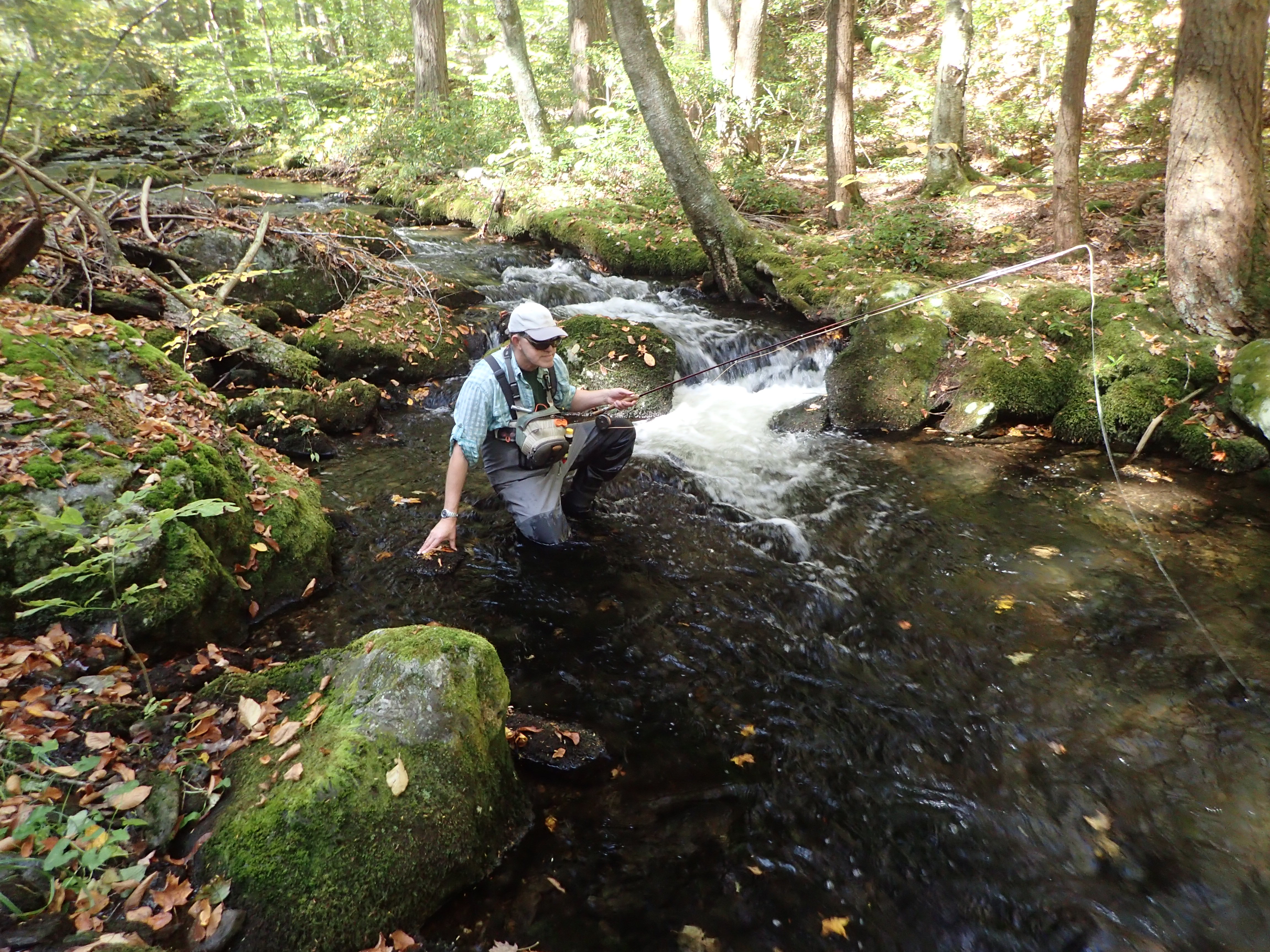
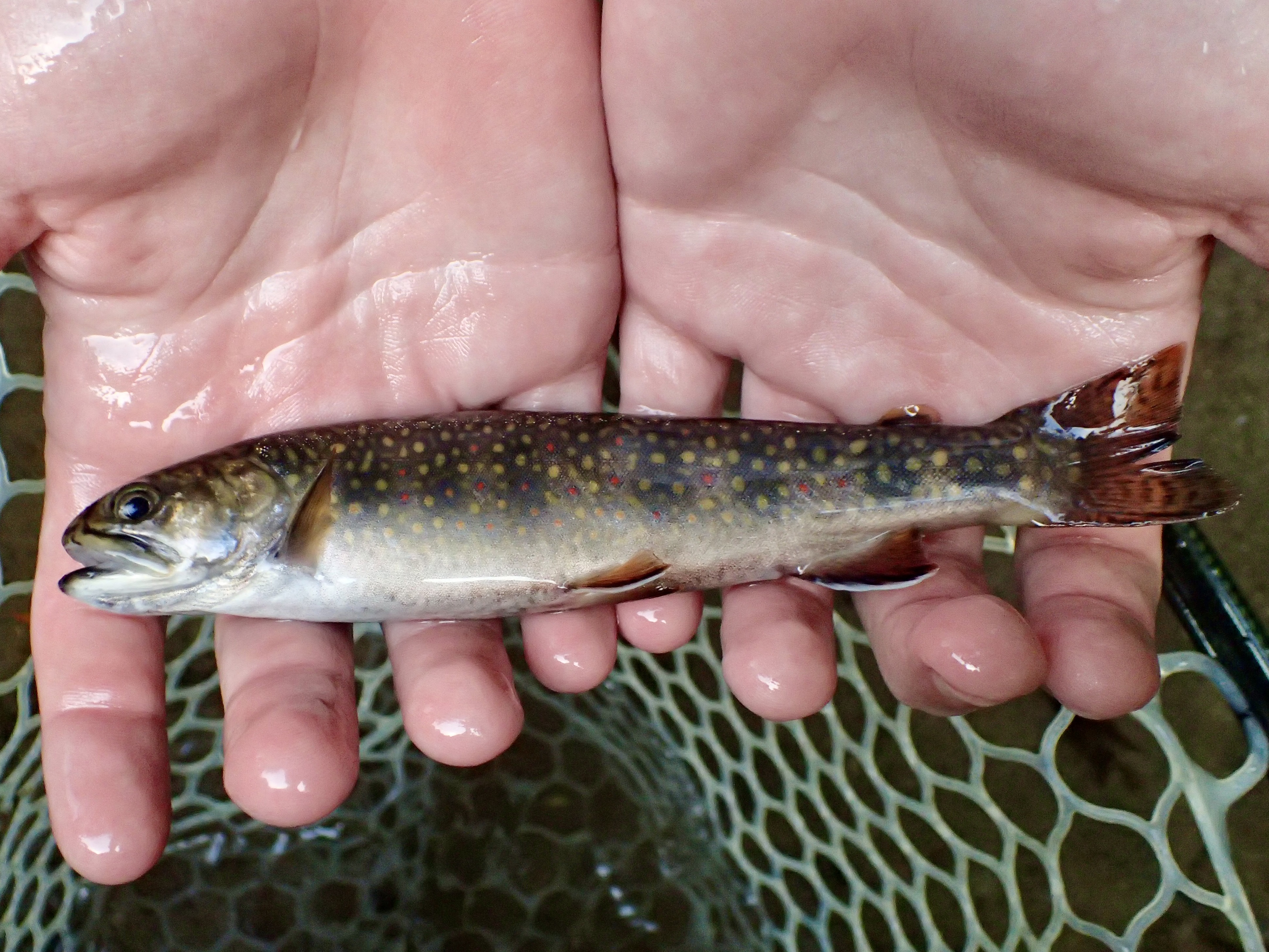
Gadzooks! Fishing twice in one week? It’s true. On Tuesday night I braved a snotty surf and 10mph wind with surfcaster extraordinaire Toby Lapinski. We fished a top secret rocky reef, and although the conditions seemed perfect for fall bassin’, we managed just one touch before we decided that it wasn’t happening. Yesterday, I headed to points far away to fish a thin blue line with #2 Son Cam. The water was painfully low, and leaves were a constant issue. The action was slow, but we had fun fooling wild brook trout on dry flies and deep jigs.
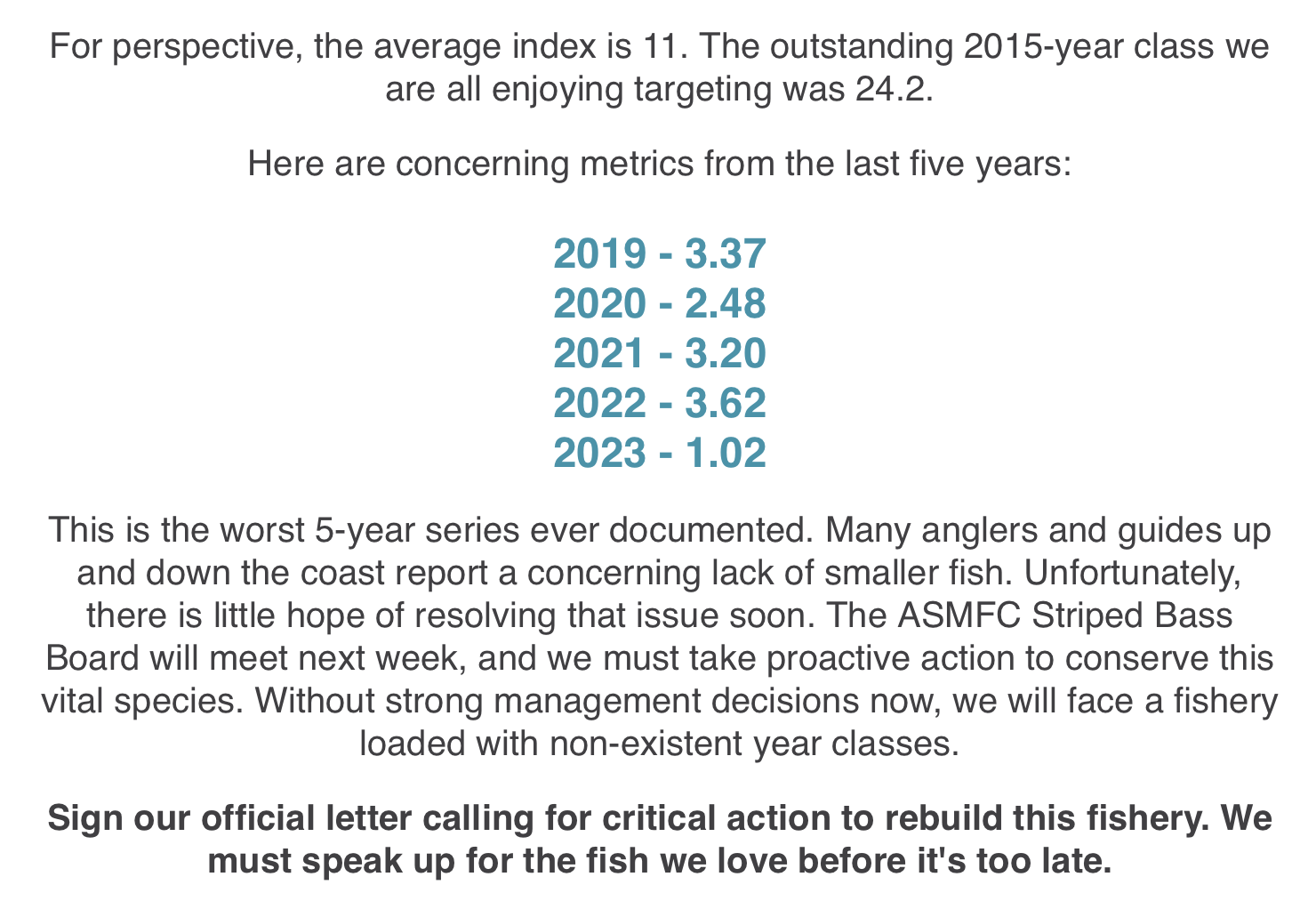
Finally, please take a minute out of your busy day to sign the ASGA letter to the ASMFC. Striped bass desperately need us to take action now. The following graphic on the Juvenile Abundance Index tells a dire story:
Once again, I’ll be appearing at the International Fly Tying Symposium this November 16-17, 2024, at the Hilton Doubletree in Somerset, NJ. This is great opportunity to mingle, mix, and see some of the best fly tiers on planet earth: Thomas Baltz. Jeff Blood. Bob Clouser. Tim Cammisa. Tim Flagler. And that’s just one partial alphabetical column. Oh! There’s also a well-stocked marketplace that always has common and hard-to-find items. There are classes, seminars, and featured tying demos. The last two are free with your admission, and I’ll be one of the featured tiers on Sunday at 11:45, which will get you home in time for football. The demo is “Matching the Hatch with Wet Flies.” I hope to see you there!
I’m kicking off my 2024 fall/winter speaking season Thursday night, September 12, 7pm, at the HCTU meeting in Meriden. The topic will be Fly Fishing CT’s Small Streams, a subject that I’m really passionate about. We’ll talk when, where, how, tackle, flies, tactics, conservation, and more. The meeting is open to the public, so I hope to see you there!
Fishing small streams returns you to the very soul of fly fishing.
This can be a tough time of year to fish. A lot of what is hatching is small. Usually flows are low (not the case in either river) and warmer (ditto). Over three days, I saw very little bug activity, and the feed bag was never on. Still, there were some bright spots in all the dreariness.
Monday, August 26: Housy (Slower). I fished with fly tier extraordinaire and fellow smallmouth bum Lou Di Gena from 3pm to 8pm. It was not good. I managed to hook four smallies in five hours of fishing. I should be hooking four smallies on consecutive casts. Bug activity was minimal (small caddis) and there were no fish in some incredibly sexy new water we fished. We ended up in a pool where I once landed 50 smallmouth in an evening. Painfully slow that night. Of course, it’s hard to be bitter when you land your biggest bass of the summer…even if it was in the first 10 minutes of fishing.
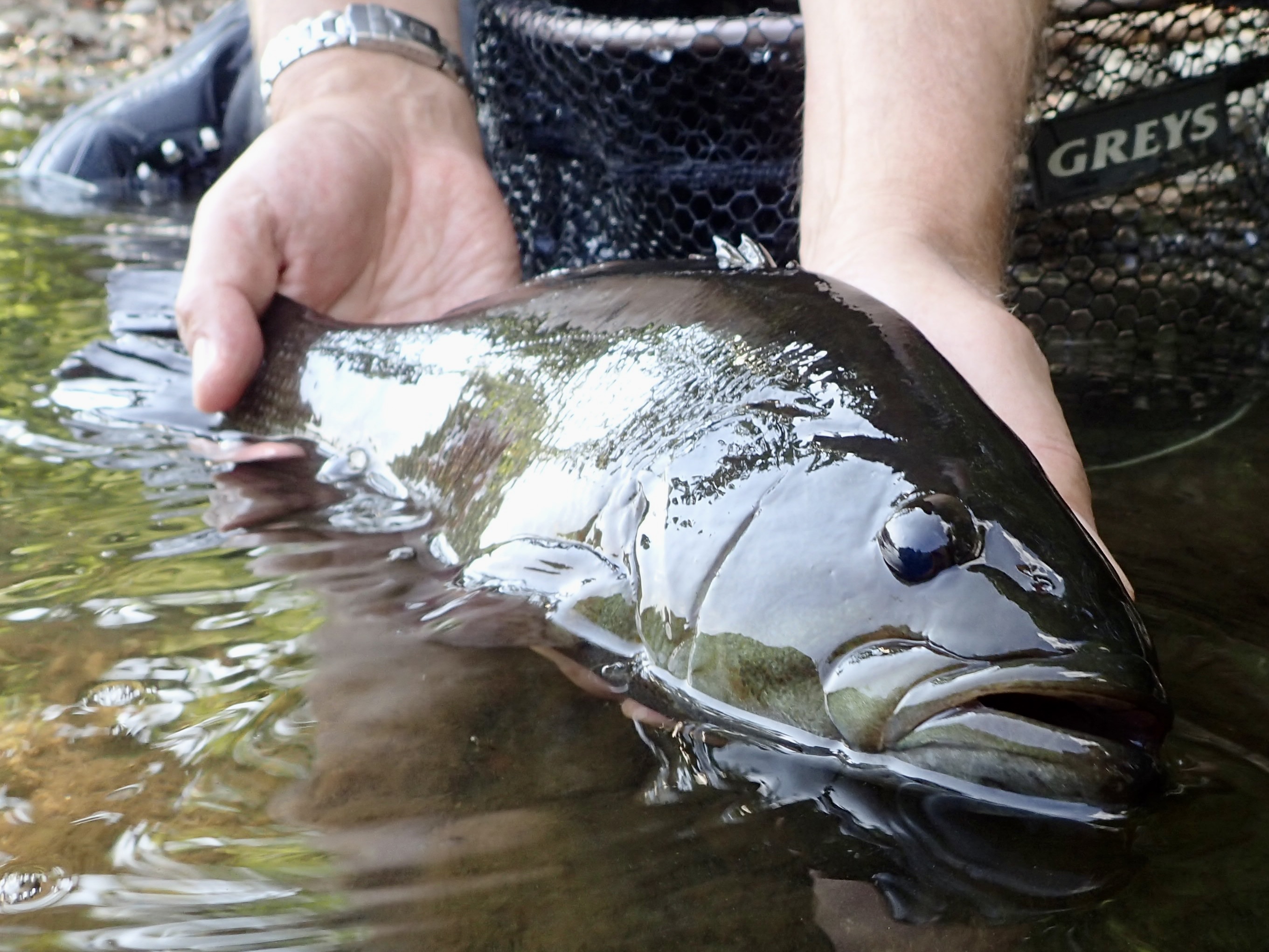
This slob went 17″ and somewhere between 2 1/2-3 pounds. Taken under an indicator with Lou DiGena’s CE Crayfish, a small (2″) weighted pattern. A real forearm burner!(Photo by Lou DiGena)
Wednesday, August 28: Farmington (Slowest). This was a photo shoot day with fellow Farmington River guide Antoine Bissieux. He fished from 3pm-7pm with dry flies — I joined in for the last hour with wets — and it was disaster slow. We fished a mark below Riverton, and hatch activity was slim to none. I don’t think I counted even a half dozen rises in three hours. Antoine blanked (to give you an idea of how pathetic the action was, it was his first skunk of the year) and I managed only four bumps and one fish to net. The bumps were half-hearted, and the one I did land was arguably the worst hit I’ve had all year on a wet fly. (Insert heavy sigh here.)
Take your time, Antoine. You’re not missing anything.
Thursday, August 29: Farmington (Slow). I gave a wet fly lesson to Corey and his son Matt from 3pm-7pm. We started off in the bottom end of the PTMA, but that was not a happening place, so we headed north. Another mark, although quite fishy, was disappointing. Both Matt and Corey had some bumps, but no real hookups. Farther north was the call, and I’ve never seen the area below the dam so crowded. My best guess on the crowds is that anglers thought there might be pre-Labor Day stocking? (There wasn’t.) But we found a very nice section to call our own, and had at it. Ding-ding-ding! It was the winner bell and the dinner bell. Both Matt and Corey brought fish to net, and it was gratifying to see their hard work pay off. Well done, gentlemen!
They’re not big, but wild brookies on the Farmington are always a treat.
My apologies or not getting this out last week. I’ll try to be a little more timely. The good news is that the terrible weekend rains mostly missed the Farmington, and the river has been fishing very well. Last week I guided Dan for a late afternoon-into evening session. The focus was on dry flies, and we started off with a hopper/dropper system. (‘Tis the season! And I promise, no more parenthetical statements.) We discovered a pod of trout taking emergers in a shallow run in bright sunshine. When Dan dialed in his cast and drift, his hopper got crushed by a very respectable mid-teens brown. We found another run formed by the confluence of two sections of river, but we couldn’t buy a hit. Even when we switched to wets, it was no dice. My best guess is that they were feeding on something far smaller than what we were throwing.
We ended the session at a classic dry fly pool within the PTMA. Hatch activity (22-24 BWOs, 18-20 Summer Stenos, and later, 12-14 Light Cahills and an absurd number of midges…and I guess I fibbed about the parenthetical statements) was light until 8:30pm, but Dan managed to stick a nice fish on a 22 BWO dry. We used a 14-foot leader-tippet system terminating in 6x to get better drifts in the languid, glassy pool. At 7:30 I was able to join in the fun. As predicted, that wild brown feeding just off the rock in the frog water got stupid as it got dark, and I took him — with great delight — on a size 16 Catskills Light Cahill dry. Both Dan and I had good action until we could no longer see our flies.
The next day, I shot some drone photos for the book with filmmaker extraordinaire Matthew Vinick. I fished for about 45 minutes below and within the PTMA until he arrived.
I was fishing some water in the PTMA I really haven’t spent any time in for at least five years when I connected with this gorgeous creature. She was part of a pod of trout taking emergers, and she chose my Squirrel and Ginger top dropper. Matt and I went to a couple other pools in the PTMA to shoot, and then we had places to be.
~
I had 30 minutes to fish before I had to pick up my son at Bradley. So I ventured into some snotty, treacherous water that’s rarely fished. This rainbow hit the Squirrel and Ginger so hard that she peeled off 20 feet of line before I could adjust my drag. The photo really doesn’t do her justice — she was fat and powerful and wonderful, and she just wouldn’t sit still for a picture.
~
There’s a happy guy! My last customer of the day was the best. She was feeding in a slot near the shore, and it took some maneuvering to get into a good position to present my team of three. This is where it helps to be physically fit (and carry a wading staff). There’s no way I could have reached her without being willing to wade into some dicey currents. Measured against my net, this is a high teens fish (I refuse to thrust a fish at arm’s length into the camera) that took an Isonychia soft hackle I’ve been prototyping for a year. I’ll publish that pattern soon, but in the meantime, I can tell you this: big fish like that fly. You can see a fly-in-mouth shot on Instagram, probably Tuesday.
I fished twice this week, Tuesday and Wednesday, and the days could not have been more different. On Tuesday, I hosted fly tier extraordinaire Lou DiGena from New Jersey. You may have seen Lou at the Fly Fishing Show, or at the IFTS. The river was up a bit, 406cfs in the PTMA and stained from rain. We started off below the PTMA and found some eaters, me with wet flies and Lou Euronymphing. Because of the stain and cloud cover, we decided to give streamers a shot in a popular pool within the PTMA. That was a total blank. Not knowing if there would be crowds for the evening rise (as it turned out, there were not) we headed to a dry fly mark above the PTMA.
I’ve been fishing this pool for a very long time, and I’m here to tell you that the bug activity and rising fish quotient were among the worst I’ve ever experienced. We kept waiting for a hatch that never really materialized. Lou did well to stick a nice brown sipping in some frog water, and I took another at dark when I suddenly saw a riser, but that was it. On the walk out, there were a few midges in the air, but water that is normally littered with spinners was strangely barren. I did see a few bigger Light Cahills and smaller Summer Steno spinners, but no real biomass like you’d expect.
Wednesday, the weather forecasters blanked. They called for showers and light rain starting at 6pm. The showers started at 1:30pm, and evolved into a steady rain that went on the rest of the day. That didn’t dampen the spirits of Kevin, who was taking a wet fly lesson with me. The water in the PTMA was down 50cfs and had cleaned up considerably. We arrived at the spot to see fish rising, and we connected within a few first casts. A couple more bumps and a juvey Atlantic salmon, and then it was over.
Our next move was to head north and fish the water above Riverton, which was running clear and cool in the mid-50s. We found a long slot that held rising fish, but we strangely couldn’t get them to eat, save for one courtesy swipe. The hatch was BWOs (not surprising given the conditions), about a size 20, and the swallows were going to town on the bugs. We gave it a good effort, then moved even closer to the dam.We had virtually the entire stretch of river to ourselves. We found a boulder field with some very sexy slots and pockets and waded in. At 162cfs, this is perfect height for this stretch of river. During a wet fly lesson we cover a lot of techniques and tactics; there are a few principles that could be considered core, and critical to success. One of them is that presentation makes a huge difference. The longer you can keep your fly in the strike zone, the better your chances of hooking up. We found a run that had a pod of rising fish — again, small olives was the fly — and I reminded Kevin that if he threw a couple mends as the team of flies moved down and across, he’d give the fish a better look at the flies. On his next cast, this happened. Way to go, Kevin! We hooked two more and then called it a very successful day.
There are precious few absolutes – like gravity or the firmness of the earth – in fly fishing. But certainly this one is unimpeachable: wet flies in the water catch more fish. This is why I recommend that you keep your wet fly team in the water as much as possible, especially when you’re wading to a new position up or down or across stream.
The value of this practice, which I teach in every wet fly lesson, was driven home to me on Wednesday when I was out on shooting photos for the Farmington River book with Derrick Kirkpatrick and Joey Takeman. We’d just returned to the river after a thunderstorm delay, and were crossing a shallow (1-2 feet) riffle. I hadn’t fished yet, but this time I had my rod with me, and while I intended to take more photos, I couldn’t resist stripping out ten feet of line and dangling my team of three (16 Sulphur soft hackle, 16 Diving Caddis, 12 Isonychia soft hackle) in the current below me. Whack! I felt a sharp tug, and although the hook found no purchase, I’d already proven my point. It was a quality take, more like a loud foul than a swing and a miss.
An hour later, on another part of the river, we were walking upstream when I spotted a pod of rising trout across the stream. I told the guys that I had to take a few casts at them. I did, landed two, then began to cross back to the other side — team of three, naturally, dangling in the current below me. Wham! Another hit, and this time a hook set.
As dusk deepened, I left Joey and Derrick to return to the area where I’d seen the pod of trout. As I started to cross the river, a large trout delivered a thunderous hit on one of my flies. It immediately put itself on the reel, and peeled off 30 feet of line as by drag was not set for such a creature. In the gloaming, a spectacular aerial revealed that I had indeed hooked one of the FRAA-stocked 5-7 pound trophy rainbows. Another run, then another aerial, and as I tried to regain some line, yet another aerial. Tremendous sport!
I wasn’t worried about the hook set as the fish clobbered the fly. I had fresh Maxima 4-pound as my tippet. I was going to land this mini-steelhead. I wish Chad a better picture for you, but I wanted to get her back to swimming. Besides, the light was lousy. And so, off she went.
Great rainbow trout, lousy photo. My net length is 19″ and she did not come close to fitting. I’d guess 22 inches or so. For those who want to know, she took the Diving Caddis. Now, repeat after me: flies in the water catch more fish…
We had a fishing trip/photo shoot on Wednesday from 3:30-9pm. Delaware River guide extraordinaire Bob Lindquist came down to take pics for the book and an article he’s writing. We (filmmaker Matthew Vinick of “Summer on the Farmington” fame) started off at the bottom end of the PTMA and the action was slow. Little to no hatch activity, and precious few risers. Matthew and I had to work our butts off (he was nymphing then dry flying, I was swinging wets) to put a few in the hoop over 90 minutes. Both of my trout took a large Iso soft hackle.
Matthew had to skedaddle, so Bob and I moved up to a dry fly pool above the PTMA. As I was wading in, an old crusty angler (meant as a compliment) was leaving, commenting that the sulphur hatch was not good. He was right. It never really got started, even later in the evening as sunset transitioned into dark. Id like to blame it all on the hatch, but I don’t think I fished particularly well, mostly because I was being stubborn. Let me explain.
I saw that the sulphurs that were on the water were an 18-20. But I wanted to see if I could get them to take the 16. They generally wouldn’t, and when I put a 20 on I had double the action. I was also committed to fishing the water in front of me, which, due to varying currents seams and speeds, was difficult to maintain a quality drift. Sometimes I like a challenge, you know? But my fish worthy-drifts were few, and even when I did fool fish, I came away with nothing. I rose six trout and stuck none of them. Ugh! Finally, I moved down a few feet to more drift-friendly water, but by then it was too late. (Stubborn Steve pays the price.)
I should mention that I had some surprising success on wet flies in some very slow-moving water pre-7pm. Two trout, two crushing hits, both on LaFontaine’s Diving Caddis size 14. Later, the pattern that the trout seemed to like best was a size 20 sulphur comparadun. As it got darker, I switched over to a size 12 Usual. Unfortunately, the typical dusk feeding orgy never manifested, and both Bob and I commented about the lack of spinners on the water at dark. So it goes.
The Diving Caddis wet. I’ve been tying these without the rib, and using tan caddis Prism dub for the body. The trout are all in favor.
George and Michele took a wet fly lesson with me on Tuesday, and deserved much better than what they put into it. We started out in the lower end of the PTMA. The water was perfect for wet flies, but there was no hatch activity and virtually no visible feeding. We had a good, long streamside classroom session, but we had to scrap for the few touches we received. George and Michele both did an excellent job of getting their flies where they needed to be, but you can’t catch what doesn’t want to eat.
So we zipped down below the PTMA and were greeted by: more of the same. The fish were a little more active, but still no real hatch, nor feeding. Although both George and Michele put trout in the hoop, they didn’t get rewarded for the fine level they wet fly fished at. Our fishing window was 1pm-5pm, and to prove it wasn’t them, I swung wets for 90 minutes, 6pm-7:30pm, above the PTMA, and managed only two trout. Not good. At 7:30 I switched to dry, and proceeded to….wait. Nothing happened. 8pm. Still no rises. Finally, I moved downstream 200 feet, where I found a couple risers and landed them both. From 8:30-9:15pm, all hell broke loose, and it was a trout on every cast, even after I could no longer see the fly. Caddis 16-18, little Sulphurs 16-18, and midges filled the air and littered the surface of the water.
This is typical for this time of year when the hatch is delayed. If you want to catch fish, my best advice is to wait it out, then take advantage of the dusk feeding frenzy.
This was the scene on the walk out. The photo really doesn’t do it justice; there were thousands of bugs in the air and on the water, and the trout were eagerly gulping them down. Fly selection was irrelevant; I took them on 16 The Magic Fly, 12 and 16 The Usual, and 12 and 16 Catskills Light Cahill.