This video includes traditional North Country spiders and a couple soft hackles of my own design. It’s going to be part of my upgraded presentation, “Wet Flies 101.”
Tag Archives: wet flies
Intro to wet flies and beyond : Essential reading from Sylvester Nemes and Dave Hughes
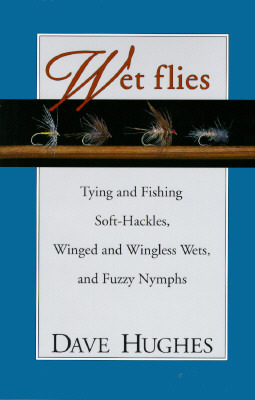
If you want to learn how to tie and fish wet flies, soft hackles, and fuzzy nymphs for trout, you can start by reading The Soft-Hackled Fly and Tiny Soft Hackles by Sylvester Nemes and Wet Flies: Tying and Fishing Soft-Hackles, Winged and Wingless Wets, and Fuzzy Nymphs by Dave Hughes. That’s what I did a long time ago, and I’m a better angler for it.
Too many fly fishing how-to books read like the dictionary — or worse, a quantum physics monograph. Not the case here. Both Hughes and Nemes write with a conversational style, perfectly weaving anecdotes with critical know-how.
The Soft-Hackled Fly and Tiny Soft Hackles is a combination of two of Nemes’ earlier works. It’s a pattern book for sure, but there’s also plenty of relevant storytelling. It’s loaded with peals of wisdom (“If you have never tied flies before, I urge you to start immediately. The practice is exhilarating.”) and hidden gems like using North Country spiders for steelhead. The purchase price alone is worth being able to tell someone that you’re catching all those trout on a size 20 Smut No. 1.

~
Hughes’ Wet Flies is likewise a pattern book, with multiple step-by-step photos and clear instructions. But it also covers history, wet fly types, and how to fish them. It’s a user-friendly read that exudes confidence in the patterns and the methods. My only complaint is that it’s a more western US-centric view of the subject. But wherever you live, you’ll find Wet Flies relevant (“Trout aren’t interested in neatness”). Note that there is now a second edition of Wet Flies, with new photos and patterns. I haven’t read it; I trust that it’s pretty darned good, too.
Farmington River Report 7/23/16: More mid-day magic
Today I had the pleasure of teaching the ways of the wet fly to a group from the NYC Chapter of TU. Thanks to everyone who participated; you all did a great job under some truly difficult (again) conditions. I saw improvement in all of you across the board — keep on keeping on, and the trout will surely smile upon you.
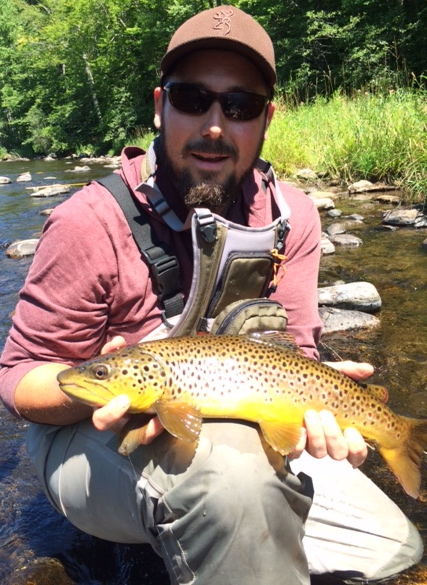
Speaking of smiles, we had a little of that mid-day magic again. Look what Jon found at the end of his three-fly team! This wild brown taped out at a full 21″. Taken in the fast water at the head of a pool around 11:30 this morning.
~
Last fish of the day for Jon. Not as big, but just as wild. Look at the white tips on those fins. One of very few actively feeding fish we saw today.

Note: they’ve lowered the flow from the dam. 165cfs and 64 degrees in the TMA. Unfortunately, it looks like a scorcher this week. Let’s all do a rain dance — or at least tweak for cooler weather.
The four wet fly food groups
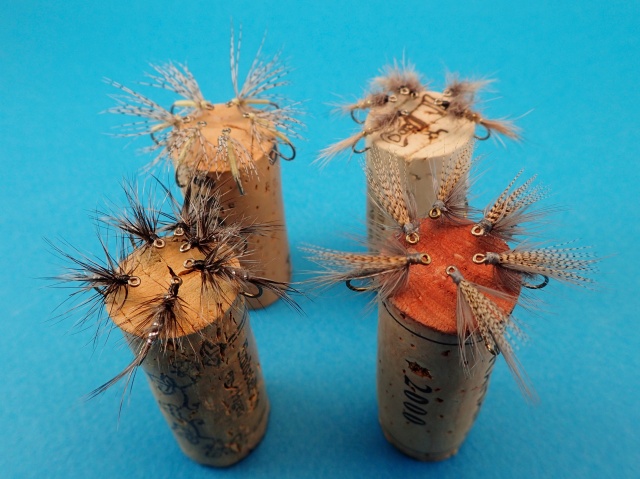
A half dozen each of soft hackles, wingless wets, winged wets, and fuzzy nymphs for an upcoming article. Counter-clockwise from upper left: Partridge and Light Cahill, Grizzly and Gray, Dark Hendrickson, Gold Ribbed Hare’s Ear.
How to built a wet fly leader for a team of three flies
One of the most frequent questions I get is, “How do you build a wet fly leader?” This material originally appeared in my article “Wet Fly 101: Take the ancient and traditional path to subsurface success” (American Angler Nov/Dec 2013) but I wanted to give it its own place here on currentseams.
At first glance, building a multi-fly dropper rig looks complicated. But basically, you’re just tying three triple surgeon’s knots. You’ll need a 9-foot, 3x or 4x tapered leader for the butt section, and some 4 or 6-pound Maxima (I prefer Chameleon [AUTHOR’S NOTE: I used UltraGreen four-pound in 2014 and it worked just as well as Chameleon]) for the droppers. I’ve tried a lot of different leader materials, and Maxima is by far the best because of its stiffness. I use the 4-pound in lower, clearer flows.
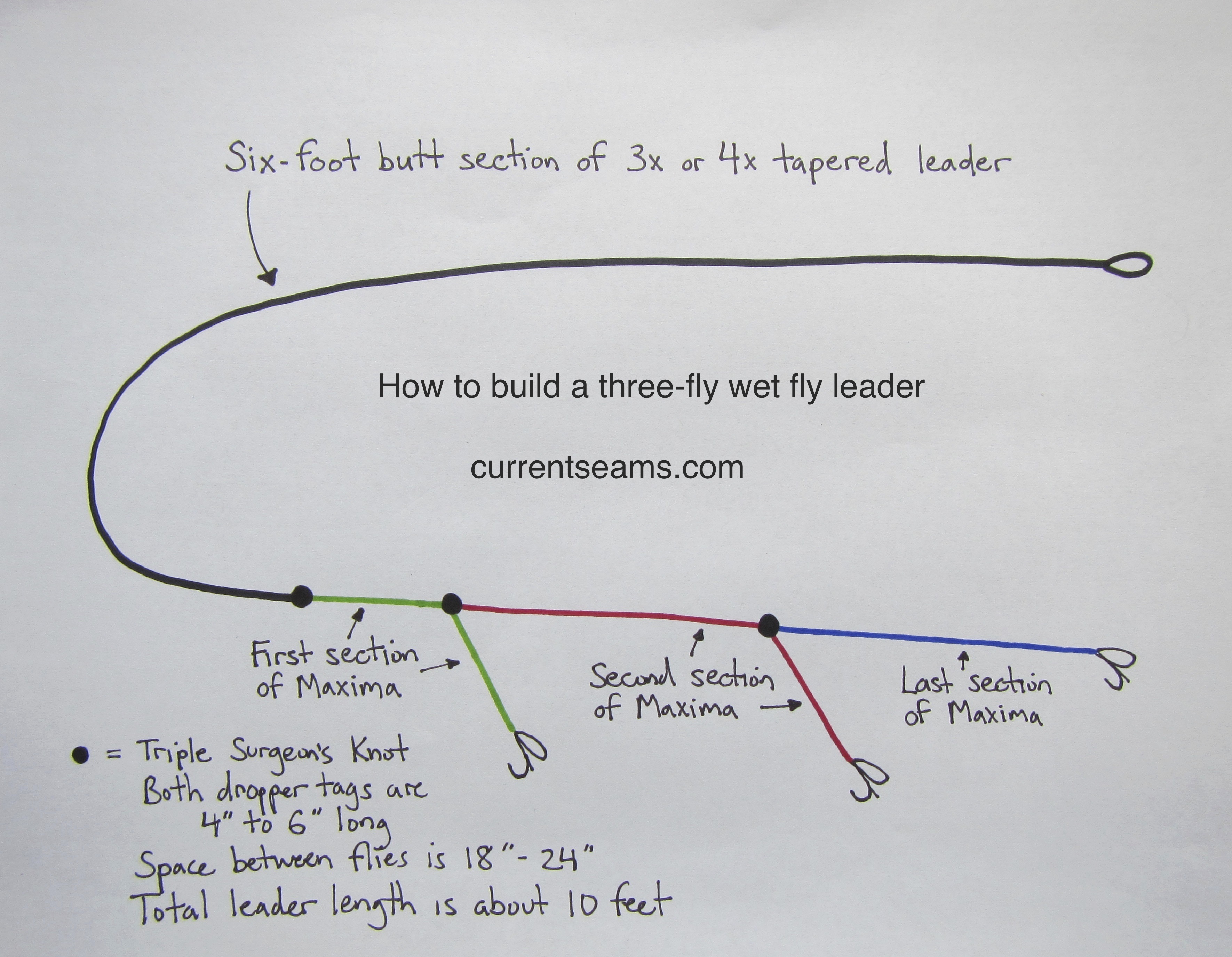
Here’s a pdf of the diagram: Three-fly wet fly leader
Step 1: Cut off the bottom three feet of the tapered leader. Discard this bottom section.
Step 2: Knots are not worthy of your trust. Wet every knot before you pull it tight, and test every knot by giving it a good tug. The heat of battle with a trophy trout is a bad time to discover you tied a substandard knot.
Step 3: Tie just over a foot of Maxima to the tapered leader with a triple surgeon’s knot. The bottom of this section will form the first dropper. Trim both tag ends.
Step 4: The ideal length between wet flies is somewhere between 18 and 24 inches; I prefer my dropper tags between 4 and 6 inches. If you’re going to build a dropper rig with the flies 24 inches apart and the tags 6 inches long, you’ll need a 30-inch section (24 + 6 = 30) of Maxima for the next step.
Step 5: Take the first, shorter section of Maxima (the one you tied to the tapered leader) and hold it 6 inches from the end. This will be your first dropper. Join the 30-inch section to the shorter section at this point with a triple surgeon’s knot.
Step 6: Trim the excess of the second section above the knot (the part you trim is on the butt side of the leader). You should now have a dropper tag about 6 inches long, pointing away from the butt, and about 30 inches of Maxima below it.
Step 7: You’re in the home stretch. This is basically a repeat of step 5. Grab the second section of Maxima 6 inches from the end, and join another 30-inch section of Maxima to it with a triple surgeon’s knot. As with Step 6, trim the excess above the knot.
Step 8: You should now have a rig that looks like the one the diagram: two shorter tags, to which you’ll tie dropper flies, and a longer end section, to which you will tie the point fly.
~
Good things happen when you give the trout a choice.

Farmington River Report 7/18/15: Wet, Dry, Pow!
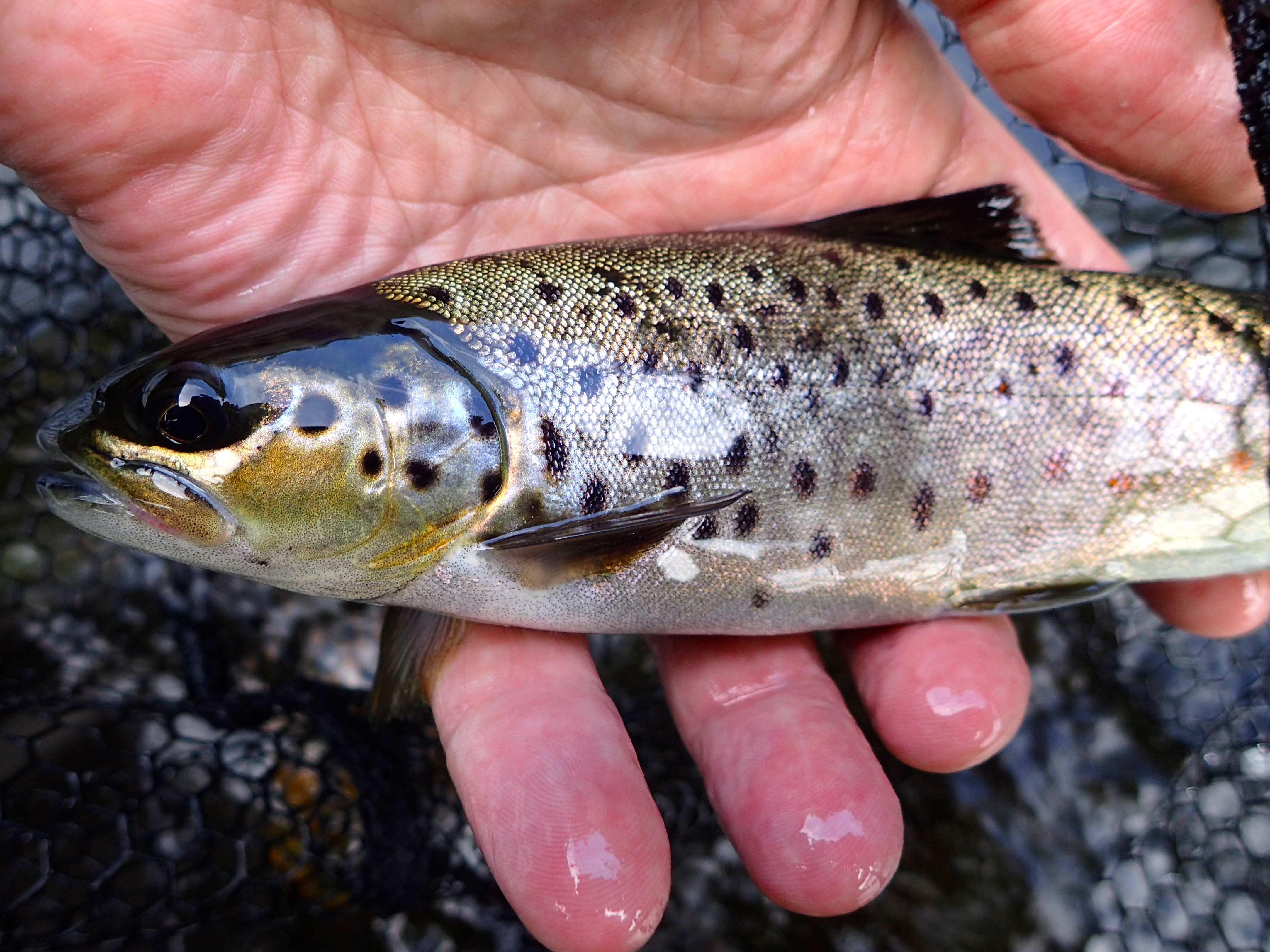
After the Wet Flies 101 class I wandered off to investigate a snotty, treacherous boulder field with a team of wets. From top dropper to point, a size 12 Partridge and Light Cahill, a size 12 Hackled March Brown, and a size 12 BHSHPT. The sulphurs and Isos were out, as were the Cedar Waxings, who were having a regular airborne feast. I witnessed several sulphurs make it out of the river, only to be snapped up by an open beak moments after their emergence. The wet fly fishing started slowly, but as the hour hand moved past 6pm, things picked up. I ended up with over a half dozen fish, all wild browns save for one recent stockee, that ranged from eight inches to the low teens. I took them on the swing, the dangle, and short line deep. Some of them were active feeders; it’s always fun to successfully target specific fish, but I’ll take the ones that aren’t showing themselves just as readily.
The smallest trout of the day, but surely one of the hardest fighters. He hammered the BHSHPT on the swing.
Part Two of the evening was dedicated to the dry fly cause. At least in theory it was. I fished a spot that has seen declining numbers in fish in recent years, and sadly, that trend continued last night. I saw only handful of rises over the course of two hours. (I think I saw two dozen rises as I drove over the bridge at Church Pool earlier in the day.) Some olives and stenos, but not many of them. I was able to get two offers to the dry, but no hook sets.
Now well into dusk, the dry skunk would have been a bummer way to end the day. So I took the long way home and walked a pool with a nameless cone head black marabou streamer tied to the end of my leader. Plenty of bumps as darkness fell kept me entertained, but no hookups meant the fish were smaller than the foot-and-a-half-plus browns I was after. Off to Spot B where I couldn’t see squat due to the dense fog bank that had settled over the river. A bit of a disappointment with only one bump and no hook sets. (I know there are some bigger fish that live there. Where you at?)
Finished up at Spot C with an olive Zoo Cougar. The fog enveloped me with its chilly fingers, but I could now see some stars in the clearing skies. It was quiet.
Quiet enough to hear the sound of the brown as it tracked the streamer down and across the current. Bump! No return strike. A second cast to the same general area, same swing, same retrieve, same sound effects…Whack! There he is, a mid-teens brown that put a smile on my face and a skip in my wading step.
Then, a few minutes later…plop. I heard the fly hit the water. CRASH! The sound of the take came before I felt the tug or even managed to get the rod into post-cast position. Another good fish, not quite a bruiser, but aggressive enough to charge headlong at what must have looked like a most satisfying dining experience.
Speaking of food, I was famished. So I sped off to the McDonald’s in Unionville, which I discovered is closed at 11:30 on a Saturday night. Really? Closed? Saturday night? Contrary to the corporate tagline, I wasn’t lovin’ it.
That last brown must have felt the same way.
Thank you UpCountry and everyone who attended my Wet Flies 101 class
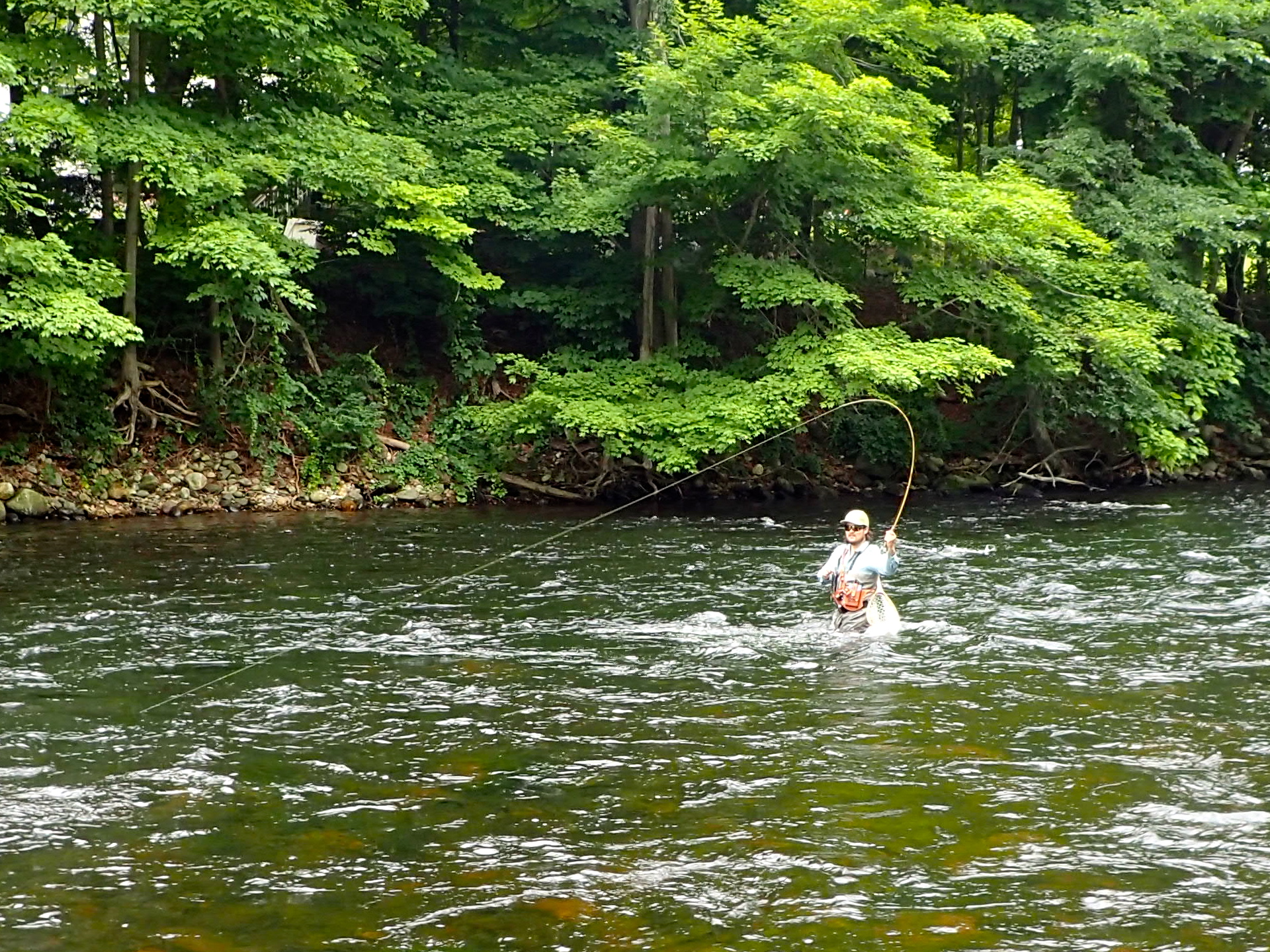
The rains held off and we had a fine (if not humid) overcast day to swing some wets on the Farmington. BWOs, Sulphurs, and Isonychia joined in the party. Many thanks to UpCountry Sportfishing for hosting me. Many thanks to Dick, Matt, Mike, Rhonda, and Wayne for participating, and for asking so many good questions (as you learned, I love talking about fly fishing). You were a great group to spend the afternoon with, and a pleasure to teach. The trout were semi-cooperative, and we found several willing to jump on. Keep on keepin’ on, gang, and you’ll see the subsurface dividends start to roll in. Special thanks to fellow Farmington River guide Antoine Bissieux for so generously sharing the water.
We like bent rods at Wet Flies 101. That’s a seven-foot 3-weight fiberglass stick Mike is doing battle with.
~
One of several trout brought to net. Good job, group!

Farmington River Report 7/16/15: It must be magic
I guided Jim yesterday afternoon into evening, and we started in some faster water in the permanent TMA with a little Wet Fly 101. While we found a few feeders, they were reluctant to jump on. So we headed up river to get situated for some topwater action during the evening rise.
A sulphur emergence of sorts. No editing legerdemain here; some funky macro setting on the camera did this. We had a nice assortment of bugs last night: Sulphurs (14-16), Summer Stenos (18-20), Isonychia (10-12), BWOs, (14, 18-20), and midges. However, the spinner fall was not what I had hoped for. Every day — or evening — is different. Cold again! Water temp in the permanent TMA was 58 degrees. 
~
A nice brown that absolutely hammered Jim’s size 20 BWO Comparadun. Terrific hook set by Jim on this fish. 
~
Same fish, moments before release. 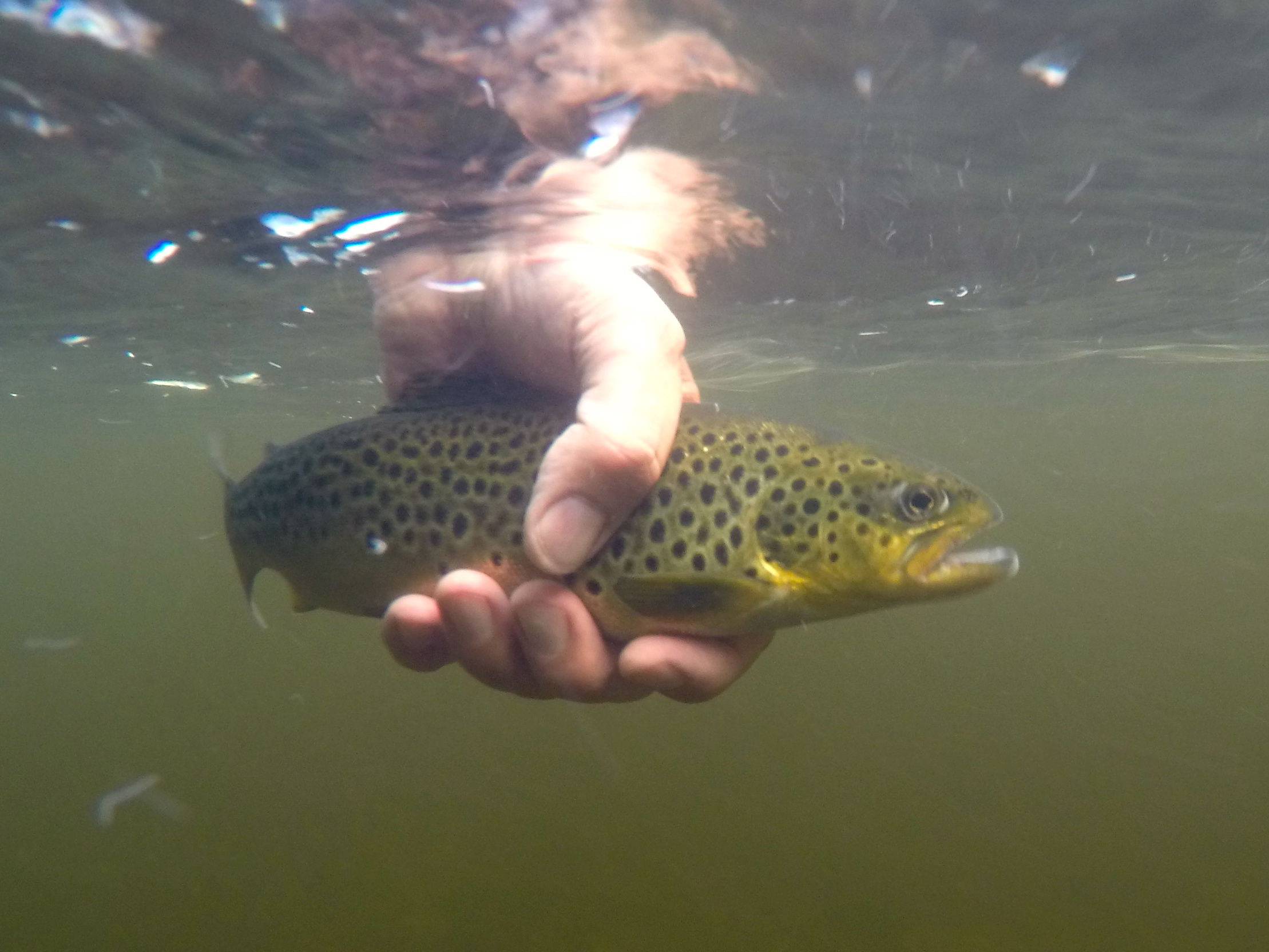
~
I waited until what I thought was the right moment during the hatch to introduce Jim to The Magic Fly. This is what happened on his second cast ever with that pattern. Another fat, beautiful wild Farmington brown to net. Jim did a great job, and was a pleasure to fish with.

~
After Jim left, I banged around the river in the dark from 9:30 to almost 1:00am. While I had plenty of action — close to ten bumps — most of them were smaller fish, with no resulting hookups. Here’s a fifteen-inch brown who did stick. I like the play of water and flash along his flanks. 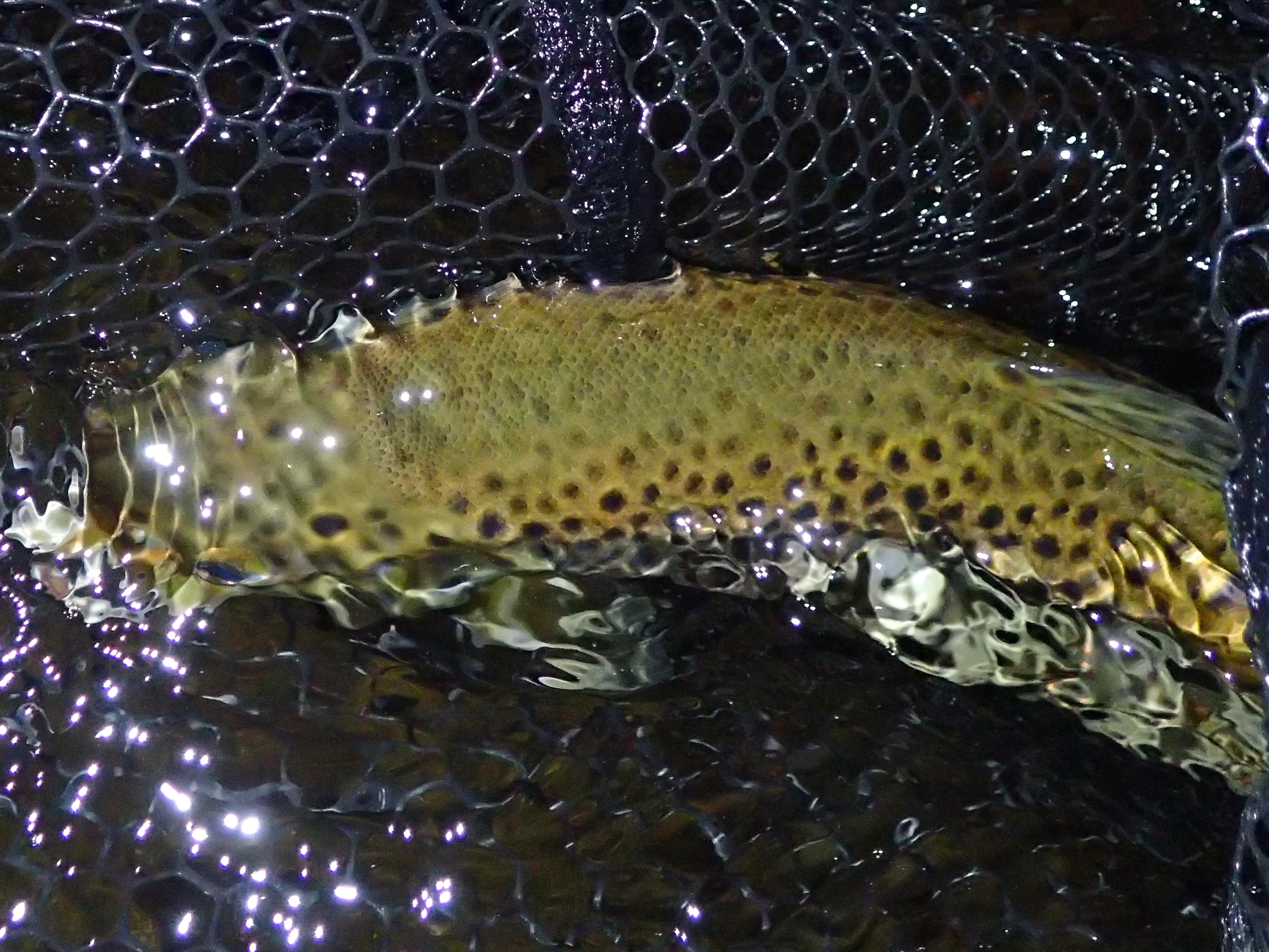
Monster Delaware brown on the Magic Fly
I received this from Keith A. last night:
Hi Steve,
Want you to know that I just caught a monster brown, at the Delaware river, on one of the flies that you tied for me. Size 18. My guess is 24+”.
Thanks,
Keith
No, Keith. Thank you. And well done!
In proper nomenclature, these would be Pale Watery wingless wet variants. I think, however, that Keith would cast his vote in favor of calling it The Magic Fly.

Farmington River Mini Report 5/15/15: Trout (nearly) everywhere
Fished from 11:30am till 3:45pm today with the goal of hitting seven spots. I made five, which doesn’t suck. What doesn’t suck even more — or is that less? — is that I found trout willing to jump on in four of the five places I fished (two within the permanent TMA and three outside it — wouldn’t you know the only place I blanked was inside the TMA). I spent most of the time dedicated to the nymphing cause, but at my last stop I switched over to a team of wets and connected with a fat rainbow on a size 12 Dark Hendrickson wet. All the trout today were rainbows.
They bumped up the flow from the dam, and we currently have about 275cfs of cold water coming through the permanent TMA. I didn’t take a temp, but I’m guessing 50 degrees — if that. Hatch activity was slow: caddis, midges, some BWOs, a few stray Hendricksons. There were very few rising fish, even with the low water levels, and what was rising was doing so sporadically. Damn fine weather, and a lovely day for a post-lunch Rocky Patel The Edge Toro.
Fred here smacked my size 12 copper bead head UV pink hot spot dark hare’s ear nymph like it owed him money.


