You haven’t heard from me this week because I’ve been busy. Some family stuff, some business stuff, and, oh, by the way, fly fishing the Farmington River. I fished Monday late afternoon into dark; Tuesday 7pm-dark; and yesterday I guided Max in the afternoon, then finished off the day all by myself till dark. Rather than divy the days up, I’ll give you some hard data to digest. But first, yesterday’s session with Max.
Max wanted to learn the ancient and traditional art of wet flies, and after several years of missed connections, we finally made it happen. It was worth the wait, as conditions were nearly ideal for wet fly: 165cfs in the PTMA and 247cfs downriver, water running clear and cold and plenty of bugs. We started off in the PTMA, and sulphurs were the story. We spent the first hour doing a streamside classroom, then entered the water around 3pm. In the space of an hour we stuck six fish. Like many anglers new to swinging wets, Max found the hook-setting process a challenge — you’ve got to wait before you set and let the fish do most of the work. We moved downstream below the PTMA and once Max found his “are-you-still-there?” equilibrium it was lights out. We stuck a bunch more, and Max did a great job of getting his flies over feeding fish and managing his drifts. Well done!

Now to my observations. This is a wonderful time to be fishing the Farmington. You’ve got actively feeding fish and bugs from daylight to dark. Witnessed: sulphurs, tan caddis, dark grey caddis, March Browns, Isonychia (well below the PTMA) midges, BWOs. All three days saw a prodigious number of sulphurs on the water and in the air from late afternoon to about 8pm.
The lower water and cooler temps aren’t hurting the wet fly fishing; but you’ve got to pick and choose your locations. Any wet fly success I witnessed and experienced came in broken water 1-3 feet deep that was moving at a brisk walking pace. Slower, languid water, even when loaded with active feeders, proved unproductive. The trout in the slower water seemed to be be keyed on spinners (present even in the late afternoon) and I had only a few half-hearted tugs to show for my wet fly efforts. Faster water was money, even when there were no visibly feeding fish.
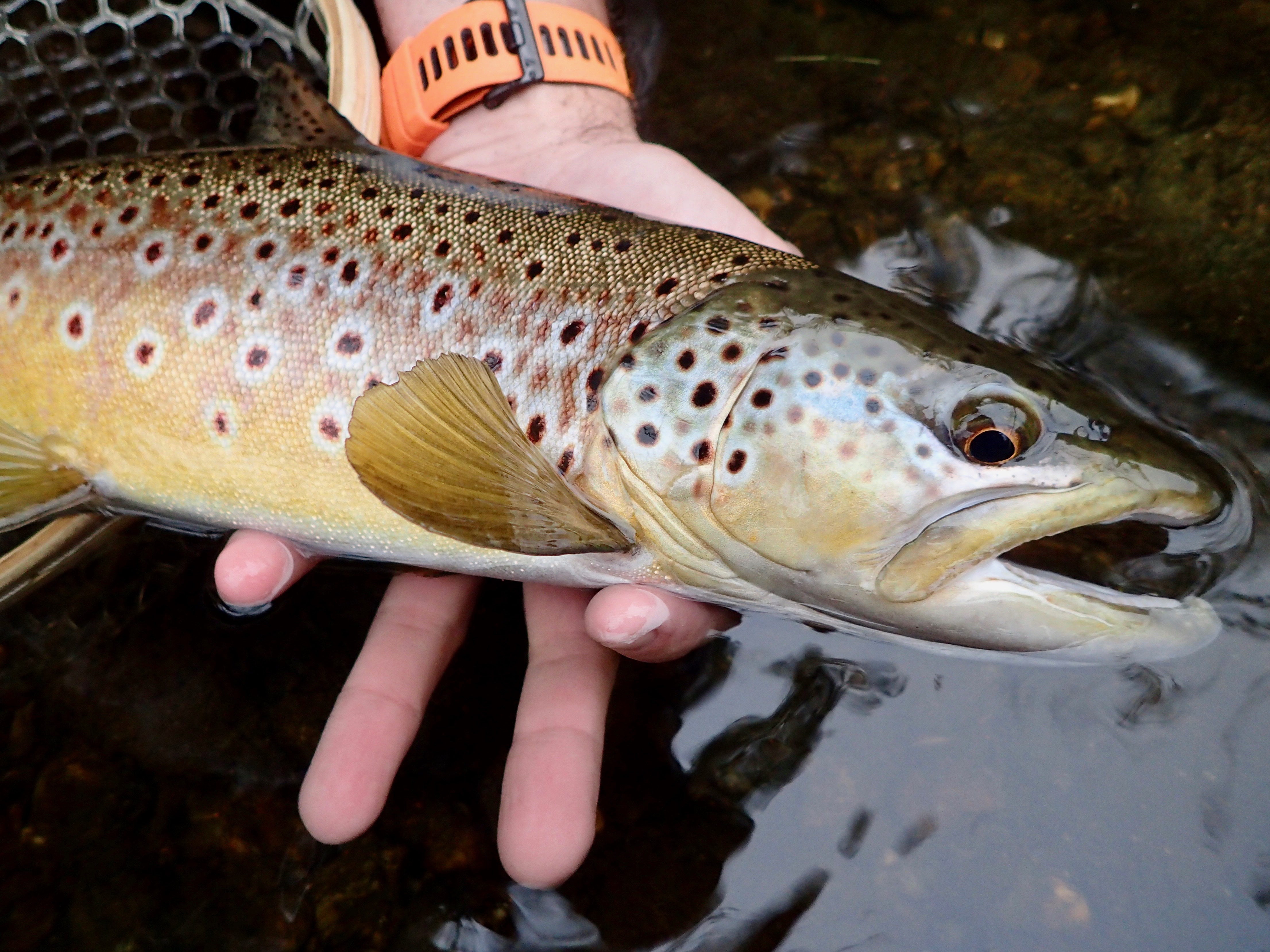
Finally, the evening dry fly bite was been vexing me (says the guy who was featured in a movie about dry fly fishing on the Farmington). We all put our waders on one leg at a time, folks, and I’m your proof. Monday, it was a lot of bad luck: I had about a dozen swings and misses by the trout, connecting with and landing only three. Tuesday, I hooked and landed a trout on my first dry fly cast; it was all downhill after that. The slot I was fishing was far less populated with rising fish than the night before; there were more swings and misses, and I only stuck one more fish into dark. Then a wind and rain squall blew in and stopped the feeding dead in its tracks.

Last night, I had the place all to myself…and about 400,000 size 16 Sulphur duns and spinners that littered the surface of the run I was fishing. My target drift lane bordered frog water and classic glassy dry water. The fish seemed to move at will from sipping spinners to slashing at emergers, and sometimes doing both. Duns were everywhere on the water and were largely ignored. With so much food in the water, I again had trouble buying a strike, let alone trying to figure out what they wanted. In 90 minutes I was able to hook and land two trout, one on a size 16 Magic Fly fished dry and the other on a size 14 Light Cahill. At 8:45pm, the feed went from an 11 to 1-and-done. I think the cold weather has changed the usual pattern of feeding long after you can see your fly.
Get out there, folks. It’s really, really good, even when it seems like it isn’t.


 currentseams.com