Three things striper fly tyers (and anglers) could learn from Gary LaFontaine

As I continue to pore through Gary LaFontaine’s masterwork Caddisflies, I’m reminded of the sheer volume of universal concepts that apply to fly fishing. So, even though he’s talking about fishing for trout that are feeding on caddisflies, LaFontaine could easily be talking about stripers feeding on sand eels or grass shrimp. A true maverick, he isn’t afraid to think or act differently, to challenge conventional wisdom, or conduct experiments to prove his theories. (Listen to the science. You’ve heard that one before) The more you fish for trout and stripers, the more you begin to see patterns and similarities between the species and how you should be fishing for them. Here are three themes in Caddisflies from which I think striper anglers and fly tyers who want to dramatically elevate their game could benefit.

Realism is the least important factor in fly design. I don’t have the actual stat, but I’m comfortable in saying that nine out of ten striper baitfish patterns feature glued on, ultra-realistic eyes. (Other than on these pages, when was the last time you saw a squid fly without big googly eyes?) If realism, from eyes to full-bodied profile to opacity to exact coloring, etc., is so important, how come my baitfish flies (and yours, and everyone else’s) continue to catch stripers long after they’ve literally been ripped to shreds? It’s a rhetorical question, but I’ll answer anyway. It’s because the bass are keying on certain bait or environmental characteristics that serve as bite triggers, and those triggers are still present in the remnants of the fly. LaFontaine knew that making a favorable impression on the fish — by showing them at least one primary feature or action that identified the fly as something that looked like what they were eating — was far more important than rendering a carbon copy.

I get this all the time: “That doesn’t look like a squid.” But Ken AbramesMutable Squid isn’t designed to “look like a squid.” It’s designed to create the illusion of life. I don’t know what stripers think it is, but they’ve eaten this fly enough times for me to know that they think it’s something good to eat.

Energy efficiency is the reason for selective feeding. Fish, especially bigger ones, are essentially lazy. So when they’re glommed onto grass shrimp in a feeding lane, you can engage in the futile activity of ripping and stripping a big fly past them, or deliver what they’re eating to their waiting mouths. This is why there is no one-size-fits-all “go-to” striper fly — and why learning presentation with a floating line is so important. Match the hatch, learn its nuances, make it easy for the stripers to feed, and you’ll catch more bass.

Fish are not intelligent. There is no such thing as an educated striped bass. Fish cannot reason. They are programmed for survival, and these primal forces have nothing to do with fly fishing or why you can’t fool that lunker. The fish is simply doing what’s it’s doing, and it’s up to you to crack the code.
Reminder: ASMFC Striped Bass Amendment 7 PID comments due Friday, April 9

If you care about building a sustainable striped bass fishery, please take a few minutes to send your comments. Here’s the link to last week’s post that gives you everything you need to know about the ASGA’s position/plan, and how to submit a comment. Thank you.

Words flowing through the writing pipeline

Busy-busy-busy is the word around currentseams headquarters these days. I’m pleased to announce that I have a couple projects in the works for Field & Stream. Both are striped bass related. The first is how to make a best fishing days striper calendar; the second on lessons that striper fly anglers can glean from surfcasters. I’ll let you know when they come out and how you can read them. But since I have not yet taken fingers to keyboard, off I go to my lonely writer’s garret…

I’ll be tethered to my laptop for the next several hours.

The Return of the Currentseams Tuesday Night Zoom! “Lessons of 2020” Jan 5, 8pm.

I’m excited to announce the first Currentseams Tuesday Night Zoom of 2021: tomorrow, January 5, 8pm. This is a free event. I want to talk about some of the lessons I learned and re-learned last year, and how you can use that information to catch more fish. I’ve got some cool video to share, so you don’t want to miss this one. Feel free to share with your friends or on social media. See you Tuesday night!

If you’re already on my Zoom email list from last year, you know the drill. I’ll send out the Zoom link tomorrow. If you’re new to currentseams and want to get on the Zoom email list, please send me a request at swculton@yahoo.com.

Striper Report 11/11/20: Precious few mouths at the mouth

Another short and sweet (or bitter, depending on your POV) striper report: fished the mouth of the Housatonic today for two hours. We had a good tide, overcast skies, and a falling barometer, three elements that should have made for a terrific outing. Unfortunately, Mother Nature forgot to CC the bass on the memo. Not a touch for me, both deep and on the surface. In fact, I saw only three three teens-inch bass caught in two hours among ten or so anglers, and it was all two guys fishing one small pocket. Deciding that you cannot catch what isn’t there, and having had enough two-handed casting practice, I skedaddled just before low tide.

Not from today. In fact, it was as warm a November day as I can remember down there. The most excitement I had was when a bird went fishing for my fly. I was relieved that the pull produced no hookup.

Tiny bait, lots of bait = a good time for droppers

I fished three marks in SoCo last night, and while the striper action was slow, the bait story was consistent: smallish to tiny, and lots of it. Confirmed sightings: silversides, anchovies, peanut bunker, and I may have seen a stray finger mullet.

My night began in the surf, but the meatball factor (bright headlamps used early and often) and a lack of action had me moving to Spot B, an estuary with a moving tide. Lots of bait, too few marauders.

I finished the evening at Spot C, some skinny water on flat, just as the tide began to flow out. Lots of worried bait in this location, and it’s a perfect place to fish a team of three. I had 2″ long Ray’s fly on top dropper, a Magog Smelt bucktail in the middle, and a micro Gurgler on point to do double duty as a suspender and waking fly. I was disappointed with the number of assembled diners, but it is what it is and you do your best. Two fish to hand in 45 minutes and I was satisfied, abetted in no small amount by a Rocky Patel Vintage 1990 corona and a come-from-behind Mets victory.

In case you haven’t seen it, here’s a quick refresher.

Block Island Report: If you can say, “It’s a braw bricht moonlicht nicht,” then you’re not catching stripers.

Those of us who grew up with off-the-boat Scots grandparents know the song “Wee Deoch an Doris” well. For the uninitiated, as you have not heard it, I shall proceed to translate and offer context. The song is about having one more drink before you head home. “If you can say it’s a braw bricht moonlicht nicht” (if you can say it’s a good bright moonlit night), then you’re a’ richt, ye ken (not nearly as intoxicated as you may think). So, have another.

That also made me think of Chip Diller getting his paddling in the Omega initiation scene from Animal House.  I might as well have been saying “Thank you sir, may I have another,” to the moon this past week, because when it was out and braw and bricht I took a right spanking.

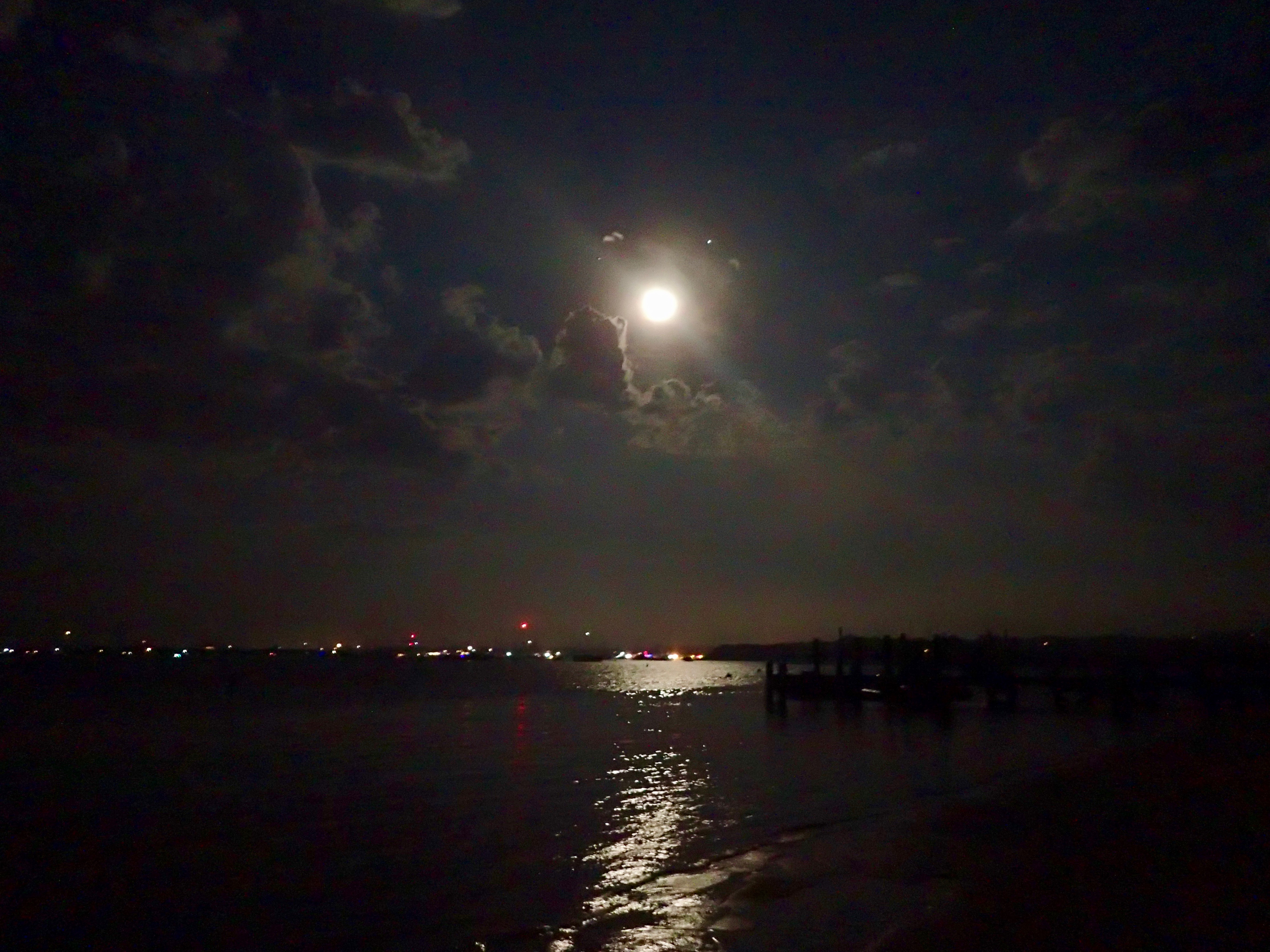
To misquote Starbuck, moonlight feels wrong. I lost the moon lottery big time — quarter going into full is by far my least favorite time to fish for stripers at night.

OLYMPUS DIGITAL CAMERA

I won’t bore you with the minutia, but here’s the story in numbers: Seven nights. Three skunks, including two in a row. The last time I took such a beating was 2012 or 2013. For context, I had one skunk in my last 15 Block outings over the past two years. I ran into an angler — I’ll call him “J” — whose response to me telling him that I hated fishing under the full moon was, and I quote, “you’re crazy.” Now, I appreciate J’s enthusiasm and confidence. And I desperately wanted to be proven wrong. But the fact is, whether flat or surf or dredging deep bottom, I scored a big, fat zero — not even a courtesy tap — on every night the moon was out.

To continue the kvetching, size — or lack of it — continued to be an issue. Used to be that I could count on Block to produce a high percentage of legal fish. Heck, in 2018, a third of the bass I landed were over 28″. This year, not a one. OK, so there were no micros in the mix, and a 24″ Block bass battles like a 30″er from the Hous…but the continued lack of bigger striped bass from the shore is disturbing, although not surprising.

Was it all misery? Heck, no! I had four fun-filled nights, three with double-digit numbers. I played around with my fishing schedule and was able to beat the moonlight — even this old dog can adjust. One night the weather gods appointed a magnificent cloud bank to shroud the Island. The stripers said yes. And I got in some seriously wonderful trout fishing for stripers.

I’ll tell you more about it soon.

Stripers Forever “Release A Breeder Club”

This just arrived in the mail and it seems like an artifact from another age. While I’m proud to say that I’m a three-time member (all on the fly while wading, which makes it even more of a challenge) it didn’t happen last year and I don’t see it going down this year, either. Of course, I’m quite willing to be proven wrong.

In case you’re unfamiliar, Stripers Forever is an organization whose mission is to make the striped bass a gamefish. The “Release A Breeder Club” was started years ago to encourage anglers to release stripers over 36″. In today’s climate, that’s a no-brainer. Plus, you get a spiffy certificate to display your worthiness. Keep the fight short, keep ’em wet, let them do their job to repopulate the East coast!

OLYMPUS DIGITAL CAMERA

Tying the R.L.S. Mutable Squid Flatwing

Tucked away in the back pages of Ken Abrames’ masterwork A Perfect Fish are three squid patterns you should have in your box: the R.L.S Indigo Squid, the R.L.S. Orange and Blue Squidazzle, and today’s tying feature, the R.L.S. Mutable Squid. Don’t be mislead by the fact that these patterns didn’t make the main squid chapter of the book; Ken thinks highly of them, particularly the Orange and Blue Squidazzle. Perhaps the under-rated gem of the bunch is the Mutable Squid.

If you do know diddley-squid, you know they can change their colors in an instant, so the name is apropos. I only fished this fly once, and it produced — stripers love squid — so I figured it was time to have another in my box. And here it is, hot off the vise, for your viewing and tying pleasure.

R.L.S. Mutable Squid

OLYMPUS DIGITAL CAMERA

Hook: Eagle Claw 253
Thread: Gray
Platform: Light gray
Support: Gray neck hackle
Tail: First, a medium-gray saddle, second, a ginger saddle, third, 4 pearl Flashabou, fourth, a pink saddle, fifth, 5 strands Flashabou one each red, gold, blue, emerald green, purple, sixth, a medium-gray saddle.
Body: Light blue braid
Collar: Bucktail, medium gray, bottom and both sides
Wing: Bucktail, medium gray
Cheeks: First, 3 hairs each orange, turquoise, chartreuse, violet, pink; second, Lady Amherst pheasant tippets, one each side.
Eyes: Jungle cock


OLYMPUS DIGITAL CAMERA

Tying Notes: Construction should be intuitive. I used 6/0 thread and a 3/0 hook.  I chose hair from the lower part of the bucktail for the collar and wing to get a bit of flaring action (the fly has not yet been shaped). The flash is 1″ longer than the saddles, giving this tie a total length of 8 1/2″.


Block Island All-Nighter X: The X Factor

You never know what you’re going to get on a Block Island All-Nighter. My tenth reminded me that I’m not young anymore. The spirit is willing, but after nine straight hours and no sleep, the body protests. The last time I did this was 2015 — I had to look it up — but the conditions were perfect in terms of tide (high at dusk), moon (new) and weather (consistent SW flow), so going was almost an imperative on principle alone. Besides, I’d have company, old pal Peter Jenkins, owner of The Saltwater Edge. So off we went aboard the 7pm ferry.

Logistics were a challenge. Be advised that fewer ferries are running and passenger numbers are limited. We couldn’t get a car reservation, and taxi service on the Island was deemed spotty due to the current situation. That meant renting a Jeep, which worked out just right. Here’s Jenks doing some leader prep as we sail past Crescent Beach. I like a simple 7’6″ straight shot of 25# or 30# mono. Block bass are not leader shy.

Jenks

~

Angler traffic was light throughout night, as a few hardy souls came and went. The bass traffic was similar: not here. Then here. Then gone. No large schools or consistent feeding. But the fish that showed came to eat. I had the early hot hand with a half dozen bass by midnight. Then Jenks caught fire. No keepers in the mix — I had bass in the 20″-24″ range with a couple 26″ers thrown in. What the fish lacked in size was made up for in pugnacity. Here’s a scrapper from early on. 

OLYMPUS DIGITAL CAMERA

~

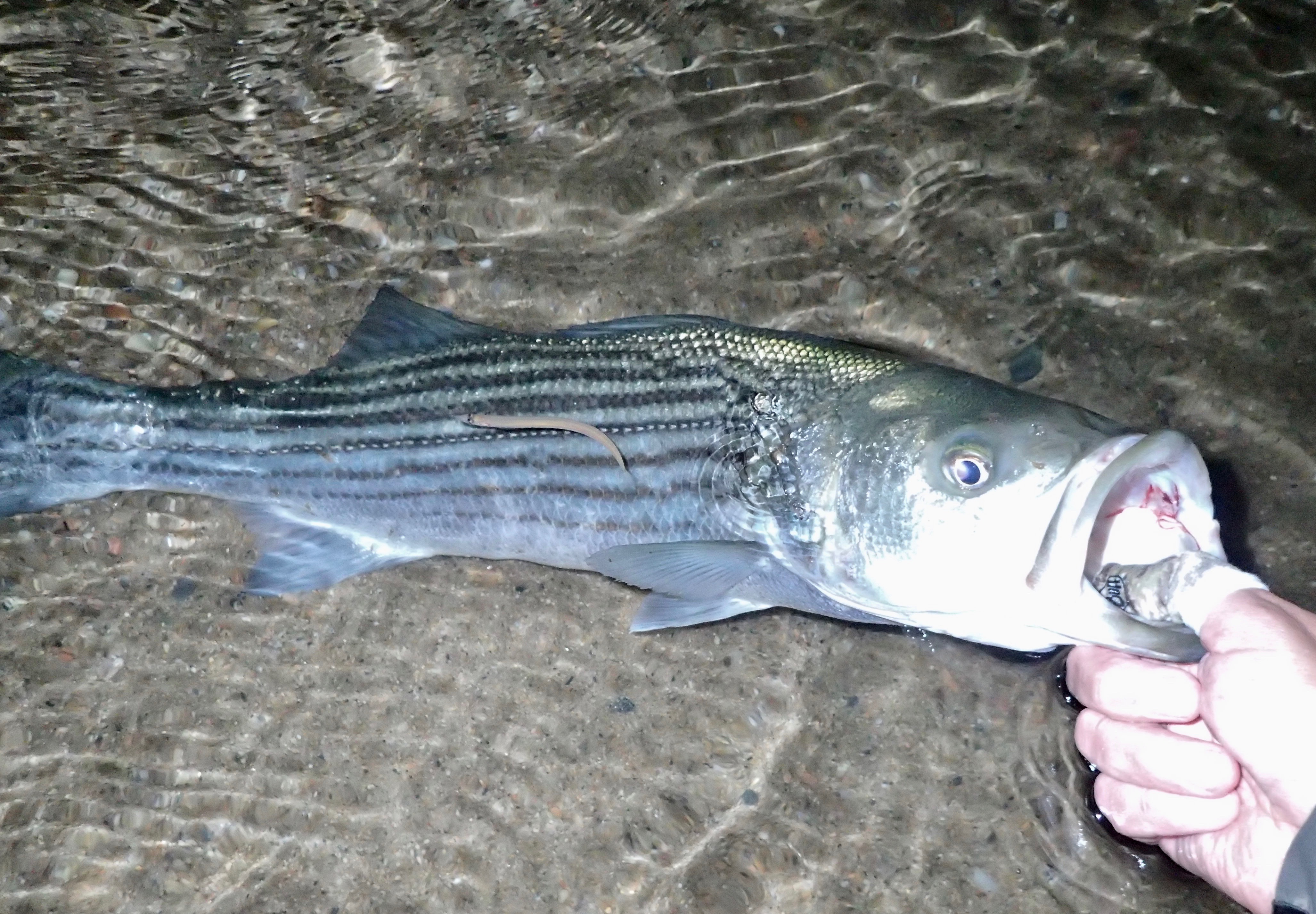
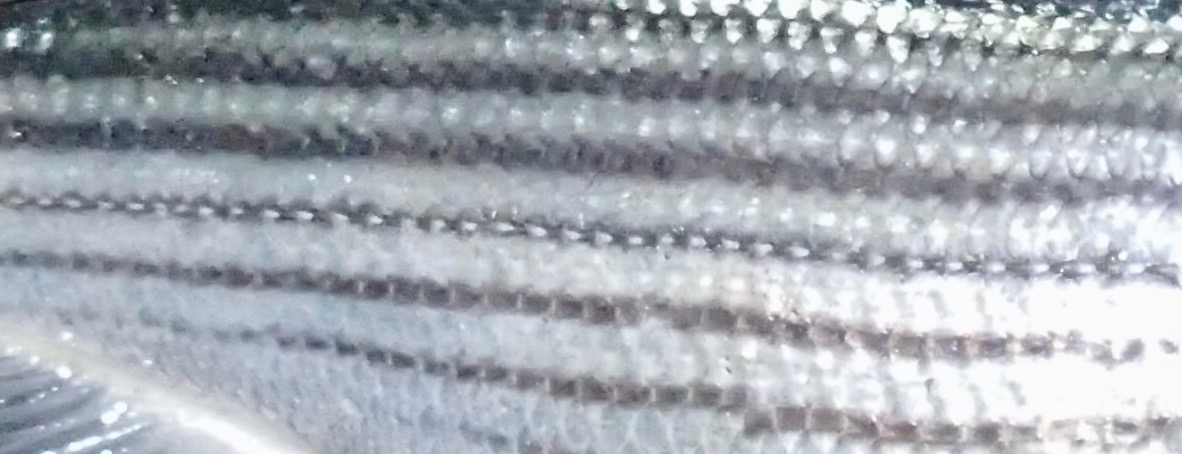
I’m often asked, “How do you figure out what the bait is?” I suppose by now I qualify as a old salt, and old salts know that this time of year on Block it’s sand eels, sand eels, sand eels. You can feel then plinking and ploinking against your waders if you shuffle your feet. And sometimes the answer can be found in a photograph (look along the lateral line).

OLYMPUS DIGITAL CAMERA

~

The Big Eelie is a high-confidence pattern for me on Block. I fish it on a floating line on a dead drift, or with very short (6″) erratic, drunken strips. It doesn’t matter what color I choose (and I fish everything from dark to lighter fluorescents to dull hues) — it’s a profile and action pattern. And, as you can see, the bass love it. This used to be a beautiful Crazy Menhaden Big Eelie. Now it’s missing two saddles and most of the marabou collar. I was still catching on it when I switched it out at false dawn for a…wait for it…Big Eelie in RLS False Dawn colors.

OLYMPUS DIGITAL CAMERA


We did some surf fishing on the west side after midnight and again at sunrise. Conditions were about as good as you could hope for: a moving tide, moderate surf, and best of all, no weeds. Fish were present both times: stripers in the dark, and bass, bluefish, and shad in daylight. Here’s one that went bump in the night.

OLYMPUS DIGITAL CAMERA

~

There comes a point in the wee hours — for me, it’s usually around 2:30-3:00am — where the gas tank nears empty and the boilers almost out of steam. That’s when I take five (literally). It may seem counterintuitive to introduce a central nervous system depressant into the equation, but after closing my eyes I poured a wee drap of Highland whisky (Old Pulteney Navigator, which seemed highly apropos). I re-slogged out to the beach just before false dawn, and wouldn’t you know? I had hits on my first four casts. Never underestimate the mojo of single malt and a cigar! 

WeeDrap

~

7:00am. Breakfast at Ernie’s. Hungryman Special: two eggs, two pancakes, bacon, and toast. (Thank you, Jenks, for being such a swell fishing partner.)  It feels amazing to have your first real meal in 12 hours. That hard wood bench on the ferry is going to feel even more amazing. I was lights out before we left the harbor. I don’t remember if I had any dreams, but right now I’m drifting off to a place where that sharp tug tells you the bass has committed to your fly and the ensuing battle is a bulldogging fight that only a Block Island striper can produce.

Ernies