I will once again be appearing at the Fly Fishing Show in Marlborough, MA (January 21-22-23) and Edison, NJ (January 28-29-30). I don’t yet have a schedule of my events/classes/etc., but when I do you’ll be the first to know. I’m excited to get back to the shows, and I look forward to seeing you, saying hello, and helping you catch more fish!
I fished the last two evenings at various marks in SoCo and enjoyed….not a touch. Well, that’s not entirely true. I felt every weed that brushed against my three fly team. Last night I accidentally snagged a few small menhaden. But nothing living that could be measured in pounds came in contact with my fly.
I fished inside a breachway in moving water, incoming and outgoing; in a pond area of an inflow; off a jetty; and from the beach. Not even a courtesy tap. I saw and heard a few stripers, but they were small and their presence fleeting, and I never really had a good shot at a target. Bait, on the other hand — wow! Masses of bait everywhere. Silversides, menhaden, and mullet in mother lode Vegas jackpot numbers everywhere. I don’t think I’ve ever seen such immense, dark clouds of menhaden.
The fighting is rounds. This was round one.
I’ll take menhaden. Look for an upcoming article from me in Field & Stream on matching fall run bait with classic striper flies.
I wish I had all good news for you, but once again we will be experiencing challenging conditions on the West Branch. Let’s start with flows. The Labor Day weekend party is over as they’ve jacked up the dam release to 1,100cfs:
And we’re back to water temperature rearing its ugly head. Look how the release temp spiked with the increased flow:
In a word, ugh. There’s nothing to be done about the flow increase, as the MDC needs to maintain a certain safe reservoir level in case of hurricanes. But the news isn’t all bad. Torrey Collins says the Still River is actually a cooling influence, and the long range forecast calls for overnight lows mostly in the upper 50s, so that’s going to help. Who knows when the DEEP will stock, or if they’ll even do a Survivor Strain broodstock gathering. I’ll do my best to keep you posted. In the meantime, I’m heading for the salt.
You can read my newest piece, “8 Flies Smallmouth Bass Can’t Resist,” right now at Field & Stream online. Even if you’re more of a trout person, I’d recommend giving it a read as many of the patterns translate to the Salmo family. Naturally, I’ve included a few of my own bugs, like the August White and the Countermeasure. Besides, it’ll give you something to do while waiting for all this water to recede…
I’m pretty sure this guy ate a TeQueely, one of the featured patterns in “8 Flies Smallmouth Bass Can’t Resist.”
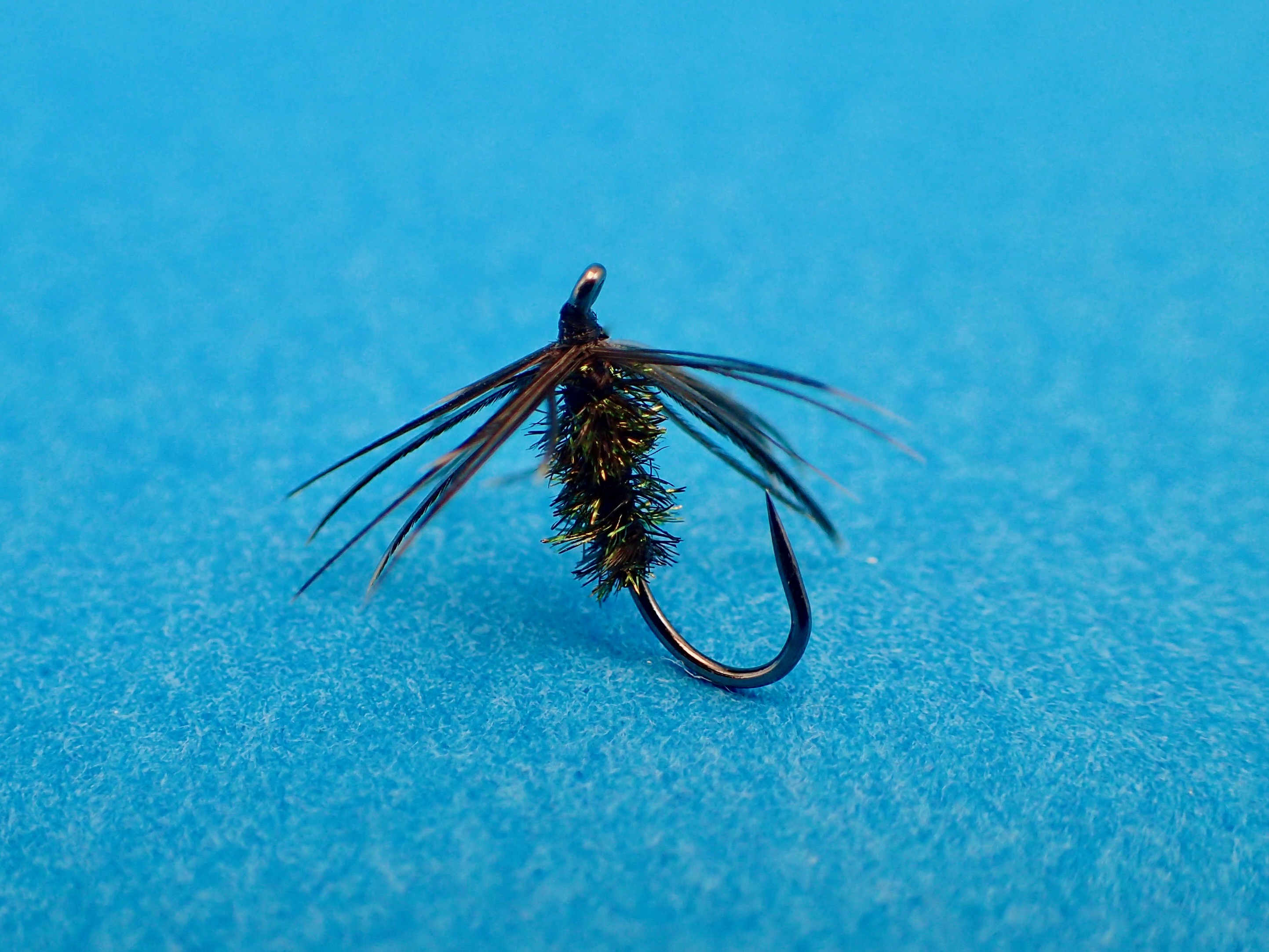
Stripers love finger mullet, and I love this finger mullet fly. You’ll find the September Night pattern in Ken Abrames’ classic Striper Moon, and now right here. (And, of course, in my 2015 American Angler article Soft Hackles For Striped Bass.) I was already planning on making this post today, and when I spoke with Ken an hour ago he — unprompted — mentioned that it was indeed September Night time. To the bench!
Ken Abrames’ September Night
Hook: Eagle Claw 253, 1/0-3/0; Thread: white 6/0; Tail: 30 gray bucktail hairs, then two white saddle hackles tied in flat, then two strands silver Flashabou; Body: silver braid; Throat: sparse, long white bucktail tied as a 3/4 collar, both sides and bottom; Collar: white marabou, folded or doubled 3-4 turns; Wing: 30 long white bucktail hairs, then 15 purple bucktail hairs, then 2 strands blue Flashabou, then one natural black saddle hackle.
What a disaster summer this has been for major river fishing in Connecticut. Pity the poor Farmington: too much rain, too much flow, too much warm water. Its current story is best told by these USGS Waterdata graphs.
They’ve jacked up the flow again. At this rate, we may not have any stratification of reservoir water for weeks…or perhaps months.Water coming out of the dam is already at a trout-unfriendly — and that’s sugarcoating it — temperature. Who knows what heated horrors exist downstream below New Hartford? Nature will find a way for some trout. Many will not be so lucky.
I regret being the messenger of such dire tidings, but it is what it is and there’s nothing we can do about it. Suffice to say, please don’t fish for trout. And hope those tropical systems out there right now stay away from Connecticut.
In case you’re wondering why the water is so warm, this article by yours truly may help.
My newest article, “Everything You Need To Know About Fly Fishing in Small Streams” is now live in the Fishing section of the Field & Stream website. This primer will help you get geared up, review basic flies, tell you how to find viable water (no spot burning!) and cover fundamental small stream tactics. I’ll ask you all to do me (and the resource) a favor: Please go barbless, keep photos to a minimum, and keep those precious wild fish wet. Thank you, and thanks for reading.
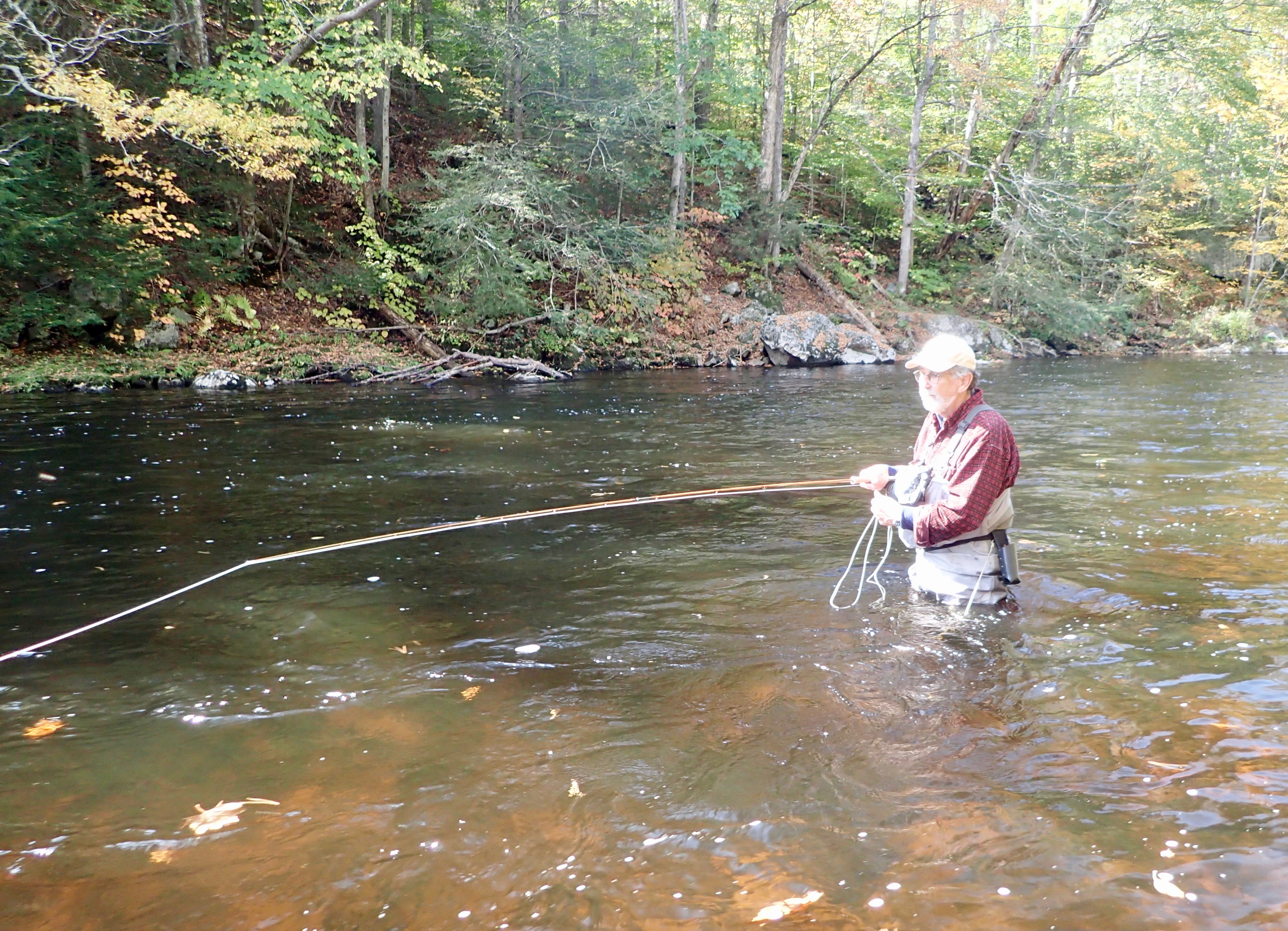
Small stream pro tip: when I’m fishing a long, languid run with a dry fly, I like to take position well upstream. By feeding line into the drift, I can cover likely holding areas, and not have to worry about spooking fish with a line slap or the movement of the fly rod. While it wasn’t possible in this run, I also like to stay out of the water as much as I can. Photo credit to Cam Culton!
About a year ago I purchased a pair of Orvis PRO Wadding Boots. I liked them. A lot. So much, that I wrote this glowing review.
A few weeks ago, though, I noticed some bad stuff happening. The soles were coming away from the boots.
The glue was failing on the outer soles. The only thing holding them on were the studs.On the right boot, the glue was failing on both the outer sole and the midsole.
So I called Orvis and explained the situation. Their website states that they are “100% committed to customer satisfaction.” You bet they are! They offered to send me a shipping label, or the option to return and exchange the boots at a local store. I went with B. At the Orvis Store in Avon, they explained that I had a very early run of the boot, and that they were aware of some issues. (I wish I knew the production run number; suffice to say, if you experience the same issues, Orvis will take care of you.) So, easy-squeezey exchange, and off I went to fish.
Now we play the waiting game. I’m hoping this new pair doesn’t self-destruct. I’m hard on boots, but I’ve had other pairs from other makers that lasted many years. Fingers crossed, as I love how lightweight and supportive these boots are.
Feast or famine. Flood or drought. It’s the new normal on rivers. But you don’t have to stay home when the conditions are less than perfect. Check out my latest article, “How To Catch Trout in Extreme High- and Low-Water Flows.” You can read it in the fishing section of Field & Stream Online.
Fishing the softer sections along the banks in high water can be highly productive.
I’ve been getting a lot of questions about Farmington River water temps. The basic outline is, “I thought the Farmington is a tailwater. Why is the river so warm?” The answer is pretty simple.
In case you don’t know, a tailwater is a river with a dam release. The flow of the Farmington River West Branch is controlled by water that comes out of gates from the base of a reservoir dam (Colebrook Reservoir and Hogback Dam). If you’ve ever gone swimming in a pond or lake, you know that the water is warmer near the surface and colder near the bottom. This is called thermal stratification. In a larger reservoir, you have three different thermal layers: the epilimnion (the warmer upper layer; the metalimnion (or thermocline, the middle layer); and the hypolimnion, the coldest bottom layer. But I said this was simple, and there I go throwing all kinds of hifalutin hydro-science terms at you.
Ideally, there’s a happy medium of bottom release flows on a tailwater: cold water is never released in amounts that cannot be quickly replenished. But there are two situations that screw everything up.
The first is severe drought. Water that flows into the Colebrook Reservoir is reduced to a warm trickle. The volume of the reservoir shrinks from evaporation. The temperature of the water rises, especially if it’s hot, which decreases thermal stratification. As a result, what comes out of the bottom of the dam is warmer than ideal. (By agreement with the CT DEEP, the MDC must maintain a minimum release of 50cfs.) Because the flow is so low, water downstream warms quickly, trout get stressed, and it’s a bad scene all around. (This was the case in 2016. It was so bad that the DEEP took the unprecedented step of declaring thermal refuges on the Farmington.)
But that’s not what happened this year. This year, we had too much water. All that rainfall in July meant that the MDC needed to bleed water, and lots of it — so much, in fact, that it wiped out any meaningful thermal stratification in the reservoir. They’re still running such a high volume of water that there’s no chance for the stratification to re-establish — at least not in the heat of August. So that’s why at noon today the water was coming out of the dam at a very trout-unfriendly 69 degrees.
Eventually, it will get better. But right now, the best thing you can do for Farmington River trout is play the waiting game.
Taken this winter when the water was very, very, cold. Hang in there, buddy!