DEEP Farmington River Sampling scheduled for September 9, 10, 11

This comes from Neal Hagstrom of the DEEP:

Just a heads up for everyone. The DEEP will be sampling the River Sept 9-11th. We will be working from Barkhamsted downstream.

On the 9th Hogback Road, around the Campground, and possibly the drive-in Pool.

On the 10th Halford’s Run, and the Greenwoods – the big brood stock collections at the Wood Shop that pm.

On the 11th Ovation and above Satan’s Kingdom. We hope to get flows restored mid-day on the 11th. 

This assumes that mother nature cooperates and no rain limits our work. Angler’s cooperation on clearing the river during these activities is greatly appreciated because your safety is a primary concern and people in the water affect the efficiency of our operation. 

As always, all broodstock will be returned to the river in early December after they complete their recovery from spawning.

If there are questions I can be reached at the Marlborough Fisheries Office 860-424-4179

Neal

~

In case you are unaware, the MDC draws down the flow from the Hogback dam in early September so DEEP and volunteer crews can take their fish census and gather brood stock browns for their Survivor Strain program. As Neal mentioned, it is best to stay clear of the crews while they are working. That doesn’t mean you can’t go fishing elsewhere on the river. However, given the recent stretch of unusually hot weather and a forecast that calls for more of the same, I would suggest that it might be prudent to give the trout a break.

If you’ve never been on a sampling, it’s a fascinating experience. Anyone can volunteer by contacting the DEEP.

Tip of the week: visit the river while the water is way down. Note where the truly deeper holes are. Bank that information for future withdrawals.

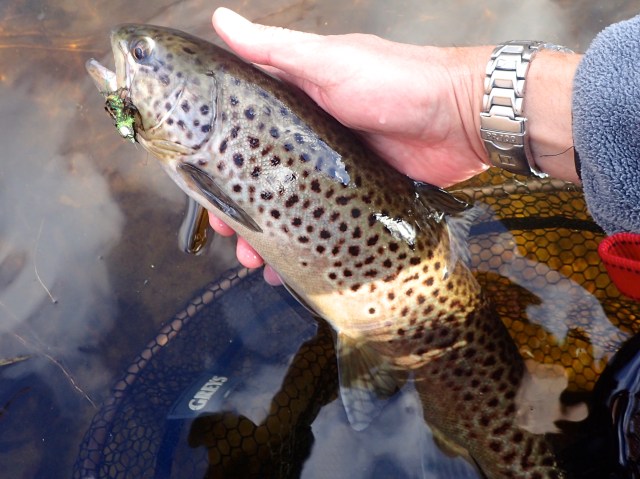
A brood stock brown that was captured and bred in fall, 2012, (red elastomer left eye) then returned to the river in December of that year. I caught her in April of 2013. I wonder how many of her kids I’ve crossed paths with?

Big Survivor Strain brown hen

Currentseams Three Hundred Followers Contest Winners

First Place: Ray Hamilton

Second Place: Rick Perrault

Third Place: Max Kantor

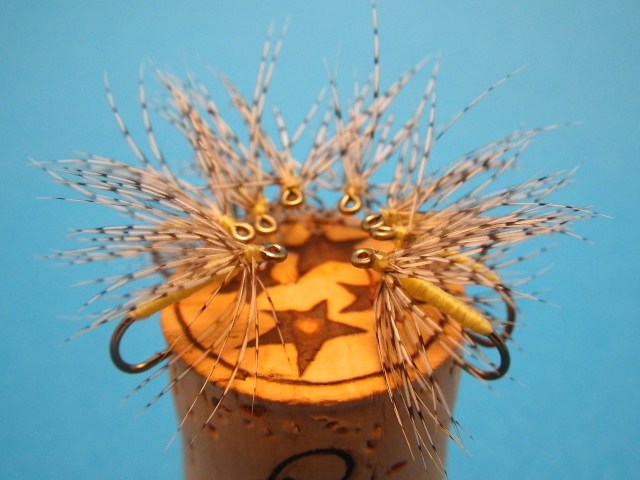
Congratulations! One of the possible prizes is the six striper soft-hackles I tied for my upcoming American Angler article. Ray gets first dibs on them. If he doesn’t want them, Rick gets next dibs, etc. If no one wants them, I will fish them myself. So there. Winners, please email me (swculton at yahoo) and let me know what you’d like. Your other options are a selection of trout streamers, trout wets, or steelhead flies. I also need your mailing addresses. Please don’t post those here.

I would like to thank everyone who entered. Your comments were both insightful and helpful. Best of all, they were just plain nice. It was truly gratifying to hear from so many people, and I feel like I got to know each one of you a little better.

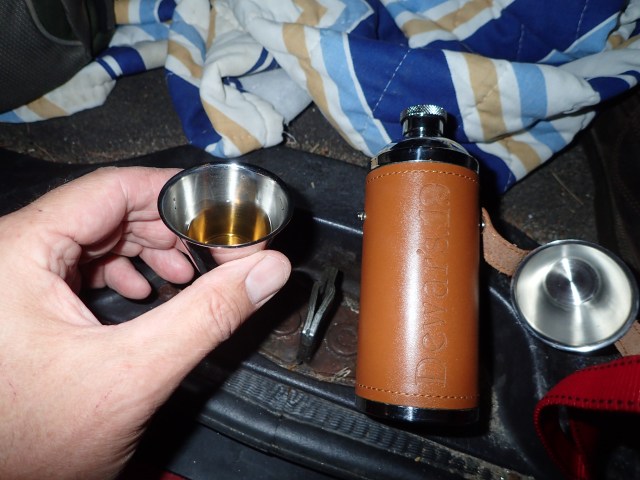
A middle-of-the-night fishing trip toast to the winners. Wait — a toast to everyone. Thank you for your readership and support.

Block Island All-Nighter Wee Drop

Why I love the Survivor Strain program

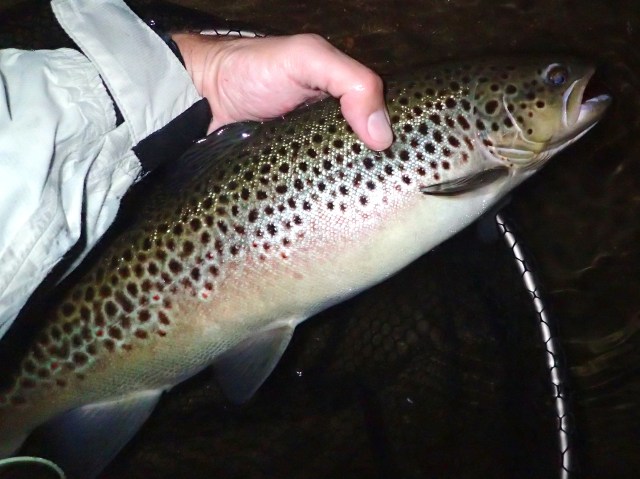
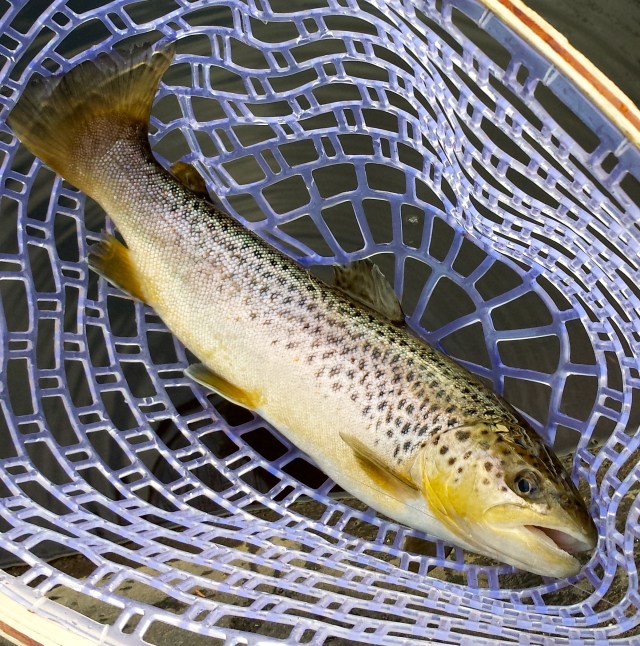
Not every big fish in the Farmington is wild. Here is a Survivor Strain brown from a recent outing. Large, well-developed fins, clipped adipose, and some distinctive haloing around the lower spots. I wonder what else is in that belly? The fish’s attack was textbook big brown: hit, hit, then the take. You read so many reports of people catching 18″ trout on the Farmington that I suspect a good percentage of those fish are actually short of 18, what with it being such a nice, round default number. But I can tell you with certainty that this fish was at least 18″, measured against my landing net, which I’m pleased to report had some difficulty accommodating the catch.

Farmington Survivor Strain brown

Fall appearances, articles, and other currentseams-y stuff

Hard to believe it’s September. Especially with this heat. We need rain, we need cool, and we need it soon.

In the meantime, here’s what’s on the fall calendar. As you can see, we have lots of “The Little Things” options all over southern New England. You don’t need to be a TU member to attend, so stop by and say hi.

“The Little Things” Presentation to TU Narragansett 225, Wednesday, September 30, Elks lodge, Coventry, RI. For directions and times, visit narragansett.tu.org.

“The Little Things” Presentation to TU Mianus, Tuesday, October 13, Waveny Mansion, New Canaan, CT. For directions and times, visit mianustu.org.

“The Little Things” Presentation to TU Farmington Valley, Thursday, October 15, (I believe it’s at the Whinstone Tavern at Stanley Golf Course, New Britain, CT). For directions and times, visit fvtu.org.

On the writing front, I’m told that my steelhead piece will be in the fall issue of The Drake. I’ll let you know if that’s the case, and I don’t mind saying that I think this is one of the better (not to mention funny) concept stories I’ve written. Look for a feature on striper soft-hackles in the next issue of American Angler. And, as I look over at my writing projects list, I see seven items. I suppose I’d better lock myself in my lonely writer’s garret and hop to it.

Only two more days till the 300 Followers contest closes! If you haven’t already, no better time to enter than now. And wow, just like that we’re up to 320.

Here’s to a tremendous fall season for everyone. (Fish included.)

October Brown 2014

Douglas Thompson talks. The American Fisheries Society listens — and responds.

“The Cost of Trout Fishing,” a recent op-ed piece by Douglas Thompson in the New York Times (Thompson 2015), included several inaccurate statements and fundamental misunderstandings of fisheries management and aquaculture.

Those words are taken from an article recently published by the AFS. Here’s a pdf of the entire article. Note a source citing  some of our own DEEP folks.

AFS Responds to an Op-ed in the New York Times 2015-2

A beautiful winter Survivor Strain brown. Thanks, DEEP, for your excellent work on the Farmington River.

2:14 SS Brown

The Squirrel and Ginger Caddis Emerger tying video

When it comes to soft-hackles, feathers get all the juice. That’s perfectly understandable. But certain furs – like fox squirrel – make excellent hackling material. The results are often deliciously buggy.

Such is the case with the Squirrel and Ginger caddis emerger. This humble creation is something I made up a few summers ago. I took the Ginger Caddis Larva fuzzy nymph and swapped out the standard wet fly hook for a scud hook. Added a flashy rib. And replaced the rabbit fur thorax with a hackle of fox squirrel.

The first time I fished this fly was on a brilliant July day that was devoid of hatch activity or rising fish. The sun was high, the air was steamy, and felt a little foolish for making the drive to the Farmington. Until I started hooking fish after fish on this little caddis emerger. It was the middle fly in a team of three, and the trout stated in no uncertain terms that this was their favorite.

The Squirrel and Ginger is a fine introduction to fur-hackled flies. It is fairly easy to tie. Best of all, it’s a wet fly you can have confidence in.

Hook: TMC 2457 (2x strong, 2x wide, 2x short scud) size 12
Thread: Orange or hot orange
Body: Ginger Angora goat
Rib: Green Krystal flash
Hackle: Fox squirrel fur
~

The Squirrel and Ginger Rogues’ Gallery

7/8/13, Farmington River

Brown Buck 7:8:13

4/24/13, Farmington River

Bigbrown hen

7/31/13, wild brown, Farmington River

WIld Farmy Brown 7:13

4/29/15, 17″ holdover brown, Farmington River

Fat Farmy Hen 4:15

10/8/19, 20″ holdover brown, Housatonic River

OLYMPUS DIGITAL CAMERA


How to built a wet fly leader for a team of three flies

One of the most frequent questions I get is, “How do you build a wet fly leader?” This material originally appeared in my article “Wet Fly 101: Take the ancient and traditional path to subsurface success” (American Angler Nov/Dec 2013) but I wanted to give it its own place here on currentseams.

At first glance, building a multi-fly dropper rig looks complicated. But basically, you’re just tying three triple surgeon’s knots. You’ll need a 9-foot, 3x or 4x tapered leader for the butt section, and some 4 or 6-pound Maxima (I prefer Chameleon [AUTHOR’S NOTE: I used UltraGreen four-pound in 2014 and it worked just as well as Chameleon]) for the droppers. I’ve tried a lot of different leader materials, and Maxima is by far the best because of its stiffness. I use the 4-pound in lower, clearer flows. 

Wet Fly Three FLy team

Here’s a pdf of the diagram: Three-fly wet fly leader

Step 1: Cut off the bottom three feet of the tapered leader. Discard this bottom section.

Step 2: Knots are not worthy of your trust. Wet every knot before you pull it tight, and test every knot by giving it a good tug. The heat of battle with a trophy trout is a bad time to discover you tied a substandard knot.

Step 3: Tie just over a foot of Maxima to the tapered leader with a triple surgeon’s knot. The bottom of this section will form the first dropper. Trim both tag ends.

Step 4: The ideal length between wet flies is somewhere between 18 and 24 inches; I prefer my dropper tags between 4 and 6 inches. If you’re going to build a dropper rig with the flies 24 inches apart and the tags 6 inches long, you’ll need a 30-inch section (24 + 6 = 30) of Maxima for the next step.

Step 5: Take the first, shorter section of Maxima (the one you tied to the tapered leader) and hold it 6 inches from the end. This will be your first dropper. Join the 30-inch section to the shorter section at this point with a triple surgeon’s knot.

Step 6: Trim the excess of the second section above the knot (the part you trim is on the butt side of the leader). You should now have a dropper tag about 6 inches long, pointing away from the butt, and about 30 inches of Maxima below it.

Step 7: You’re in the home stretch. This is basically a repeat of step 5. Grab the second section of Maxima 6 inches from the end, and join another 30-inch section of Maxima to it with a triple surgeon’s knot. As with Step 6, trim the excess above the knot.

Step 8: You should now have a rig that looks like the one the diagram: two shorter tags, to which you’ll tie dropper flies, and a longer end section, to which you will tie the point fly.

~

Good things happen when you give the trout a choice.

20

Calling all readers: help me with some future Q&A videos

As we transition into fall, I will be trying to get off my video butt. One of the items I want to get back to is the “Currentseams Q&A” series. Here’s where you come in.

I need some input on questions and subjects you’d like answered. Fishing, tying, equipment — whatever’s on your mind. If you could take a few moments to respond in the comments section, I’d appreciate it. (Good fishing karma will be bestowed upon those who offer suggestions.) To be clear, I’m looking for input on questions to be answered — those could involve fly tying (“How do you double or fold a marabou hackle?”) or anything else related to our sport.

Thanks in advance.

Q: Is that a sculpin or a crayfish or a trout fry? A: Nope. 

Farmington River brown buck

Quote of the day: Casting vs. Fishing

If Ray Bergman came back today and saw the endless discussions about casting and distance on internet message boards, he would never stop throwing up.

Bergman knew that it was more important to be a good angler than a good caster. Of course, the two are not mutually exclusive. And it is true that it’s hard to be a good angler if you are a poor caster. But I’ll let Ray take it from here. This is from his book Trout:

“That you cast so well that others compliment you for your skill is not so important, but that you handle the flies in some particular and almost indescribable way may be very important indeed. You may gather from this that I am not particularly interested in perfect-form casting, and that is very true…If you become a perfect-form caster while achieving the necessary results, so much the better; but it is best to concentrate on the other points, rather than on form, and the casting will usually take care of itself. In this connection let me say that some of the best fishermen I know could not be called “pretty” casters, but they do cast their flies so that they act the way they should and catch the fish.”

Fish don’t examine the tightness of your loops, your line speed, or how far you cast. This twenty-pound striper certainly didn’t.

Block Island All-Nighter 20 pounds

Tag Team Nymphing

I’ve been teaching Rob how to fly fish, and Friday afternoon we met for a quick indicator nymphing lesson. Even though Rob is completely new to the fly game, he landed a juvenile Atlantic salmon his first time out. Friday was our second session, and it was slow going. There wasn’t much (if any) visible hatch activity, and the water was slightly stained from the day’s earlier rains. Rob did great job casting, mending, and presenting.

Everyone learns differently, and after an hour Rob said he wanted to watch me fish. We were targeting a riffle that dumps into some deeper water, and as the two-fly rig completed the dead-drift phase, the flies began to swing up. The indicator went under, and I handed the rod off to Rob, who landed this fine wild brown.

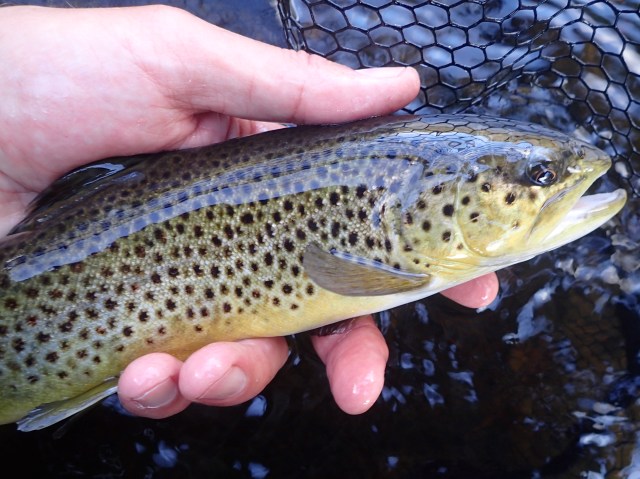
Some substantial shoulders on this wild Farmington brown. You can just make out the faint parr remnants, and those haloed spots speak volumes about how lovely these fish can be. Taken on the bottom fly of a two-fly rig, a size 14 olive Iron Lotus.

wild Farmington River brown