Illegal harvesting, poaching, illegal activity, whatever: if you see something, say something!

Call immediately: DEEP Law Enforcement at 860-424-3333 or Turn in Poachers (TIP) at 800-842-4357. Program it into your phone. Make the call.

Yes, I know. It’s frustrating. You can’t get a cell signal. EnCon never shows up. Nobody ever does anything about it. It’s too much trouble. Call immediately: DEEP Law Enforcement at 860-424-3333 or Turn in Poachers (TIP) at 800-842-4357.

Poachers making an illegal harvest? People fishing barbed trebles in a Class 1 WTMA? People using saltwater boat rods in FFO areas? One person fishing, followed by a second with a bulging trash bag? Call immediately: DEEP Law Enforcement at 860-424-3333 or Turn in Poachers (TIP) at 800-842-4357.

No spinning gear allowed.

If all of it makes you seething-rage mad, I get it. It pisses me off, too. I can’t stand the lack of respect for the rules or the environment. I loathe the selfish, boorish behavior. I’m frustrated as hell that I’ve never seen an EnCon officer anywhere near the Housatonic in summer, the ground-zero Mecca for poaching and other illegal activity. Nonetheless:

Call immediately: DEEP Law Enforcement at 860-424-3333 or Turn in Poachers (TIP) at 800-842-4357. Program it into your phone. Make the call.

That is all.

Back in the Small Stream Groove

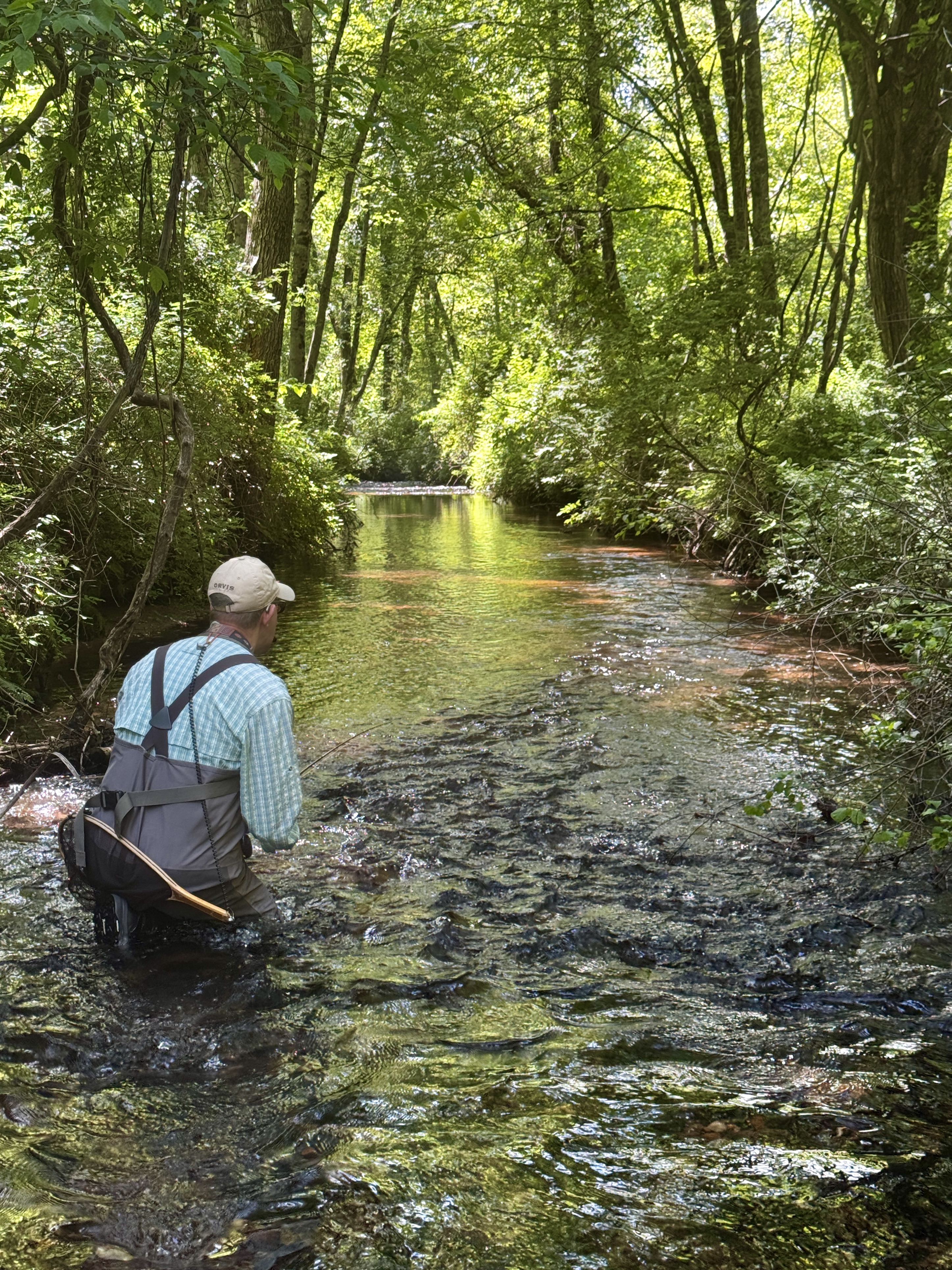
What a treat to be able to fish a small stream again. It’s hard to believe that this was my first fishing-for-fun-only outing of 2025. Surfcaster extraordinaire Toby Lapinski and I spent a few hours last week exploring a woodland gem. Although we fished mid-afternoon, dense canopy blocked the sunlight and the water was surprisingly cold. Water height was on the low side of medium. Although I fished a dry dropper system, the local char showed a clear preference for the dry. Toby fished a size 10 hopper, and they attacked it with wanton ferocity. We pricked a bunch, landed several, and left feeling happy.

I could get used to this. I really, really could. Toby Lapinski photo

Given the daylight and shallower water, I found it curious that the fish weren’t that interested in subsurface offerings. Besides the dry/dropper, I also fished the Squirmy Jiggy Thingy. I felt many nips and tugs, but those were clearly generated by smaller fish. (By the way, we saw/spooked dozens of fingerlings, which portends for a bright next year.) The moment of the day, however, was when we witnessed a 3-foot long northern water snake capture and kill an 8″ brook trout. I’d never seen anything like it. The snake took the fish out of the water, and clamped down on its “neck” to suffocate it. There’s a theory which states that on small streams, terrestrials become a huge part of the trout’s summer diet. Apparently, the tables are sometimes turned.

Farmington River Report 5/28/24: A tale of two outings

I’ve been having a tough time with lessons this year. Not the clients! All have been enthusiastic learners and a treat to coach and teach. Rather, the bite windows have generally stunk (and they really shouldn’t be stinking). Yesterday’s lesson was a case in point. Craig did an outstanding job casting and mending and presenting and hunting and covering water. The last couple hours in particular, you could really see him taking to the wet fly. He never got discouraged, and he deserved a lot better than four touches and two in the hoop. But I’m happy to declare that Craig is going to be a certified Wet Fly Dangerous Machine if he keeps on keeping on! Great job, Craig.

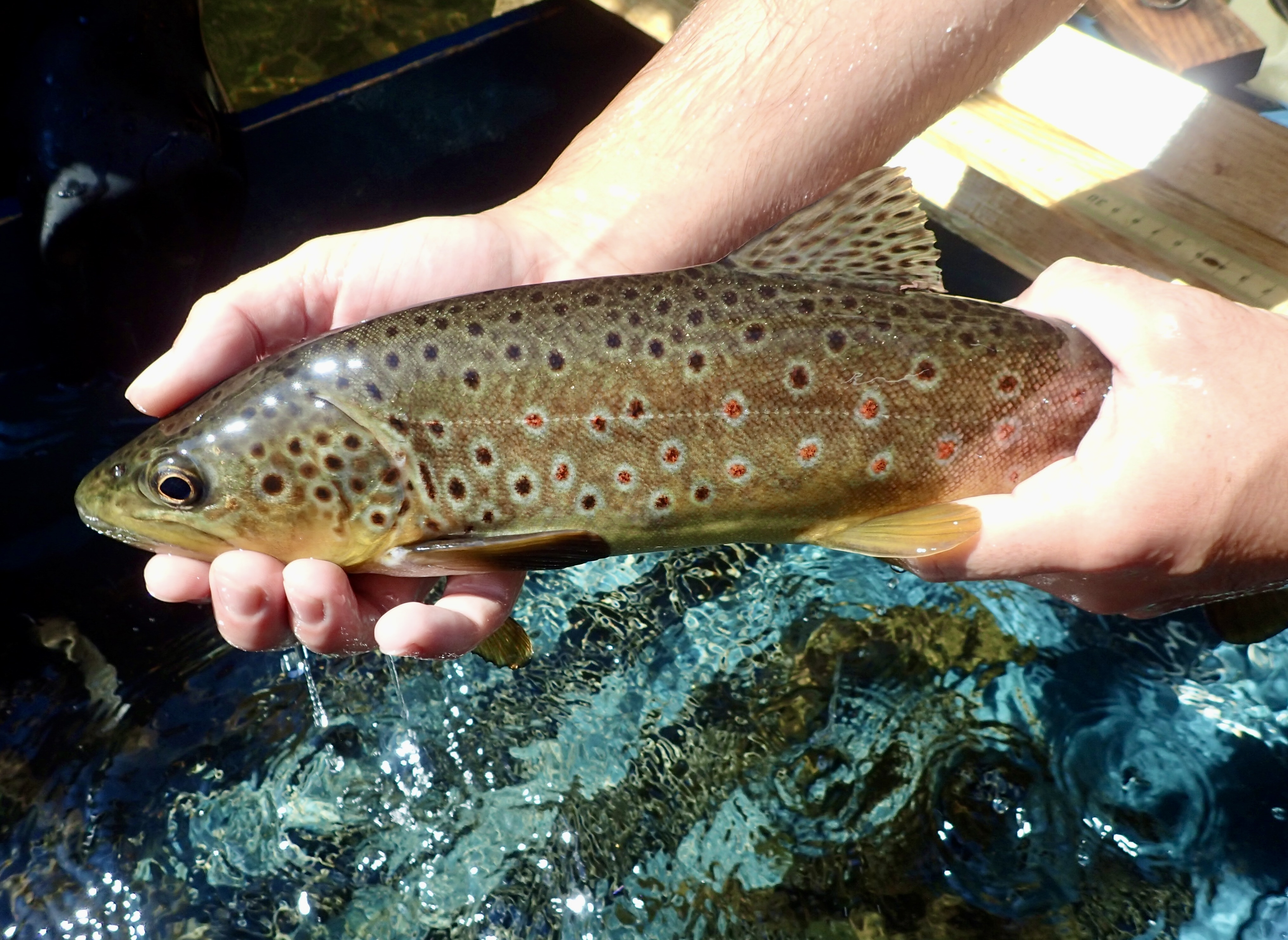
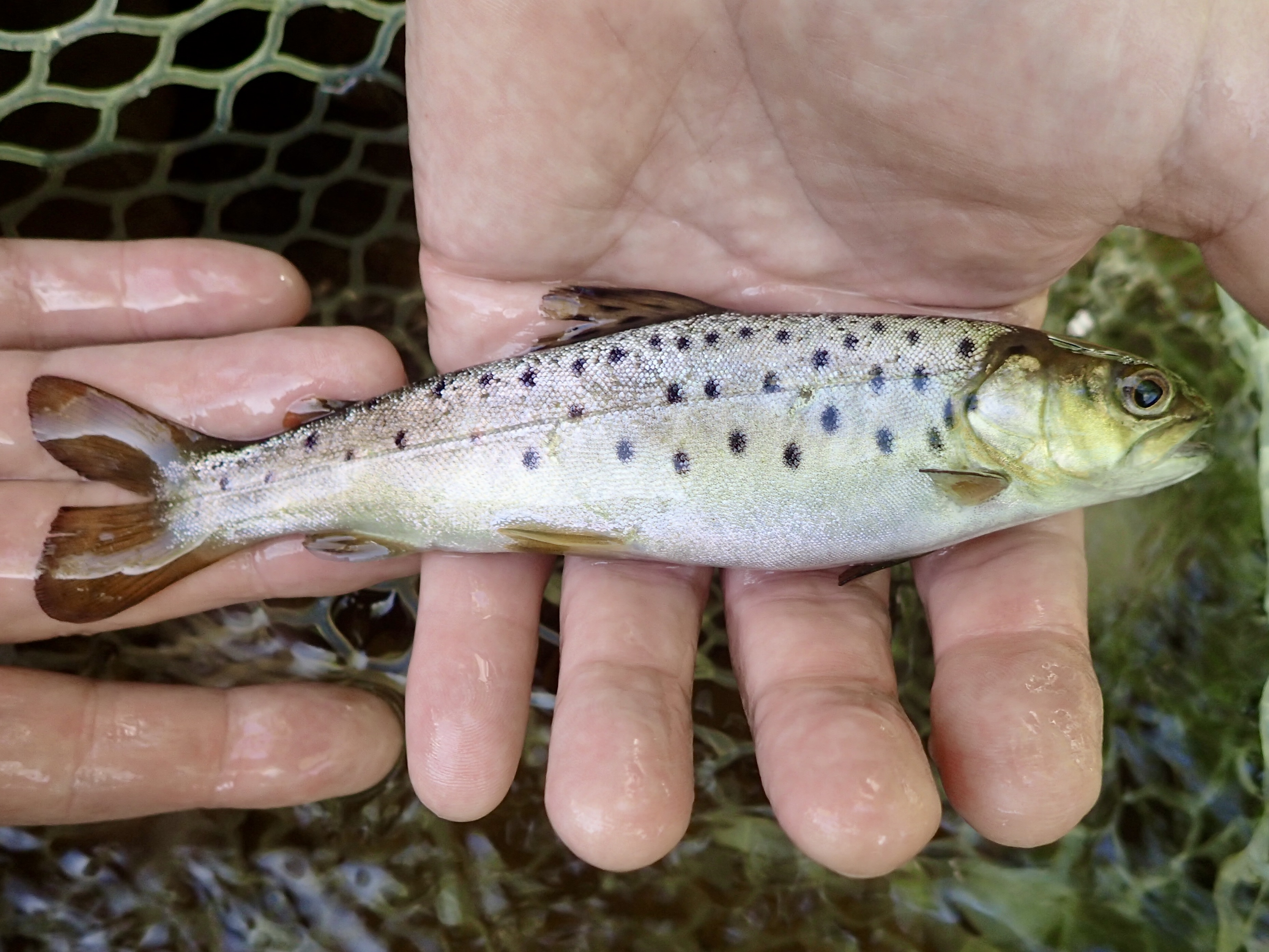
The river was up from the rains, but in the 400s of cfs it was not too high for the wet fly. Weather was perfect, save for some breezy moments. No, I think the main culprit was the almost total lack of hatch activity, and zero visible feeding. I think I saw a half dozen(!) caddis in four hours. This was Craig’s first fish. I thought at first it might be a salmon/trout half-breed, but after closer inspection the maxillary is all brown trout. What threw me off was the tail, but I believe the fork is created by rending of the tissue. Whatever it is, it smacked the fly with gusto, and is a beautiful creature worthy of the wet fly.

I had a window of opportunity, so I decided to try my luck with the evening rise, although, between you and me, I didn’t think there would be much of one. Turns out I was right. Kindof. I wanted to fish the lower river, which was running much higher at 730cfs. It was, to say the least, a tricky wade. I was in the water fishing at 6:15, and for quite a while, absolutely nothing was happening. I started debating the merits of fishing vs. having a couch date with my wife, but decided to stick it out, if for no other reason than scientific curiosity. Then I got into a fish. And another. It wasn’t gangbusters, and still nothing was happening bug- or hatch- or rise-wise, but I was catching trout and having fun. I stuck it out to 8:30. Moments before, I had declared that it was over, when a big wild brown slammed by fly. I don’t usually put fish on the reel, but this hefty brown told me I really should. Final tally was 15 hooked and 12 in the hoop. Not bad for high water and nothing going on.

Of the dozen to net, 9 were stocked rainbows, a few of which thought they were steelhead, with multiple gravity-defying aerials. Three were wild browns: the big guy, a little guy, and this mid-range guy. This is significant because I was fishing in an area that would have been torched last summer in the heat and low flows. Nature finds a way. For those keeping score at home, the big one took LaFontaine’s Diving Caddis winged wet, middle dropper, which you should be fishing right now late afternoons into dusk.

From the Archives: The best soft hackles and wet flies for the Hendrickson hatch

Yeah, baby, it’s getting to be about that time. OK, maybe not for a couple more weeks. We’ll see what Ma Nature has in mind as far as warmth and rain are concerned. But indeed it is coming. And right now is the perfect time for you to stock the box with your favorite Hendrickson patterns.

If you’re not fishing under the Hendrickson hatch with wet flies, you’re missing out. In fact, you’re missing out on some of the best trout-on-the-fly action of the year. Tie these up, place them over a rise, and hold on. Oh. And be prepared to clip one or two flies off your three-fly team. Such are the travails of the angler getting doubles and triples!

The Best Soft Hackles and Wet Flies for Fishing the Hendrickson Hatch.

Mssr. H awaits your pleasure…

Striper report: If you want to catch big bass on a consistent basis, do this

Anyone can luck into a big fish. Way back when, when I was just starting out, I wanted no part of that. I wanted to be able to consistently catch big stripers.

If you want to catch big bass — and make it repeatable — you don’t need a casting lesson. You don’t need to be able to reach 90 feet. You don’t need the latest in intermediate line technology. You don’t need a huge monstrosity that looks more like a plug than a fly.

You need to study. And ask questions. Why would there be a big striped bass where I’m fishing? Is there current, cover, and food? Is it pre-spawn? Is it migration time? Is the bait spawning (and therefore gathering in large numbers)? Is it dark, so the fish feels comfortable coming in close? What’s the barometer doing? Which way is the wind blowing? What’s the tide, and how is it moving? These are all part of the equation.

Then, you need the right fly. Something that looks like the bait, or what the bait should be at this time and place. Does the fly look alive and like something good to eat, even when at rest?

Don’t forget presentation. You need to learn that, too. Big fish are lazy, and frequently unwilling to chase. How can you present the fly in a way that makes it easy for the striper to eat?

Last but not least, you need to put in your time. There is no substitute for time on the water. You can do all of the above, check all the boxes, and still blank. (Ask me how I know.) Nevermind, I’ll just tell you. Last year, I fished the mark I fished last week six times and had only two tiny bass nibbles and no bass to hand for my efforts. But every year is different, and this is what I found on a greased line swing with an 11″ Bombardier flatwing in March of 2024:

Miss Piggy went 25 pounds and taped 39 inches. This was one of the best fights I’ve ever had with a bass, and I hope to write about it sometime soon. I am humbled and grateful for the chance to hook, land, and release this fish. I’ve been doing this for years, folks, and I was so pumped with adrenaline that my hand was shaking as I took this photo.

Small Stream Report 2/27/24: The kids are all right

I didn’t really have the time yesterday, but since my default setting is when in doubt, go fishing, I did. The venue was a small woodland stream, and the time frame was 3:45pm-5:30pm. It was mostly cloudy and very warm for February, with a water temp of 48 degrees. The stream was running medium-low and clear. No hatch activity, although I did see one lonesome sz 600 midge flitting about.

I’ve written before that I’m a massive creature of habit, but on this outing I decided to explore about 100 yards of new water. I was glad I did, as that turned out to be my most productive stretch. I fished mostly subsurface with the Squirmy Worm Jiggy Thingy, but I did get a hysterical swing and miss on a bushy dry for the 5 minutes I fished it. All told, I pricked about 18 and brought probably a third of them to hand. I did catch the same beautifully spotted hen I took in January at the same hole. She really clobbered the fly.

A few of my favorite things: a cigar, a glass rod, and a small stream, and if I can get them all at once that’s even better. What a glorious day to play hooky for a few hours and lose myself in a babbling brook.

Small Stream Report, or: I finally go fishing!

We all know the scientific certainty that all work and no play makes Jack a dull boy. But add a bout with Covid, a never-ending string of home improvement projects, change Jack’s name to Steve, and holy cow, the dullness is magnified when there’s no fishing in January.

So, I snuck out during the last few hours of the month to visit a small stream. It was chilly and overcast, but the water was a good medium height, running clear with an occasional bit of decaying vegetation detritus tumbling by, and a surprisingly warm 42 degrees. Here are some details.

I pricked four and landed three, all on a swung/dangled/stripped Squirmy Worm jig. They had no interest in the dry nor tiny nymph dropper.

I interested, but did not hook, two behemoths (for this size stream) in separate locations. Both fish came out from their holes to inspect the fly, follow it, and then ultimately reject it. In both cases, I tied on, then offered, a larger micro Woolly Bugger in black, but neither fish reappeared. Round 1 to them. (Be advised, fishies, that I know where you live.)

Most of the fish came in water moving at a moderate pace, and all of those locations offered both depth and some form of cover, be it logjams, cutbacks, boulders, etc. Another smaller guy repeatedly whacked the fly as it dangled near his hideout beneath a cutbank.

The last fish was a spawned out female, 8″-9″. Please take care not to wade in gravel beds until mid spring s that the next generation can get a healthy start.

On the board for 2024, and my first fish was a beauty. Please consider taking the Wild Trout One Photo Challenge. It’s better for the fish, the resource, and you’ll feel good about it, too.

Small Stream Report: First foot instead of last blast

As a creature of habit, I lovingly cling to my routines. So I was as surprised as anyone when I decided to not go small stream fishing on New Year’s Eve. Logic trumped tradition; by delaying a few days, the water would be a little warmer and hopefully any residual ice would be long gone. On the drive up, we did see some sheltered woodland streams where mini-glaciers abounded. But when we (myself and surfcaster extraordinaire Toby Lapinski) arrived at the stream we were relieved to see that frozen water was almost non-existent.

The water was barely into the high side of medium, which is just about right for winter fishing, and the brook was running clear and cold. Overcast skies didn’t hurt, nor did temperatures in the low 40s. Toby started out bottom bouncing and jigging, while I went the dry/dropper route. The action far exceeded our expectations. As you can imagine, going deep won the day, but I had enough action on both the dry and dropper that I kept them on for hours. (If reading this is getting you fired up for small streams, I have a presentation tonight in Danbury, The Eastern Brook Trout; later this month, you can see me present Finding Small Stream Nirvana at the Marlborough Fly Fishing Show, and a week later in Edison.)

The first fish of any year is noteworthy, even more so when it’s a stunning display of nature’s paint box. Taken on a size 14 Improved Sofa Pillow.
When I was a kid, I ruefully wondered why tropical fish had all the cool colors. Cut to 55 years later when I now know better. Since fish like this aren’t ever getting replaced by the stocking truck, it bears repeating: barbless hooks only; keep photos to a minimum (I landed dozens and took shots of only three); make sure your hands are wet; keep fish in the water in your net until ready to shoot; never expose fish to air for more than a few seconds; and never lay a fish down on rocks/gravel/leaves/grass. Thank you. (Photo by Toby Lapinski)
Small stream fly fishing for native trout may be fly fishing in its purest form. (Photo by Toby Lapinski)
Halo, I love you (again). Besides pulchritude, this fish is noteworthy because its thinness indicates a spawned out fish — and therefore a redd may be nearby. It’s a good idea to limit walking within the stream bed from mid fall to mid spring; the last thing anyone wants to do is tread on a redd and make all those future brookies dead. (Yes, I know it.) (Photo by Toby Lapinski)

Small stream anglers, take care: the spawn has begun

The spawn is taking place on some northeastern wild brook trout streams. I recently fished a brook on consecutive Thursdays, and the changes over the course of a week were dramatic. Seven days ago, there were only a few leaves in the water and no visible signs of spawning activity. A week later, the brook was congested with foliage and several redds were apparent. I spotted a large hen on one, and a few active fish on another.

In case you don’t know, a redd is a spawning bed. The fish select an area with enough water and current and the right size gravel, then clear the area of debris and other sediment before depositing eggs and spreading milt. (This is why spawning and post-spawn fish often present with scraped bellies and frayed fins.) Redds are fairly easy to spot; they look like light colored patches contrasting against much darker substrate. On a small stream, redds may be anywhere from a couple of square feet in area to significantly larger. A distinct light colored patch with fish darting about on the bottom nearby is a sure sign that you’ve discovered a redd.

Every small stream angler should know how to identify a redd, or spawning bed. Here’s a classic, can’t-miss-it redd: A dramatically lighter patch of gravelly stream bottom surrounded by darker substrate. There were a few fish milling about, but they scattered when I stood up to take this photo.

Maintaining the integrity of redds and protecting spawning fish is vital to the future of any wild trout stream. The stocking truck is not coming to replenish what humans destroy! Here’s what to do if you see a redd: First, leave it and the fish that are near it alone. Don’t try to catch spawning fish. Let nature take its course. Next, make a mental note of the location. Chances are that the fish have been using the general area to spawn for dozens or hundreds or thousands of generations. Finally, stay out of the water near the redd for the remainder of the fall, winter, and early spring. If you crush the eggs or the developing fry, that would be bad.

Besides, it’s pretty cool to simply sit on a rock and watch the beginnings of the next generation of Salvelinus fontinalis.

Small Stream Report: Nature finds a way, Part MMXXII

This is a very late report from last week. After a hot, dry, droughty summer like the one we experienced in 2022, I like to head to a few small streams to get a handle on how the natives fared. This trip was last Friday, well before this week’s much-needed soaking. As I suspected, the water level on this brook was on the low side of low. Much of it was unfishable. But there was plenty of good news.

The water temperature was bracing and cold, certainly colder than it ever was this summer, but this brook has many places for the char to go to escape the summer heat, even in low water. I saw dozens and dozens of fish, many of which looked to be young of year. I also found a few pods of bigger brook trout — nothing really huge, but in the 7-8″+ class. On an outing like this, I do get to do some fishing, but a lot of it is more inspection-oriented, with the intent of spooking fish. Often, with the water so low, the natives want nothing to do with the sight of you or your rod waving around. I got no interest of the dry fly, and pricked two with a weighted jig-type fly.

Then, yesterday after the rains, I visited a different stream. What a bounty! But you’ll have to wait a couple days for that report…

At a normal level, the flow should be covering the rocks you see center photo. This pool is usually good for a couple of hungry swipes; on this day it was a barren brookie wastleland. A reminder as we get near spawning time: be on the lookout for redds. Consider not wading into brooks at all. Redds are pretty easy to spot; usually a lighter area a foot or two in diameter against a darker gravel bed.