UConn wants to divert 5 million gallons of water a day from the Farmington River. What can you do about it? Start here.

Yes, the same UConn that drained the Fenton River Class 3 Wild Trout Management Area dry a few years back, killing hundreds of trout. They’re up to their greedy, water-sucking ways again. Only this time it’s the Farmington River they’re after. Yep, the same Farmington River that had lethally low flows last August, killing scores of fish. But, what’s another five million gallons a day in the name of progress? So what if we have to build a pipeline halfway across the state? Who cares if more fish die, or if people can’t fish or kayak or float, or if businesses that depend on the river suffer?

If you do care, please sign this petition. Pass it along to a friend.

http://petitions.moveon.org/sign/voice-your-support-for?utm_source=2013-05-30+UConn-MDC+water+petition+%2B+calls&utm_campaign=UConn+water+petition+5-30-13&utm_medium=email

The future of the Farmington remains cloudy. Help send a clear message to UConn and the MDC: Leave our river alone!

Image

Farmington holdover browns on wet flies

Spent a few hours today doing some advance scouting for Saturday’s wet fly class. Found fish everywhere I went. Gloriously alone today, but that won’t be the case on Saturday. Water was a crisp 50 degrees, skies overcast, and a few showers here and there. We need more rain than this.

Not a lot going on bug or rising fish-wise, but I did see some light tan caddis, about a size 16, a few lonely Paralepts, and mounds of miniscule midges. I was fishing a Squirrel and Ginger as the top dropper, Leisenring’s classic Iron Blue Dun in the middle, and a black bead head grey soft-hackle nymph on point. The trout were split right down the middle, half of them on the Squirrel and Ginger, half on the point fly. They took the fly with gusto. Powerful, demonstrative hits.

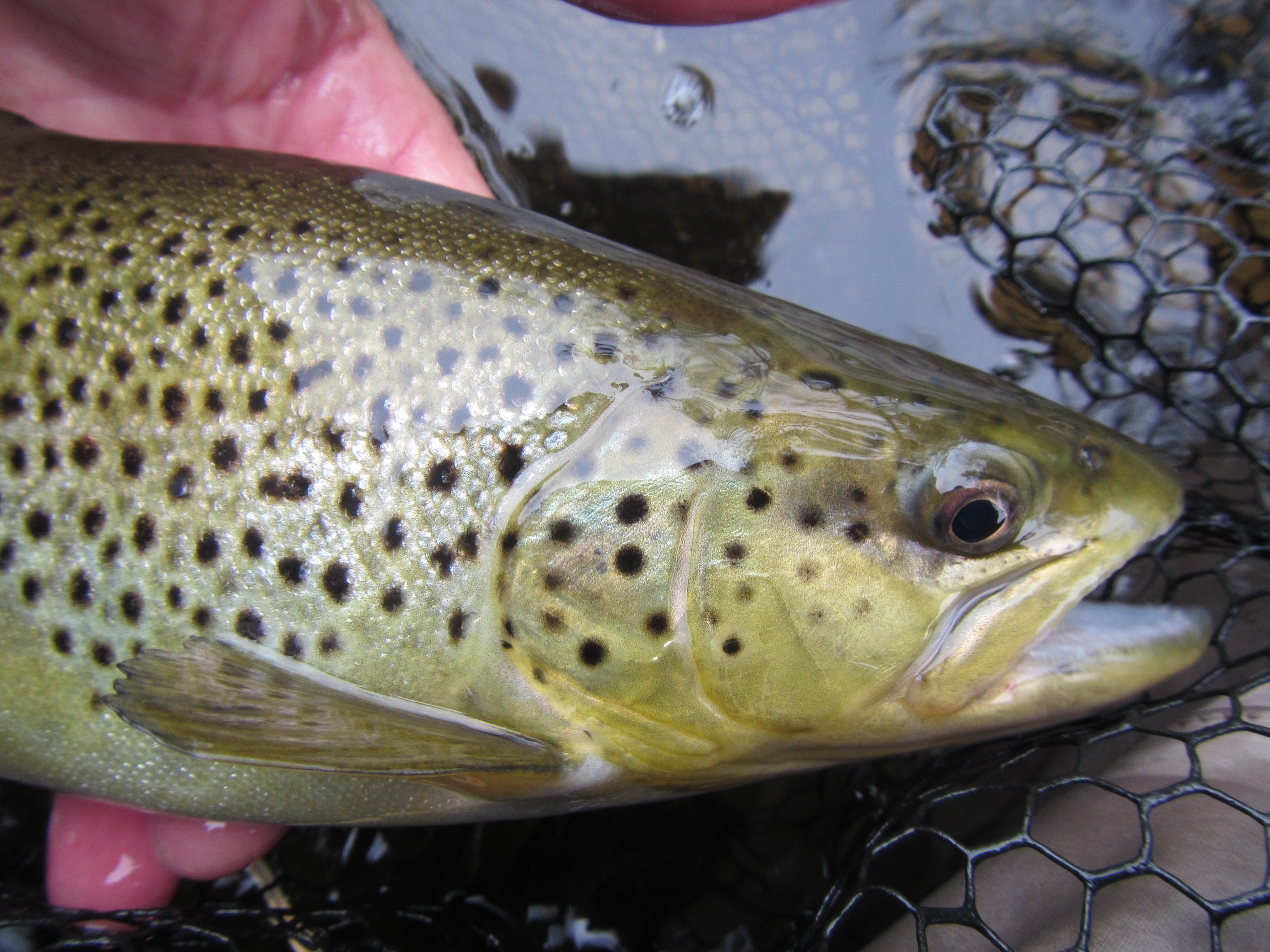
A lovely Farmington River holdover brown that took the top dropper, a Squirrel and Ginger, on the dead drift.

Image

Two trout of note. The first came where a riffle dumps into a long, deep pool. I was being lazy, mindlessly fishing wets downstream, when I looked above me and saw this pocket that I’d swung flies through a thousand times before. I made an upstream cast to it, letting the flies dead drift, when I saw a trout flash at an emerger just below the surface. Just as my brain was forming the thought, “Must cast there again,” I realized the emerger was my Squirrel and Ginger. It was a  handsome holdover brown, metallic and buttery.

A little farther upstream, there’s a sapling that hangs over the river like a drunk caught in mid-stagger. Its branches drag in the current, and the shade from its leaves clouds the already mysterious waters beneath it. It’s one of those spots where there’s always a fish. But not today. Well, not on the upstream side. Just below, whack! This brown did her finest impersonation of a steelhead, cartwheeling out of the water multiple times. I could see it wasn’t a big trout, but I almost put her on the reel. Up and down the pool she went. Foul hooked, I wondered? Nope. Just a fat, obstreperous holdover brown, about 14″,  with the Squirrel and Ginger lodged neatly in the corner of her mouth.

For a moment, I considered putting her on the reel. She had some shoulders, this one.

Image

Now, if the trout will only cooperate Saturday.

It’s wildflower season on the Farmy. I don’t know what these are, but they’re everywhere.

Image

Farmington River Report: Fishing under the Hendrickson hatch with wet flies

After’s Wednesday’s hatchstravaganza, I decided it was a moral imperative the go back to the Farmington on Thursday. Unfortunately, the time-space continuum prevented me from attempting another daily double. So I sacrificed a repeat of the morning caddis frenzy for Hendricksons in the afternoon.

Got to my spot at 1pm. Not a bug in sight, not a fish rising, but the Hendrickson hatch on the Farmington is like clockwork. Even though you don’t see anything on the surface of the river or in the air, there’s a lot going on down below. First cast, a mend across some current seams into a pocket, and bam! Just like that, we’re catching trout on Hendrickson wets.

Like yesterday, a good mix of stocker browns, chubby rainbows, and holdovers. This brown has been in the river for a while. It took me several attempts to hook him, but it was well worth the wait.

Image

The hatch was even stronger today, and as it picked up in intensity, it was harder to catch trout, I think because of the sheer number of bugs in the water. Unlike yesterday, where all you had to do was pick a rise and put your flies over it, there were a good half dozen trout today that I could not entice to strike, and another half dozen that took repeated attempts over the course of an hour. Fortunately, there were plenty of wanton gluttons willing to jump on. I caught trout on the dead drift, the greased line swing, and the dangle.

My rig was a Squirrel and Ginger caddis as the top dropper, a Dark Hendrickson winged wet as the second dropper, and another Hendrickson below it. As the hatched waned, I did see some caddis start to come off, and a few of my last fish took the S&G caddis.

And, like clockwork, it was over by 3:30. Water temp was 53 degrees.

Spectacular wet fly action on the Farmington River

“People tell me I’m the world’s greatest comedian. Ask me why people tell me I’m the world’s greatest comedian.”

“Why do people tell you –“

“Timing!”

Sometimes it’s like that with wet flies. Time the hatch just right, and you can look like the second coming of Joe Brooks. Legions of obliging trout and the right fly don’t hurt, either.

Such was my good fortune on Wednesday. The DEEP had recently stocked the upper TMA with several thousand trout. Armed with this intelligence, I met Todd Kuhrt and his brother in New Hartford, and we were on the water by 10:30am. We had won the April weather lottery, with blazing, brilliant sunshine and temperatures that were supposed to climb into the low 60s. I was rigged up for nymphing, so I wandered off to the head of a deep run while Todd and his brother set up shop a hundred yards downstream.

 A nice holdover brown taken on a Dark Hendrickson winged wet.

Image

Catching nothing when you’re expecting to bail fish is lesson in humility, and I took my licks for an hour. By the time had I worked my way down to Todd and Scott, I still hadn’t had a touch. They had each taken three on nymphs. The ignominy.

But, sometimes you must endure such hardships to reach Nirvana. I realized that what I really wanted to do on this glorious spring day was swing wet flies, smoke cigars, and relish the fact that I was blowing off all the work to do. So I swapped out my nymph rig for a team of three wets I had tied up the night before: a size 14 Partridge and Green dropper, a size 12 Squirrel and Ginger caddis in the middle, and a classic Hendrickson Dark on point. I had just finished nymphing a run, and now I made a quartering cast downstream. The trout hit just after the third mend. First cast. Wet fly. Squirrel and Ginger.

Life was good again.

It was about to get great.

For the previous fifteen minutes, I had been eyeballing some splashy rises about 50 yards downstream from me. Unfortunately, a spin angler had the area on lockdown. But now he was packing up his gear. I coiled my line in my hand and made a beeline for the trail along the river’s edge. This being a gentleman’s sport, it’s probably uncouth for a middle-aged man to race through the woods with his fly rod just to secure a fishing spot. But sometime we must toss propriety to the wind and indulge our inner barbarian.

 The fly of the morning, my Squirrel and Ginger caddis wet.

Image

The air was teeming was caddis, and the surface film was being punctured by the slashes of feeding trout. I couldn’t see any bugs on the water, so I figured the trout were taking emergers just below the surface. That’s the cool thing about newly stocked fish on the Farmington. They discover pretty quickly that those food pellets aren’t on the menu anymore. I picked out a rise, and made a cast. Bap! On the caddis emerger. In fact, the first eight trout I caught all picked that Squirrel and Ginger out of my lineup of three. I clipped off the Hendrickson and tied another caddis on. I soon had my first double.

Crazy kids. My first double of 2013.

Image

OK, so they were just dumb stockers. But, it’s hard to embrace self-loathing when you’re having so much fun. I waved Todd and his brother down so they could get in on the caddis orgy that was – hard to believe – building in intensity. I can’t say it was a fish on every cast. But I also can’t remember too many drifts that didn’t draw a strike. All you had to do was look for a rise, then swing your fly over it.

It would have been unfair to expect a repeat on the lower TMA. I really just wanted to see if the Hendrickson hatch was in full swing. Turns out that it was. We got to our target pool around 2:00pm. Same intense, splashy rises, and the air thick with windblown Hendrickson duns. Same drill, too: find a rise. Swing your fly over it. Come tight to the take that was sure to follow. Unfortunately, Todd and his brother had to leave at the height of the action, but I stuck it out for another 45 minutes until the hatch wound down. Upstream, it had been all stocked browns; here, the fish were bigger, with a substantial number of fat rainbows and a few big holdover browns in the bargain.

 Ending on a high note: the best fish of the day was my last, this chubby holdover brown hen. 

Image

That night, I noticed a little sunburn on my hands. My arm was pretty sore, too. Life’s tough, you know?

Industrial-Strength Wild Browns

Not all trout streams are created equal. There may have been a time when this one could have been called pristine. But that was a good industrial revolution and dozens of deserted factories ago.

This river may have hit every branch on its way down the ugly tree, but it is not without its charms. If you can get past the cinder blocks, broken glass, and discarded aluminum siding, you’ll find ducks. Plenty of invertebrate life. And wild brown trout.

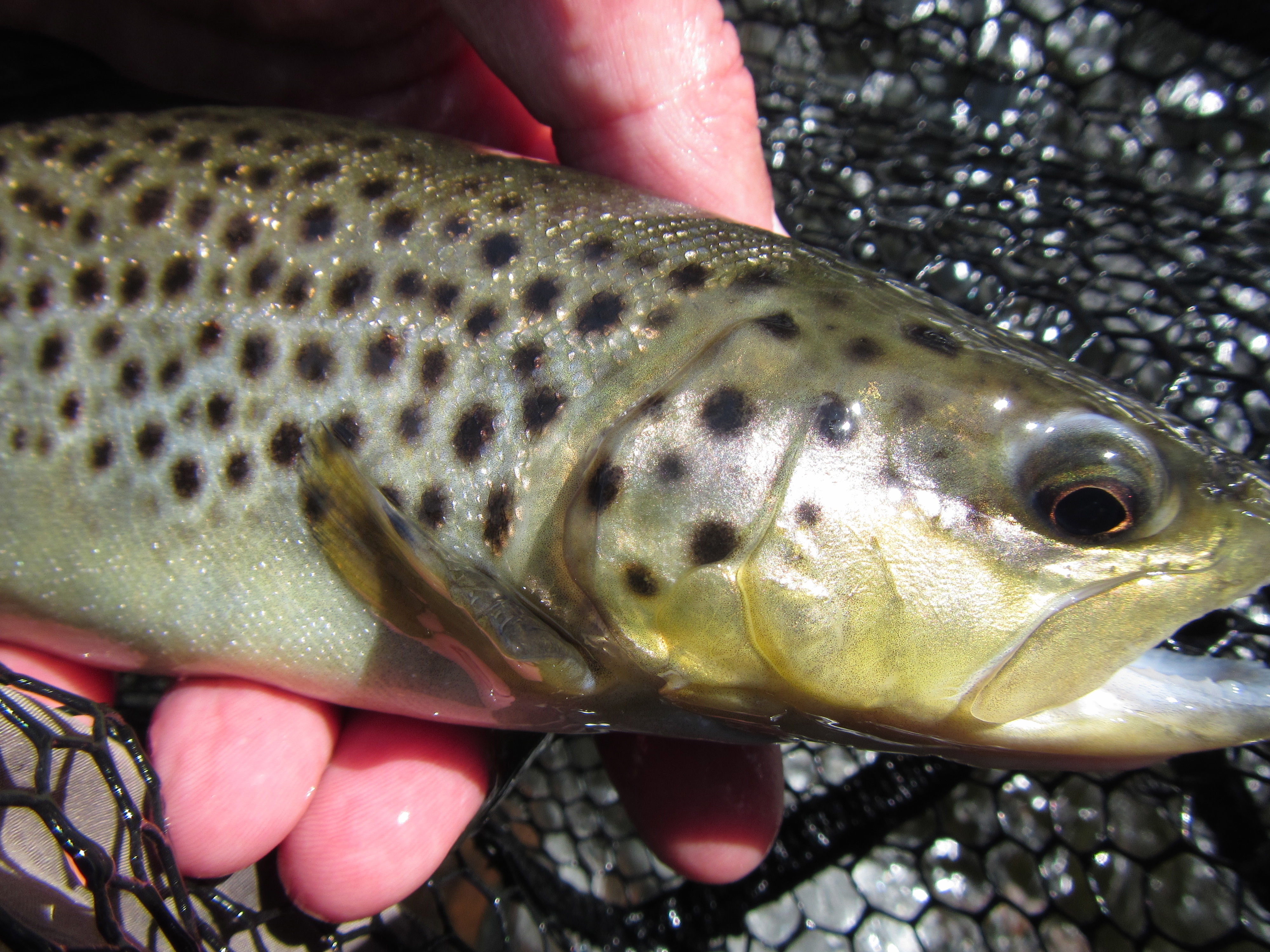
Just look at those pecs. Someone’s been working out. My best fish of the day.

Image

I had originally planned to go striper fishing today, but unfavorable reports, unavailable cohorts, and a nasty south wind put that idea to rest. Still, I needed to fish. So I decided to head over to a Class 1 WTMA. Before this past March, I hadn’t fished this stream in years. Buoyed by my success 10 days I ago, I thought I would explore it a little further.

Nothing says “wild trout” like urban factory blight. You could hit this building from the stream with a good enough cast.

Image

Second cast, and I was into the fish pictured above. Today’s fly was a white beadhead min-bugger, and this lovely brown clobbered it on the downstream strip. It’s funny how you find fish in the same sections of river over the years. This one was sitting in — where else? — a current seam. I took a few more smaller fish in parts below, then headed up to another section.

I find that old heater hose gives any fly fishing experience that romantic je ne sais quoi. Don’t you?

Image

That was a mistake. Most of the river was densely overgrown with saplings that made even roll casting impossible. The bottom was covered with fly-eating branches and in one pool, some kind of evil magnetic-to-tungsten bead flies metal grate.  By the third snagging encounter, I decided to pack it in.

I did notice that the suckers were in for spawning. There was also a strong midge hatch. Most of all, there were gloriously-colored wild browns, alive and well in living in their own little version of paradise.

Beauty truly comes from within.

Peepers. But sadly, no stripers.

I usually fish for stripers twelve month a year, but somehow January and February escaped me in 2013. March nearly got away, too. But I took care of that last night.

Met old fishing buddy Dr. Griswold to catch the bottom of the tide at one of our old haunts. The conditions were certainly favorable. A strong moon tide, good water level, and a water temp of 46. But alas, no stripers for either of us. I swung. I greased lined. I nymphed. I stripped. I jigged. I fished deep, on top, and all points in between. But, you can’t catch what isn’t there.

On a positive note, Bob didn’t lose his Christmas gift. Every year I tie some flatwings for friends as a present, and every year Bob loses his fly on the bottom or in a tree within the first five minutes of fishing it. Not last night. Well done, Bobber.

What Santa brought this year: the Rock Island flatwing

Image

I was also able to coax ninety minutes out of an E.P. Carillo Golossos while on the water. Terrific cigar.

And when I got home, the choir was singing. Spring peepers. Their first performance signals that the over-wintering bass in my local rivers are getting ready to move.

Not tonight. But soon.

Small Stream Wild Browns For Lunch.

No, no. Not the kind you eat. The kind you use as an excuse to avoid that pitfall of adulthood: Responsibility.

Back when I had a salaried job, I was fortunate to work within short driving distance of two Class 1 WTMAs. Many were the warm spring days when I’d take an elongated lunch to wet a line. Well, just because I’m working from home now doesn’t mean I couldn’t do likewise. And so today, I did.

I hadn’t been to either of these streams in years. “Hello, old friend,” I said to the first as I stepped out of the truck. The water was a perfect height, clear, 44 degrees, and there were midges and small grey stones flitting about. After last summer’s drought I wasn’t sure what to expect. So I decided to hedge my bets by fishing a size 14 beadhead white mini-bugger. I never met the wild trout who didn’t like a flashy streamer in early spring.

Hello, Mr. Stone. You successfully navigated to this rock without falling prey to Mr. Trout’s jaws. Fly and be free!

Stonefly

It felt both familiar and comforting to cast, mend, and swing that fly across my old stomping grounds. Nothing in a few of my favorite pools, then – bump – was that a fish or the bottom? Next cast I’m on with a lovely little brown, about five inches long. A fish to hand is currency, and with that trout my trip was bought and paid for. More nothing as I waded downstream. Then, near the tailout of a languid pool – was that a rise? You betcha. Small fish, smutting, and the best solution I had in my box was a size 20 Winter/Summer caddis. First drift, up he comes, but the hook point found no purchase. And that was that. Try as I might, I couldn’t coax a reprise.

With my time budget melting like the remaining snow pack, I motored over to WTMA number two. Fished a run where I’d had some early season success before, but drew a blank. I was just getting ready to leave when I talked myself into venturing about 50 yards downstream. There, in some shallow riffles, I hooked another small brown who liberated himself as I pulled him out of the water. Then, in the run below, bang! Classic hit on the strip. A stunning brown about ten inches long, his tummy the color of aged cheddar and pectoral fins the size of kayak paddles.

So what if I would have to work tonight?

Another Good Night For The Five-Weight

“What?”

That was my wife’s response, delivered with no small amount of incredulity – or was it sympathy – when I told her I was going fishing tonight. I really couldn’t blame her. After all, I had been traveling home from Florida all day. Now it was evening, and I was on the phone with her, calling on a New Haven-bound Amtrak from Manhattan. I wouldn’t be home for another two hours, and then it’d be another two hours before I could leave.

But, you get to used to the oddball treatment from people who don’t obsess over tide times, heights, moons, and river levels like you do. Even if you’re married to them.

I hadn’t fished in over a week, so I had it bad for some stripers. Tonight would be a perfect night for the five weight rod. Not too windy, and the prospect of a striper in the 15 pound class. I attached a fresh 30-pound test leader about eight feet long to the line, then tied on a Herr Blue flatwing about eleven inches long from nose to flash. Everything looked just right.

Not even a nighttime roadwork traffic jam could slow my spirits. I ended up getting my spot ten minutes late. So what? The fish would still be around.

The current on the outgoing tide was moving at a slow walking pace. In what little ambient light there was, I could see the intricate cake-frosting swirls of the eddies as they passed over the hidden bottom structure. I tried to guess the water temperature with my index finger. 58? 62? The thermometer said 59 degrees. Not a bad couple guesses.

I began by working a deep little run between the rocks. Herring swirled near the surface right in front of me. I tried a few dead drifts, almost like high-stick nymphing, but there were no strikes. So I began to methodically walk down-current, greased line swinging the whole way.

The fish in this section of river tend to hit on or about my second mend, but forty minutes had gone by without a tap. The drill was comforting. Cast. Immediately throw an upstream mend. Then another. Let the fly swing around. Swim, pulse, and dance it in the current. A few short strips, then let it fall back. Even fishless, the presentation was pleasant and meditative. A glance at my watch showed it was well into the wee hours, and I was out here all by myself.

Except for her.

She took the fly as they often do on the greased line, slowly, with full confidence, inhaling the Herr Blue near the head, then turning back toward the bottom. I felt it as a sudden change in pressure on the line. Subtle, nuanced, yet distinctive from the unimpeded drift. No demonstrative WHACK! No explosion on the membrane between water and air. Not yet. I came fully tight to the line with a backward thrusting motion. The hook point found its seat in the corner of her mouth. Right where it was supposed to be.

Now she becomes unhinged, tail thrashing at the surface. At first, I’m unsure how large the striper is, and I under-guesstimate her to be in the 24”class. She’s moving toward me, and I’m hand stripping her in. Once she reaches the edge of the sand bar and discovers she no longer has the comfort of depth to rely on, she lets me know that hand stripping will be ill-advised. The fish begins her first run, taking the slack line out of my shooting basket through my thumb and forefinger at a jerky, frantic pace.

The drag protests as more line is peeled off. I ratchet things down a little tighter, and that stops her. Just to be sure, I re-set the hook. Line is regained, lost, and regained. She’s tantalizingly close now, about twenty feet out, but not quite finished.

Her last defense is her undoing. To escape the shallows of the sand bar I’m standing on, she heads for the deepest nearby water, which happens to be upstream. Between the current and the pressure I put on her, she tires quickly.

As I cradle her in the water, I wonder how many herring she’d eaten that night? Our time is all too brief together, not only the fight, but the release as well. I don’t have her in the revival position for more than a few seconds before she thrusts out of my hands and melts away from the beam of my headlamp into the darkness.

I climbed into bed around 4am. The birds were singing. I was, too. All the way home.

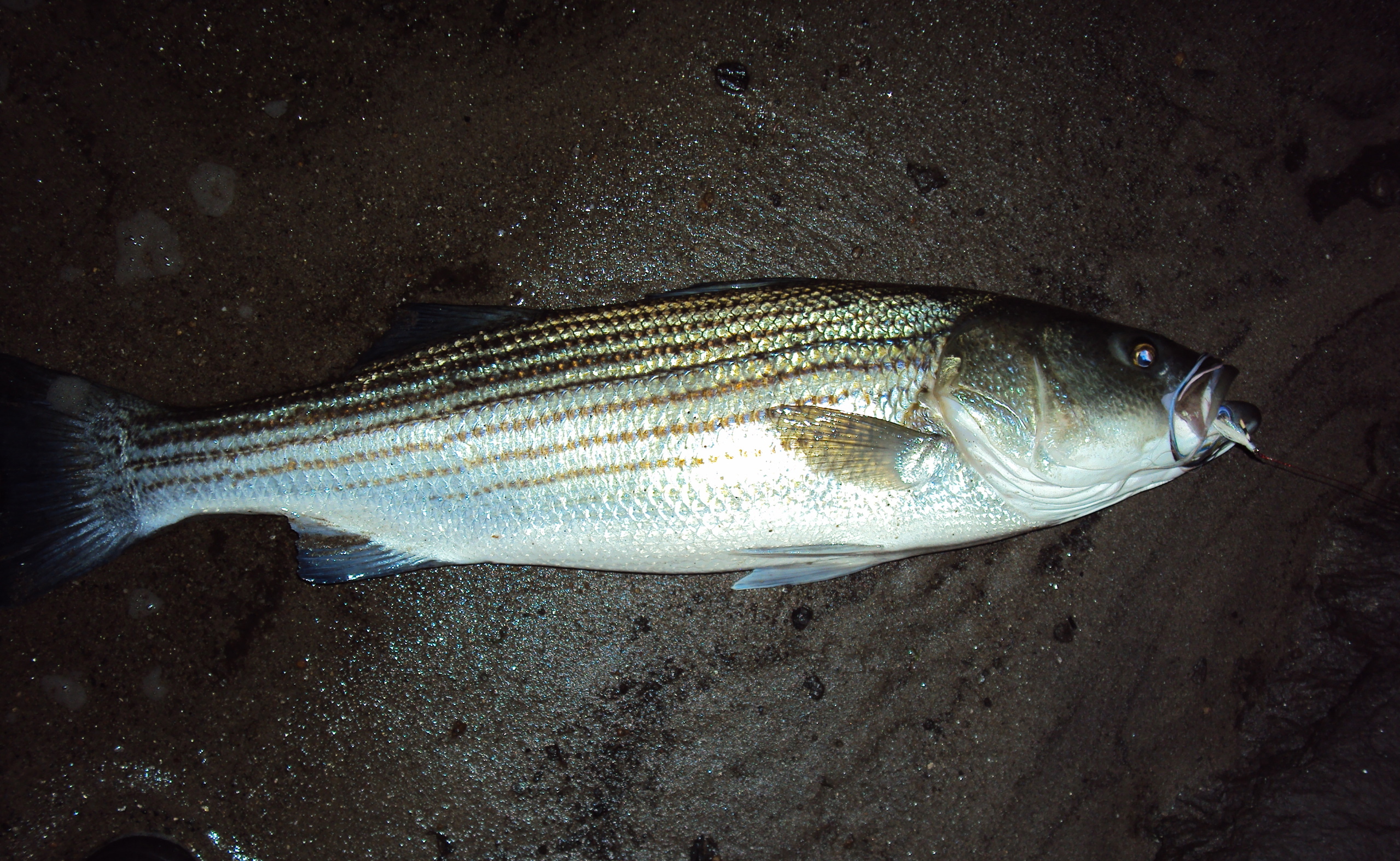
Miss Piggy poses for posterity. “Dang,” she’s thinking, “I really thought that was a herring.” For perspective, the fly, a Herr Blue flatwing, is about 11″ long.

Image

A close-up of the Herr Blue flatwing.

Image

This piece was written in May, 2012, and originally appeared in several online fishing forums.

The Peter Ross Wet Fly

The next time you fish the Peter Ross, be grateful that his name was not Aloysius Karbuncle. The Peter Ross is a traditional Loch style fly that dates back to the late 19th century. Ross based his pattern on the Teal and Red, another stillwater fly.

This fly is also a popular sea trout pattern, and you can easily see why. I like the contrast of the red, the black, and the dramatic barring of the teal. With its silver body, I’m thinking small baitfish or fry. Perhaps even something shrimpy. Something that looks alive and good to eat. I’ve already used it for steelhead, and I’m going to try it as the point fly on a team of three wets this spring.

The Peter Ross

Image,

Hook: 8-16
 (this is an Orvis 1641 size 10)
Thread: Black
Tail: Golden pheasant tippets
Body: Rear half silver wire, front half red angora goat
Rib: Fine silver tinsel
Hackle: Black hen
Wing: Teal flank

Tying notes: When you’re tying a small wet that calls for a body of “half this, half that,” it’s easy to mess up calculating how much area you need on the shank for each section. (Ask me how I know). You end up with a body that’s two-thirds one and one-third the other. Remember to take the head of the fly into consideration. Then, divide the remaining space between where you think the head will end and the end of the shank. There are many ways to tie in waterfowl wings. Some like to create an effect like a quill wing. Others like to fold the wing several times on top of itself, dull side in. Another way, the one I used here, is to tie the wing in small folded sections. For this size fly, I used three sections of teal flank about ¼ to 3/8 inch wide, folded them once, dull side in, and tied them on top of each other.

Thanks to the Saltwater Edge for tonight’s flatwing class

I spent a very enjoyable two hours tonight at the Saltwater Edge tying flatwings. We kept it simple with single-feather and two-feather patterns, like the Morning Glory and the September Night. Another great group, very enthusiastic, with lots of good questions. It is a privilege and a pleasure to be able to teach tying these magnificent flies. Thanks to Peter Jenkins and his gracious crew for having me. And thanks to Ken Abrames for leading the way.

Some flatwing-bucktail hybrids. Even at rest, they have a palpable energy.

Image