The third of three traditional striper fly videos from “Trout Fishing For Striped Bass.” If you can read a newspaper through the fly, it’s sparse.
Tag Archives: Ken Abrames
Cape Cod Fly Rodders awarded the Legion of Fresh Fried Scallops with Hops Clusters
Many thanks to the Cape Cod Fly Rodders for their hospitality and welcoming nature. “Trout Fishing For Striped Bass” made its debut last night, fortified by a hearty scallop dinner and a Cape Cod IPA. (I’ve heard somewhere that a fed presenter is a happy presenter.) Good group of anglers, excellent turnout, and I hope they’ll have me back.
Next up: “The Little Things” at the Catskill Fly Fishing Center & Museum’s Arts of the Angler show, Ethan Allan Inn, Danbury, CT, Sunday, November 5 at 10:30. A great little fly fishing show. Hope to see you there!
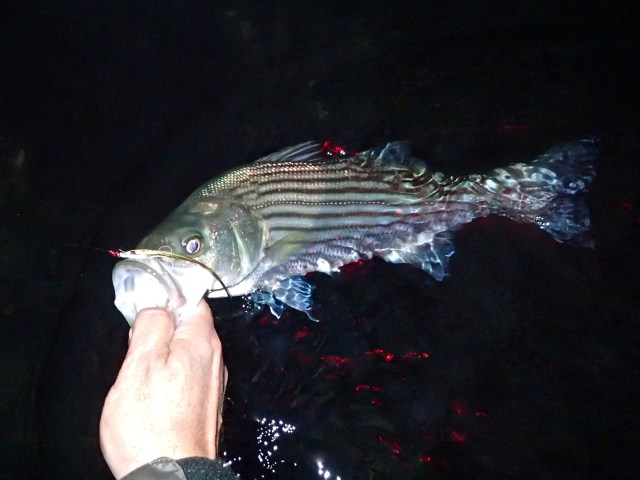
A handsome Cape stripah, taken this August on a Ray’s Fly flatwing on the greased line swing.
Flatwings, flatwings, everywhere!
A wee video sampler of flat wing streamers for striped bass, also part of my new presentation, “Trout Fishing for Striped Bass.”
A surprise guest, Steve Culton (at the Conn/RI Coastal Fly Fishers Thursday 9/28)
At the gigs just keep on coming! I’m a last minute replacement speaker for next Thursday night, September 28, at the Connecticut/Rhode Island Coastal Fly Fishers meeting. The presentation will be “The Little Things,” and it’s at the Elks Club in Groton, CT. You can get more information from their website. Hope to see you there — and man, do I need to get out out and do some fishing.
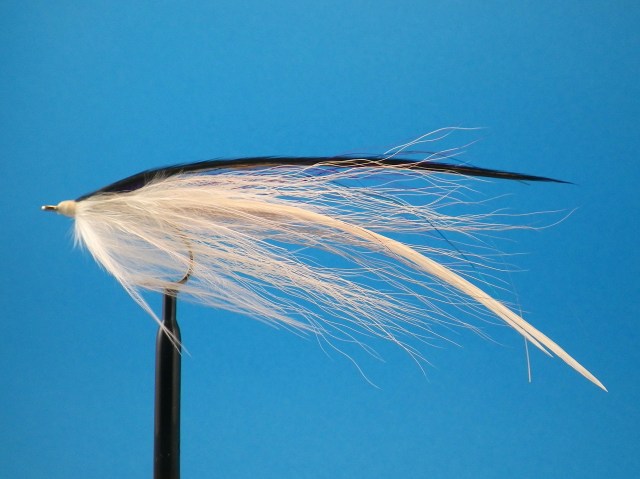
Time to tie up some September Nights! It’s a two-feather flatwing (three if you count the topping) with some sexy, soft marabou into the bargain. My favorite mullet fly. Did I mention it also works on trout? Do an internet search for the recipe.
Rare find for flatwing fans: R.L.S. Extra Long Saddle Hackles available
A selection of Ken Abrames R.L.S. Extra Long Saddle Hackles was recently put up for sale online. These are the genuine item — “New Old Stock” as we’d call them in the vacuum tube world — as originally sold by the creator of the modern flatwing. The saddles are in their original packaging and are in excellent condition. Many are unused; some are missing only a few feathers, leaving you hundreds of hackles to work with.
I want to make this very clear: I am not selling these, nor do I have an interest other than helping the seller offer these to people who may be passionate about tying and fishing flatwings.
The saddles are priced from $45-$50 depending on color, which I believe is a very fair price (shipping cost varies). Available colors include — this is current to my best knowledge but of course will change as he sells these off — Claret, Off White, Off White Variant, Natural Black, Umber Brown, Ginger Olive, Olive (seller’s comment: “The same name on pkg but looks more like Emerald Green to me.”) and Eggplant Harlequin.
If you’re interested, please email georgejjohnson@gmail.com.
This was the original lot. Many of the colors shown are gone; jump on the remaining ones while you can.

Banging around the Cape in the dark
At dinner at the Chatham Squire Friday night, Gordo asked me, “Are you going fishing tonight, dad?” My stock reply for such questions is: “Have we met?”
I spent 90 minutes fishing a mark on Pleasant Bay toward the bottom of the tide. Not a breath of wind. The current was good and my drifts were true, but it was one of those nights where the bass were elsewhere. I cycled through some basic patterns, and the only bump came on a black deer hair head fly about 5″ long. I did see a shooting star, and that helped take my mind off the fact that I was standing in the water in the dark near white shark central. I did note silversides on the wade out.
Saturday I headed to Steve’s Secret Spot (I’ve seen one other angler there in 10 years). It’s a nondescript mid-Cape creek mouth that is either on or off. Tonight it was infested with silversides and a few striped brigands. But unfortunately, it’s an outgoing tide spot only, a fact drilled home to me while I waited almost an hour for the tide to go from slack to incoming to find that the silversides were still there but the bass had skedaddled. I had had only a half hour of outgoing, and could manage only one bump.
So I hightailed it back to Friday’s spot and gave myself 15 minutes to catch a bass. Midnight, second-to-last-cast, bump on the swing, then bang on the dangle. Our Blessed Lady of the Ray’s Fly Flatwing comes through again.
Four-oh. A perfect fish at a perfect time on a perfect fly.
Ken Abrames 1994 Striper Fly Tying Presentation Video
I discovered this gem just yesterday: archival footage of Ken Abrames making a presentation on striped bass fly tying to the Rhody Fly Rodders, circa 1994. Now you too can watch, listen, and learn from the grandmaster as he covers striped bass fly design, materials, color, and traditional tying methods. While I’ve had detailed conversations with Ken on all these topics, it’s still a special treat to be able to see him in action over 20 years ago.
Recorded long before the days of home HD, the video is perfectly watchable — certainly, its content far outweighs any video washout or digital artifacts. You can find it on YouTube in three parts; here’s the link to part one.
What happens when you mix water and bucktail (and other secrets of the art of tying the sparse fly) revealed.

Striped Bass Podcast in the can
Or so they’d say in the days of film and reel-ro-reel tape. I guess the proper term now would be “on the drive.” Regardless, last week we recorded material for a podcast(s) about fly fishing for striped bass with a floating line, flatwings, sparse flies and other traditional fly fishing methods. There are over two hours of material to sift through — thankfully, not my job — and unfortunately, I don’t have a release date. But hopefully the editor will hop to it and we’ll have something fun and informative to listen to on long drives or — shhhh! — while goofing off at work. When I have more information on a completion date, I’ll let you know.
The boys are back from summer camp, so my three weeks of hedonistic binge fishing are over. Not to worry. I have brilliant plans for sneaking out to the water…
I haven’t been in ten days, but my spies tell me the Farmington continues to fish well. Plenty of cold water has the trout fed, fat, and happy.
As always, thanks for reading and following currentseams.
Flatwings. Floating lines. Traditional presentations. You too can learn the secrets of catching stripers that are measured in pounds instead of inches. Coming soon to a podcast near you.

Block Island Stripers From The Shore
“Block Island Stripers From The Shore” first appeared in the October/November/December 2016 issue of Mid Atlantic Fly Fishing Guide — sadly, the last issue of this regional gem. I consider Block Island to be sacred fishing ground. Some of my favorite fly fishing memories have been created along its shoreline.
My grandparents had an old map of Block Island in their basement. To my young eyes, it looked like a pirate treasure map from a story book. (I wasn’t too far off – the notorious Captain Kidd was known to frequent the island and its waters.) Then, there was the curious name. Why Block? It was shaped more like a pork chop than a cube. (I would later learn the island was named for Dutch explorer Adrien Block.) It was small enough to be charming (7 miles long and 3 miles wide, situated 13 miles off the coast of Rhode Island) yet substantial enough to have been around since the last ice age.
Then there were the magical names of its shoreline and landmarks: Pots and Kettles. Rodman’s Hollow. Black Rock. It all sounded like a fanciful netherworld inhabited by wizards and elves.
The wondrous reality is that from May through November, Block Island is home to Morone saxatillis. And if the year, moon, and tides align, you can reasonably expect an unforgettable encounter with a striped bass on the fly from the shore.
A feisty Block Island school bass taken on a dead drift using a small, sparse sand eel pattern.

~
Where to fish. Finding a place to fish on Block Island is a good news-good news scenario: many possibilities, ample public access. You can find most of these spots on an online map. Note that there is no camping on Block Island, and no sleeping in vehicles.
Crescent Beach stretches several miles north from the ferry landing in town to Mansion Beach. The sandy bottom makes it a popular place for sight fishing. Some people bring ladders, but most anglers are content to walk and wet wade. Mornings – the beach crowds start building around 11am – and late afternoons are the best times to try your hand at stalking a cruising fish. If you see a substantial number of bass during the day, it usually means they’ll be around at night, too.
You’ll find structure, waves, and current like this along much of the island’s shoreline.

~
Sandy Point is the spit that juts out from the northern tip of the island. Currents from Long Island Sound and Cow Cove smash together, creating the dangerous – and sometimes deadly – North Rip. This is the place where Block Island angling legend Ben Lubell lost his life in the early 1980s. Take a lesson from Ben, and never wade in the North Rip. Stay out of the water and the wash at Sandy Point.
Those same lethal currents can also make for great fishing, acting as a conveyor belt that delivers helpless bait to waiting mouths. Local historians will tell you that Cow Cove got its name when the island’s first settlers forced their cattle to swim ashore there. Noted author and fly tyer Ken Abrames says with a smile that the name really comes from the size of the stripers that have been taken there over the years.
The Great Salt Pond was once a brackish, landlocked lake. A channel was dug in 1895. The pond offers the fly fisher a rich diversity of angling opportunities, from shallow flats to deep water drop-offs to pinch-points to river-like currents. The channel at the Coast Guard Station, also known as the Cut, is the most popular fishing spot on the island. However, popular doesn’t always mean best, and parking is often limited.
West Side. Charlestown Beach runs along the middle of the west side of the island. When it’s on, gird yourself for a bad case of striper thumb. The largest blitzes I’ve experienced on Block Island – both in numbers and pounds per fish –have taken place along Charlestown Beach. The West Side is also home to Grace’s, Dorie’s, and Cooneymus Coves. All are rocky bars that are in fly rod range at high tide.
South Side. The stretch from Black Rock Beach to Mohegan Bluffs features the kind of rocky structure that stripers like to frequent. However, both surf and prevailing winds can be a challenge to fly casters.
Some final words of advice and caution: never fish an area you’re unfamiliar with at night. Reconnoiter it first in daylight at the same tide you’ll be fishing. Don’t venture out in rough surf. And fish with a friend.
Flies and gear. Sand eels, squid, and silversides are the predominant inshore baits, so bring plenty of flies that match their action and profile. Sand eels start out small – 2” or less in early June – and grow as the summer progresses. I favor sparse, impressionistic patterns like Ken Abrames’ Eelie and Big Eelie. I tie the Big Eelie in a wide range of color combinations, from the original white/yellow/olive/blue to blue/black/purple. I make them about 4 ½” long, and stripers relish them all. It’s hard to go wrong with any simple, slim-profile baitfish pattern.
I’ve caught more Block Island stripers on the Big Eelie than any other pattern. This is the fly’s original color scheme.

~
It’s not uncommon to find both smaller (2”-3” long) and larger squid in the Great Salt Pond. And while I’ve never done very well using big flies on the Block, I always bring some foot-long eel patterns, because one day I’m going to find that 50-pounder. Crab and shrimp flies designed for bonefish will also work quite well on Block Island’s flats.
Bring your favorite one- or two-handed rod. As with any island, expect windy conditions, and match your rod accordingly. The water I fish is typically 2 to 8 feet deep. A floating line gives me the option of presenting from the surface to the bottom in most places. I always bring my full-sink integrated line in case it’s insanely windy or I want to fish a deep channel.
Waders and studded boots are essential gear for navigating the rocky shores and jetties of Block Island. Lightweight and comfortable boots will make that one-mile slog down the beach a little more endurable. Keep in mind that Block Island is surrounded by cool water for much of the summer; you’re probably going to need a jacket at night. Use a personal flotation device and carry a compass – Block Island can get Transylvania horror movie foggy.
And for those rare nights when the wind lies down and the air is still, make sure you have a generous supply of effective bug spray. The no see-ums on Block Island are torturous.
When to fish. Every year is different, and as east coast striper stocks have ebbed and flowed, so has the fishing on Block Island. In the previous four years I have caught as many as 75 bass over 8 nights, and as few as 4. There’s no way to predict which island you’re going to get.
While you can certainly catch Block Island stripers in daylight, Ray Charles put it rather eloquently when he sang, “night time is the right time.” Because most of the water I fish is shallow, I favor the dark of the moon or cloud-covered nights. Of course, the best time to go fishing is when you can. Catching or merely fishing, Block Island is a unique and beautiful location – and you’ll quickly understand why it was named by the Nature Conservancy as one of the “Last Great Places.”
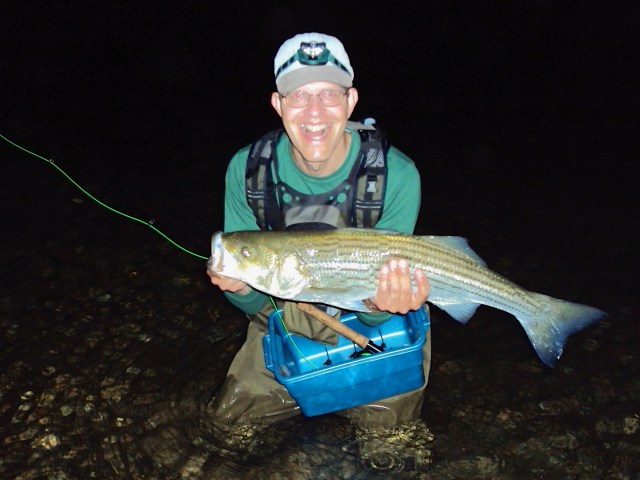
Why I love fishing at night. This striper was part of a school of 10 to15-pound fish that set up on a shallow cobble-bottomed bar to ambush bait.
Block Island striper report: small is the new black
Another year, another seven days to chase linesiders in one of The Last Great Places. What each new season brings is always a mystery until you get out there, and then you can toss all the reports you’ve been hearing because they’re either spot on, nothing like that at all, or varying points of somewhere in between.
In 2017, I’d been hearing credible talk of voluminous schools of sand eels inshore and the Bass-O-Matic running on high. That sounded swell, but there were two x-factors to consider: we were coming out of the new moon into first quarter with a waxing gibbous and its bite-killing light; and the weather. Good news/bad news on both fronts. On the plus side it was cloudy most nights, so moonlight was not a factor. On the down side, it was windy. Like small craft warning windy: 20 knots sustained with higher gusts that pushed the limits of what is reasonable with a fly rod. And wind usually changes everything on the Block.
Like last year, I caught stripers every night. But the bargain of two consecutive years without a skunk was a preponderance of small fish. This was the first time in a decade that I didn’t take a legal bass out here, and I found myself longing for those schools of 15-pounders that would sit off the beach for 90 minutes, having their way with sand eels. I had two double-digit nights, then a six, then three singles, and wrapped it up with another half dozen. But 27″ was the largest bass I could muster.
Sight fishing from the beach during daylight was tough due to wind, but mostly to the clouds that made finding those elusive shadows a chore. What’s more, on the sunny days I spotted very few cruisers. I did get two fish to follow my fly, one of them a good 20-pounder, but in the end they both broke off the chase.
And then there were the Meatballs. I had enough nights where I enjoyed blissful solitude, but there were a few sessions where the Meatballs were out in force and in rare form. I’m usually the quiet sort on the water, but at one point on a certain night I was blasted so often by so many hundreds of lumens that I finally turned and barked, “Please stop shining that light on me NOW!” They left shortly after. I had a cigar to celebrate.
And that’s the thing about Block. Even when it’s bad, it can be very, very good.
I had high hopes for this fish — he went on the reel — but the tape measure didn’t lie and he came up an inch short. I mostly stuck with my usual eclectic mix of Big Eelies. This fish thought the Crazy Menhaden color scheme looked tasty. Kind of a neat stained glass effect going on in the water around him, too.

~
Unless there’s a specific hot spot, I always try to mix it up on the Block. I fished the east side and west side beaches, southeast side, off some jetties, in the Great Salt Pond, and — regrettably — the North Rip. I say this only because the Rip had been producing a consistent good bite if you had a spinning rod. The night I slogged out there was about the worst night for fly fishing you could imagine. The wind was rain jacket whipping-fast, and I had to cast my line backhand over my right shoulder (I’m a lefty) to shoot it into the rip, then feed line into the left to right current. So far so good. But, rats. Mung. Every cast. I took this shot when I got back to the truck. Yes, it was that hot and that humid and that foul. I love the Block, but walking a mile and a half in the sand for nothing will make anyone dour.

~
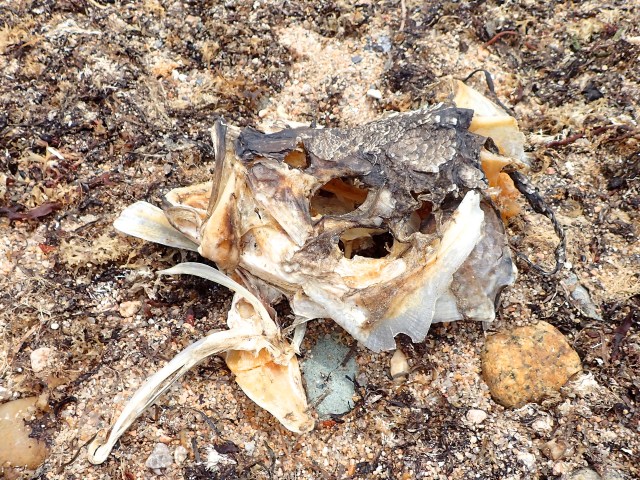
I discovered that striped bass have great camo against the sand and rocks — even when they’re dead.
~
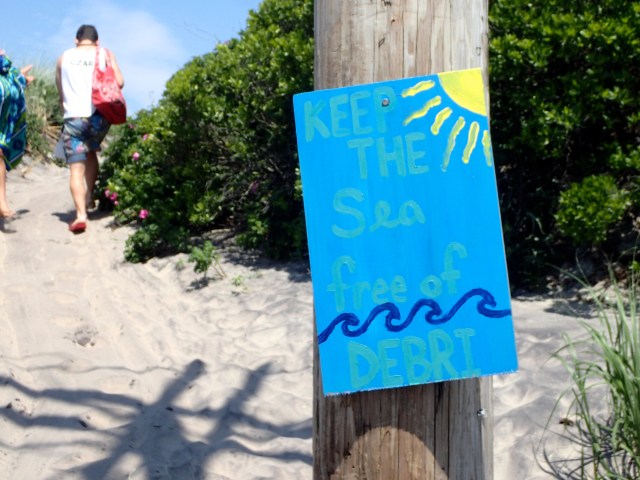
A public service message brought to you by the National Spell Check Society.
~
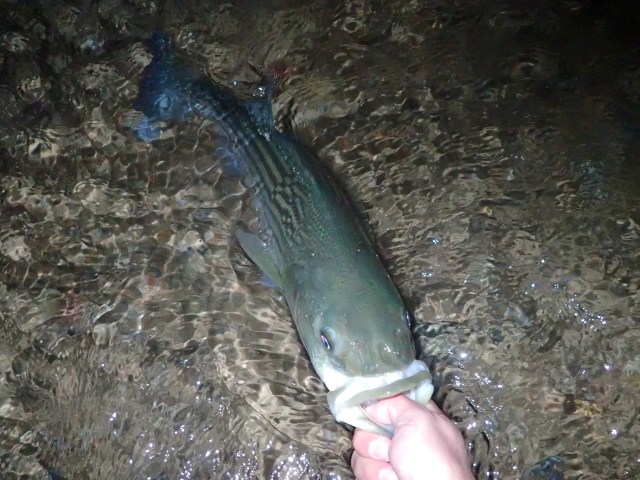
On the last night I caught bass two ways. First, off the beach, where I found a school of hungry fish feeding in the moonlight; then, inside the Pond on a flat with a team of three flies suspended in the film. (Floating line, of course, for both methods.) My last two fish of the trip came as the flies dead-drifted across the flat. That building pressure I felt let me know a striper was flaring his gills to suck in one of the small sand eel flies, in this case a 3″ Eelie in olive and chartreuse. See you next year, when one of us has put on a few more pounds.
 currentseams.com