“Mainly Misunderstood — Five Myths and Realities About Using Floating Lines For Striped Bass” in the current issue of American Angler

Why are floating lines so underused for striped bass fly fishing? Are intermediate lines  truly versatile? These questions and more are answered in “Mainly Misunderstood,” and you can read all about it in the current (May/June 2017) issue of American Angler. If you’re looking to open the door to a whole new world of presentation options, the floating line is the antidote to the mind-numbing metronome of cast-and-strip.

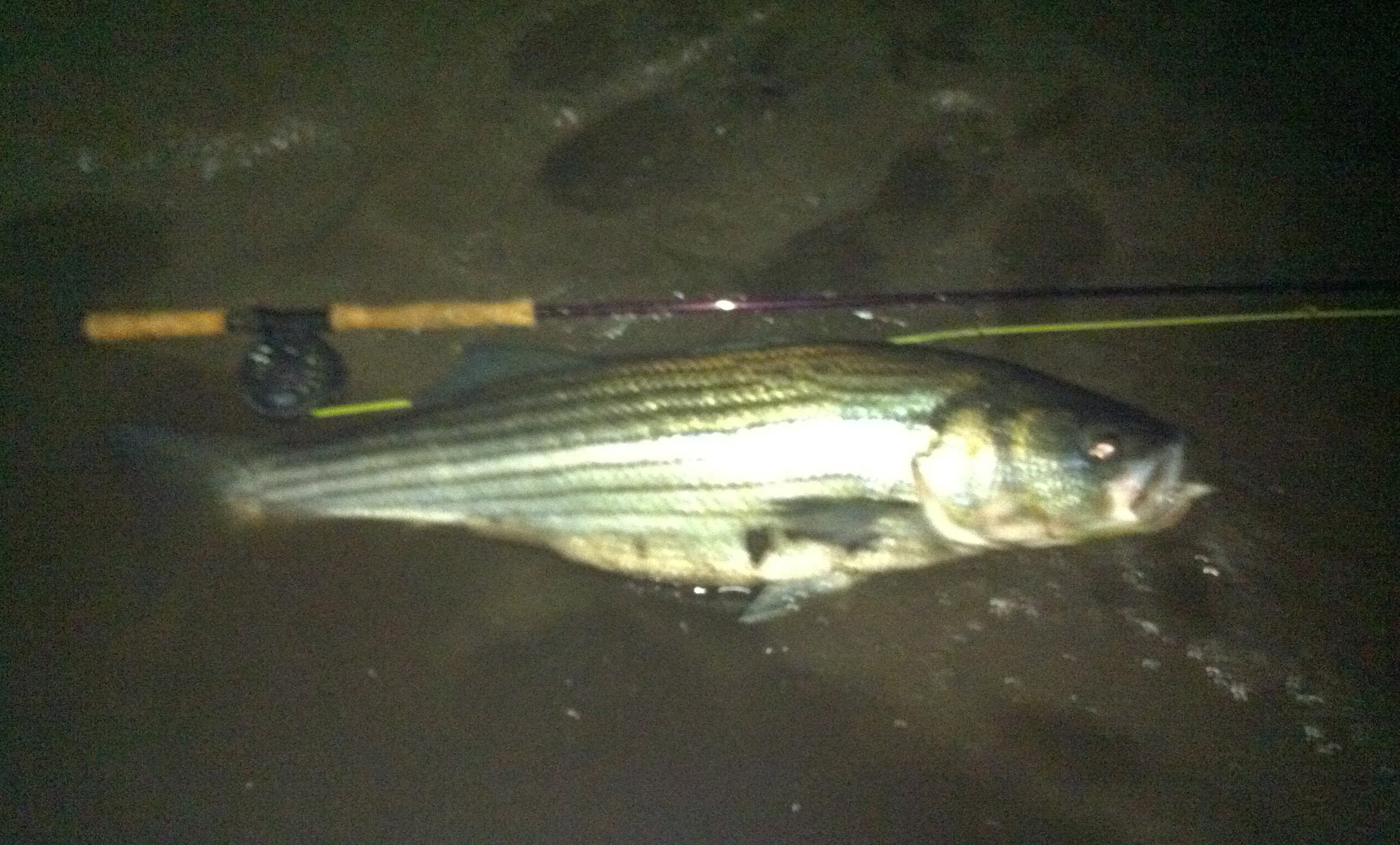
If you want to catch keeper bass like this with flatwings fished on a greased line swing, you’re gonna need a floating line.

OLYMPUS DIGITAL CAMERA

~

I love fishing floating lines in surf around structure.

OLYMPUS DIGITAL CAMERA

Striper Report: Walkin’ after midnight. Searchin’ for you.

I started on Monday and finished Tuesday. No moonlight or starlight. Rather, one of those misty, showery nights where the atmosphere is so dense it seems you could wrap your fingers around it and grab a handful. Mysterious. Striper. Weather. The five-weight with the new Rio Outbound line and a seductive 9″ Rock Island flatwing fresh off the bench, ready to swim. Hours of greased line swings. Rhythmic mending. The rise and fall of the fly in the current on the dangle. Short pulsing strips on the retrieve. Water haul, tip flexed, the line coils shooting from the basket through the guides. Ears cocked, listening intently in the dank as best you can for the sounds of a swirl or the pop of an open mouth. Nothing. Still, nothing. And more nothing. Just you, the rod, the fly, and your thoughts.

You may ask why I keep doing this when the repetitive result is neither fish nor hits. Because this could be the night I get my first 25-pounder on the five weight. Because the next cast might be the drift over a striper holding in ambush. Because you can’t catch striped bass while you’re asleep in your bed. Because I’m fortunate enough to be able to set my own schedule, and people like you send me comments and emails telling me that when you can’t go fishing, you enjoy reading about when I can.

Most of all, I do it because I love it.

I left home almost five hours ago. I fished hard and I fished well, so I fell asleep as content as an angler could be after a skunking.

IMG_3078

Curl up baby. Curl up tight.

Back to the night shift. Dozing on the couch at 10:45, taking care to not really fall asleep because the bus is leaving at 11:30. On the road, JR Cuban Alternate Cohiba Esplendido ceremoniously lit at the appropriate landmark. Now past midnight, and it’s raining. Maybe it will keep the yahoos away. Only a few cars in the lot. That’s good. The weather people said showers, but this is more like a fine mist. Three other guys out fishing, more than I expected, but better than Monday’s daytime lineup. There are fish around — the spin guy to my left just hooked up. Now it’s really raining. I didn’t order this wetness. Everyone is leaving, and I’m all by myself. Thirty minutes in. The rain stops. A few stars try to wink through the parting clouds. There it is, a sharp pull at the end of the greased line swing. My first keeper of the year? No way. It feels like a short. And it is. Not why I came out tonight, but the stink is off. Working the stretch of water down, then backing up the pool, even though there is no true pool to be backed up. Over an hour of meditative casting, mending, swinging, repeating. Alone. Magnificently alone. Let’s try up there. I haven’t caught a striper up there in a long time. The answer is no. Until the answer is yes. A better fish, struck on the second mend, but still a short. I can see Scorpio and the Summer Triangle and it makes me dream of being out alone on Block Island in July. There’ll be some keepers there for sure. There probably are a few here, but not for me or my Crazy Menhaden. Perhaps when next I return. Big girls. Ready to eat.

Undercover of the night.

That’s AM, people. Very AM.

IMG_3023

And on the 500th cast, a striped bass

It’s been a pretty weird spring for those of us who chase striped bass from the shore on the fly. Ye Olde Striper Shoppe, usually overflowing with eager school bass this time of year, continues to fail to produce. You’ve heard me say it before — every year is different — and as Joe Jackson might say, “so there goes your proof.”

I almost didn’t go yesterday because I simply wasn’t feeling it. But I talked myself into it. Not too hard a sell, since it’s got to turn on sometime, right? In the interest of avoiding crowds and trying something different, I went to a place that had no right to be holding stripers. It wasn’t. But I got my money’s worth of casting practice. Oh. And there was that rip. That paramour-sexy rip with its erotically dancing, undulating surface that made brazen overtures to my weaknesses for such water. Mark my words, there’ll be a bass or ten in it sometime soon.

I forgot my good camera. Usually that means a big striper. But you’ll have to settle for this water, weed and sand sculpture.

April sand bar

Switched from the full sink to the floater for a second piece of water. Nearly two more hours of casting practice. It was rejuvenating to perform a proper greased line swing again. (The poetic majesty of the greased line swing cannot be under-estimated.) But, time on this session had run out. Three more casts. And on the third, as the seven-inch long Crazy Menhaden flatwing swung down and across, a firm take worthy of the year’s first striper. A standard-issue school bass, under twenty inches, still wearing the colors of estuary in winter. But for today, a perfect fish.

I gotta tie some more of these. And some Rock Island flatwings, too.

Crazy CU

A Floating Line Myth. Sunk.

Striped bass don’t read internet forums or hang out in breachway parking lots. This fifteen-pounder was part of school that was feeding in a strong rip. The bait, sand eels, was trapped between the rip and the shore and the stripers were feeding with impunity. It was one of those magic moments (rather, episodes — it lasted close to 90 minutes) where it was a fish on every cast. You guessed it. I was using a floating line.
Mouth
~

Salmon Fishing for Striped Bass

Salmon Fishing for Striped Bass first appeared in the October 2014 issue of Mid Atlantic Fly Fishing Guide. Many thanks to them for allowing me to share it on currentseams.

Most striper fly anglers have never heard of A.H.E. Wood or the book Greased Line Fishing For Salmon. That’s a pity, because Wood’s greased line swing is one of the most elegant, pleasing – not to mention effective – ways to fish for striped bass in current.

Wood fished for Atlantic salmon in Scotland over a hundred years ago. Greased Line Fishing for Salmon, a technical how-to based on his extensive letters and notes, was first published in the 1930s. It was re-issued in 1982 by Frank Amato Publications with “[and steelhead] “ added to its title. While the writing style is a bit moldy, the content will transform the way you fish for stripers. You may never approach an estuary or a breachway the same way again.

The greased line and the fly rod.

Before the advent of the modern floating line, anglers were compelled to use lanolin dressings (grease) to keep their silk lines on the surface. Why grease the line? A floating line allowed them to mend. Mending meant they could harness the power of the current, rather than have the current dictate the fly’s path. As Wood wrote, “The basic idea is to use the line as a float for, and controlling agent of the fly; to suspend the fly just beneath the surface of the water, and to control its path in such a way that it swims…entirely free from the pull on the line.” It is a concept, Wood observed, “entirely opposed to that of the normal sunk fly procedure.” If you fish for stripers but don’t use a floating line, here is your chance to break free from the shackles of the sinking line – and use your fly rod as a fly rod, rather than a glorified spinning rod.

You can perform the greased line swing with a standard-issue nine-foot rod. But a longer rod makes mending a delight instead of a chore. And mending is at the heart of the greased line presentation.

Open wide. That’s about all this fifteen-pound Block Island striper had to do to eat my sand eel fly.

Mouth

Why greased line swing?

Like their salmonid cousins, striped bass love current. They will take up feeding positions, holding on station, moving no more than a few lateral inches while they dine. Often, the stripers will not chase a stripped fly. Why would they? The current is conveniently delivering their food. All they have to do is rise to meet each morsel with an open mouth. Those morsels can range in size from minutia like crab larva, to inch-long grass shrimp, to more substantial fare like mullet, menhaden and herring.

And therein lies the genius of the greased line swing. Regardless of the size of your fly, you are sending it on a pathway to a hungry striper’s mouth. She doesn’t have to work hard to eat. What’s more, during much of its drift, the fly is presented broadside to the fish. This gives the predator a full profile of what’s for dinner, rather than a fleeting glimpse of a tail or head.

 Presentation flies like these Crazy Menhaden flatwings are an excellent choice for the greased line swing.

Crazies

Performing a simple greased line swing.

Use the greased line swing in tidal rivers, breachways, sand bar rips – any place stripers hold in current to ambush bait. Make a cross-current cast with your floating line. The moment the line hits the water, begin throwing a series of upstream mends. Be sure to mend the entire fly line, from the rod tip to the line/leader junction; half a mend is no mend. While you are mending, the fly will be travelling downstream at the natural speed of the current, while appearing to slowly swim toward the shore behind you. When the fly is nearly two-thirds of the way down and across from your position, stop mending, and hold the line so the fly can complete its journey with a wet fly swing. Keep the fly in the current below you for a few moments, then retrieve and cast again.

Obviously, if you see signs of an actively feeding fish, be sure to present your fly over its feeding lane. The greased line swing is also an excellent searching tactic. “Backing up a pool,” another traditional presentation method, involves working a stretch of water by moving upstream. Backing up a pool with the greased line swing allows you to cover a tremendous amount of water.

To execute the greased line swing, cast cross-current and throw a series of upstream mends (A-C); hold the line so the fly makes a wet fly swing (D); at the end of the swing, retrieve and re-cast (E).

Culton_Greasedline_Currentseams

Hooking stripers on the greased line swing.

The take of a big striper on a greased line swing is sublime. Rather than the blunt force hit with a stripped fly, the angler initially feels only a presence – a mere building of pressure. This is the striper acquiring its target, flaring its gills to suck the fly into its mouth. You might be tempted to set the hook at this point; but that would be a mistake. You’ll pull the fly right out of the striper’s mouth. Instead, let the bass hook itself. It is feeding with confidence, and does not yet sense that it has been deceived. Simply hold the line, and let the bass come tight as it turns away with the fly in its mouth. All this happens in a matter of seconds, or less. The hook point (of course, you constantly check your hooks to make sure they’re sticky sharp) will find purchase in the corner of the striper’s mouth, just like your father taught you it should.

When you present on the greased line swing, the stripers you catch will be neatly hooked in the corner of the mouth every time.

Culton_Greasedline_2

You may be thinking, “But I like the way that big hit on the strip feels!” Not to worry. The adrenaline rush you crave is coming.

Now, the striper realizes that this baitfish bites back. The water erupts as the fish’s primal reflexes of fight and flight kick in. This is where you set the hook. Point your rod directly at the fish, hold the line tight to the rod handle, and thrust rearward with conviction. I cannot emphasize enough the importance of a solid hook set. If you’re fishing with a strong leader – mine is always twenty, twenty-five, or thirty-pound nylon, substantial enough for any inshore striper I’m likely to encounter – you can dictate terms to the fish. From this point, the striper will be fighting a losing battle.

And you’ll have Arthur Wood to thank.

New article in the current issue of MAFFG: “Salmon Fishing for Striped Bass”

“Salmon Fishing for Striped Bass” is a primer on greased line fishing for stripers. I’ve been wanting to write this article for a long time, since the greased line technique is one of my favorite ways to fish. If you’ve never tried it, you’re in for a treat. It is an elegant, effective, and just plain fun way to catch stripers. The greased line swing is tailor-made for presentation flies like flatwings and soft-hackles. You can read all about it in the Steelhead — Salmon — Saltwater issue (October 2014) of the Mid Atlantic Fly Fishing Guide. MAFFG is available free in fly shops from Connecticut to North Carolina.

GLS MAFFG

In any given year, my largest stripers come on big flatwings presented on a greased line swing — like this thirty-pound beauty taken on a 10-inch long Razzle Dazzle.

IMG_1367

A tale of two five-weights

All five weights are not created equal. I should know. I’ve got four of them. You may ask why I need four of the same rod. The answer is that while they’re all five-weights in name, they could not be more different. Each is a specialist in its field. The two I want to talk about here are my 6’ Fenwick glass rod and my 9’ TFO TiCr.

This all started with a steelhead trip I had planned with my ten year-old. We had to cancel due to weather, and we were were both a little bummed about it. But I told Cam that since we weren’t making the drive to Pulaski, we could spend the day fishing closer to home. I gave him options: trout on the Farmington, stripers on the Hous, or wild brook trout over the hills and far away. Cam decided on brookies. I thought that was a fine choice.

I’ve had the Fenwick for many years now. It’s a sweet 2-½ ounce stick that flexes down to the handle. A five-weight line works just fine on it, and like bamboo it’s an exceptionally easy rod to cast. Cam told me he wanted to do a little more of his own fly casting this year, and this would be a good starter setup for him. Unfortunately, the first stream we hit was turbid with runoff. So we hopped in the truck and took a little drive north. The second stream was in fine fettle, medium high, and clear as an aquarium.

 It took us several tries to hook this fish. She kept whacking the microbugger, but we couldn’t seem to get a good hookset. Classic haloes and Fontinalis fin.

Image

Cam got to work with on the surface with a size 14 Improved Sofa Pillow, but we had no takers, even over some confidence-is-high pools and runs. Undeterred, I tied on a blackish micro-bugger with a chartreuse bead head. That did the trick. Whereas the brookies were bashful about showing themselves on the surface, they were more than happy to nip and tug as soon as the fly settled beneath the surface. We landed four nice brook trout with glowing blue haloes and dropped a bunch more. It was a tired and hungry but happy hike out of the mid-April woods.

Eight hours later, I was swinging flatwings for stripers with my TFO TiCr five-weight. Where the Fenwick is a flexible birch sapling, the TFO is one of those redwoods you could drive your car through. I mate this rod with a 9-weight Rio Outbound floating line, and even with that night’s ten mile-per-hour crosswind, casting an eight inch fly was effortless – provided I found that sweet spot where the shooting head met the running line. Not easy on a moonless night.

I was mostly greased-line swinging, my favorite presentation with bigger flatwings. Sometimes the takes are nearly subliminal – instead of a tug, you feel a minute change in pressure that exponentially accelerates into mayhem. On this night it was different. The fish were taking the fly moments after I had completed my mends (I was fishing a narrows that only allowed two) and the takes were an adrenaline-produced amalgam of pull, boil, and surface thrash. I took three stripers on the greased-line swing; two of them in the double-digits pound class.

 31″ of pure pleasure on the five-weight. She fell for my Rock Island flatwing, tied about 8″ long.

Image

Both of those larger fish were quickly played and landed. Both tried to run upstream when I attempted to coax them onto the sandbar I was standing on, and the side pressure I applied with the butt of the rod easily dissuaded both.

Miss Cow never showed up. But she’s out there, somewhere. And one night, on a moon tide, she and I and one of my trusty five-weights are going to go for one hell of a ride.

Two-handed casting practice.

You don’t know if you don’t go, so this morning I headed to Ye Olde Spring Striper Spot to see what the outgoing would bring.

I can’t remember the last time I saw ice in saltwater, but there it was, a hoary reminder of last night’s unseasonable cold.  Water was slightly off-color and a sparkling 41 degrees. A most unbenevolent 10-15mph wind lashed at my face, turning the water into a frenzied chop that made riplines hard to see. The four fly anglers who had been fishing were retiring for the day, and the two spin guys weren’t very far behind.

Yup. Didn’t look like it was going to be my day.

On the plus side, I got to re-acquaint myself with my old friend the sea. My morning cigar was splendid, though the wind made short work of it. And I got to shake some of the rust off my two-handed casting (to be fair, there was enough oxidation there to want a wire brush). I test-drove the four-foot T11 sink tip I made over the weekend, and discovered that I could easily get my fly to the bottom in current  with some strategic mends. Best of all, I had the whole place to myself.

So, not yet. But soon. And, like Ah-nold, I’ll be back.

Peepers. But sadly, no stripers.

I usually fish for stripers twelve month a year, but somehow January and February escaped me in 2013. March nearly got away, too. But I took care of that last night.

Met old fishing buddy Dr. Griswold to catch the bottom of the tide at one of our old haunts. The conditions were certainly favorable. A strong moon tide, good water level, and a water temp of 46. But alas, no stripers for either of us. I swung. I greased lined. I nymphed. I stripped. I jigged. I fished deep, on top, and all points in between. But, you can’t catch what isn’t there.

On a positive note, Bob didn’t lose his Christmas gift. Every year I tie some flatwings for friends as a present, and every year Bob loses his fly on the bottom or in a tree within the first five minutes of fishing it. Not last night. Well done, Bobber.

What Santa brought this year: the Rock Island flatwing

Image

I was also able to coax ninety minutes out of an E.P. Carillo Golossos while on the water. Terrific cigar.

And when I got home, the choir was singing. Spring peepers. Their first performance signals that the over-wintering bass in my local rivers are getting ready to move.

Not tonight. But soon.