Big room news: “Wet Flies 101” at the Fly Fishing Show in Marlborough, MA

Once again, I will be presenting “Wet Flies 101” at the the Fly Fishing Show in Marlborough, MA. Only this time, on a bigger stage.

I’ve been elevated to Seminar status for Friday, 1pm, January 20th, as I present “Wet Flies 101” in the Catch Room. On Saturday the 21st, I’ll be making the same presentation at 10am in Room A of the Destination Theater.

And so, dear reader, I’d like to ask you a favor: if you’re planning on going to the show, please try to come to the Friday the 21st show in the big room. I’d to have as full a house as possible. If you can make it, good fishing karma and positive tight line energy shall be bestowed upon you. And of course, if you’re there, please come say hi.

For more information, visit the Fly Fishing Show’s Marlborough website.

Here’s your chance to visit Yorkshire without ever leaving New England.

Soft-hackles

Further implements of steelhead destruction

Or, an angler can hope. Either way, fly boxes must be replenished, here with an eclectic selection of attractors, eggy fare, classic soft hackles and gaudy streamers. A few hungry customers is all I ask.

The best flies for Great Lakes steelhead are the ones that get eaten. Surely a delectable morsel lies within this diverse menu.

OLYMPUS DIGITAL CAMERA

Pennsylvania, meet Pulaski (by way of Yorkshire)

It’s cold in Pulaski, but even on the most miserable days there seems to be a midge hatch. I’ve decided that small flies in natural colors are underutilized on the Salmon River. And so, buoyed by last week’s success with the Snipe and Purple, I took to the tying bench.

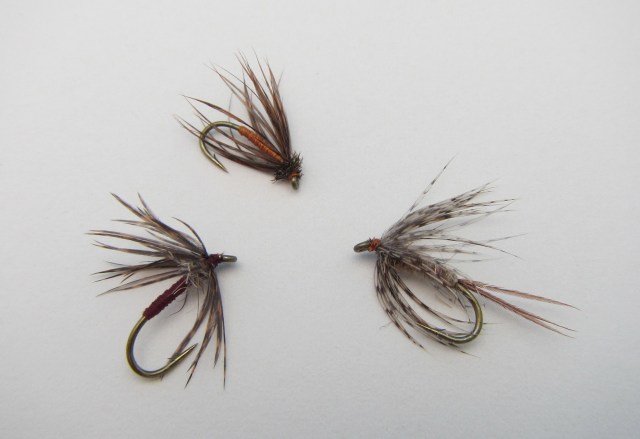
Here are four classic soft hackles adapted for steelhead: Pheasant Tail, Leisenring’s Black Gnat, Starling and Herl, and a midge-like rendering of Leisenring’s Iron Blue Nymph. Three of them use the Orvis 1641, a 1x short, 2x strong wet fly hook. They’re a size 12, so they’ll effectively fish as a 14. The other hook is a size 12 Daiichi 1120, likewise 1x short/2x strong. Some of the original patterns called for tinsel; I substituted small diameter wire.

Now all we need is a hatch and some feeders.

Steelhead soft hackles, clockwise from upper left: Pheasant Tail, Black Gnat, Starling and Herl, Iron Blue Midge. 

OLYMPUS DIGITAL CAMERA

~

Pheasant Tail
Hook: Daiichi 1120 size 12
Thread: Brown 8/0
Tail/Abdomen: Pheasant tail fibers
Rib: Small copper wire
Thorax: Peacock herl
Hackle: Brown hen
~
Black Gnat
Hook: Orvis 1641 size 12
Thread: Pearsall’s Gossamer Silk, claret
Body: 3 fibers from a jackdaw secondary wing
Rib: Small red wire
Hackle: Iridescent purple from a starling shoulder
~
Starling and Herl
Hook: Orvis 1641 size 12
Thread: Pearsall’s Gossamer Silk, claret
Body: Peacock herl
Rib: Small gold wire
Hackle: Starling
~
Iron Blue Midge
Hook: Orvis 1641 size 12
Thread: Pearsall’s Gossamer Silk, claret
Body: Mole fur spun on silk
Rib: Small silver wire
Hackle: Light blue dun hen

A flash mob, steelhead style

The corks are loaded. Soon, empty fly box slots will be filled. And then all that will be needed are hungry mouths.

OLYMPUS DIGITAL CAMERA

Steelhead Hammer variant

It’s a nymph! It’s an egg! It’s an egg-sucking nymph! Whatever it is, steelhead like the Steelhead Hammer. And that’s half the battle, isn’t it?

There are two versions of the Steelhead Hammer that I’m aware of. The first is commonly referred to as “the Orvis version.” It features a woven body and an Estaz thorax that extends east-to-west from under a case back, much like Rusher’s Steelhead Nymph. The version I’m featuring here is a much simpler tie. (I’m all for simple when there’s a good chance my fly will be sacrificed to the river bottom gods.) Canadian tyer Darren MacEachern did an online SBS on this fly several years ago, and that’s where I first learned of it. I’ve been fishing it ever since.

~

Hook: Orvis 62KC size 8-10
Thread: UNI Fire Orange 6/0
Tail: Soft hen hackle fibers
Body: Two strands of black floss
Rib: Small silver holographic tinsel
Thorax: Estaz Opal Petite (color to match tail)
~
 My favorite colors are purple, chartreuse, light blue, and pink. You, of course, should play around with your favorites. Anyone for peach, orange, red, white, black…?
A purple Steelhead Hammer sits for a formal portrait.

OLYMPUS DIGITAL CAMERA


~
The Steelhead Hammer Rogues’ Gallery:
Pink size 8, Salmon River, Pulaski, NY
IMG_1353

Farmington River report, Arts of the Angler show reminder, and a (gasp!) tying video

I visited the Farmington today to test the waterproofness (if that’s a word) of my winter waders and to get in a little fishing. Lord, it was crowded for weekday in November. I visited five location above, below, and in the TMA. For me, the catching stunk. I blanked on nymphs, and it wasn’t until I switched over to streamers that I was able to bump up a couple fish. No one else I spoke to reported having much success, so maybe it was just one of those days. The water is still low and the rock garden effect remains.

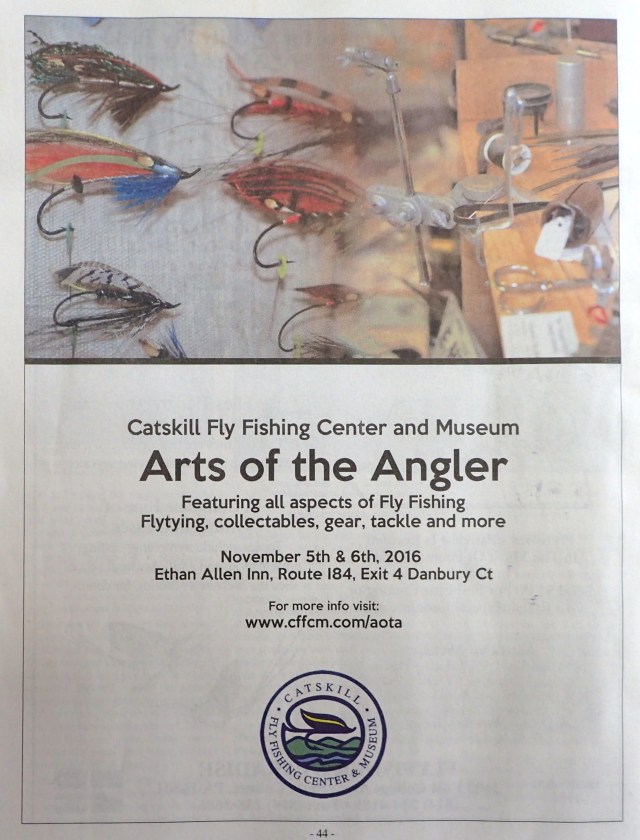
A reminder that I will be tying and presenting “Wet Flies 101” this Saturday afternoon, November 5, at the Arts of the Angler show in Danbury. You can find everything you need to know here.

Finally, ladies and gentlemen, we have a tying video. It’s a steelhead attractor pattern, and I will post it tomorrow.

An 11th hour steelhead that came on the fly featured in my newest video.

IMG_1353


No more Mid Atlantic Fly Fishing Guide

I received this sad news last week. No more print issues of the MAFFG will be forthcoming. The publishers are currently exploring means of converting the magazine to a viable electronic format. But the days listening to the sweet-sounding rustle of heavy stock newsprint as you devoured the latest issue are over.

Its publishers dubbed MAFFG “the finest regional fly fishing magazine on the planet.” I’d be inclined to agree. I really loved that magazine, both reading and writing for it. There was something in every issue I could count on to make me a better, more well-rounded angler. From a professional standpoint, the editor, Mike Klimkos, gave me one of my first opportunities as an outdoor writer. And as my product matured, he gave me extraordinary editorial freedom.

So, thank you, Mike. Thank you, publisher Paul Rouse, for your kindness and generosity. And so long, old friend.

I’ll take some solace knowing that my work appeared in the last issue of MAFFG.

OLYMPUS DIGITAL CAMERA


“Wet Flies 101” at the 2016 Arts of the Angler show

The Arts of the Angler is a terrific regional show hosted by my friends at the Catskill Fly Fishing Center and Museum. It’s a weekend affair, and it happens this year on November 5th & 6th at the Ethan Allan Inn in Danbury, CT.

This year, I’ll be tying and presenting “Wet Flies 101” on Saturday afternoon, November 5th at 3pm in Room 1. I have a hectic morning, so I’ll be tying as soon as I am able, but it won’t be until 1pm or later. My Sunday is still up in the air — I may be tying on Sunday, too. I’ll update you with that information if it happens. Come out and support the museum, and of course please stop by and say hello.

Here’s the current presentation schedule (I am not responsible for changes):

Saturday, 11/5

OLYMPUS DIGITAL CAMERA

Thank you, Mianus Chapter TU

A heartfelt shout out to my friends at Mianus TU for hosting me last night. Good crowd, lots of familiar faces, and a very positive energy in the room made the evening a success. I’m really liking how “The Little Things 2.0” is being received, and it’s a fun presentation for me to make.

My favorite question was, “When are you going to do some more tying videos?” The answer is yes. Keep on bugging me. Sooner or later I will bow to the pressure.

See you tomorrow night, Thursday, October 13, 6:30pm at the Hammonasset Chapter TU, “The Little Things 1.0”. The original “Little Things” presentation, packed with tips, tricks, and strategies to help you catch more fish. Quinnipiac Watershed Association Building, 540 Oregon Road, Meriden, CT. For more information and directions, visit hctu.org.

Remember, don’t be a meatball. Red light at night.

ElectricSmoke

Four things striper anglers could learn from wet fly anglers.

Wednesday night I fished for stripers in the kind of water that I love: current, structure, and bass feeding on station. The bait was silversides, and the stripers had them cornered. All the predators had to do was wait for the meal to come to them. I did very well; the spinning guy to my right with the plug did poorly (wrong presentation, wrong size lure) and the guy to my left with the intermediate line and the stripped sinking fly did poorly (wrong presentation, fishing in the wrong part of the water column) as well.

After they left, I started thinking about how I approached the situation. I realized that all I had been doing was fishing wet flies. If more striper anglers applied wet fly principles to their fishing, they would surely catch more bass. Here’s where anglers using wet fly tactics have an unfair advantage:

Wet fly anglers know that they can master the current with a floating line. The simple act of mending slows the swing of the fly to a speed that is far more agreeable to fish — especially those unwilling to chase. By casting to the outer edges of the bait ball, and mending, I was able to make my flies swim along its periphery, moving at the same pace as the naturals.

Wet fly anglers know the value of sparse, impressionistic, unweighted patterns. The Partridge and Orange. The Starling and Herl. The Pale Watery Wingless. None of them look exactly like what they’re supposed to imitate. None of them are bulky. But they can be fished anywhere in the water column, particularly just below the surface where the fish are feeding. The flies I was fishing looked and did likewise.

Wet fly anglers know that droppers are the fastest way to find out what the fish want. I was fishing a team of three. Top dropper was an Orange Ruthless. Middle dropper was The Tick (small isopod/crab larva/shrimp). Point was a September Night or a Morning Glory. The bass eagerly took the top dropper and point flies. And I was covered in case they switched to something small.

Wet fly anglers know that sometimes the best retrieve is no retrieve. I’m lazy. So are predators. I didn’t catch any fish on the stripped fly. It was all on the swing, mended swing, or dangle. Explosive hits generated by fish feeding in confidence. Why would a fish chase bait when it is being delivered to them by the current?

Where’s the beef? Nowhere on this sparse, impressionistic single-feather flatwing, the Morning Glory. (You can find the recipe by doing an internet search for “Morning Glory striper fly”.)

OLYMPUS DIGITAL CAMERA