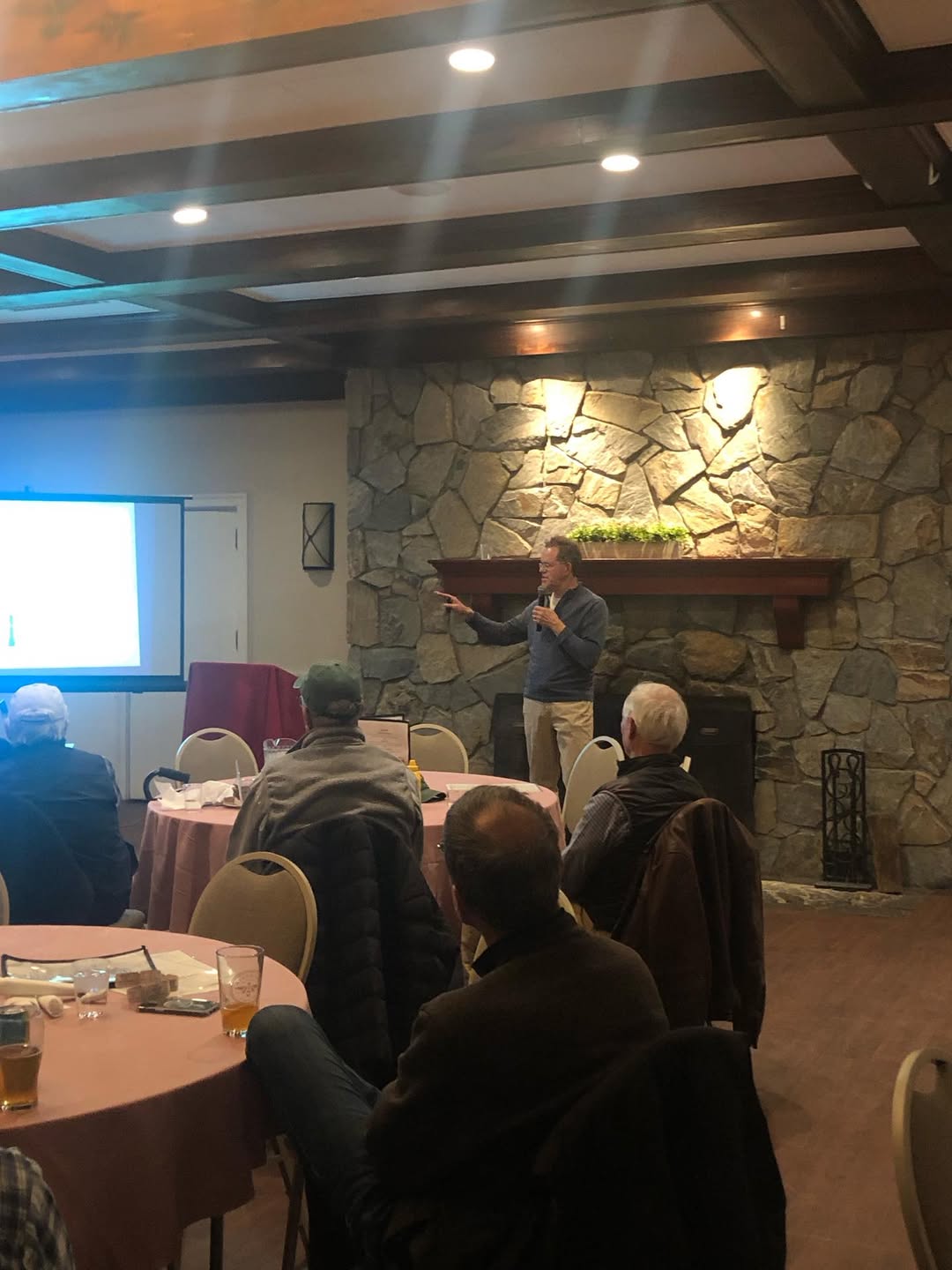
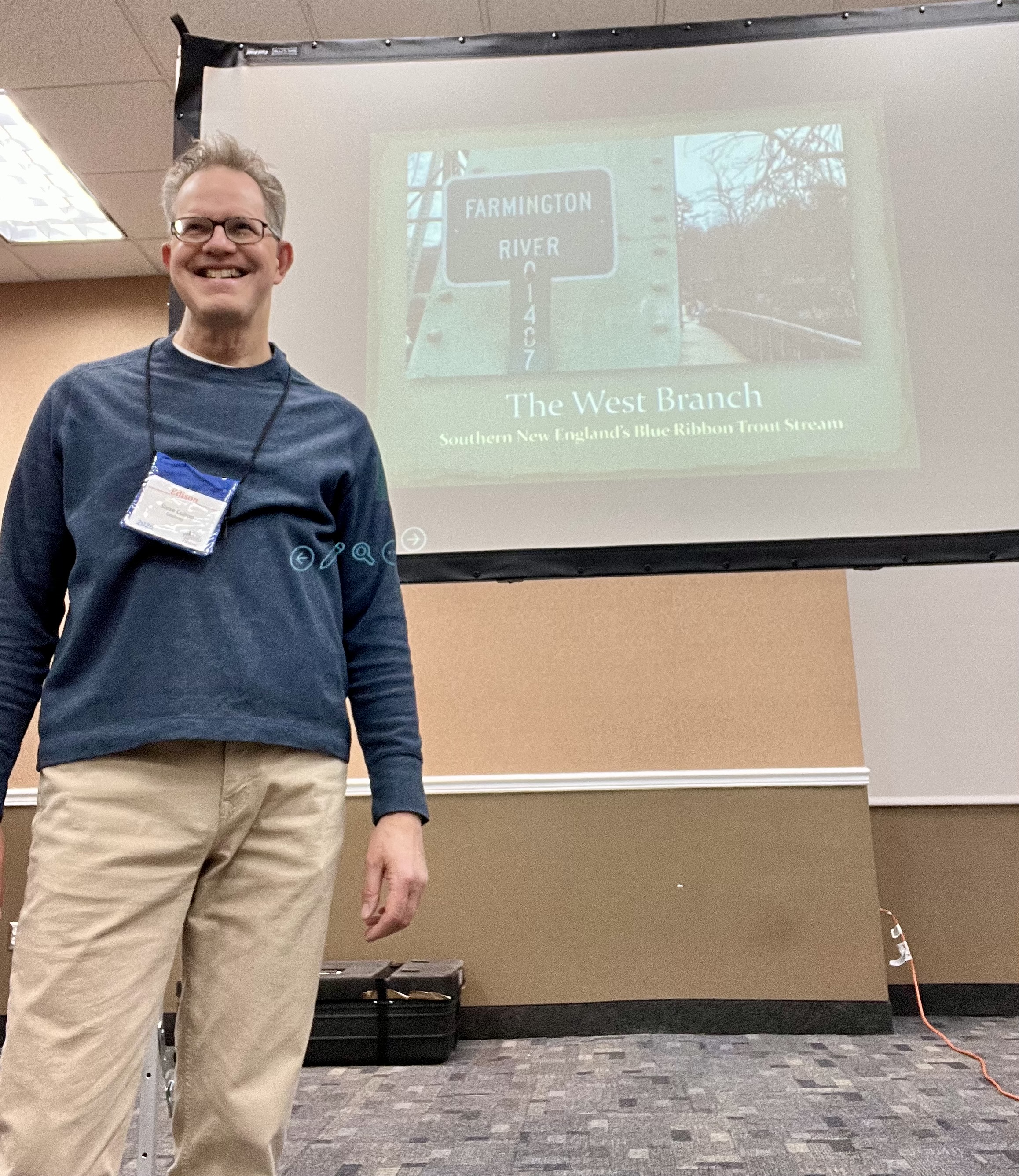
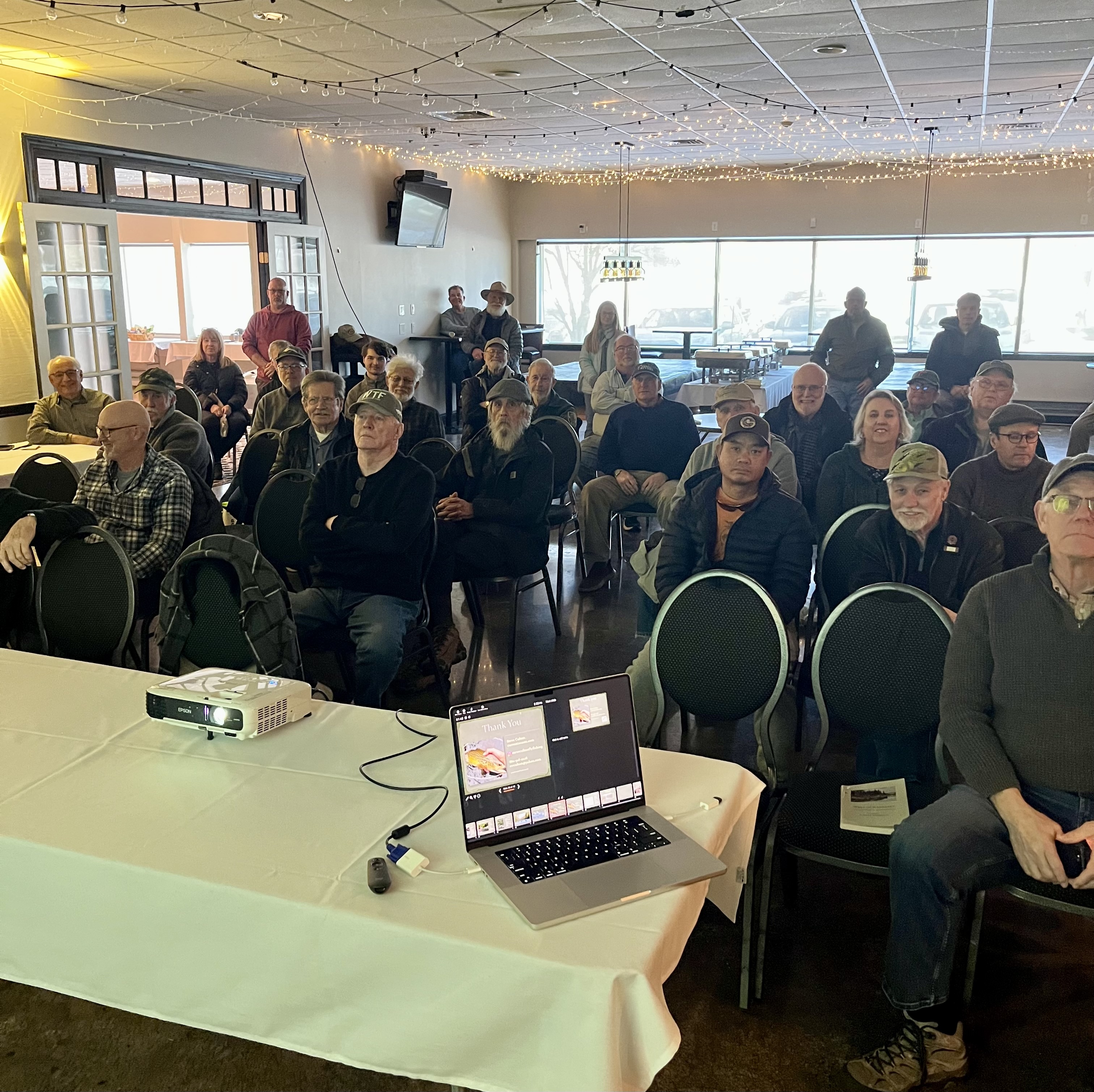
What a treat to return to see my friends at the Farmington Valley TU Chapter last night. FVTU understands that a fed presenter is a happy presenter, and I relished my delicious burger, piled high with mushrooms and onions, washed down with a tasty Headway IPA draft. Ladies and gentlemen, thank you! The subject was “Wet Flies 2.0,” which takes a deeper dive into the subject. This group is filled with many dedicated, inquisitive anglers, and I particularly enjoyed the post-talk Q&A session. There was a palpable excitement in the room for the Farmington River book, and I’m planning on returning in the fall for a talk on the book and the river.
Photo courtesy of an unknown FVTU member. The meeting room at the Back Nine Tavern in New Britain is a terrific venue for presenting.
I tend to be slightly messy in my workspace, whether it’s tying flies or writing about fly fishing. I think it adds a creative, mad-scientist je ne sais quoi to the experience. But, there’s a point where messy looses its charm and morphs into the dreaded enemy of productivity. Worst case, it threatens your sanity. I’m generally a happy guy, and no one wants or needs to get pissed off when they’re tying flies. But writing the Farmington River book meant that I had less time to do other things, and one of them was to organize my work/tying room in the basement. This month, I finally got the toolbench under control and hung up a shiny new pegboard. My bigger tools and other implements of destruction are now all neatly stored in their proper location on metal shelving. That left my tying area.
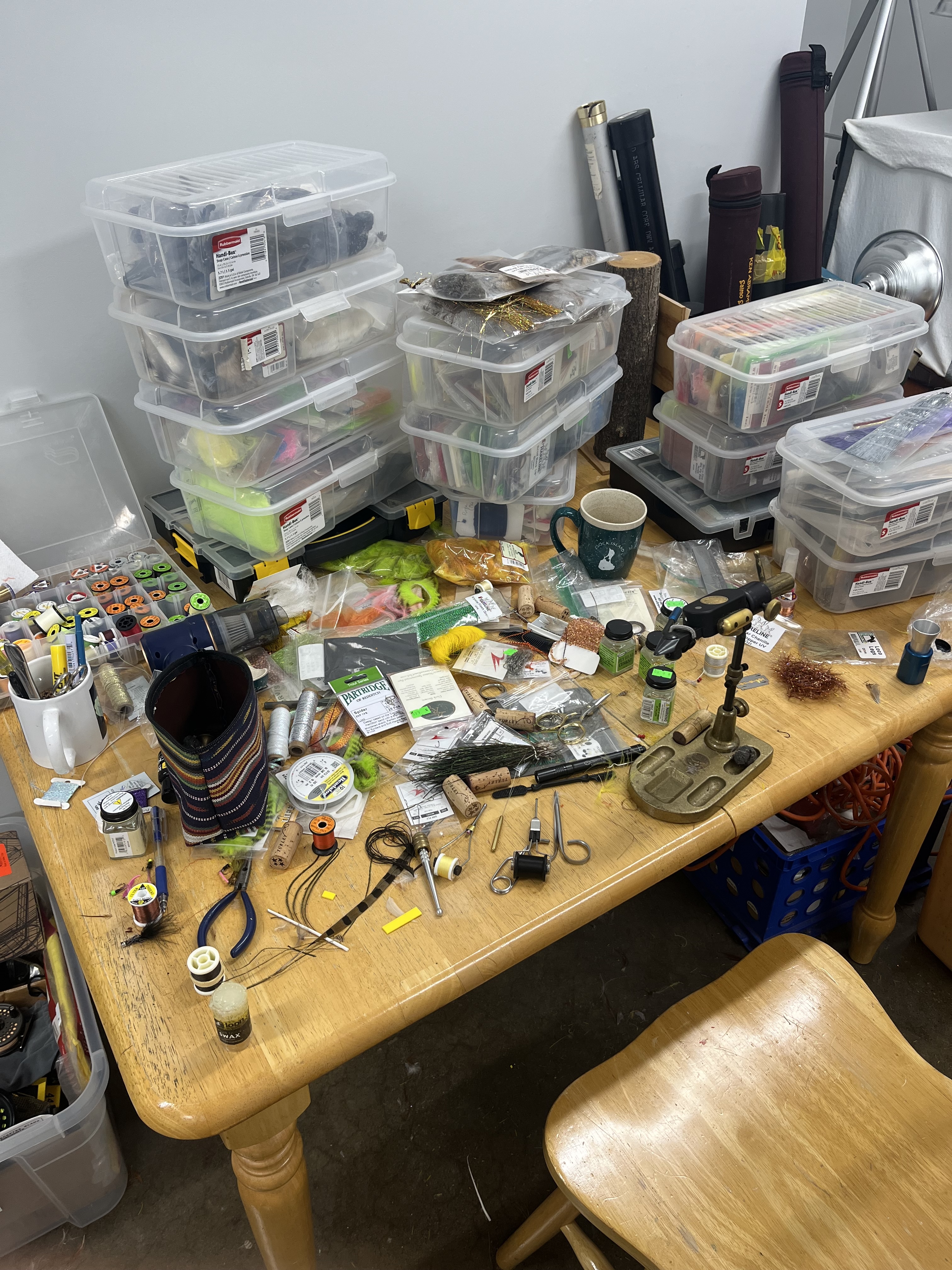
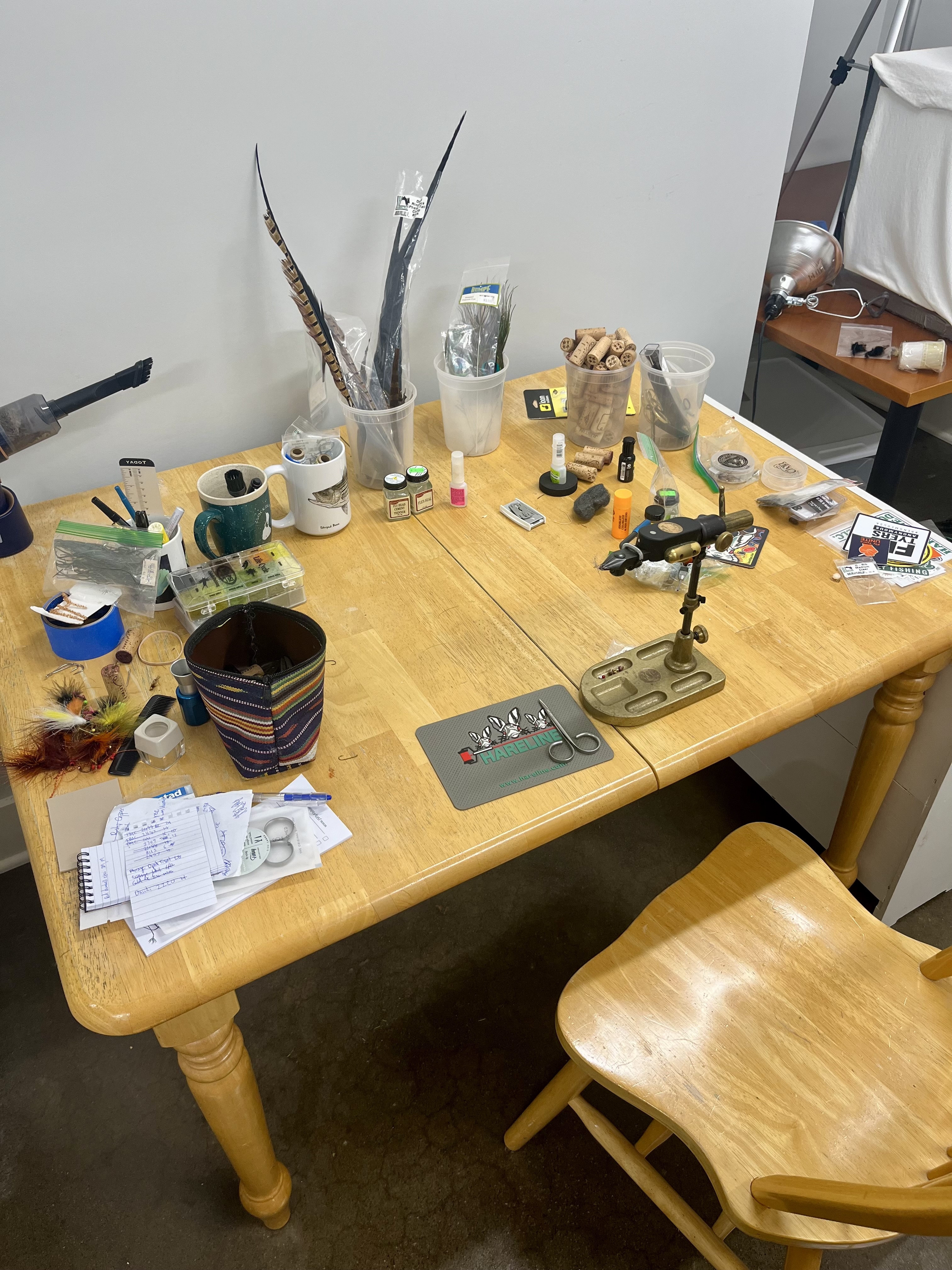
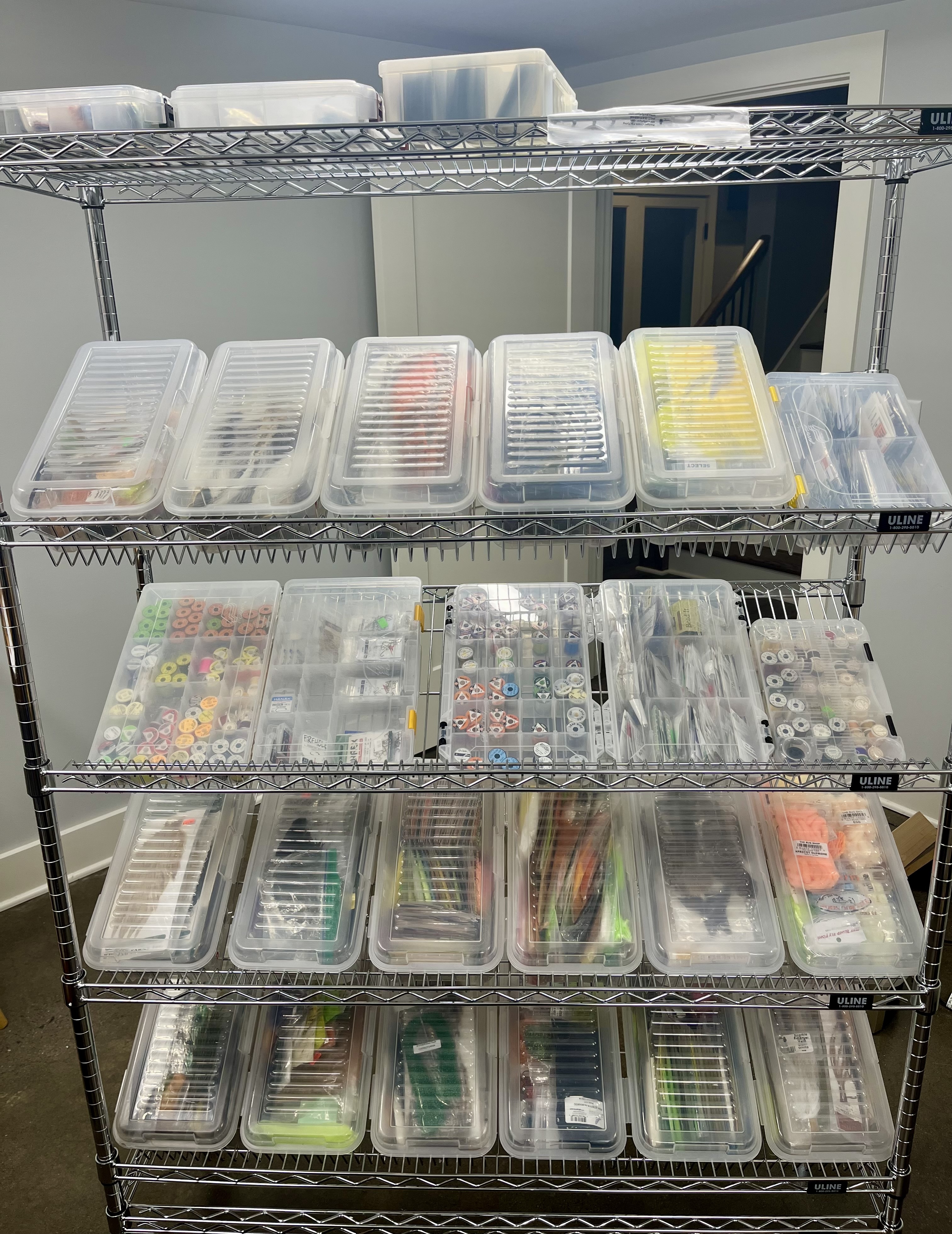
BEFORE. Good lord, what a disaster. Messes grew exponentially, like a snowball rolling down a hill. While I had vast stores of tying materials in boxes, many of them were crammed to the point of being too hard to find that hackle when you needed it. What’s more, the system of box-stacked-upon-box was frustrating as hell: pick it up, move it elsewhere, find another box, re-stack it, arrrrrrrgh. Time to put an end to this madness!AFTER. Much better! Room to breathe, and, truth be told, this is a work in progress with some organizing still to be done. But this is a much more ergonomic workspace. The question you’re probably asking is, “What the heck did you do with all those boxes?”TA-DAH! Enter the Uline Wire Picking Cart. It measures 48″x18″x69″, with four angled shelves and one top rack. That’s plenty of space to hold materials bins, hook boxes, and threads and wires. But its best feature is that it’s on wheels. So all I have to do to access it from my chair is to roll it next to the desk. It’s a sturdy build with a very smooth roll, and I can reach the vast majority of boxes from my seat, which delights my lazy side no end. I’ve strategically placed the boxes I use the most on the lower three angled racks.
As I use the cart and test drive the work space, I’ll revisit the subject and let you know how it’s working in a future post. But for now, I’ve got flies to tie…
I hope this Monday finds you happy and healthy and ready to fish! Or, at least think about fishing. I believe we’ve all had enough of this particularly loathsome winter, and the warmer weather this week should continue the melting trend. I haven’t fished since the first week of January, and I could really use some time on the water. The Farmington River beckons….
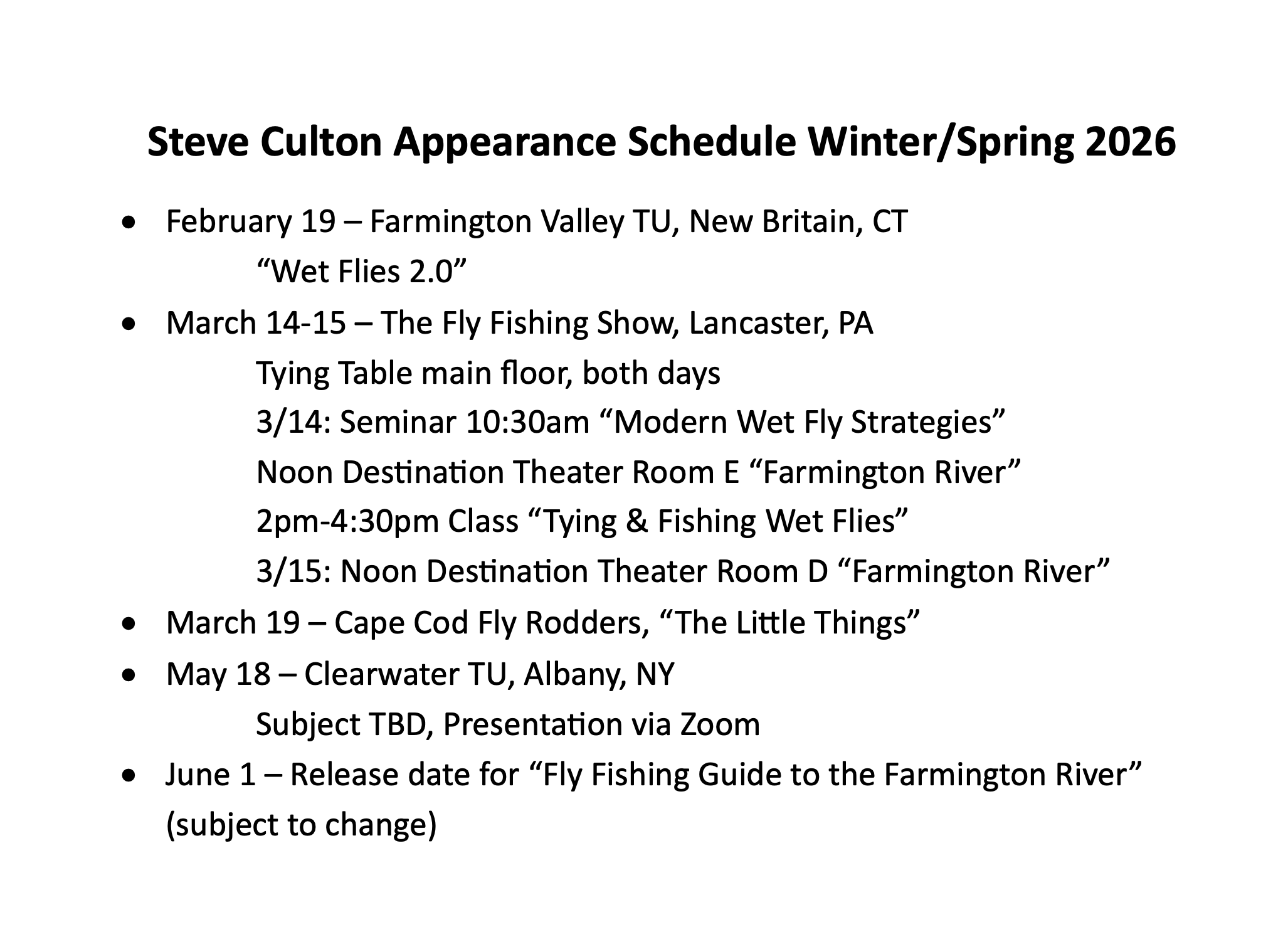
No fishing doesn’t mean I haven’t been busy. I spent most of last week working on my tying area, cleaning and organizing, and I think I’m in a place where I’m ready to tie with a minimum of frustration (where the heck is my patch of rusty deer belly hair?) You’ll get to see it all in a future post/video etc. I’m also gearing up for the Lancaster, PA, Fly Fishing Show, now less than four weeks away, so for those of you in the area, be there or be square. Talks, classes, tying — I’m going to be doing it all. This will be my first time at this show, so I’m hoping for a strong turnout.
I’m looking forward to reconnecting with my friends at the FVTU Chapter this week. Note also the rescheduling of the Cape Cod presentation. If you’re the person in charge of hiring speakers for your club, I do in-person and Zoom presentations. Send me an email or call me, and we’ll get the ball rolling.
I’ll be posting more details on Lancaster here and on Instagram — @stevecultonflyfishing if you’re not already following — in the coming weeks. Thanks as always for reading, and for your enthusiasm.
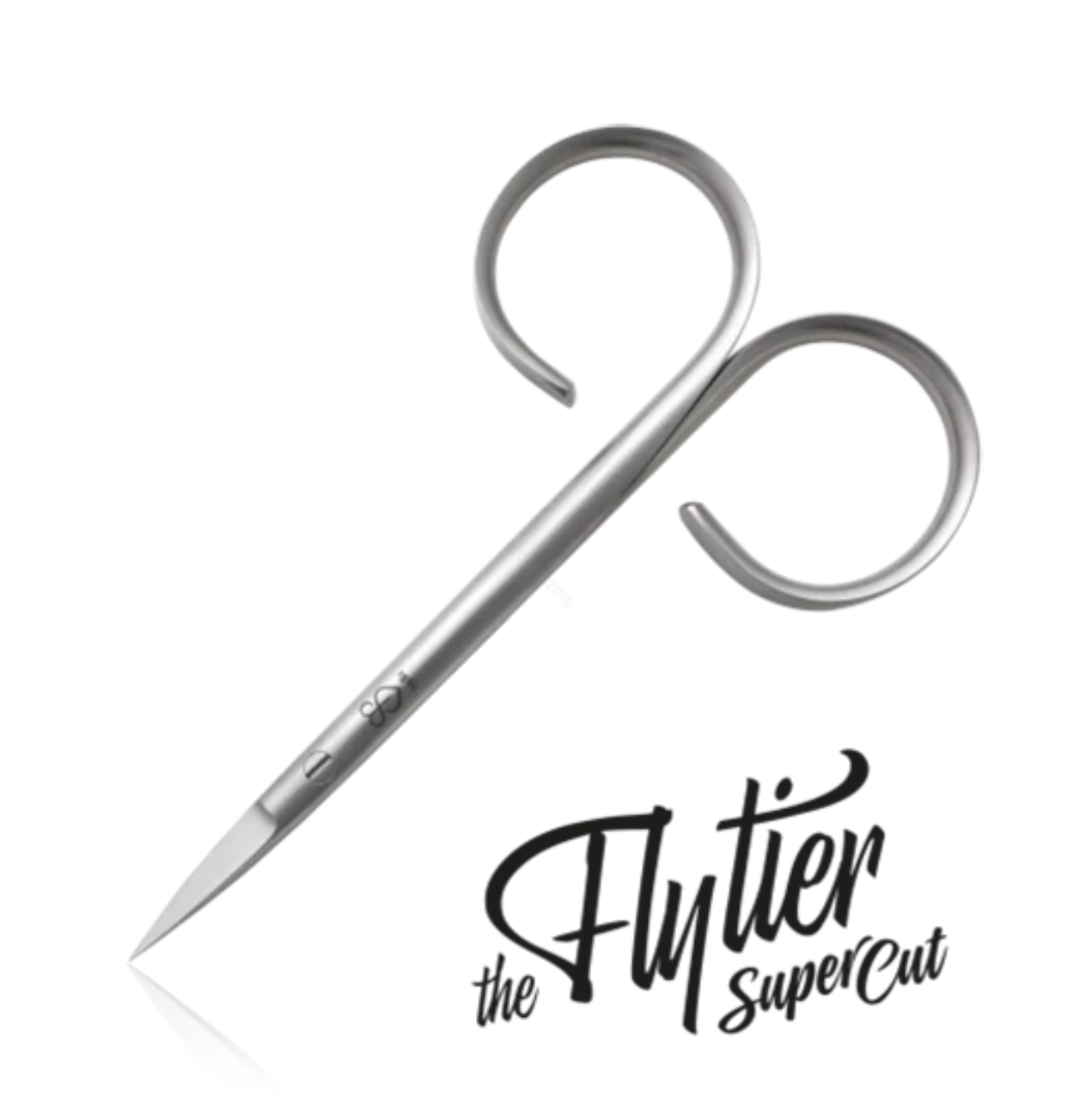
This review is a layup. It’s not just that I love these scissors. It’s that they are, by far, the best fly tying scissors I’ve ever owned.
The two biggest problems with tying scissors are their price and their all-too-inevitable dullness. A double-edged sword, if you’ll pardon the expression, but they work fine until they don’t — and then you need to buy another pair. I used to use Brand X, which, out of my desire not to embarrass them, will remain nameless. It’s a popular brand name, and their scissors are generally available for between $20-$40. They’re nice and gleaming and sharp out of the pack, but before too long, you begin to notice that the blades just don’t have the edge that they used to. I’ve got about a dozen of these Brand X scissors littering the bottom of various receptacles in my basement, all long past their best use.
Enter Renomed. I’d seen other tiers using these scissors at the shows, and all parties had given rave reviews. Curious, I wandered over to the Renomed USA booth (this was at the Edison Fly Fishing Show) and introduced myself to Phillip, the owner. I asked him, what’s the deal with these scissors that everyone tells me are so fantastic? Less than 10 minutes later, I’m walking away with a new pair of scissors with their unique serrated blade and razor blade design.
That was a year ago. The blades still show no signs of wear. The scissors feel light in the hand, and move and operate with the kind of ergonomics you’d expect from a such a precision instrument. I like them so much that at this year’s Edison Show, I bought a larger pair, the FS8, to use for cutting deer hair and other synthetics.
The Flytier SuperCut Straight retails for $60. It’s worth every penny.
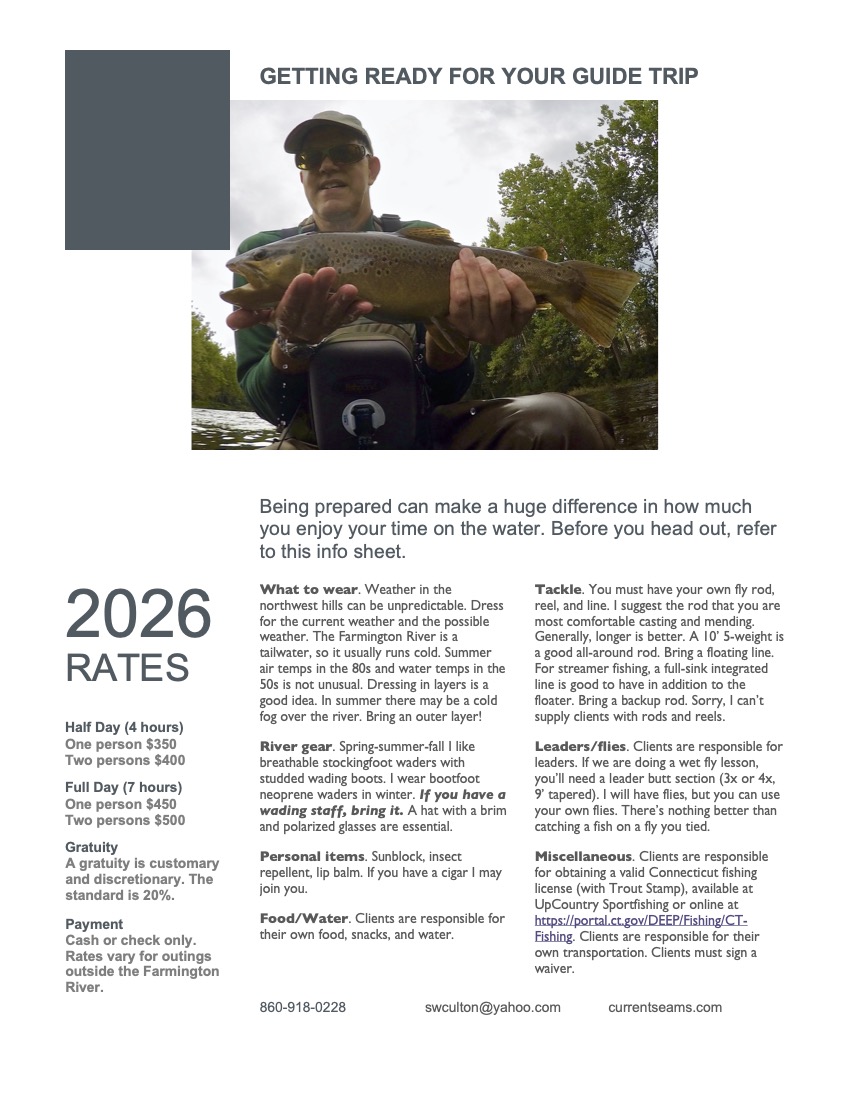
I was so busy with the book in 2025 that I kept my previous year’s rates in place. But, times change. Travel distances get longer, my cost of doing business goes up, inflation is a thing, and my altruism extends only so far. So, we’ve got new rates for 2026. Some things haven’t changed: I’m still a teaching guide; still guiding part-time only; still almost never guiding on weekends; you still need to call or email me to book a date. And — I can’t emphasize this enough — I’m strongly pushing the 4-hour lesson. Anything longer than that, and people begin to fall apart, so 4 hours is the best bang for your buck. I appreciate everyone who’s already booked time with me this year, and I’m looking forward to spending time with you on the water, and helping you improve your angling skills.
If it weren’t for the weather, this might have been the best show ever. But you don’t get to decide on such things, and when a once-in-a-decade snowstorm is thrown at you, you deal as best you can. But I come not to bury this year’s show (certainly not under 18″ of snow!) but rather, to praise it.
The Edison show is the largest fly fishing show on the east coast, and, perhaps, in the world. It has it all: vendors from rods and reels and gear and fly tying and books to guides and shops and lodges and fishing/destination travel. It’s got dozens of some of the best fly tyers in the world. If you want education, you’re in the right place: you can partake in presentations and seminars and demos and classes put on by some of the best anglers in the world. (If you want to be a rock star, you can’t hang out with Aerosmith for a few hours. If you want to become a better angler or tier, you can take a small class with George Daniel or Tim Flagler.)
Seminars! Getcher seminars here! What an honor to be included on a list with such fly fishingluminaries. All seminars are included in the price of your admission ticket. That’s a win for everyone. Classes require an additional fee, but it’s money very well spent — I get people telling me years after they’ve taken a class how much it improved their fishing. Thank you to everyone who took a class with me this year.
As a presenter, the Edison show is, for me, a multi-faceted journey into fun. I get to speak to (hopefully) large groups of people; that’s something I love to do. I get to reconnect with old and distant friends, and make new ones. I get to wander the show floor and discover all the fly fishing and tying items I didn’t know that I needed. I get to be a fanboy. And, I get to teach classes and turn other anglers on to new concepts that will help them catch more fish.
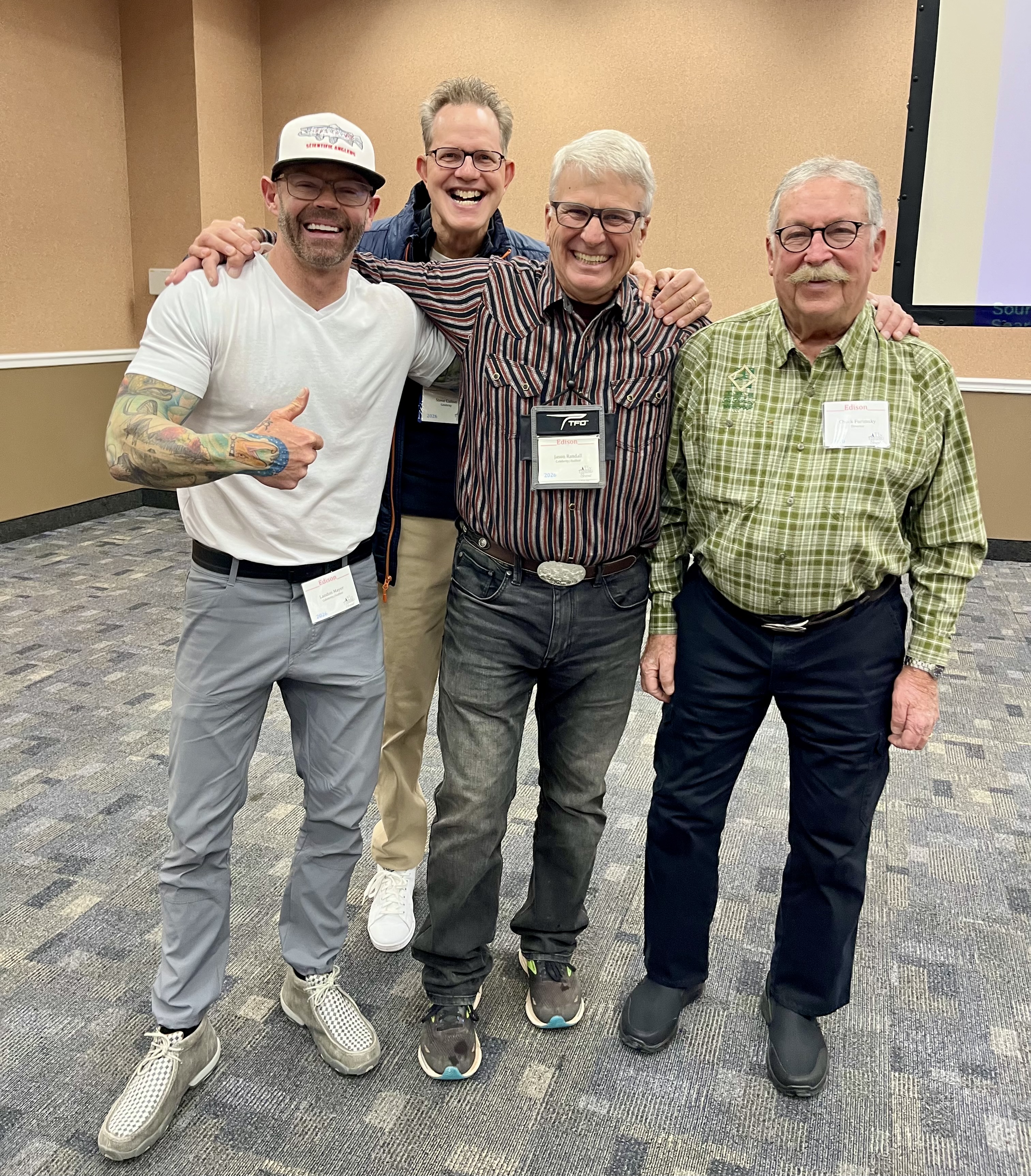
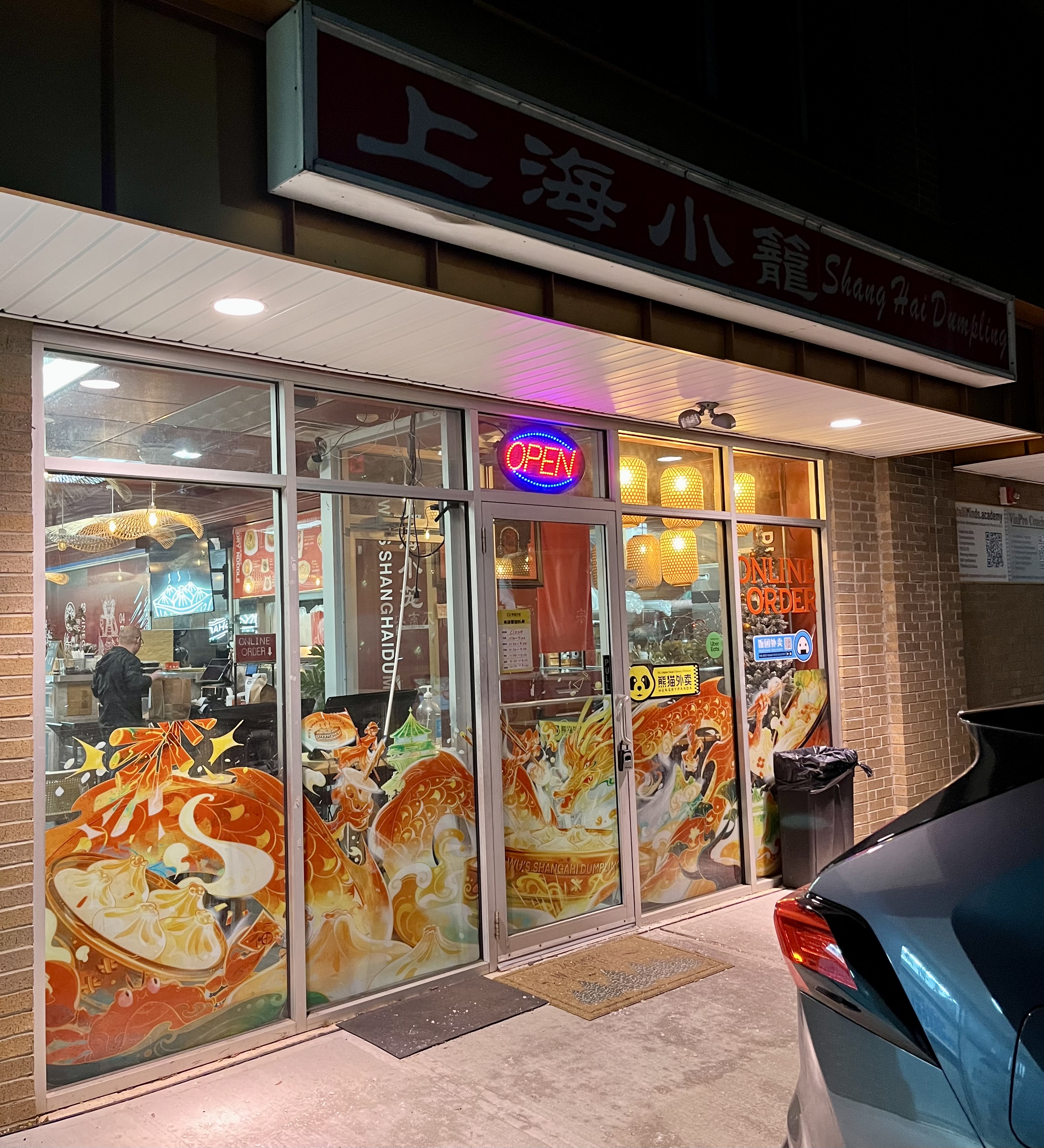
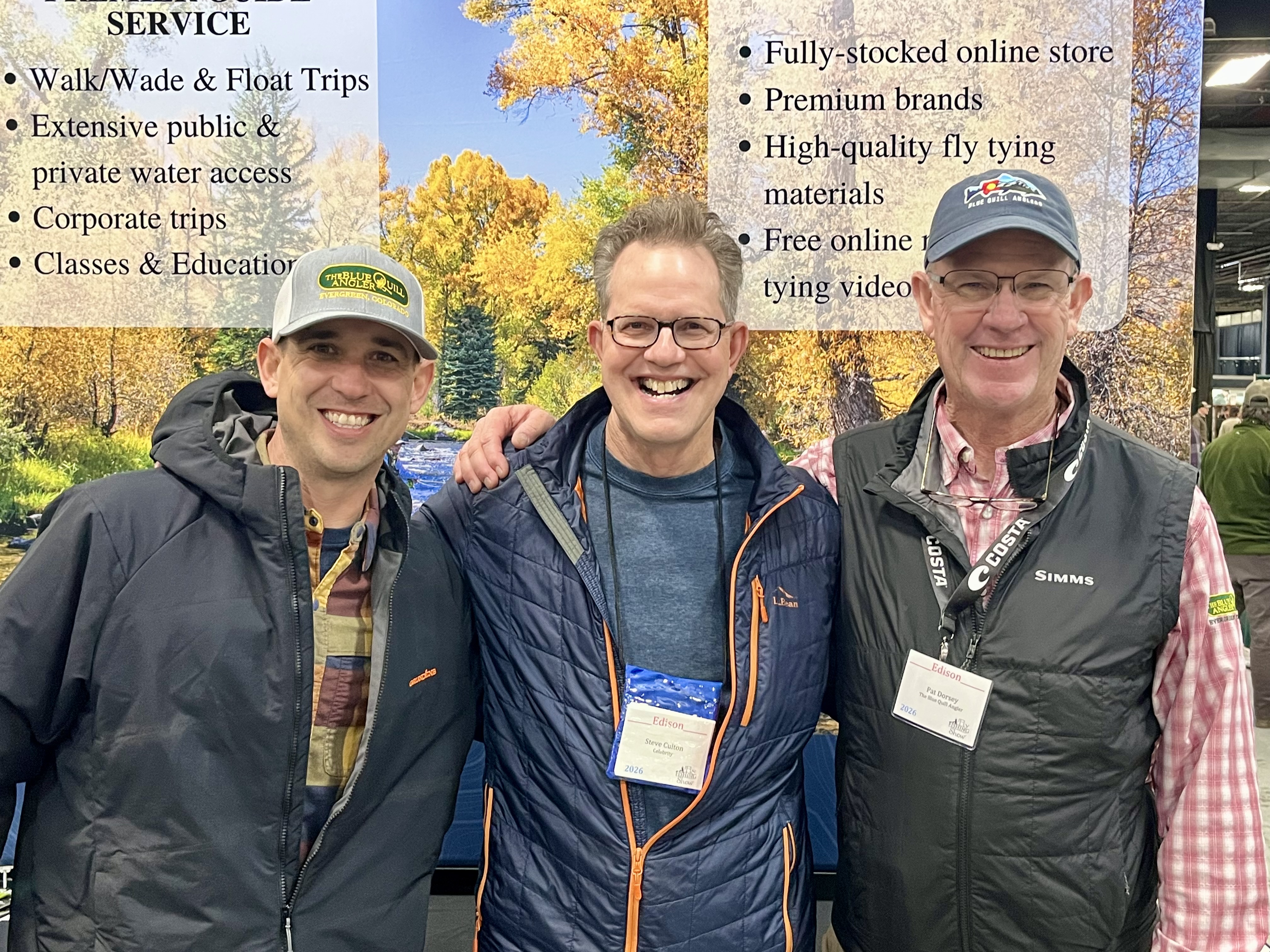
I did multiple talks on the Farmington River and was delighted by the size and enthusiasm of the crowds. The book is generating a lot of excitement, which seems to be growing exponentially. The Fly Fishing Guide to the Farmington River is at the printer, with a projected release date of June 2026. Stay tuned here for release details as they come in.Fly fishing is serious business. Or not. A little pre-seminar festivity with Landon Mayer, Jason Randall, and Chuck Furimsky.My annual pilgrimage to Wu’s Shanghai Dumpling in Edison. This is THE place for authentic Chinese dumplings and udon. I always make sure I get enough to take home. Not exactly low-cal dining, but oh-so-scrumptious. My buddies Chris Steinbeck and Pat Dorsey from the Blue Quill Angler. The BQA booth is my safe haven in Edison; I can hang out between gigs, take a load off, and socialize with passers-by. If you’re going fishing in the Denver area, these are the people to see! I managed a little bit of shopping, coming away with four wet fly capes at a bargain price, and another pair of Renomed scissors. You’ll be hearing more about Renomed on this site soon, these scissors are, by far, the best I’ve ever used.
And then on Sunday, the snows came. But the show went on, as it always does. This year, I’m doing the Lancaster show, which is March 14-15. I’ll have a tying station. See you there!
I still owe you an Edison Show report, but I wanted to take a moment today to say thank you to the CFFA for hosting me on Tyers’ Row, and for the opportunity to speak about the Farmington River. The Expo drew a good crowd, and I had a seemingly constant stream of people at my tying table. On the the things I look forward to most at this show is being able to connect with fellow tyers, vendors, and people in a scaled-down setting. The CFFA show always has a pleasant, chill vibe. I made off with some of Charles McCaughtry’s wonderful fly fishing-themed art greeting cards, some beads, and a small pack of indicators to try for low-water steelhead situations.
The highlight of the day was my standing-room-only presentation on the Farmington River. Thanks so much for coming out to see me, and I hope you buy the book when it comes out in June. Stay tuned to this website for details as they come in!
This book-writing thing is like the building of Rome: it takes time. While I finished writing the “Fly Fishing Guide to the Farmington River” months ago, there are dozens of post-manuscript submission steps that must be completed — proofing galley pages, correcting mistakes, reviewing and re-reviewing — to ensure that we print a quality product. Yes, there will probably still be some errors, but hopefully, those will be minor.
And now, as you read this, the book is at the printer! So now, we’re at printing, then binding, and hopefully I get my advance copies in a couple month. As of this writing, the scheduled release date hasn’t changed, and that’s June 1. Of course, I will update you here and on other social media channels as new and better information comes in.
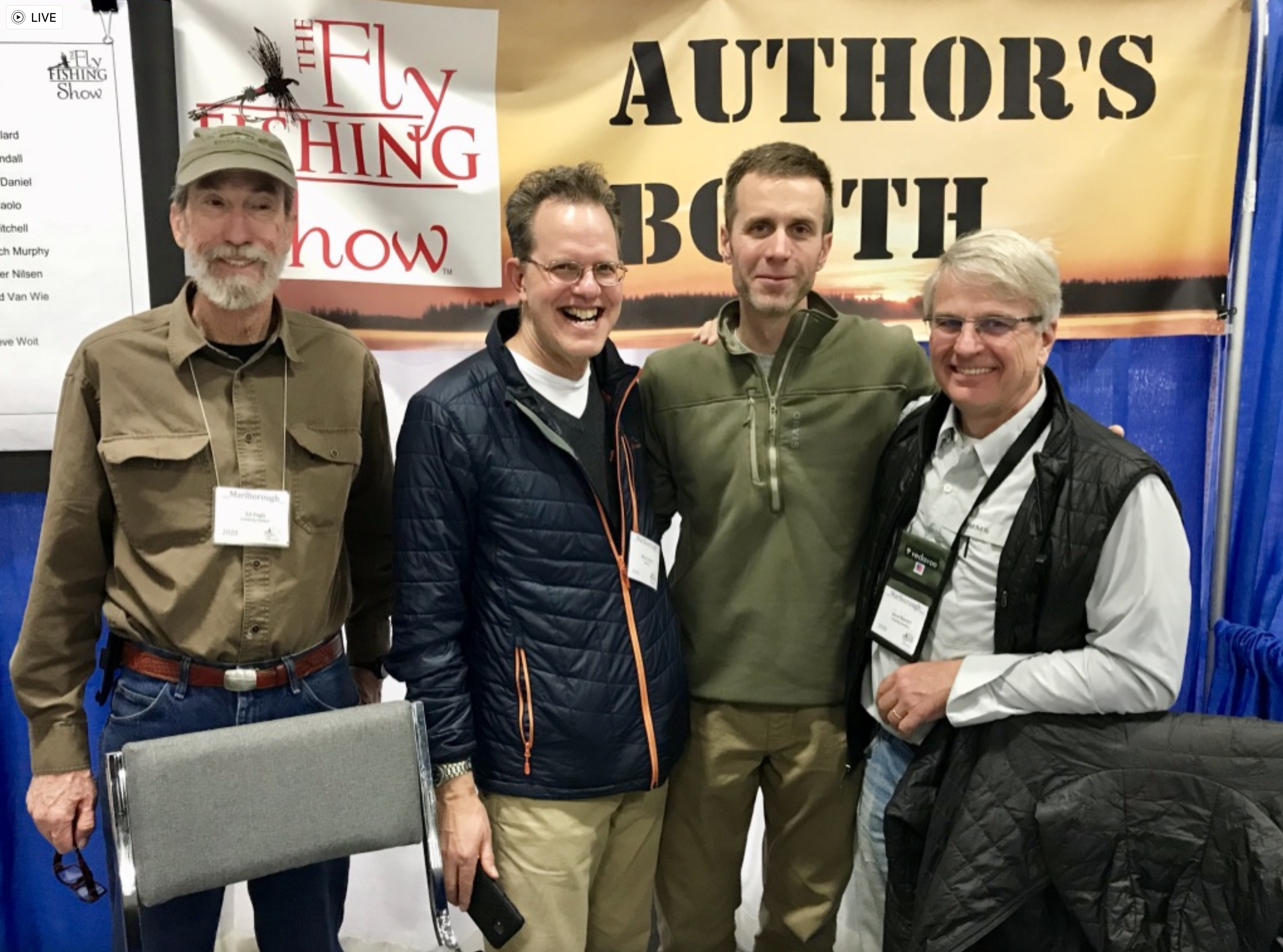
I’m looking forward to sitting under this sign, pen in hand!
I’m still undecided about when and how I might sell books from this site. There may be a mass pre-order, which would likely be cash, check or Venmo only, then out go signed copies into your hot little hands. I first need to research the costs of doing that business. Again, you’ll find out here once a decision is made.
I love the positive energy and anticipation I’m feeling from people who are really looking forward to the book. Believe me, I share your excitement!
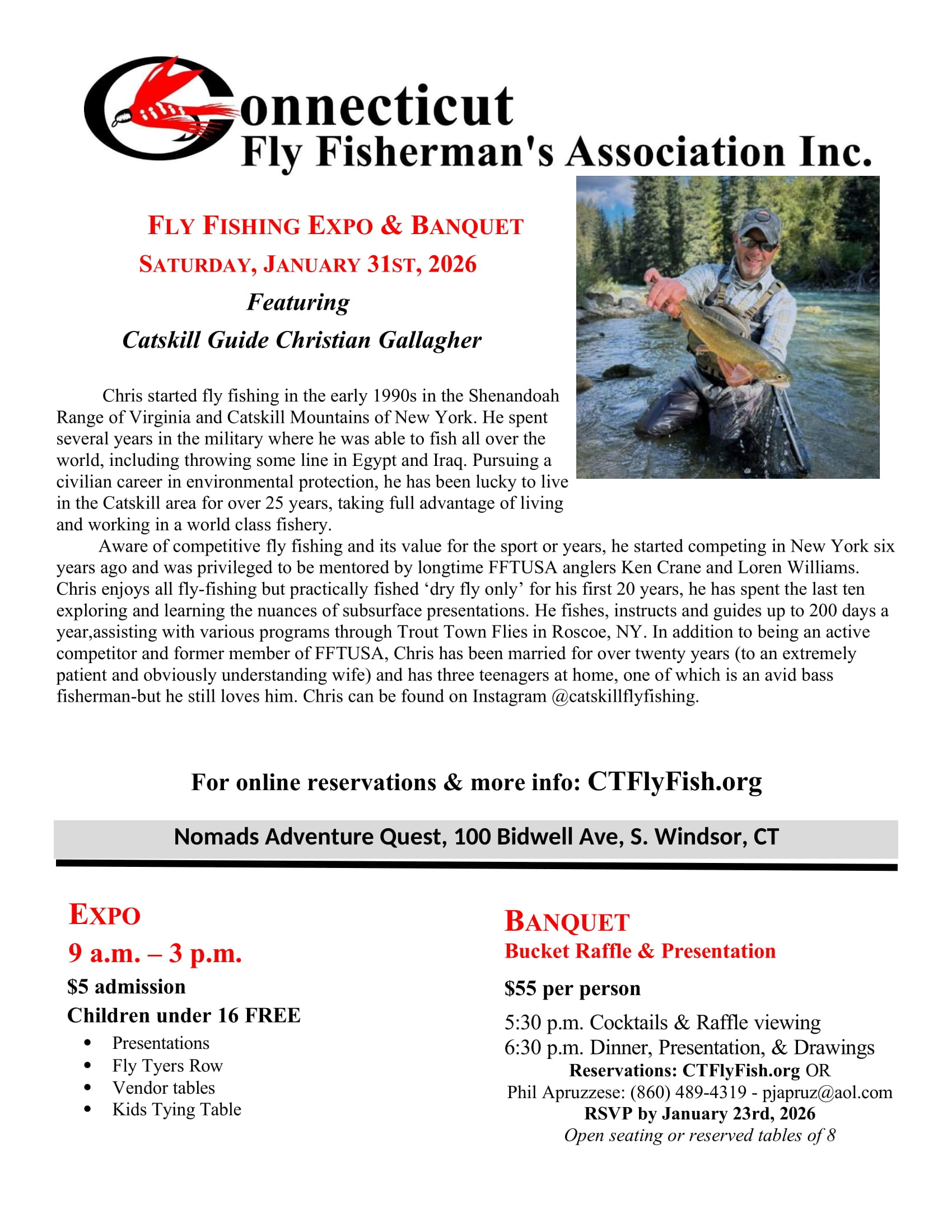
Back from a terrific Fly Fishing Show in Edison, NJ, freshly dug out, and now prepping for “the best little fly fishing show around” — the CFFA Fly Fishing Expo & Banquet. It’s all happening this Saturday, January 31, from 9am-3pm at Nomad’s Adventure Quest in South Windsor, CT. This show is wonderful cure for cabin fever — I mean, it’s brutal out there, even by steelheading standards. I’ll be on Tyer’s Row for most of the day, probably focusing on wet flies, and taking a few walking breaks to stretch my legs and see what goodies the vendors have (I seem to always find a hidden gem that I didn’t know I needed). Stick around, because at 1:30pm I’m doing a new talk on the Farmington River. Even if you are a Farmington veteran, I guarantee you’ll learn something new. See you there, and don’t forget to come by and say hello.
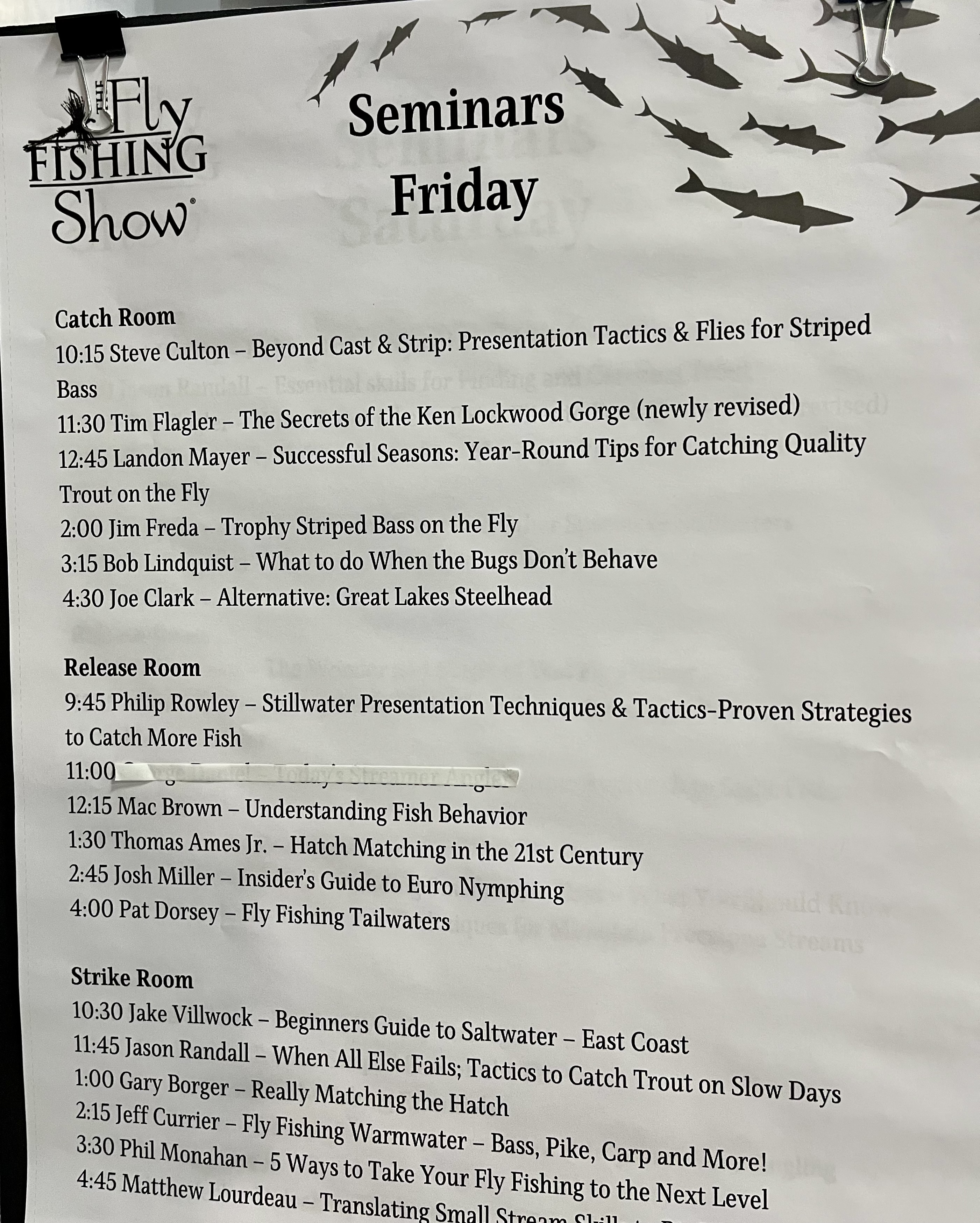
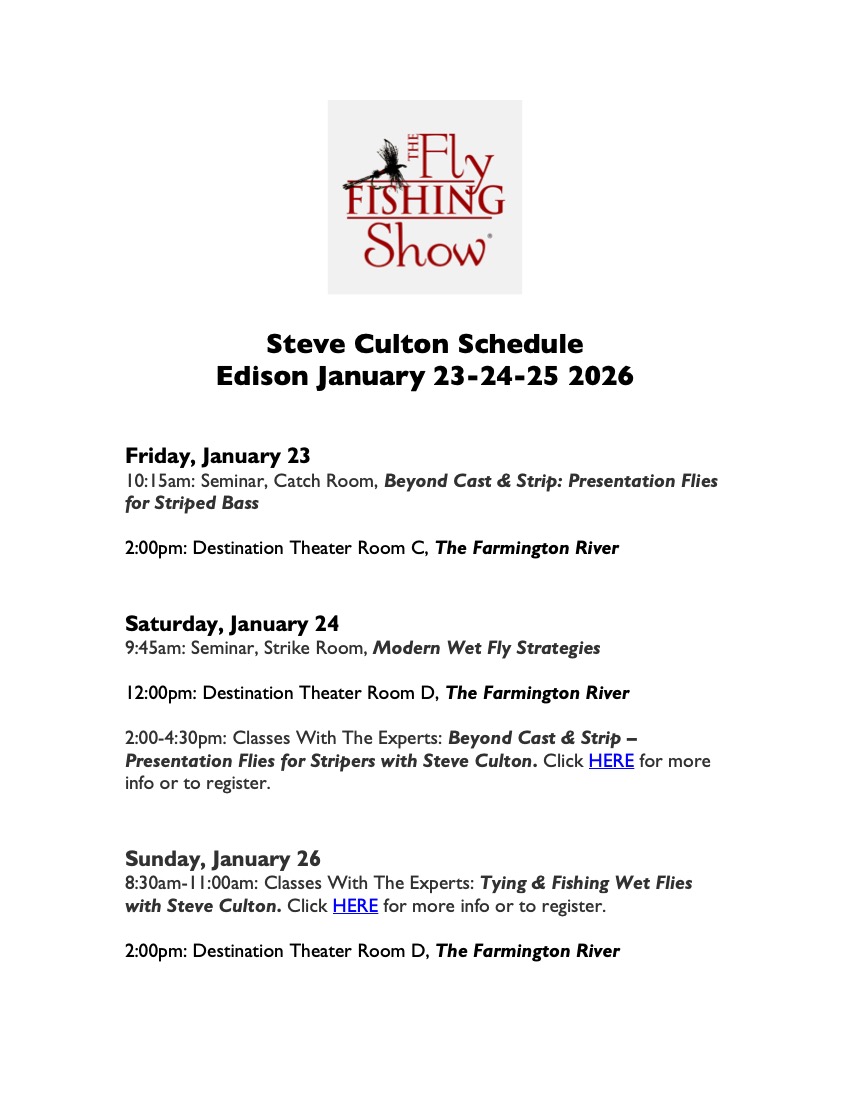
This is the biggest fly fishing show on the east coast, and I’m ready and rarin’ to go! While my plate isn’t quite as full as Marlborough, I’m still going to be out and about and meeting and greeting and presenting and teaching and…whew. I guess I’m going to be pretty busy. Here’s the rundown. Friday, January 23 at 10:15am: Seminar, Catch Room,Beyond Cast & Strip: Presentation Flies for Striped Bass; 2:00pm: Destination Theater Room C,The Farmington River. Saturday, January 24 at 9:45am: Seminar, Strike Room,Modern Wet Fly Strategies; 12:00pm: Destination Theater Room D,The Farmington River; 2:00-4:30pm: Classes With The Experts:Beyond Cast & Strip – Presentation Flies for Stripers with Steve Culton. Click HERE for more info or to register. Sunday, January 26 at 8:30am-11:00am: Classes With The Experts:Tying & Fishing Wet Flies with Steve Culton. Click HERE for more info or to register; 2:00pm: Destination Theater Room D,The Farmington River. I know snow is forecast for Sunday, but we can get you in and out of that class before it gets bad. The show will go on!
As of this writing, I still have room in both classes. If you’ve never taken a FFS Classes With the Experts, this is a terrific way to spend some quality instructional time with me. It’s always a low student-to-teacher ratio, so you can be sure you’ll receive plenty of individual attention. And it’s fraction of the cost of a guided trip, so bonus, you. You can sign up HERE .
When I’m not speaking, I’m attending other talks and walking the show floor. Please come say hello. I’m expecting another strong turnout from currentseams followers!

 currentseams.com