Last night’s Zoom books list, fly tying, and other nuggets

A good virtual crowd last night for my Tuesday Night Zoom, “Good Reads.” In case you missed it, I shared a dozen books that have had a major influence on my fly fishing approach/philosophy/success. I had several requests for the list, so here it is: Trout Fishing by Joe Brooks. Trout by Ray Bergman. The Soft-Hackled Fly and Tiny Soft Hackles by Sylvester Nemes. Wet Flies by Dave Hughes. Two Centuries of Soft-Hackled Flies by Sylvester Nemes. Trout Lessons by Ed Engle. Striper Moon and A Perfect Fish by Ken Abrames. Steelhead Fly Fishing by Trey Combs. Steelhead Dreams by Matt Supinski. Nymph Fishing by George Daniel. Tactical Fly Fishing by Devin Olsen.

Some of the language in Trout is a little moldy, but Bergman still nails certain truths that have withstood the test of time.

It occurs to me that each of these books deserves its own review. I’ve already formally reviewed some of the newer ones on these pages, but I’ll be starting a series featuring the others very soon. Last night’s Zoom was so well received that I’m going to do another on Good Reads (Son of Good Reads? Good Reads II? Attack of the Good Reads?). The well of influential material is deep!

There’s still room in Saturday’s (January 30) class, Tying Wingless and Winged Wet Flies. We start at 1pm, and you can literally sign up for it any time before then. Here are the details.

And now, I’m off to write something for Dennis Zambrotta’s followup to Surfcasting Around The Block. Stripers on the brain…

The Un-Dead of Winter revisited

A quick, fun read from the archives, and judging from comments over the years, one of my more popular essays. Enjoy, and see you tonight.

The Un-Dead of Winter

Farmington River Mini-Report 1/22/21: The fastest two hours

I got a late start and had to run a few errands, so I didn’t get to the river until noon. I fished above and within the Permanent TMA. I made the decision to look for unpopular winter water, and so I had three marks all to myself. The river was up a tad from last week (400cfs) and we had a few snow showers. Observed: midges and Winter/Summer caddis, although not many of either. The method was tight line\small jig streamer. I only had one take, and I missed the fish; it was a very subtle pause, and I didn’t even get a head shake into the bargain. Wow, where did the time go? Reluctantly, I left to tend to responsibilities that were far less fun than tracking a drift through a fishy-looking run.

It’s beginning to look a lot like winter.

2nd Zoom Fly Tying Event: “Tying Wingless and Winged Wets” Saturday, January 30, 1pm

By popular demand, I’m doing a second winter fly tying pay-per-Zoom event on Saturday, January 30 at 1pm. Like the first, this will be about 90 minutes of fly tying/tie-along instruction. The cost is $10. To “register,” you send 10 bucks to me at PayPal (ID is swculton@yahoo.com) and I’ll send you the link to the meeting. Tying Wingless and Winged Wets will cover some basic, useful patterns. Again, the focus is on template and technique. You should have different color threads, different hooks, tools, etc. You should have at least one hen hackle/hen cape — Whiting makes a good basic hen hackle. The “right” color is not critical, but if you want to go all in you should have light or dark grey, light ginger, and brown. The point is, if you don’t have a specific color hackle, you can find it later. Questions? You know where to find me.

Many of you will want a complete materials list, so let’s plan on three patterns: Dark Hendrickson Winged Wet (Hook: 2x strong wet fly size 12 Thread: Grey Tail: Dark blue dun hackle fibers Body: Muskrat fur (any grey dubbing works) Hackle: Dark blue dun hen Wing: Lemon wood duck (mallard flank can be used in a pinch); Pale Water Wingless AKA The Magic Fly (Hook: 1x fine, size 16-20. Thread: Pearsall’s Gossamer silk, primrose yellow (you can use regular yellow thread) Hackle: Light ginger hen Tail: Light ginger hen hackle fibers
Body: Rabbit fur, color to match the natural; and Brown or Red Hackle (Hook: Dry or wet fly, 12-14 Silk: Crimson or claret Hackle: Red furnace (brown is fine, even grey) Rib: Narrow gold tinsel Body: Bronze peacock herl). Like last time I’ll answer questions and you can pick my brain.

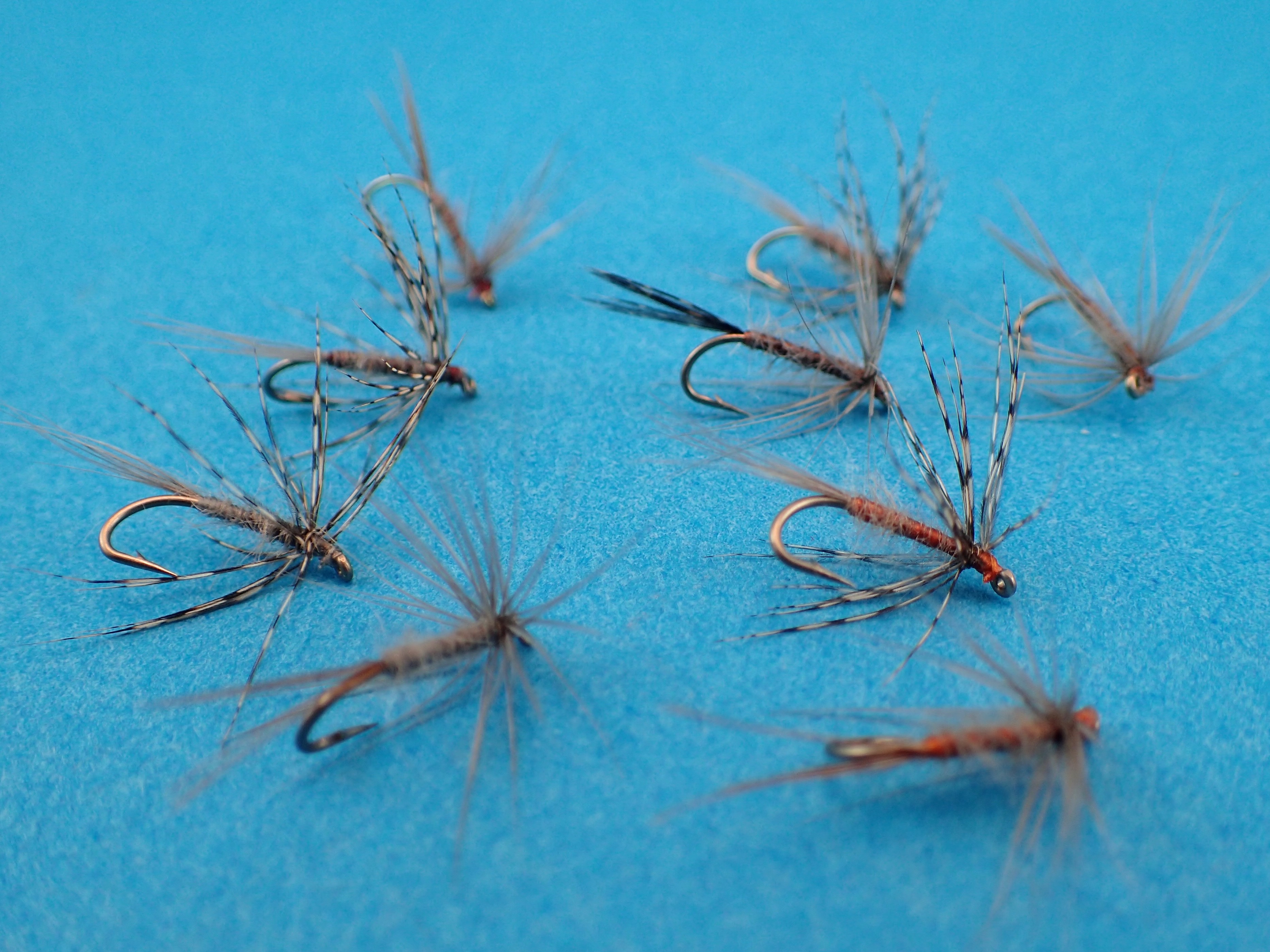
Stuff like this. Yeah. I can already feel the tug…

Fun with soft hackles, Tuesday Zoom, and another wet fly class

Many thanks to those who attended yesterday’s class, Tying The The Soft-Hackled Fly. Good group, good questions, and we made it through a few minor technical glitches in fine form. I was very pleased with the new camera for the closeup tying action — it was exponentially better than the stock cam on my Mac laptop. There will be another class, very likely on Saturday January 30th, 1pm, Tying Wingless & Winged Wet Flies. I’ll formally announce that class in a couple days. There will also be a Tuesday Night Zoom this week — check out the site tomorrow for the topic. Enjoy your Sunday — you deserve it!

Yesterday’s question of the day was, “What soft hackle can I tie that I can fish right now?” My answer was this, the last fly we tied, the Starling and Herl. Perfect for the top dropper on your nymph rig. This is a size 14; I’d go with a 16-18, and especially a size 18 2x short scud hook. It’s a great match for all the tiny bugs that are prevalent on our cold northeast rivers right now. Make your body more durable by making a herl rope; you can see that technique in my video for the Drowned Ant Soft Hackle.

Today’s Soft Hackle Zoom Tying Class, 1pm

Thanks to everyone who signed up for Tying The soft-Hackled Fly! If you want to join us at 1pm, there’s still time to sign up. If you’re already paid, you should have received an email from me with the Zoom link last night. If you didn’t get it, please send me an email ASAP and I’ll get the information to you. See you at 1pm.

Farmington River Report 1/14/21: Jiggin’ and Strippin’ and Catchin’

Yesterday I fished with Toby Lapinski, a long overdue payback for all the striper outings he treated me to this fall. We decided to go for big instead of numbers, so streamers it was. We started in the Permanent TMA, although we first bounced around looking for a mark that didn’t have the equivalent angler population of Manhattan. (Hint: stay away from the big name pools.) Conditions were perfect for winter streamers: 325cfs, clear, no slush ice, 40 degree air temp and overcast with occasional mists and drizzle.

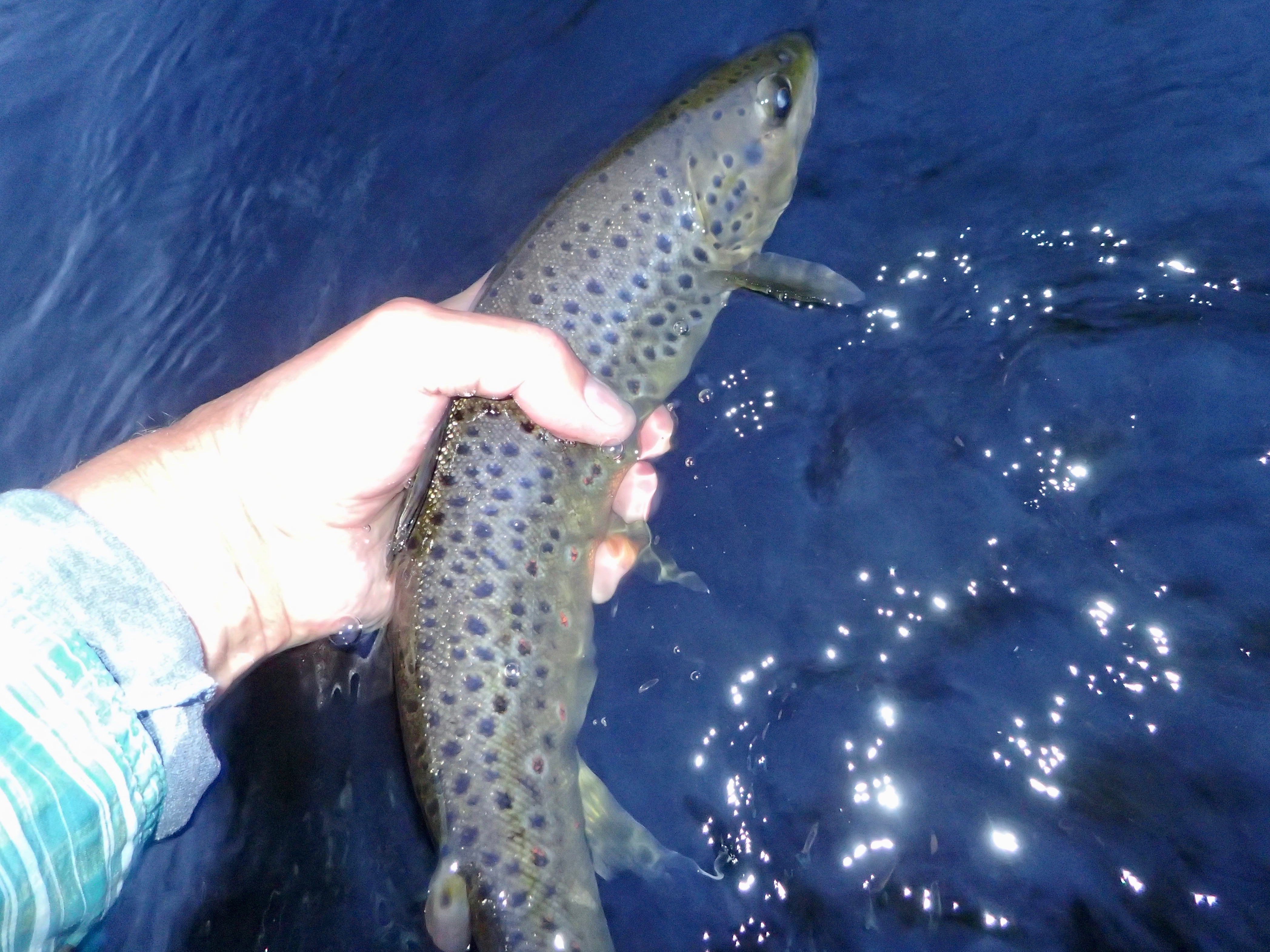
Rule one of winter streamer fishing: find the fish that want to eat. We decided to mix it up at the first mark. I was long-leader-tight line small black jig streamer in faster water; Toby was traditional fly line with a white jig streamer in slower, deeper stuff. I blanked, but Toby scored a big, bad brown. You can’t see it in the photo, but that’s just over 20″ of trutta buttah. Awesome trout. Observed: a modest midge hatch and trout rising to them in the frog water. We started with the place all to ourselves; by the time we left, there were five other anglers.

~

Although anglers were seemingly everywhere, we had the second mark all to ourselves. Oh. This guy was there, too. He was hanging out in some faster water and hit on the drop as the streamer was jigged downstream. I missed him on that first take, but fortunately I didn’t deviate from the presentation, and he came right back and struck on the drop again. Here’s to second chances! Great photo by Toby. I had one more hit on the jig, then I switched over to a traditional streamer winter streamer setup: full sink tip line and short leader with a weighted fly (Coffey Sparkle Minnow).

~

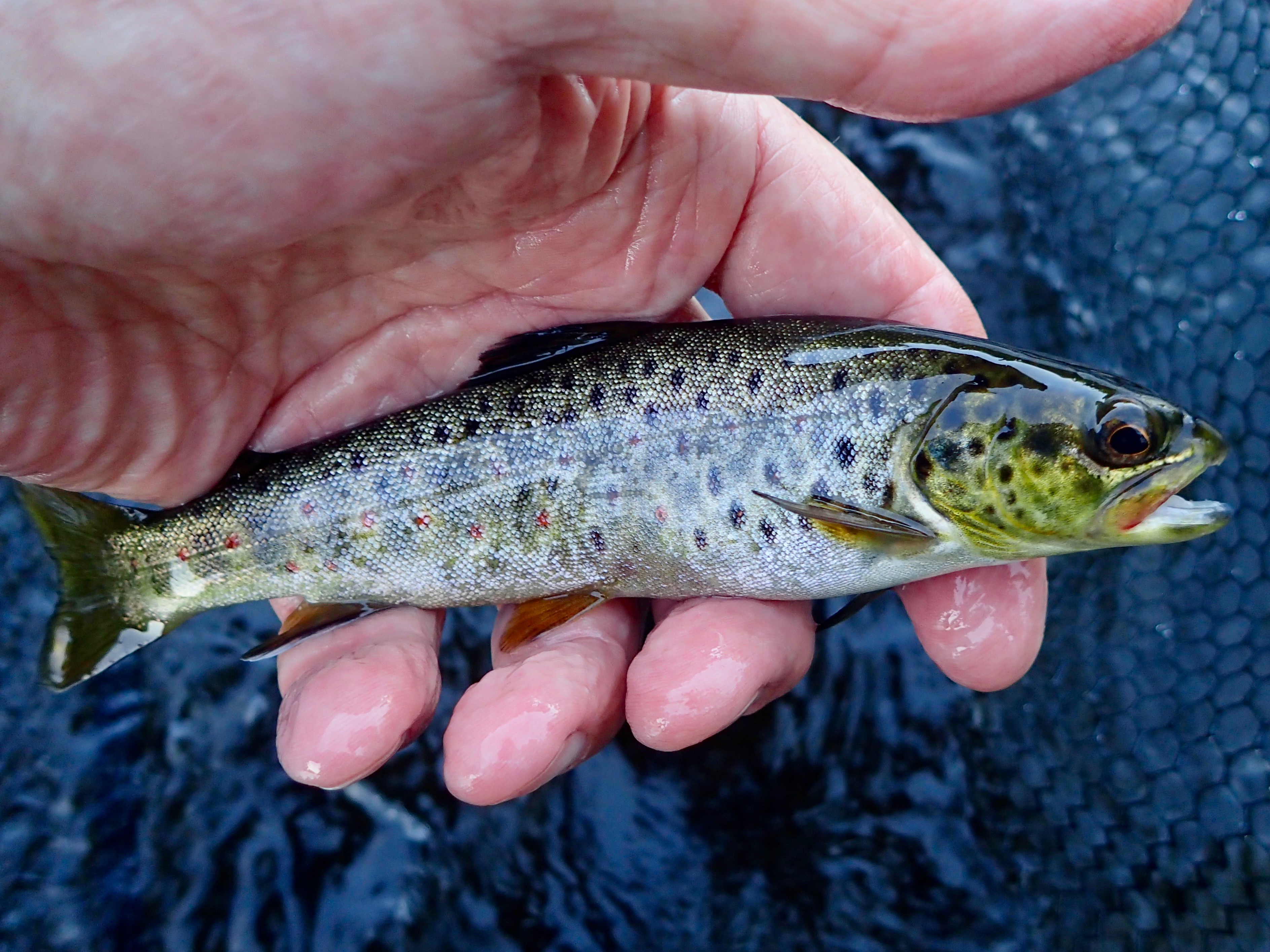
Winter fishing requires attention to detail. If you’re not ready, you might miss it. Here’s a hawk-eyed Toby focusing on his sighter. I had one little bump on the Sparkle Minnow, then we moved to the third mark. Only one angler there, but he left after 5 minutes and again we had a long section of river all to ourselves. I managed a fine 13″ wild brown and then we called it a (victorious) day. We fished from 11:30am-4:00pm, and I was grateful for the time spent on the water, the action, and the good company.

The Next Currentseams Tuesday Night Zoom: “Winter Fly Fishing” Jan 12, 8pm

I’m pleased to declare war on cabin fever with another free Currentseams Tuesday Night Zoom, tomorrow, January 12 at 8pm. The subject will be winter fly fishing, and you can read all about it on the poster below. Hope to see you there!

Plus, if you haven’t done so already, there’s still time to sign up for my first winter fly tying Zoom class, Tying the Soft-Hackled Fly, this Saturday January 16th. This class is a pay-to-play event, and the cost is a very reasonable $10.

Farmington River Report 1/8/21: Fun with long-leader jigged streamers

Every once in a while I need a new project. Since I’ve been on a streamer kick, this seemed like a capital idea: try fishing small jig streamers on a long leader. This video featuring Lance Egan had piqued my interest. The point is not to cover vast stretches of river, but rather to work in close and target likely holding areas, tempting trout with a protein payoff. I’d fished in a similar manner for smallmouth on the Hous, bouncing dumbbell eyed streamers or larger jig streamers (like Barr’s Meat Whistle) along the bottom, but I wanted to try the longer leader thing with a smaller bug.

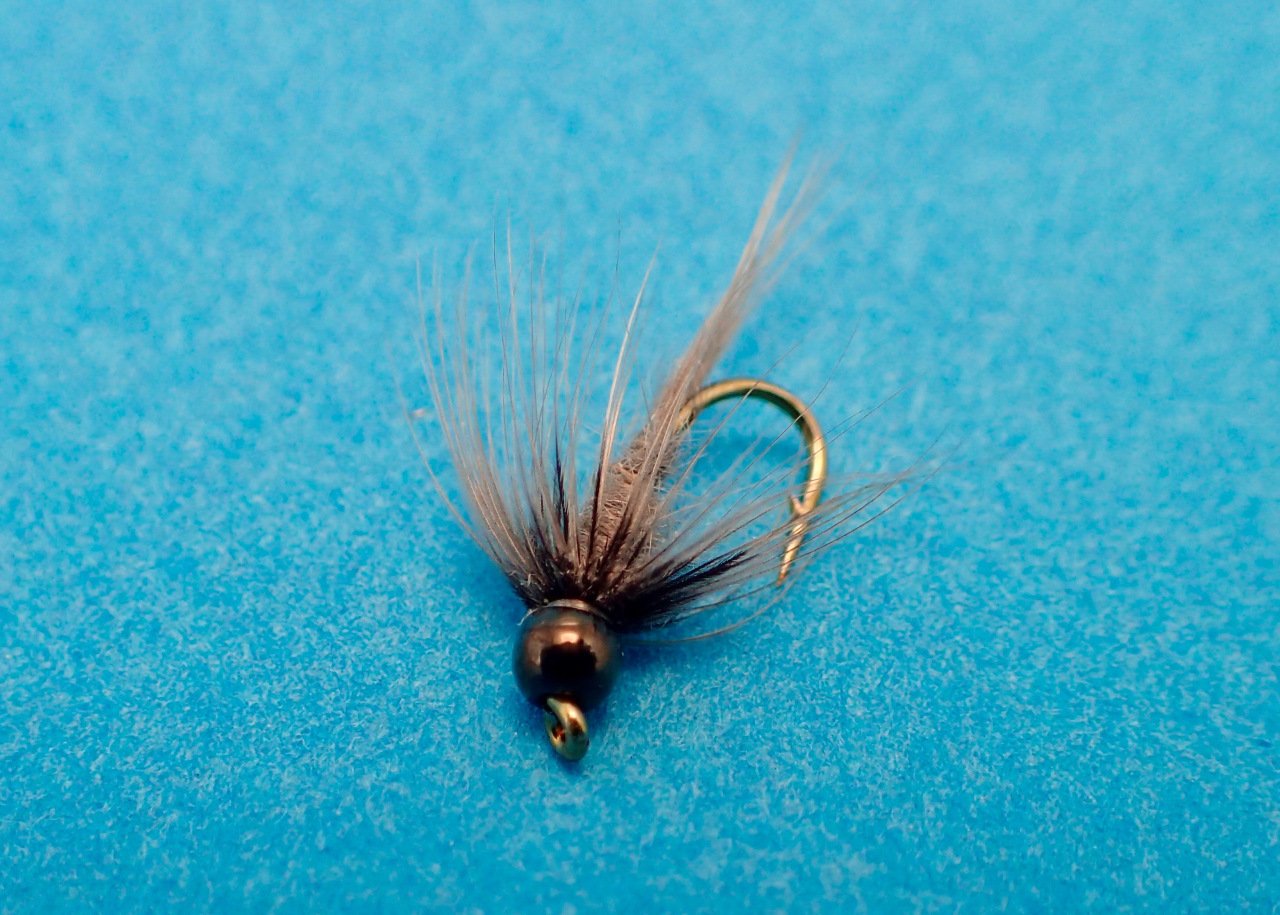
I reached out to fly fisher extraordinaire Devin Olsen for a quick leader formula. He suggested a basic construct like the one in his book Tactical Fly Fishing: 12 feet of 15# or 20# Maxima, 3 feet of 12# Amnesia, 18″ of 0.012 sighter material, tippet ring, then 6′-10′ of 4x or 5x tippet. I kept fly selection simple with this basic black and silver jig streamer, tied on a size 8 hook. Total length is about 2″.

So I hit the water. The winter crowds continue to astonish. I saw more anglers out yesterday than I do during an entire previous typical winter. I stayed within the Permanent TMA, with was running cold and clear at 450cfs. I shared the first mark with four other anglers; I blanked, and the only trout I saw taken came on bait.

I scored a lovely mid-teens wild brown in Spot B. This fish hammered the fly on the drop. This is a video still so the shot really doesn’t do the fish justice. I thought I had a trophy brown in Spot C, but two-thirds through the fight I could tell that something wasn’t quite right. My suspicions were confirmed when I netted a large sucker, foul-hooked in a pectoral fin.

The last two marks I hit were also blanks, but I counted the day as an unequivocal success. I’ll be working on this technique some more this winter, and will also be using it at times for smallmouth. It’s certainly best for in-close work, not only in terms of presentation, but casting as well. (The rig is an absolute bitch to cast; you’re not so much casting as you are lifting, loading, and lobbing.)

J.C. Mottram’s Smut Number 1

“Smuts — I welcome smutting trout.” So writes J.C. Mottram in his book Thoughts on Angling. I don’t have the book, but I do have Syl Nemes’ second edition of The Soft Hackled Fly and Tiny Soft Hackles. In that book, Nemes devotes a chapter to Mottram and his collection of soft-hackled smuts. (“Smut” is a colloquial British term for a very tiny fly, such as a midge, and trout that are “smutting” are delicately feeding on those miniature bugs.)

There are six Smuts listed by Nemes. I’ve only tied one, the Number 1 (shame on me for not exploring further). I revisit it today because I happened to have Nemes’ book out, and this is a great time of year to fish midges. (Midges are a major, consistently available food source for trout in the winter.) I’ve mostly fished Smut Number 1 as a dry fly, but I’ve also used it subsurface. The wise winter nymph angler will no doubt want to include this tiny soft hackle as the top dropper in their nymph rig.

Nemes includes a photo of the Smut Number 1, and it bears only a faint resemblance to what I tie. His looks like the body is entirely constructed of working thread; mine uses the specified wool. (UNI makes a nice wool yarn thread on a spool.) His hackle is wound wingless wet style, covering the front third of the body; mine is wound at the head. I suspect the wingless wet style would be very appealing to trout. Worth the price of admission alone is the blank stare you’ll get from the angler who will inquire, as you hook trout after trout, what fly are you using? “Smut Number 1,” is your response. Soak in that moment. And here it is, J.C. Mottram’s Smut Number 1.

Hook: TMC 100 18-22

Thread: UNI Black 8/0

Abdomen: Black wool

Thorax: Black wool

Hackle: Long white