Damn you, Omicron! Sadly, this recent COVID spike has forced the postponement of Director Matthew Vinick’s world premier of “Summer on the Farmington.” Originally slated for Wednesday January 12, no make-up date has been posted — but I’ll let you know when it comes down. Certainly it was a difficult decision, but it’s surely the right one. And we still have something cool and wonderful to look forward to! (Not to mention craft beer.)
Also noteworthy is the CFFA’s decision to cancel their Expo Saturday, February 5. That’s two years in a row with no “best little fly fishing show in New England.” But we also appreciate the CFFA’s concern for us, and we will look forward to its triumphant return in 2023.
It’d advise going fishing, but really, it looks brutal over the next few days. Me, I’m going to be working on presentations and tying and dreaming about warmer weather, hungry fish, and tight lines.
Here’s to being able to feel your fingers…and an end to this damn pandemic!
My schedule is up for the 2022 Fly Fishing Show in Edison, NJ, January 28-29-30. On Friday, Jan 28, 4:30pm in the Catch Room, I’ll be presenting a brand new seminar, Modern Wet Fly Strategies. This is mostly new material, and folks, I’m really excited about this one! Modern Wet Fly Strategies builds on the basics of Wet Flies 101 and expands on the tactics of Wet Flies 2.0. With new video and content, this is a more detailed program about wet flies and wet fly fishing. Topics include matching hatches, situational use of wet fly types, presentation options, gear, and the tactical use of wet flies under varying conditions and situations. A must for anyone who wants to improve his or her subsurface game! Admission is included in your ticket price.
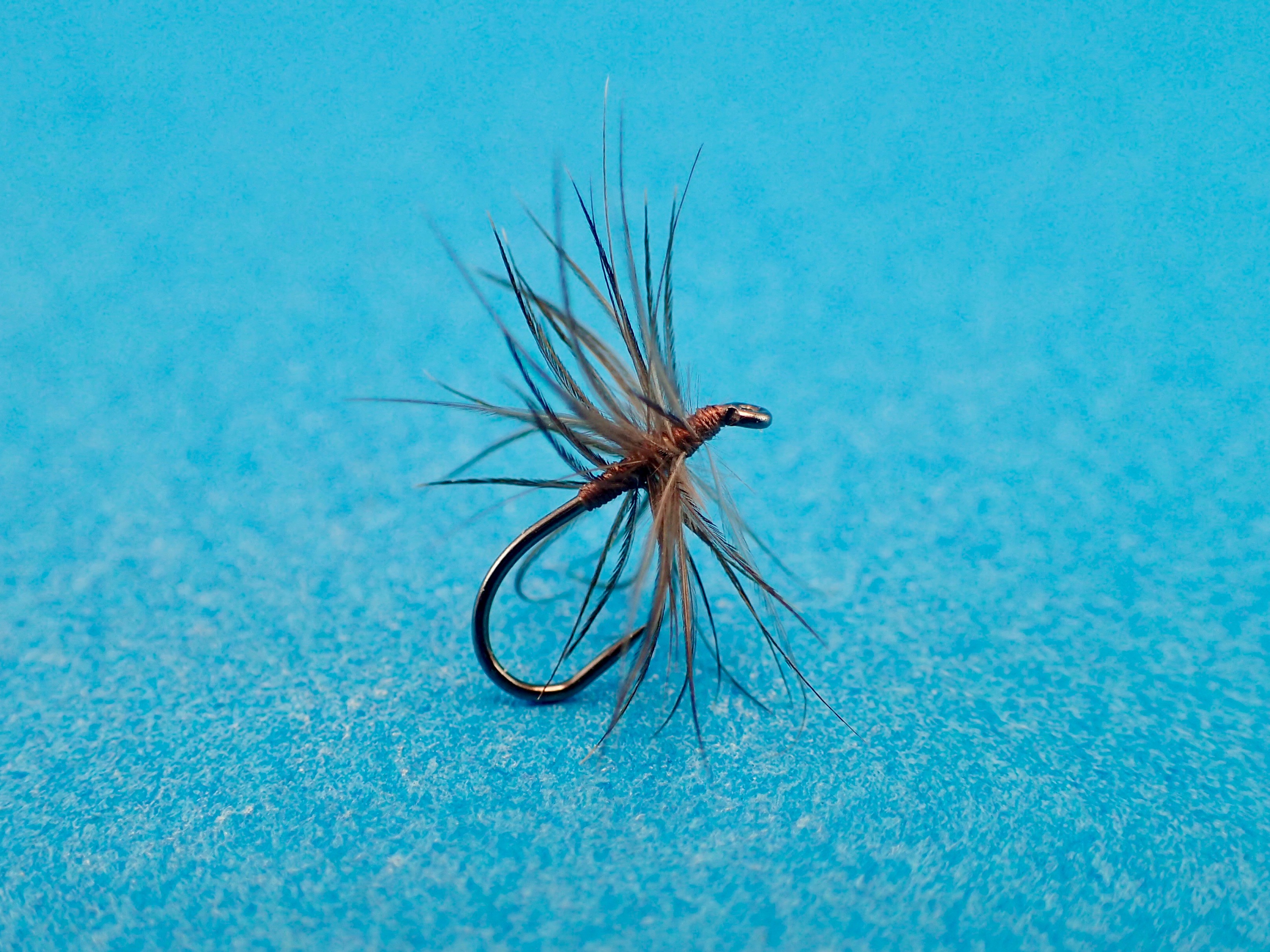
Trout still don’t know that this soft hackle pattern is hundreds of years old. They just know that it looks like something good to eat.
Saturday, January 29, is another busy day. At 9:45 in the Strike Room, I’ll be debuting another seminar, Finding Small Stream Nirvana. Fly fishing a small stream is possibly the closest an angler can get to touching fly fishing’s soul. Small streams are everywhere, from remote woodlands to hiding in plain sight in urban areas. In addition to gear, flies, tactics and strategies, I’ll also discuss how to discover your own small stream paradise. Finding Small Stream Nirvana will be eastern brook trout-centric, but will also cover non-natives like wild browns. Lots of cool video in this one. As with all seminars, admission is included in your ticket price.
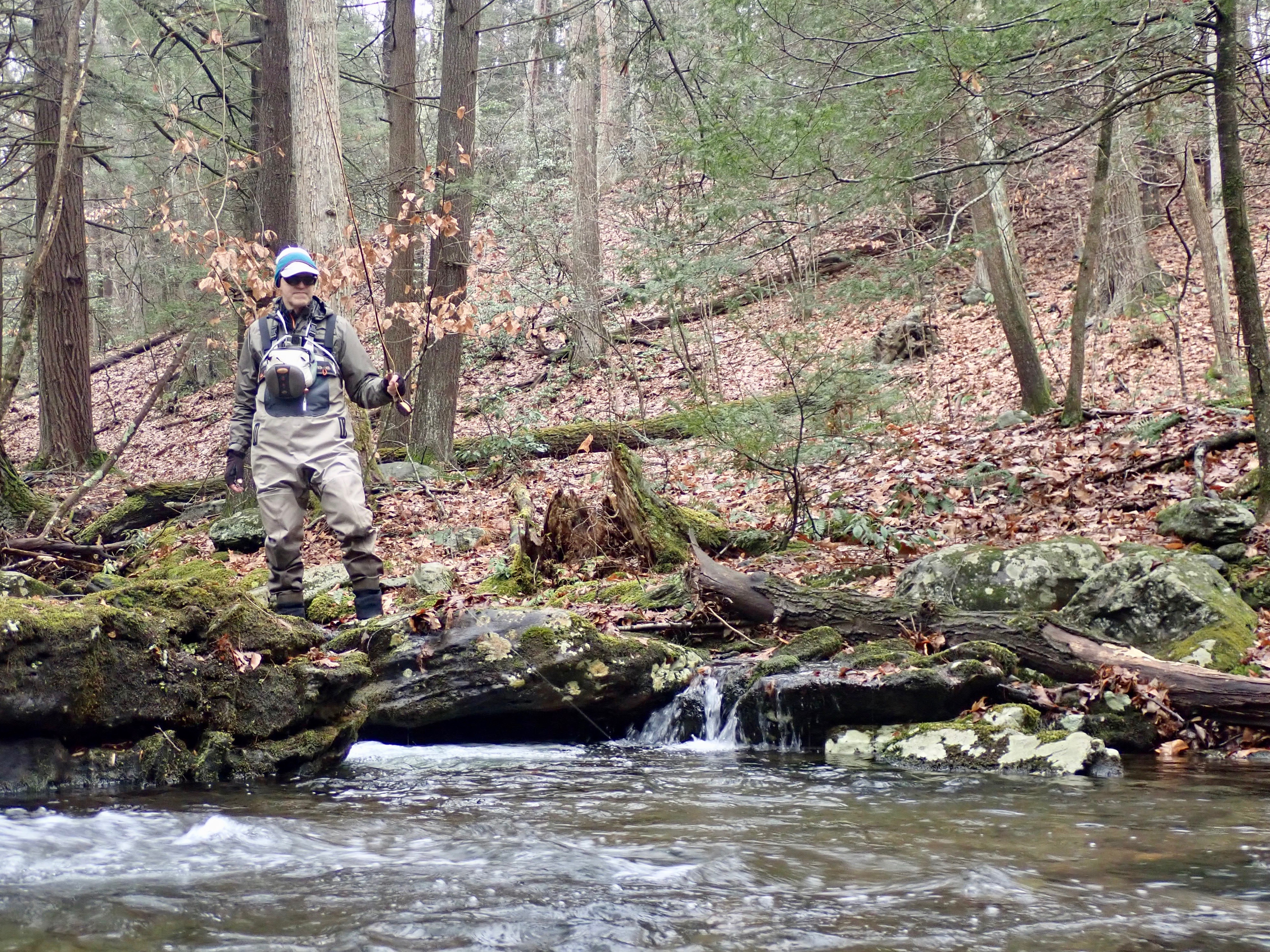
Very small stream nirvana…
At 2pm, you can take my class Tying and Fishing Wet Flies. Learn to tie and fish classic North Country spiders and other wet flies that trout can’t resist. The course also covers basics like leader construction, fly selection, where to fish wet flies, and how to fish them. Intermediate skill level. This is a paid class, and you have to sign up through the Fly Fishing Show. Here’s the sign-up link.
And of course, there’s the Marlborough Show the weekend before, January 21-22-23. I’m hoping to see lots of currentseams folks at both shows — please come say hello!
I don’t remember when I started doing it, but at some point I got into the habit of fishing a small stream on New Year’s Eve day. There’s a lot I like about it, not the least of which is tradition. But to end the fishing year on a small stream seems romantic, poetic, and just generally good for the soul. It’s arguably fly fishing at its most innocent. Not every year has worked out — youth hockey tournaments have been a primary culprit — but I’ve managed to do it quite a bit.
This year I took a fishing buddy, Toby Lapinski. We hauled out into the deep, dark woods on a day that had no right to be the last few hours of December. We did a brisk brookie business (say that three times fast!) once we figured out where they were willing to eat. Add a celebratory pre-New Year’s cigar, and we sent 2021 off in fine form. Don’t forget to get your 2022 license!
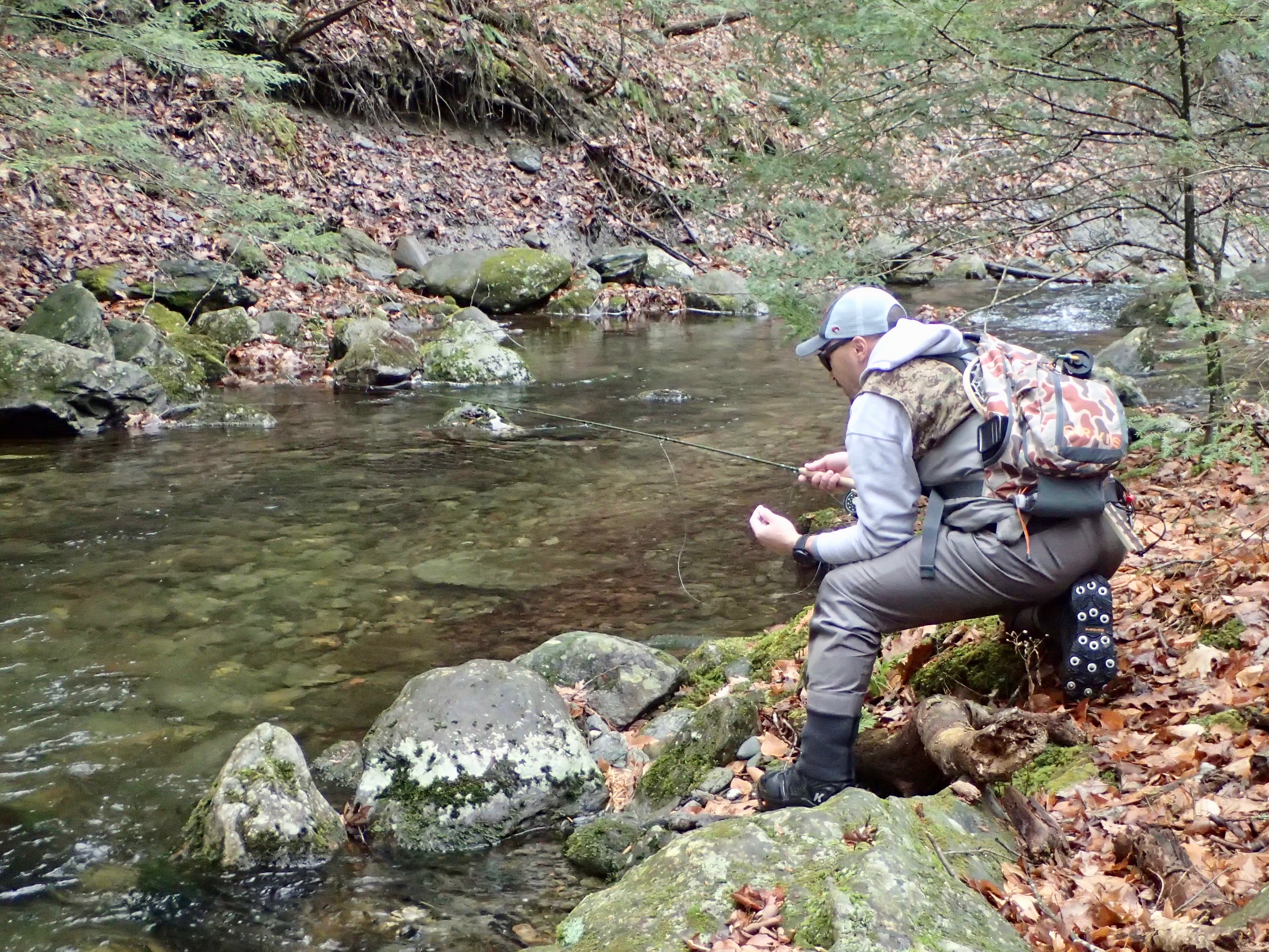
Why is Toby bottom bouncing in one of my favorite dry fly pools? Because we devised a brilliant plan to find out what the fish wanted. Toby started with a tungsten bead-head micro Squirmy Worm thingy, while I fished a bushy dry/glass bead dropper. The char voted overwhelmingly for the bottom. Toby was nearing double-digit hookups before I even got a sniff on the dry. Even my tiny midge nymph dropper went largely unscathed. I do love making them come up, but with the water on the upper side of perfect and running very cold, I switched to running deep mode. And that simple move was the difference between fishing and catching.Me being stubborn with the dry. Alas, ’twas not to be, although I did get one to latch on in this lovely little bit of water. I made what passes for a cast, then dangled and waked the fly while making a rough figure-8 with my rod tip. There’s an awful lot of green for the day before January 1! Tightest of lines to all of you in 2022. Photo by Toby Lapinski.
(cue drum roll) In the end, this was an easy choice. I’d been trying for over a decade to reach 100 steelhead landed. What with trips few and far between, some truly bad luck/bad timing, and dwindling runs, the last few years had slowed my progress to a glacial pace. A fish here…none there…one…repeat. I was stalled at 97, and when I dropped my first hookup on April’s trip, it seemed like I had another appointment with disappointment. And then, the mojo shifted. Fish were on. And landed. And then I held #100 in my hands. I capped the day with a monster hen and a celebratory cigar. You can read the full, original report here.
Number 100, trusty yarn indicator in the background. I’m truly lucky to be able to pursue my passion for fly fishing, write about it, teach it, and have an audience. Thank you, everyone. And to those steelhead who suddenly came off for no reason even though I had a good, sharp hook set and played you flawlessly…well, never mind. I’m trying to be nice here.
This is where making such lists gets hard. Is #3 really better than #4? And what about #1? Is it clearly the summit? What if you have two really great moments? Such are the things that we detail-oriented writers obsess about. But I’m happy with my choices. I hope you’ll be, too.
#4 The High Water Smallmouth Slob Bonanza. You know, I waited all year for July to come so I could go smallmouth fishing. Heck, I couldn’t even wait that long. So I went in June. That outing produced far more trout than bronze, so I waited for a few weeks. And then the rains came. And came. And seemingly never left. The Hous would spike and fall and then spike higher and kindof fall and then it would rain some more and….yeesh! What a disaster. Finally, I made the command decision to go fish. Yes, the water was disgustingly high. Yes, it was the color of chocolate milk. Yes, it rained again while I was fishing. (No, really. A line of severe thunderstorms came through, and I had to find shelter for an hour. It poured buckets. And…what a shock. The water came up even higher and dirtier. You can’t make this stuff up.) The good news was that I now had a chance to work on my high/off-color water summer smallmouth game. That first night was an eye opener. I caught more, bigger fish than any outing in a couple of years. The rest of the smallmouth summer was an exercise in patience, timing, and mostly frustration, but I had money memories of that July evening already in the bank.
You could measure this slob in pounds, not inches. Best of all, it was taken at the surface. Hot diggity!
#3 You Oughta Be In Pictures. Director Mathew Vinick’s love song to the Farmington River, Summer On The Farmington, will premier January 12, 7pm, at Brewery Legitimus in New Hartford. I’m excited to have been a part of this film, and I’m really looking forward viewing the finished product. Hope to see you there!
#2 My First Snook on the Fly. There are two things I’ll get up at 4 o’clock in the morning for, and one of them is fishing. It’s a 90-minute drive from Miami to Flamingo, and you go through some of the most barren country in the U.S. But the Everglades are a beautiful, wondrous place, and you can catch snook there. Well, sometimes. No snook for me on my first trip a few years ago. But this year… yeah baby! What a great fish upon which to break the snook seal. (Kudos again to my guide, Capt. Mark Giacobba.) Now, I gotta go back and get a tarpon…
I can still see the dark bulge of water materializing from within the mangroves, racing on an intercept course to the fly, and feel the sharp pull of the take and turn. Even the smaller ones are fun to catch.
(to be read in Casey Kasem’s voice) We’re counting down the 10 most memorable moments of 2021 on currentseams-dot-com. (to be read in singing chorus voices) Number Seven!
#7 Teaching Wet Fly Fishing. I didn’t have as many guide trips this year as usual, mostly because of high water — and then I cancelled most of the summer due to elevated water temps on the Farmington. But in the spring, I did get the chance to do what I enjoy most about being a teaching guide: introducing people to the ancient and traditional art of wet fly fishing. The bite gods generally smiled upon us, and we had multiple memorable outings. You’ll be able to learn more about tying and fishing wet flies from me next month at the Fly Fishing Shows in Marlborough and Edison. Of course, there’s nothing like an on-water lesson. April and May are coming!
Eric was just one of several clients this year who locked up on bunches of fat Farmy trout with wet flies. (I was smiling, too.) Well done, everyone!
#6 Peacock Bass Fishing in south Florida. When you’ve never caught a tarpon or snook, and you’ve been fantasizing about doing so for months, and then your guide tells you that conditions in the Everglades aren’t good so you won’t be realizing your dream today…well, that just kinda sucks. But wait, he says. I’ve got a plan B: peacock bass. If you love smallmouth, you’ll love peacocks. They’re aggressive and feisty and leapers and beautiful fish to boot. Plus, I know a spot. Okay, you say. You’re still disappointed, maybe a even little reluctant. But you go because it is what it is…and then you discover that what it is is fan-freaking-tastic. But wait, there’s more: find the right water and it’s bass after bass after bass. What a delightful way to wreck your forearm.
Hooking a peacock bass is like reenacting a fight scene from the old Batman TV show. Pow! Biff! Smash! Crunch! They blast the fly, and if you apply upward pressure they leap and cavort and tail-dance (and sometimes do that regardless). Tremendous sport, especially in the 2-5 pound range. I love living in a seasonal climate, but there’s something about Florida fly fishing that really appeals to me. Photo by Mark Giacobba.
#5 Being a Contributing Author to the Followup to Surfcasting Around The Block. When surfcasting legend Dennis Zambrotta asked me to contribute a chapter to his new book, I was thrilled. I pretty much knew what I wanted to write about, and after much drafting and polishing I sent it off to Dennis. My piece is called “The All-Nighter and the Nor’Easter.” The book’s working title is Surfcasting For Striped Bass: Fifty Years of Legend and Lore from the Islands of Block and Aquidneck. Target publish date: fall 2022.
Sacred fly fishing grounds. Dagnibbit, you can see all my secret spots!
Every year, I go through the same angst-ridden process. What will I write about for my top ten year-end wrap-up? Did I even do anything that’s worthy? Maybe it’s due to residual holiday stress. Maybe it’s simply mind clutter. Or maybe I’m just a dork. Because it always turns out that once I make a list, I have so many things to write about that it seems impossible to whittle it down to ten.
2021 was another challenging year. The pandemic robbed us of so many precious in-person moments, from shows to club meetings. Rivers and oceans continued to see an unprecedented number of anglers, and I can’t say that that has improved the angling experience. Climate change continued to wreak havoc on our weather patterns; it seems we were either flooded or baked or parched. Even tailwaters like the Farmington were not immune to the ravages of the new normal.
But, enough of what’s not so good! Let’s have some fun. Ready? Here we go…
#10 Tuesday Night Zooms/Tying Zooms. Pandemic be damned — we can still safely connect via Zoom. These sessions often drew well over 50 people. It’s always cool to be able to see faces and hear voices, even if it’s over the internet. I’m grateful for the gifts some of you sent to show your appreciation — thank you for your generosity. And thank you again to everyone who attended my virtual fly tying classes.
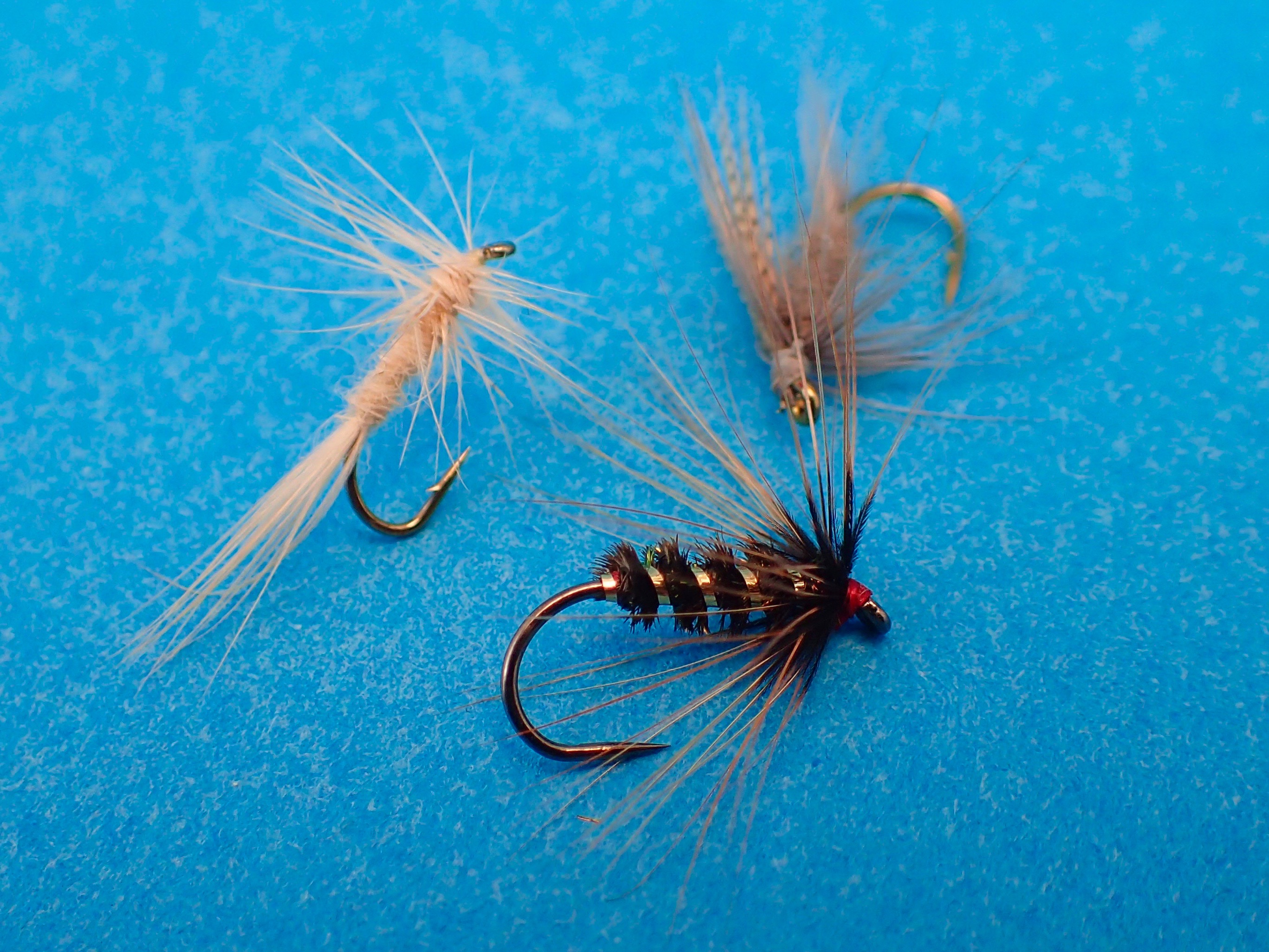
The product of a virtual wet fly tying classes. I also had the opportunity this year to perform one of my favorite tying demos of all time. It was a private virtual gig for a gentlemen in an assisted living home that specialized in early memory-loss issues. He was a former angler and fly tier, and I promised that I would fish with the flies I ted and send him pictures of those fish. I kept that promise, and his caretakers said he was thrilled to see those shots. Wow!
#9 Big Winter Browns. You may not always connect, but when you do, there’s a chance that what you hook on that streamer is going to be good. I still don’t Euro nymph, but I did spend some time tying and learning to fish long-leader jigged mini-streamers. It’s an effective tactic for close-in work. Here’s the proof.
A substantial spawned-out hen. I still relish the sight of those stunning haloed spots on her flank and her golden belly. Photo by Toby Lapinski.
#8 Writing and Finding New Audiences. For years, magazines have been in a sad decline. It’s shame, because when it comes to reading pleasure, there’s nothing more enjoyable for me than the printed word on a paper page. But, this is the modern way. Some print pubs continue to hang on, if not do rather nicely. Others have shifted to electronic formats. Whatever the medium, I’m grateful for the opportunity to write and be read. You could have found me this year in The Fisherman, On The Water, Field & Stream Online, Surfcaster’s Journal, and American Fly Fishing. And, of course, right here at currentseams.com.
You can read my story “Sensei Elmer & The 50-Fish Nights” in this issue of Surfcaster’s Journal, but you’ll need to subscribe or buy the issue. Please support publications that you enjoy reading.
I’d like to take this opportunity to spend a minute with you at Christmastime to tell you how much I appreciate your readership. Loyal followers like you are a wonderful present. I’m looking forward to sharing more fly tying and fly fishing adventures and advice with you in 2022. Stay safe, be well, and I hope you have the happiest of holidays.
Here I am, walking through the December woods along a small stream…and there it is. The perfect Charlie Brown Christmas tree. Add a fly rod to the snow, and suddenly we have one of my favorite holiday photos I’ve ever posted. Merry Christmas, happy holidays, and season’s greetings to all!
A hearty thank you to Nutmeg Chapter TU for the virtual hosting last night. I presented one of my more popular talks, “The Little Things.” The Little Things is all about seemingly insignificant factors that can have a huge impact on your fishing. Pay attention to the little things in your fishing, and tight lines will follow. I know everyone’s busy getting ready for the holiday so I’ll keep this short. Annual Christmas photo card coming soon!
One of those little things: target river banks, especially in high water. Doing so yielded my biggest smallmouth bass of 2021. What a pig!
This was an unexpected treasure. One of my wife’s relations was cleaning out some books belonging to her deceased husband, spotted the title, knew I was a fishing kind of guy, and sent it along. I first heard of The Compleat Angler when I read Joe Brooks’ classic Trout Fishing in the mid-1970s. I don’t know that I’m going to read it cover-to-cover, but I will be browsing. Thanks, Santa!
A little piscatorial humor. I don’t know who wrote the inscription, but the owl sticker is covering some kind of personal dedication.