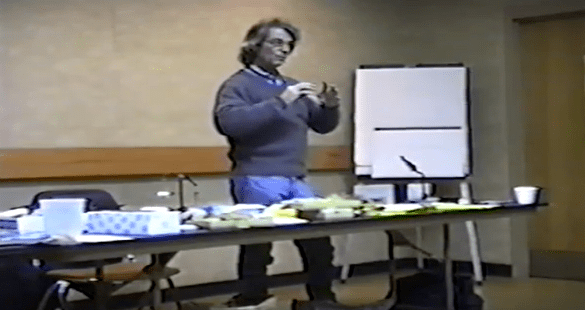
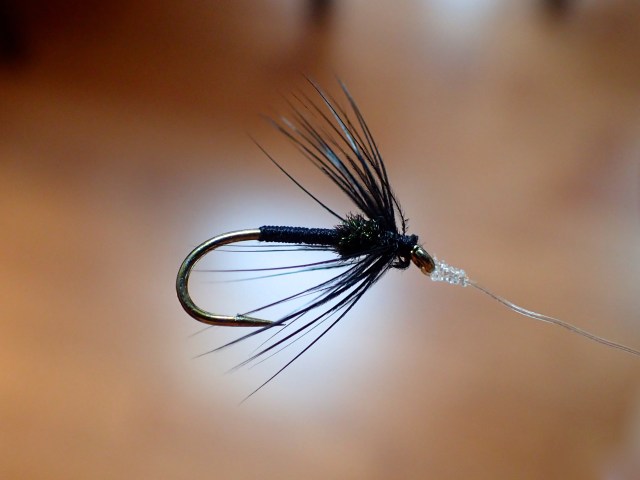
Tying video: Snipe and Purple North Country Spider

The Snipe and Purple (sometimes called the Dark Snipe) is a classic North Country spider. North Country spiders aren’t particularly hard to tie, but there are some techniques you can use to help create the classic umbrella shape of the hackle fibers and keep the body neat and trim. This Snipe and Purple is often referred to as a good match for the Iron Blue Dun. The Iron Blue is frequently mentioned in older texts, from numerous Yorkshire anglers to Pennsylvania’s  James Leisenring,  but you hardly ever hear about it today. I like the Snipe and Purple for small, dark stoneflies and especially midges. I also tie this fly on a 1x short, 2x stout hook, add a gold rib, and fish it for steelhead.

Currentseams Q&A: Of droppers, drop-shot, and indicators

Currentseams reader Steve M. asked this question on the Farmy Report post below. I thought the answer deserved its own thread. Thanks for asking, Steve.

Q: How about a refresher on your dropper nymphing method? Specifically how you use/position the indicator? 

First, some semantics. Dropper nymphing setups and indicator nymphing are two different things. You can nymph with droppers and not use an indicator. Or do you mean drop-shot? Same deal: you can fish a drop shot rig without an indicator. “Droppers” refers to flies that are attached to the rig by tags of leader material. “Drop shot” is a method that uses split shot suspended by a tag below the bottom fly. A drop-shot rig can have droppers or just one fly. Hope that clarifies rather than confuses!

How I use and how I position the indicator are also different things. Generally, I use an indicator when:
I want to cover water/get longer drifts;
It’s cold and the takes might be subtle;
I want to fish the bottom in deeper holes;
I don’t want to feel like my arm is going to fall off after keeping it raised above my shoulder for hours.

I use my own yarn indicators, dense, bushy creations, and I’m fairly dialed in to their nuances. The indicator need not go under for me to want to set the hook. (Look for a reason to set the hook on every drift and you’ll catch more fish.)

The general rule of thumb is to set the indicator at 1.5 times the estimated water depth away from the bottom fly or shot. I’m not sure I follow that so much as I estimate the greatest depth I’ll be fishing and place the indicator on the leader where I reckon the drop shot will be ticking the bottom. It’s more feeling than formula. Specifically, I want to find this equilibrium: the shortest distance between the shot and the indicator, and enough distance to make a natural drift along the bottom. I want to see that indicator bouncing along. If you’re not catching fish and you’re not seeing those bottom return tells, you’re not fishing deep enough. Adjust your indicator (which you can now refer to as a depth regulator) accordingly.

I often check my indicator. “Checking” means that if I feel the indicator is leading or dragging the nymphs downstream at an unnatural pace, I’ll mend the indicator upstream, literally lifting it off the water and placing it where I want it. Remember that current at the surface moves faster than current at the bottom.

Finally, a word about weight. I like to use as little shot as possible. But sometimes you’ve got to go heavier. In winter, the water’s cold, and things slow down, trout included. I’ve been using two BB shot on my drop shot rig this winter — not because the water’s deep or fast, but because that extra weight slows the drift to a pace where a trout has to move less for the fly.

Hope that helps.

Steve’s secret weapon: home brew indicators made from acrylic macrame yarn and a #36 o-ring. I build them dense, and treat them with Gink or Loon Fly Spritz 2 before each use. This is a color I can see easily, and this indicator is about as big as I’d ever use on the Farmington. I know, you want a video tutorial on construction. The answer is yes — I just need to figure out the when.

OLYMPUS DIGITAL CAMERA

Farmington River Report 3/7/17: What’s all this, then?

Let’s start with some good news, where a picture is worth 200cfs:

FarmyDamRelease

Add to that 100+cfs from the Still, and we finally have a proper level in the permanent TMA, running clear and 34 degrees. Of course, we need to keep those rain dances at the ready. A little more snow in the Berkshires wouldn’t hurt, either.

To the fishing. Spot A was a blank, and friends, I want to tell you that I nymphed the snot out of that run for the better part of 90 minutes without a touch. Spots B and C were dedicated to the streamer cause but with the same result. At this point I paused to reflect upon the manifest iniquity of fishing — and to consider newly received intel that there had been a recent significant melting of ice shelves where I had been fishing .

La Aroma De Cuba Reserva Bellicoso in hand (well, mouth, too) I headed north.

And that’s where I found a whole bunch of trout that were most eager to eat my nymphs. They were fairly split between the size 16 Weisner’s midge dropper and the size 14 Frenchie variant. I used two BB shot to keep my drifts nice and slow. The takes were on the subtle side, but nonetheless my indicator received a good soaking. By 3pm the action had tailed off, and I called it a day.

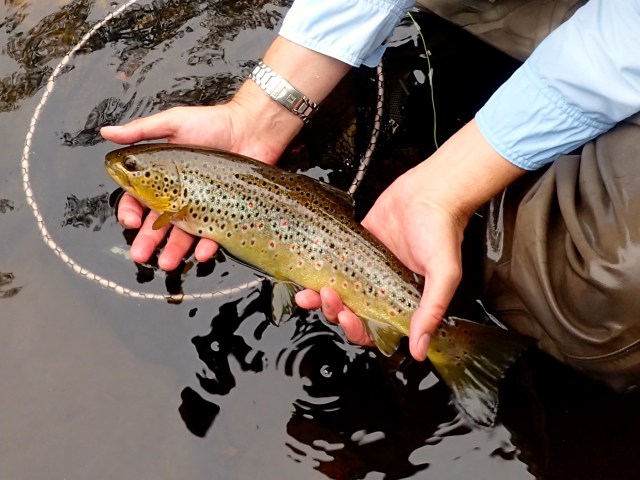
Several of my fish were well-fed browns in the mid teens. No wonder this hen gave me a battle. Look at the size of her pectoral fin.

OLYMPUS DIGITAL CAMERA

~

Another fine specimen from the chilly waters of the permanent TMA.

OLYMPUS DIGITAL CAMERA


Flirting with 500 followers, spring appearances

We’re winding down the spring 2017 appearance schedule:

“The Little Things 2.0,” Thursday, March 16, Farmington Valley TU, Unionville, CT. Doors open at 6:30pm. Meeting is open to the public. For more information, visit the FVTU website.

“The Little Things,” Monday, April 3, FCFGPA. This is a members only gig.

“The Little Things,” Thursday, May 4, Housatonic Fly Fishermen’s Association, Wallingford, CT. St. Paul’s Episcopal Church, 65 North Main St, 7pm. Everyone welcome. For more information, visit the HFFA Facebook page.

Whew! Then we can all just go fishing.

On to the fantastic 500. One day we’re at 502 followers. The next, 499. So it goes in the razor-edge, cutthroat world of website subscribers won and lost. Once we stabilize over the 500 mark, we’ll have our usual currentseams follower appreciation giveaway. You, being a loyal reader, never let your subscription expire. Right?

Ooh. Ahh. Ohh. Striper swag from a previous giveaway.

Striper Soft-Hackles

Fly tying video: Steve Culton’s Drowned Ant Soft Hackle

By popular demand:

You can find my original currentseams write-up on the Drowned Ant here.

Small Stream Report: We’ve got bugs

Yesterday seemed like far too fine a day to spend shackled to my laptop. Priorities in order, I headed for a thin blue line in the northwest hills.

Glory, what a good decision. The sun was warm, the water cool, and the smoke from my Rocky Patel Special Reserve Sun Grown Maduro robusto danced around the budding branches. Lots of bug activity: the rocks were coated with little black stones (16-18), and I saw caddis (16), midges (tiny) and two large un-IDed mayflies (Blue Quill?) locked in a fervent mating embrace. Water was an excellent height and running clear.

You can still find snow in the woods, albeit in isolated patches.

OLYMPUS DIGITAL CAMERA

Inclement weather has a tendency to place branches and even entire trees in rather inconvenient locations. So I spent a few minutes doing some in-stream flora removal where needed. Here are my rules-of-thumb: if it’s living, it doesn’t get touched, no matter how badly it cocks up a pool. If it’s dead and in the water, and provides cover or generates seams and oxygenation, it doesn’t get touched. Anything else is fair game.

Pricked a bunch, mostly on the 2x short size 18 nymph dropper, and landed a half-dozen. I did see one fish rising to something small in a long, flat pool. I couldn’t hook him, even on a size 20 Bivisible. Due to the bright sun, most of the fish were holding deep or near structure. This lean, mean fighting machine grabbed the nymph.

OLYMPUS DIGITAL CAMERA

Finally, a reminder that any small stream that’s not a Class 1 WTMA is now closed until 6:00am second Saturday in April. I know, it doesn’t make any sense, but we’re stuck with it.

Tip of the week: watercraft and wisdom, or: You’re smarter than the fish

Heed the sage advice of Harford Henry Edmonds and Norman Nellis Lee:

“The proficient wet fly angler is not disadvantaged at finding no rising trout at the surface, he will instead use his watercraft and wisdom to fish all the spots where he knows a trout will be.”

I tied up this Drowned Ant yesterday, thinking about the shady banks, grassy edges, and pocket water I will drift it through this summer.

drowned_ant

Works-in-progress: Hendrickson spiders

I don’t usually share patterns in the development stage, but the energy of these flies and the promise of spring has me feeling reckless. I’ve been prototyping some Hendrickson spiders, playing around with different colored threads and silks, hackles, and tailing materials. The one constant is the body fur, a moderate dusting of muskrat over the waxed thread or silk. These will get a test run this spring, and I’ll let you know what I — and the trout — think.

A nod to the tradition of North Country spiders and legacy American patterns like the Dark Hendrickson winged wet.

OLYMPUS DIGITAL CAMERA

Farmington River Report 2/15/17: Bottom return

There comes a point in the nymphing session — usually after I’ve been at it for a while with no touches, and especially if I’ve been losing a war of attrition with the bottom — when the indicator goes down, I set, and I cannot believe that I’m stuck again.

Depression sets it.

But sometimes the bottom moves. And despair turns into the delightful prospect of possessing that which we love and desire.

It’s a fish, and by the feel of things, a decent one.

Even after walking it down the run a ways, the trout still won’t come, and I wonder if it is fouled. No, it’s just a big ‘ol Farmington brown — nearly twenty inches worth — with my tiny midge lodged firmly inside the white of its mouth.

The prize for hiking a good distance to fish in solitude. Celebrated with the cigar gifted to me by Alton (thank you).

OLYMPUS DIGITAL CAMERA

River conditions: 140cfs, clear, 33 degrees. Not much hatch activity (a few W/S caddis and midges). Most of the pull offs and dirt roads were inaccessible due to snow pack/plowing piles. That may change with the warm weather this weekend. I managed a nice rainbow in another spot, then called it a day after three hours. Two BB shot on the drop shot rig today resulted in a lot of snags, but also produced the kind of slower drift that I think catches more fish in water that’s barely above freezing.

The winning fly, Glenn Weisner’s blue bead head midge. You can read more about on Ed Engle’s Lone Angler Journal.

weisnerbluemidge

I know you’ll ask, so here’s the recipe:

Impressions from a tying demo

Here are a few things from yesterday’s tying demo at the Compleat Angler that are top of mind with me this snowy afternoon:

Wet flies tied in the North Country style are admired both for their simplicity and bugginess. (And trout like them, too.) By the way, group, I was wrong about the Snipe and Purple: the feather in the hackle is not an under covert, it’s from the top of the wing. Nonetheless, I’ll fish that fly with its horrible botched head and catch a trout.

It’s amazing how you can change the energy of a fly simply by altering the color of the hackle. Two Partridge and Light Cahills, the same but different.

plcs

The more I use the rotodubber, the more I like it for fur hackles. Like the NoCo spiders, people gravitate toward the Squirrel and Ginger, and with good reason. It’s one of my most consistent producers.

No two Usuals I tie seem to come out the same.

Confidence catches fish.

I really enjoy the questions and discussions during a demo, both fishing and tying related. I’m humbled — and grateful — that people take the time to come out and connect with me. Thanks to everyone who showed up, and thanks to the Compleat Angler for being such swell hosts.

By the way, I was impressed by the shop’s selection of hackles — and fly tying materials in general. Lots of wonderful wet fly capes in stock, and I left with a lovely Light Ginger hen neck. Check them out at 541 Post Road in Darien, CT.

Marabou adds a little magic to any fly. All that’s missing on this Deep Threat is the Ice Dub collar. Thanks for the photo, Mina.

deepthreatprogress