Fishin’, writin’, ‘n’ stuff

Busy is the word here at currentseams, although I have been able to get out a little bit. Due to my schedule it’s all been night action.

I fished the Farmington twice this week with mixed results. The first night was painfully slow; two or three bumps in two hours, all small fish. Last night was far more active with over a dozen bumps. One standard-issue brown to net, and one big mysterious hit that failed to hold. I did do something stupid last night: I walked down a side stem I hadn’t fished in two years to discover it was basically unfishable, then decided to walk back up a different stem that was fast, deep, and should have been the one I fished. What a workout! It wasn’t a total waste of time as I did find some very fishy hide holes that I will investigate on a future outing.

On the writing front, I just submitted a steelhead piece to Mid Atlantic Fly Fishing Guide, and I’m putting the finishing touches on a soft-hackled flies for stripers article for American Angler. There are a few other things in the pipeline at some other pubs; I’ll let you know if they are accepted.

Finally, currentseams has reached 300 followers. Hooray! That means a fly giveaway. Details on that coming soon.

As always, thank you for your loyal readership. Writers aren’t much without readers, so I truly appreciate it.

Come say hello to currentseams. I know it’s my site, but really, most of it doesn’t suck. While you’re here, sign up to follow. You’ll get fishing reports, how-to articles, essays, fly tying, photos, videos, random stuff like this, and the occasional chance to win some flies tied by yours truly. 

Hello

Farmington River Report: The rewards of putting in your time

After more blanks and (relatively speaking) dinks than I’d care to mention, finally a really good night. Hit four spots and found hungry fish in three of them. I had more bumps than I could count. Four fish to net, three in the upper teens, and the fourth just in at 20″.

This buck was hiding under a tree, waiting to ambush. Taken on the dead drift.

Brown Buck 8-15

~

A substantial hen that crushed the fly on the swing.

Brown Hen 8-2015

~

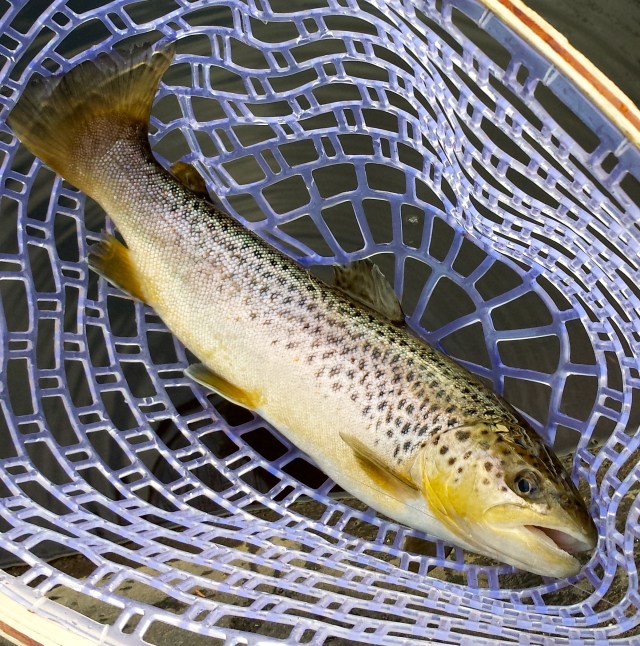
Saving the best for last. She whacked the fly on the swing, then followed up, but no hook set. Two casts later, I started to strip at the end of the swing. Ker-POW! I had a little trouble fitting her in the net.

Big wild brown hen 8-2015

Why I like foam-backed mouse patterns

Because if the gator brown photos come out lousy, you still have a record of a good night.

Evidence from a recent outing. This fly is called the Master Splinter (not my design). You can find the pattern recipe if you do an online search.

Chewed Mouse

Farmington River Mini Report 7/29/15: If only the fishing were this hot

You know it’s hot when you’re standing up to your waist in sixty-degree water and there’s sweat streaming down your face — and it’s only 10am.

I fished from 9am to 1pm today. My focus was on prospecting for bigger trout by nymphing the fast water. No bigguns’, but I did get into an assortment of lovely wild browns, one in the mid teens. I used the drop shot rig under a yarn indicator, with a size 14 olive Iron Lotus on the bottom and a size 16 soft-hackled Pheasant Tail as the top dropper. I adjusted between one and two BB shot, depending on the depth of the water and the speed of the current.

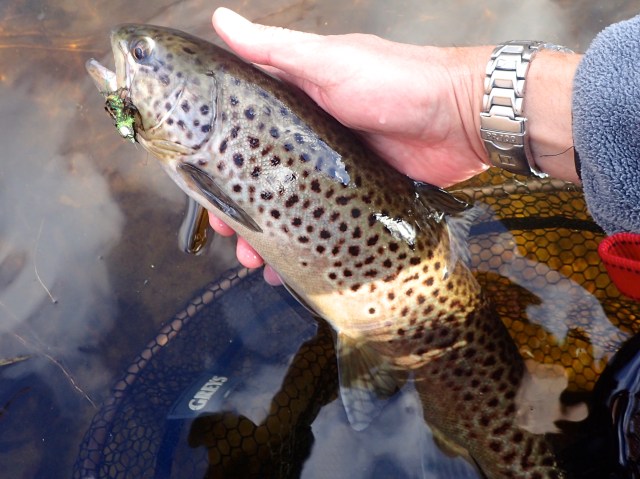
Now that is one impressive tail. Full adipose, nice little kype — this buck is a surely a wild thang. Taken on the SHPT. Why I like indicator nymphing: the indicator never went under with this guy. It was the slightest of takes, almost imperceptible. The indicator just suddenly slowed and twitched. Remember, it doesn’t cost anything to set the hook.

Wild Farmy Brown 7/29/15

Maybe it was the heat. Maybe it was the full sun. Maybe it was the lack of hatch activity. But I blanked in three runs today that I was certain held fish. The other three I hit all produced. Go figure — I did better outside of the permanent TMA. The river was surprisingly busy for a mid-weekday.

If you are heading out in this heat, please don’t forget to hydrate. And while the water is still plenty cold, let’s do our best to get those fish in and released quickly.

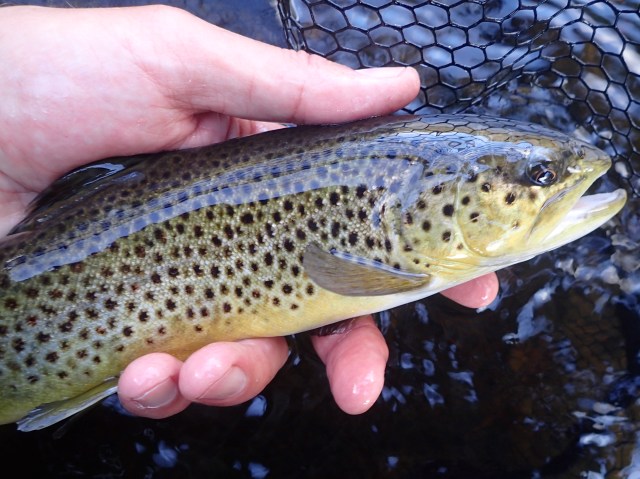
A jewel of a mid-summer Farmington brown. I can’t decide what I like better: the halos around the spots, the golden belly, or the parr mark remnants.

Wild Farmy Brown 2 7/29/15

Farmington River Tip of the Week

Yesterday, I went fishing. Sunny, middle of July, and windy. The perfect day for a grasshopper to get blown off its perch and into the water.

I fished some fast water — a mix of riffles and pockets that ranged from shin high to waist deep — with a team of three wets. The top dropper was a just-about-too-small-for-a-hopper-and-way-too-big-for-a-caddis fly I call The Monstrosity. Size 8-10 streamer hook, body of yellow or insect green rabbit fur, gold wire rib, palmered with webby brown hackle. Deer hair wing lashed at the junction of thorax and abdomen, same deer hair strands tied over the thorax, then a caddis-like head. Simple. Impressionistic. By mending the line I was able to keep that fly on or just below the surface.

The trout loved it.

Back you go, Tubby. Thanks for playing. Look at that sky. Ain’t summer grand?

Brown release

I whipped through the run in 45 minutes. No hatch, no active surface feeders, but the fish picked that fly out to the exclusion of all others (Drowned Ant and SHBHPT). None of the trout I brought to hand were under fifteen inches. And I regret to report that I lost a pig of a brown just as I was coaxing him into the net.

Hoppers. Wet or dry, ’tis the season.

Not the fly I was fishing — this is a Hopper Hammerdown, which is a little bigger than The Monstrosity and doesn’t have the soft hackle palmered along the whole body. But you get the idea and the energy of the design.

Culton_Hopper_Hammerdown

Farmington River Report 7/18/15: Wet, Dry, Pow!

After the Wet Flies 101 class I wandered off to investigate a snotty, treacherous boulder field with a team of wets. From top dropper to point, a size 12 Partridge and Light Cahill, a size 12 Hackled March Brown, and a size 12 BHSHPT. The sulphurs and Isos were out, as were the Cedar Waxings, who were having a regular airborne feast. I witnessed several sulphurs make it out of the river, only to be snapped up by an open beak moments after their emergence. The wet fly fishing started slowly, but as the hour hand moved past 6pm, things picked up. I ended up with over a half dozen fish, all wild browns save for one recent stockee, that ranged from eight inches to the low teens. I took them on the swing, the dangle, and short line deep. Some of them were active feeders; it’s always fun to successfully target specific fish, but I’ll take the ones that aren’t showing themselves just as readily.

The smallest trout of the day, but surely one of the hardest fighters. He hammered the BHSHPT on the swing.

Fast Water Wild Brown

Part Two of the evening was dedicated to the dry fly cause. At least in theory it was. I fished a spot that has seen declining numbers in fish in recent years, and sadly, that trend continued last night. I saw only handful of rises over the course of two hours. (I think I saw two dozen rises as I drove over the bridge at Church Pool earlier in the day.) Some olives and stenos, but not many of them. I was able to get two offers to the dry, but no hook sets.

Now well into dusk, the dry skunk would have been a bummer way to end the day. So I took the long way home and walked a pool with a nameless cone head black marabou streamer tied to the end of my leader. Plenty of bumps as darkness fell kept me entertained, but no hookups meant the fish were smaller than the foot-and-a-half-plus browns I was after. Off to Spot B where I couldn’t see squat due to the dense fog bank that had settled over the river. A bit of a disappointment with only one bump and no hook sets. (I know there are some bigger fish that live there. Where you at?)

Finished up at Spot C with an olive Zoo Cougar. The fog enveloped me with its chilly fingers, but I could now see some stars in the clearing skies. It was quiet.

Quiet enough to hear the sound of the brown as it tracked the streamer down and across the current. Bump! No return strike. A second cast to the same general area, same swing, same retrieve, same sound effects…Whack! There he is, a mid-teens brown that put a smile on my face and a skip in my wading step.

Then, a few minutes later…plop. I heard the fly hit the water. CRASH! The sound of the take came before I felt the tug or even managed to get the rod into post-cast position. Another good fish, not quite a bruiser, but aggressive enough to charge headlong at what must have looked like a most satisfying dining experience.

Speaking of food, I was famished. So I sped off to the McDonald’s in Unionville, which I discovered is closed at 11:30 on a Saturday night. Really? Closed? Saturday night? Contrary to the corporate tagline, I wasn’t lovin’ it.

That last brown must have felt the same way.

Farmington River Report 7/7/15: Scary Monsters

I wish I was referring to the gator browns I envisioned catching, but last night’s late night (or early morning) streamer session produced only three bumps, no hookups, and lots of angst. It’s easy to see why kids are afraid of the dark. Once you are robbed of the sense of sight, the imagination of all things terrible exerts a relentless grip.

A dense fog blanketed the water and woods. The headlamp was useless. It’s not easy working your way through a run in the soggy blackness (while trying to fish) — not to mention having to bushwhack after you realize that you’ve strayed well off the beaten path. I’m a fearless wader, but I have to cop to being a little antsy while negotiating that first run. It’s unnerving to feel the bottom sloping downward, the water rising up toward your waist, getting faster, and you have no visual reference as where your next step might lead you.

That first hit felt like I had snagged a tree stump. Ker-shloosh! The roll on the surface sure sounded like it was a good fish. Tug-tug, and then it was gone. Dammit.

Blanked at Spot B. Surprised at that. Two whacks at Spot C — the same fish, I’m sure — but again, no hook set. I almost jumped out of my waders when I saw the headlamp glowing on the shoreline right behind me. Silly rabbit. It was a firefly.

Spot D was also a blank. Well into the wee hours, time to call it a night. I sang improvised songs as I trekked through the woods. As everyone knows, monsters cannot attack you if you have your music with you.

Farmington River Report 6/19/15: Fishing with Batman

Those of you old enough to remember the classic 1960s series on prime time — or young enough to know it through syndication —  are familiar with the show’s schlocky fight sequences, complete with comic-book graphics: BAM! POW! OOOFF! Hold that thought for a moment, please.

I got to the river at 6pm last night, and I quickly learned two things. One, one of my favorite wet fly runs that might produce one or two fish in the daytime is infested with feeding trout in the evening. And two, I can enjoy it in glorious solitude. Save for the cedar waxwings.

To the hatch: sulphurs (16-18), caddis (16-18), Isonychia (10-12), and BWOs (18). Midges, of course. Then a tremendous sulphur spinner fall at dark. Feeding came in waves; seemingly long periods of nothing followed by five minutes of boiling water. Every fish I took was an active feeder.

Back to Batman. Remember my last report of fish rising to my flies and coming away with nothing? Not last night. These were some of the most aggressive rises I’ve seen in a while. Acts of pure hostility that kept me delighted beyond measure.  Many of the trout were fat, mid-teens rainbows. One was the smallest wild brown I’ve caught on the Farmington. Another was its polar opposite. This guy absolutely murdered my size 16 Magic Fly. One tremendous leap, then the fish tore downstream like he was late for a job interview. My cane rod is outfitted with a click-and-pawl reel — there’s no rim to palm — so the only drag is my fingers on the line. I applied pressure at the end of his second run, then (to borrow from Batman) PLOINK! Popped the tippet. Now, 6x Frog Hair paired with the forgiveness of cane should be able to handle most Farmington trout. I have no doubt that the loss was a result of compromised material — or the misfortune of nylon wrapped around fin. I fantasized about re-catching him and getting my fly back, but I knew that would be an unrealized dream.

A closer look at this bruiser’s mouth reveals that this isn’t his debut with a hook.

Fat Rainbow Dry

What the Isonychia hatch lacked in numbers, it made up for with gorging trout. It was very much like a good Hendrickson hatch, with dozens of reckless fish lacerating the surface with showy takes.

Between 8pm and about quarter past, the pool was strangely quiet. I had just made the decision to move to another spot downstream when the spinner fall commenced. I moved into some water with a smoother surface, and had at a multitude  that were still taking emergers and gently sipping. I stuck my last brown at 9:15pm, when I could no longer see the fly.

All I could say was, WOW!

Excuse me sir, but is that a Pale Watery wingless wet in your mouth?

Magic Fly Rainbow

Notes: Flies I caught trout on: size 16 Pale Watery wingless wet, size 16 creamy Usual, size 12 grey Usual, size 10 Isonychia Comparadun, size 18 and size 12 Light Cahill Catskills dry.

Jefferson, a former wet fly student, made this report from the permanent C&R section: I had an excellent evening. I was fishing wet blue wing olives, size 12 and size 16. Everyone else thought the fish were hitting sulphur spinners (cus it was evening and it was sulphur season, perhaps?) One of the beauties of fishing wet right at dark is that one doesn’t have to obsessively try to see the  fly on the darkening water. All you have to do is watch the line and have a general idea of where the fly is.

Farmington River Report 6/9/15: Lessons learned (and re-learned)

Learned: If you lose your Cocoons on Sunday night in two feet of water because you were stupid enough to try to wedge them over your cap on top of your headlamp, you can return on Tuesday morning to the scene of the bumbling and recover them. (This might have been the highlight of my day.)

Re-Learned: You can follow a nymphing session where you drop nearly every fish with one where you land nearly every fish.

Learned: When caddis are hatching and you’re dedicated to the nymphing cause, a Squirrel and Ginger makes a damn good top dropper on a two-fly drop-shot rig. (Every trout I took today while nymphing came on that top dropper. First time I used that fur-hackled wet in that position, and it won’t be the last.)

Re-Learned: If you want to fish alone, stay outside the permanent TMA.

Re-Learned: When fish start taking emergers, it’s almost never a bad idea to swing a team of wet flies.

Water was medium height, clear, and cold. Midges and a few creamy mayflies (size 12), but mostly caddis (size 14-16).

Off you go. Didn’t think that caddis emerger was going to bite back, didja?

Farmington River Mini Report 6/7/15: Let the dry games begin

A quick 90-minute session on the river last night from 7:30-9:00. Walked a riffle-pocketed run swinging wets. A couple bumps, but no firm hook sets. I was a little disappointed by the lack of surface feeding activity — there were plenty of bugs (caddis, midges, light Cahills), but nothing on them. That changed once I moved down to some smoother dry fly-type water. Three anglers were just leaving, so I moved in. I witnessed three different rise forms: the showy slash/splash, the subsurface boil, and the spinner sip. Unfortunately, it was one of those evenings where very few of the fish were showing any consistent feeding pattern. Still, I managed to stick a half-dozen browns ranging from nine to about fifteen inches. They liked the Pale Watery wingless (Magic Fly) size 18 and a size 20 Catskills Light Cahill. There was one good fish feeding (spinner sip) in about a foot of frog water on the edge of a impossible-to-mend-across current seam. I had at him repeatedly over the course of an hour. He did not come to net, but getting him to take was the highlight of the evening.

Time to warm up the cane pole for sulphurs.