Yesterday I wrapped up some drone footage with Director Matthew Vinick for his upcoming film “Summer on the Farmington.” Elevated flows (650cfs in the Permanent TMA) and leaves were an issue, but we got it done. Adverse conditions didn’t discourage the legions of anglers I saw out enjoying the river and weather. I had 30 minutes to fish for pleasure after the shoot, so I hit a favorite mark for some tight line nymphing. Sadly, every stall of the sighter or tangible bump turned out to be either bottom or debris. I was not alone — of the dozen or so anglers I shared water with, I did not see a single trout hooked. On a positive note, the water is noticeably cooler than it was a week ago. Things can only get better, right?
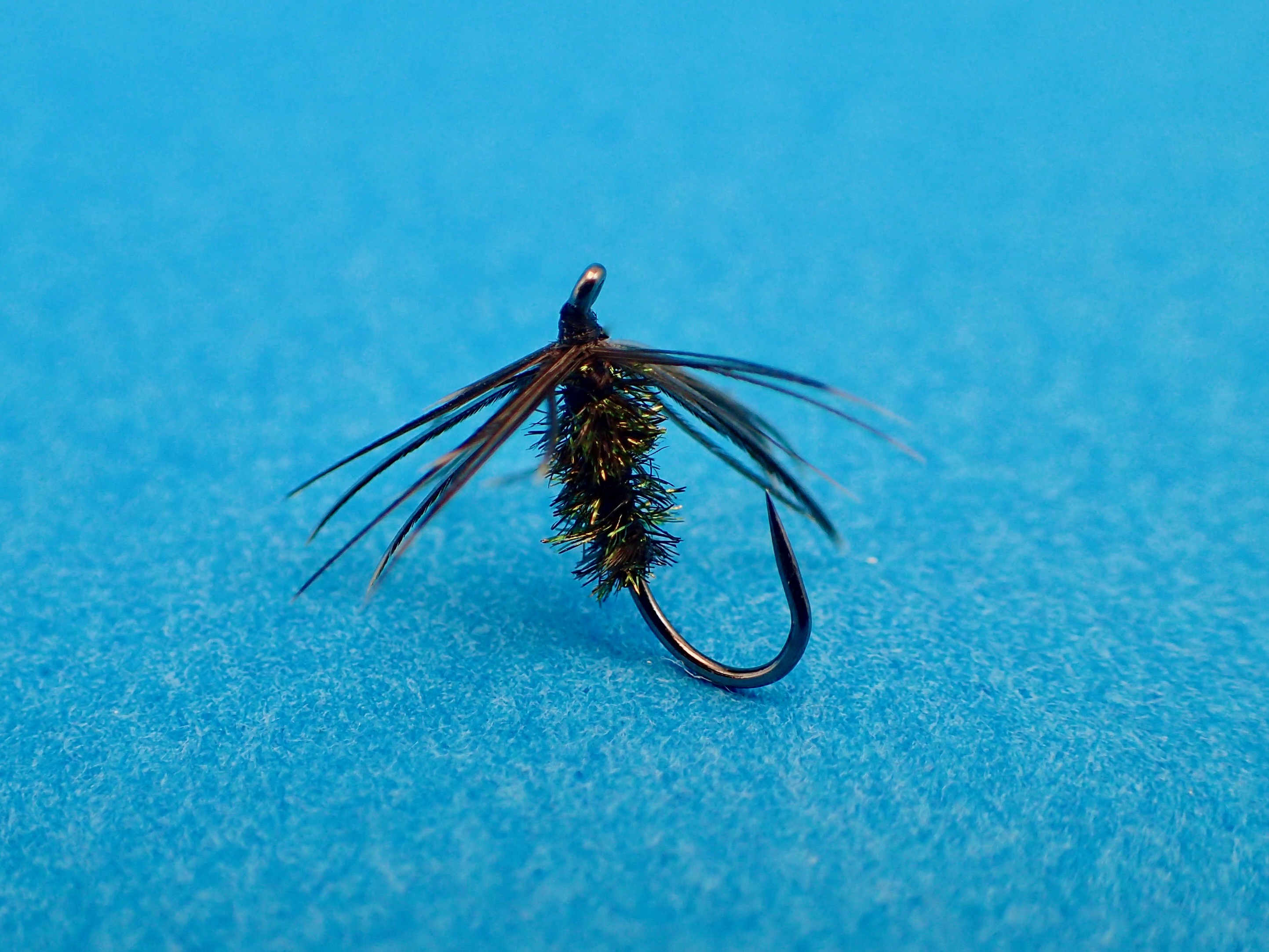
Pro tip: when there are so many orange/yellow/red leaves in the water, try going dark or white with streamers — and make sure one of your nymph droppers is small and dark (it’s tiny BWO season). A small Starling and Herl soft hackle would be a fine choice.
Yesterday was supposed to be a shooting day for a film and some personal projects, but the wind was most uncooperative, so we bailed. Already on the river and two hours to kill…what’s an angler to do? If you said, “fish,” you are correct! I decided that absent any consistent rises, and with the gusty wind, indicator nymphing would be my best bet for hooking up. I fished three marks and found players in two of them. I was asleep at the switch for one of the hits, and dropped the fish as I fumbled and bumbled the late hook set. But I did connect with evidence that even in harsh, trout-stressy warm water, nature finds a way. Believe it or not, this was my first outing on the Farmington since June.
This YOY wild brown fought like a tiger and almost refused to sit still for a portrait. Taken on a size 18 soft-hackled pheasant tail. It’s always gratifying to discover that even seemingly fragile creatures have the genetic programming to make it through the most challenging conditions. See you in a few years, OK?
On Tuesday the DEEP collected broodstock for the next generation of Survivor Strain brown trout. The MDC drew down the reservoir to about 70cfs and the collection crews had at it. Normally, I like to give warning of the event (you can still fish, but you need to stay clear of the collection crews) but I missed that boat. However, I’m happy to report that well over 100 trout were collected — and after the challenging summer conditions these fish made it through, you can rest assured that the survival aspect of their genetic material is exceptional.
With cooler days and nights upon us, re-stocking the river will begin soon. Then we can pretend that this summer never happened.
Task completed. Back up she goes! It may take a day or so for the fish to regain their bearings.
I wish I had all good news for you, but once again we will be experiencing challenging conditions on the West Branch. Let’s start with flows. The Labor Day weekend party is over as they’ve jacked up the dam release to 1,100cfs:
And we’re back to water temperature rearing its ugly head. Look how the release temp spiked with the increased flow:
In a word, ugh. There’s nothing to be done about the flow increase, as the MDC needs to maintain a certain safe reservoir level in case of hurricanes. But the news isn’t all bad. Torrey Collins says the Still River is actually a cooling influence, and the long range forecast calls for overnight lows mostly in the upper 50s, so that’s going to help. Who knows when the DEEP will stock, or if they’ll even do a Survivor Strain broodstock gathering. I’ll do my best to keep you posted. In the meantime, I’m heading for the salt.
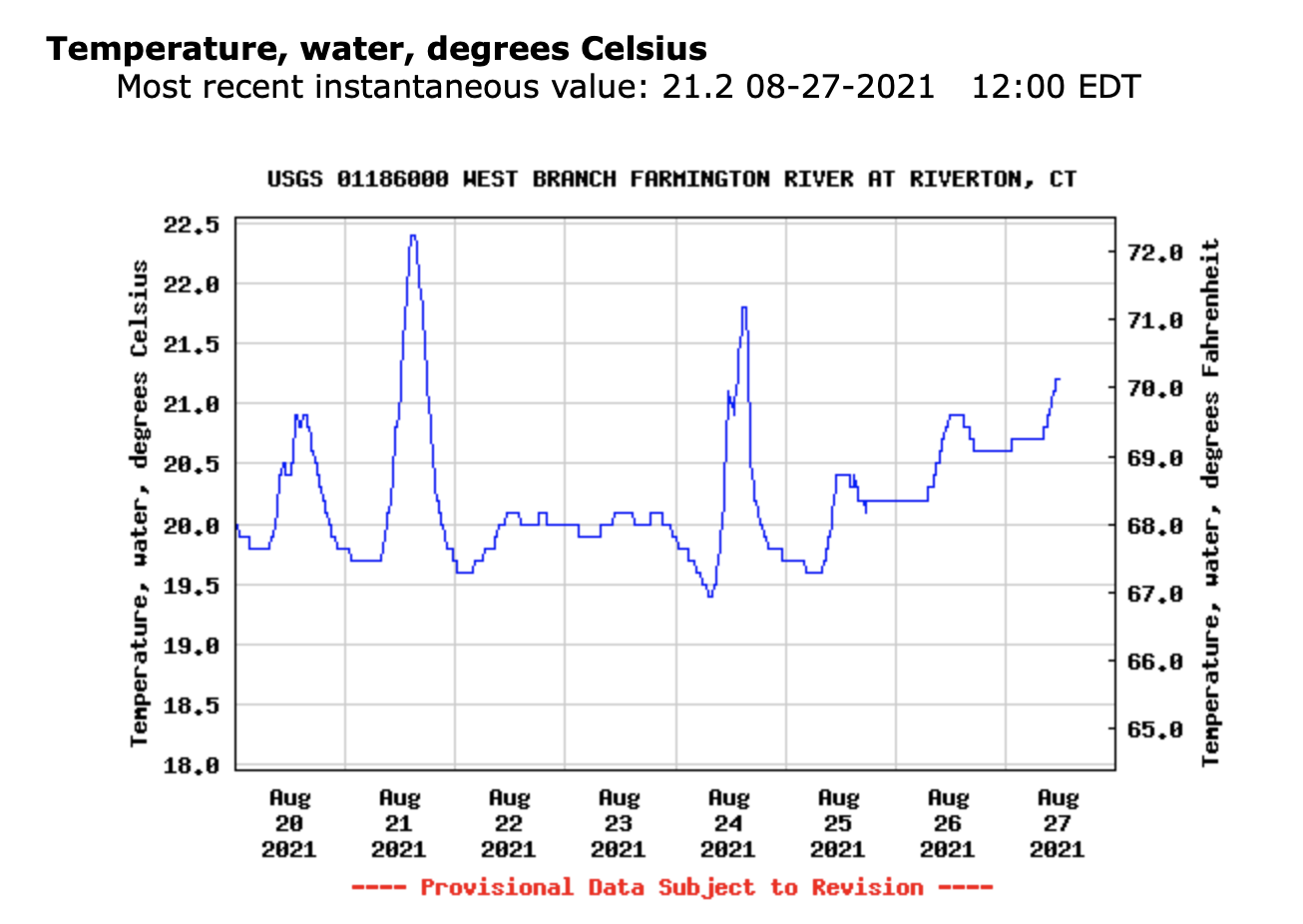
What a disaster summer this has been for major river fishing in Connecticut. Pity the poor Farmington: too much rain, too much flow, too much warm water. Its current story is best told by these USGS Waterdata graphs.
They’ve jacked up the flow again. At this rate, we may not have any stratification of reservoir water for weeks…or perhaps months.Water coming out of the dam is already at a trout-unfriendly — and that’s sugarcoating it — temperature. Who knows what heated horrors exist downstream below New Hartford? Nature will find a way for some trout. Many will not be so lucky.
I regret being the messenger of such dire tidings, but it is what it is and there’s nothing we can do about it. Suffice to say, please don’t fish for trout. And hope those tropical systems out there right now stay away from Connecticut.
In case you’re wondering why the water is so warm, this article by yours truly may help.
I’ve been getting a lot of questions about Farmington River water temps. The basic outline is, “I thought the Farmington is a tailwater. Why is the river so warm?” The answer is pretty simple.
In case you don’t know, a tailwater is a river with a dam release. The flow of the Farmington River West Branch is controlled by water that comes out of gates from the base of a reservoir dam (Colebrook Reservoir and Hogback Dam). If you’ve ever gone swimming in a pond or lake, you know that the water is warmer near the surface and colder near the bottom. This is called thermal stratification. In a larger reservoir, you have three different thermal layers: the epilimnion (the warmer upper layer; the metalimnion (or thermocline, the middle layer); and the hypolimnion, the coldest bottom layer. But I said this was simple, and there I go throwing all kinds of hifalutin hydro-science terms at you.
Ideally, there’s a happy medium of bottom release flows on a tailwater: cold water is never released in amounts that cannot be quickly replenished. But there are two situations that screw everything up.
The first is severe drought. Water that flows into the Colebrook Reservoir is reduced to a warm trickle. The volume of the reservoir shrinks from evaporation. The temperature of the water rises, especially if it’s hot, which decreases thermal stratification. As a result, what comes out of the bottom of the dam is warmer than ideal. (By agreement with the CT DEEP, the MDC must maintain a minimum release of 50cfs.) Because the flow is so low, water downstream warms quickly, trout get stressed, and it’s a bad scene all around. (This was the case in 2016. It was so bad that the DEEP took the unprecedented step of declaring thermal refuges on the Farmington.)
But that’s not what happened this year. This year, we had too much water. All that rainfall in July meant that the MDC needed to bleed water, and lots of it — so much, in fact, that it wiped out any meaningful thermal stratification in the reservoir. They’re still running such a high volume of water that there’s no chance for the stratification to re-establish — at least not in the heat of August. So that’s why at noon today the water was coming out of the dam at a very trout-unfriendly 69 degrees.
Eventually, it will get better. But right now, the best thing you can do for Farmington River trout is play the waiting game.
Taken this winter when the water was very, very, cold. Hang in there, buddy!
In case you didn’t hear, the historic New Hartford House building was gutted by fire earlier this week. The three-alarm blaze happened Monday night/Tuesday morning. New Hartford House was the large, stately building with the clock tower in the center of town. Please send your thoughts and prayers to those who lost their homes and businesses, and also to the first responders who were injured fighting the blaze. You can read more about the fire in this story from the Courant.
Meanwhile, you shouldn’t be fishing the Farmington right now. Here’s the Riverton gauge at noon — and the heat wave has only just begun.
We are certainly going to lose some trout (nature will find a way for others). If you must go fishing, pond bluegills are a blast on a small stream rod and an Elk Hair caddis. Bass, striped or largemouth or smallmouth, are other viable options right now. But please, give these stressed fish a break.
Good Monday afternoon! A bit of a late start for me today as I was out chasing fish last night and didn’t get to bed until the wee hours. August is traditionally viewed as a prime vay-cay month, but here at currentseams we are busy-busy-busy. First up: I have three new articles in the pipeline for Field & Stream Online. In no particular order (these are just working titles): Tactics and Strategies for Fishing High and Low Water; Seven Best Flies for Smallmouth Bass; Small Stream Fly Fishing 101. As I have not yet begun to write, I have no pub date other than ASAP. I’ll get that information out to you when I know it. In the meantime, it’s not all chained-to-my-writer’s-desk energy. I still have fishing — lots of fishing — to do.
To the Farmington River. August is typically an active guide month for me, but I’ve had to make the difficult decision to suspend lessons on the Farmington until further notice. The issue is one of elevated water temperatures, which begets limited time and access. This graph of the water temp out of the gate at Hogback says it all:
A short week ago, you had just a shade over 64 degrees out of the gate, with a spike of a still trout-friendly 66. Today we’re already over 68 degrees (keep in mind that this is Riverton) and it’s not even a scorcher kind of day. With a heat wave projected for this week, it doesn’t take a degree in environmental science to recon that the trout will be experiencing stressful conditions. So please: give the trout a break. Protect the resource. It sucks, but it’s the right thing to do. And, as with gravity, what goes up must come down.
In a normal summer, August water temps are not an issue on a tailwater like the Farmington. When you get into an extended heat/drought matrix, it’s easy to see how water temperatures can get dangerously high for trout. Less obvious is our current situation. As a result of blowing so much water out of the reservoir — July was the third wettest month on record — the lake is now less temperature stratified. What’s coming out of the bottom isn’t in the upper 50s, but rather in the mid-60s. The issue becomes one of day and night-time air temperatures, and sunshine. Lower and lesser is better. The one current saving grace is that there is still a lot of water moving through the system, and more water means it’s harder to heat up. (Yesterday was 540cfs in the Permanent TMA, and 610cfs in Unionville.)
So, please try to use common sense. Check water temps before fishing, and pick and choose your locations (closer to the dam is better) and times (morning is best, cloudy days, and after the sun goes behind the hills also works) — not to mention your tippet and landing strategies. With that in mind, I was curious about both water temperatures and trout vitality. I fished a mark below the Permanent TMA for an hour yesterday, late afternoon. The water temp was below 70. It was a fast-moving, riffly/pocket water section that was sure to be highly oxygenated. I was fishing a team of three wets with Maxima Ultragreen 4#, which is strong enough to quickly land any Farmington River trout. Finally, I resolved to strip in anything I hooked fast. I stuck four fish and landed two. The two I landed were brought to net in under 15 seconds. They both looked and behaved like very healthy fish, with no signs of stress.
This was a surprise. Given the conditions, I debated the merits of taking a photo, but I can tell you this with certainty: the char was landed in 10 seconds, kept within the net in moving, oxygenated water, then removed for 3 seconds for the photo. All we can do is our best.
Happy Friday! I hope your summer is going along nicely. If you’re a river and stream angler here in southern New England, it’s been a tough July. But it looks like we’re going to get a fairly long semi-dry spell, and that should allow the rivers to come down. I’m curious to see what, if any, negative impacts the flooding created. Rest assured, there will be impacts. As for the Farmington River, they’re still blowing water out of Hogback (over 2K cfs), but I think there’s a good chance they may lower the flow for the weekend. Check the USGS Water Data site for Connecticut for real-time information. In other happenings:
I’m working on a short piece about using a floating line in the surf. It takes the form of a case study, using a specific location/conditions, and it will be a currentseams exclusive.
Yesterday, I recorded a podcast for Fish Untamed. The subject is “Trout Fishing For Striped Bass,” and I’ll let you know when it goes live. (Give it two weeks.)
Drat this high water! I had all kinds of smallmouth fly experiments planned for July, and they’ve been blown to smithereens. So, we punt. I’m hoping flows drop enough in the next week so I can proceed. In the meantime, to the tying bench…
My article for Surfcaster’s Journal, “Two Nights in October,” should be live next week. This is an online subscription-only zine, so if you want to read it you’ll have get a subscription. It’s $20/year, which isn’t much for quality writing and storytelling, is it?
Stay safe, be well, and thank you as always for reading.
What’s the big deal, if any, with UV materials? Let’s find out. UV or not, this is going to get stomped.




 currentseams.com