Tuesday greetings from the Currentseams world headquarters. The show season is upon us, and I have a partial schedule for the Edison, NJ Fly Fishing Show, which happens January 23-25. If you’ve never been, this is the biggest fly fishing show in the world: vendors, tiers, outfitters, guides, world class fly fishers, and instruction. Not to be missed!
Friday, January 23: Seminar, Catch Room, 10:15am: Beyond Cast and Strip — Presentation Flies for Striped Bass
Saturday, January 24: Seminar, Strike Room, 9:45am : Modern Wet Fly Strategies; and Class, 2pm-4:30pm: Beyond Cast and Strip — Presentation Flies for Striped Bass
Sunday, January 25: Class, 8:30am-11am: Tying and Fishing Wet Flies
Classes are a terrific way to get more personalized instruction without the cost of a guide trip. It’s the next best thing to being on the water!
I don’t have my Destination Theater schedule yet, but when it comes in, I’ll certainly share it here. All seminars and Destination Theater talks are included in your admission ticket. You must pre-register for classes, and you can do that here.
Yup, it’s that time of year. Mark your calendars! New England’s edition of the Fly Fishing Show takes place Friday, January 16 through Sunday, January 18 at the Royal Plaza Hotel & Trade Center in Marlborough, MA. I’ll be there along with some of the biggest names in fly fishing today: Tim Flagler, Mac Brown, Jeff Currier, Phil Rowley, Alan Caolo, Landon Mayer, Joe Cordeiro — just to name a few. I’m still waiting on my Destination Theater schedule — there will be a Farmington River book talk for sure — but here’s what I know so far:
Friday, January 16, 2:30pm: Featured Tier, “Subsurface Caddis Lifestages” and 4:30pm Seminar, “Wet Flies 101.”
Saturday, January 17, 10:00am: Featured Tier, “North Country Spiders” and 11:30am Seminar “Finding Small Stream Nirvana” and 2pm Class, “Beyond Cast and Strip.”
I’m not sure what I’m saying, but clearly there was an important point to be made. Currentseamsers usually make a strong showing, and I’m expecting no less for this show.
Destination Theater, Featured Tier, and Seminars are all included with your admission. There’s a fee for classes, and you must pre-register. (Hint: Classes are a tremendous opportunity to learn, ask questions, and dramatically improve your game.)
I’ll be talking more about the Marlborough Show in upcoming posts, and providing more details on each of my events. Save the dates, plan on coming, and of course please say hello. See you there!
I’m a lucky guy to have so many people who look forward to reading what I have to say. You’ve been so patient with me as I’ve navigated the twists and turns of my first book project, and for that I am truly grateful. So many of you have come to see me tie, teach, and talk at shows or club meetings — so I’m sending more gratitude your way. And it’s a thrill to be spotted out on the river when I’m fishing (as happened this week in Pulaski multiple times — yes, the book is coming!) by people who follow currentseams. Always, always, please come say hello.
Wishing you a happy, healthy Thanksgiving. Dig in and enjoy the food. Savor your beverage of choice. Smoke ’em if you’ve got ’em. And I’ll see you next week with my Pulaski steelhead report.
I’m thankful for every steelhead I release. May we meet again!
Much to talk about today. I’m currently recovering from last weekend’s International Fly Tying Symposium. That is, I’ve unpacked everything, gotten back to my regular sleep and eating (and coffee!) schedule, and here I am, clacking away at my keyboard on currentseams.com.
While this is the largest fly tying show in the world, there’s a sense of intimacy about IFTS that resonates with me. (If Goldilocks tied flies, she’d be all over this show.) I behaved myself wallet-wise, coming away only with a pack of size 14 Ahrex North Country Spider hooks (LE810). My Saturday seminar on Tying and Fishing Wet Flies was very well-attended, and I want to thank everyone for showing up and for asking so many thoughtful questions. I couldn’t have asked for a better tying bench mate than Peter Simonson, who specializes in classic Carrie Stevens-style streamers. I spent the rest of the day tying wet flies and soft hackles and socializing and answering questions about the Farmington River book.
The view from my bench Saturday morning. What a treat to reconnect with so many old and newer friends, and to put faces to names of currentseams subscribers.
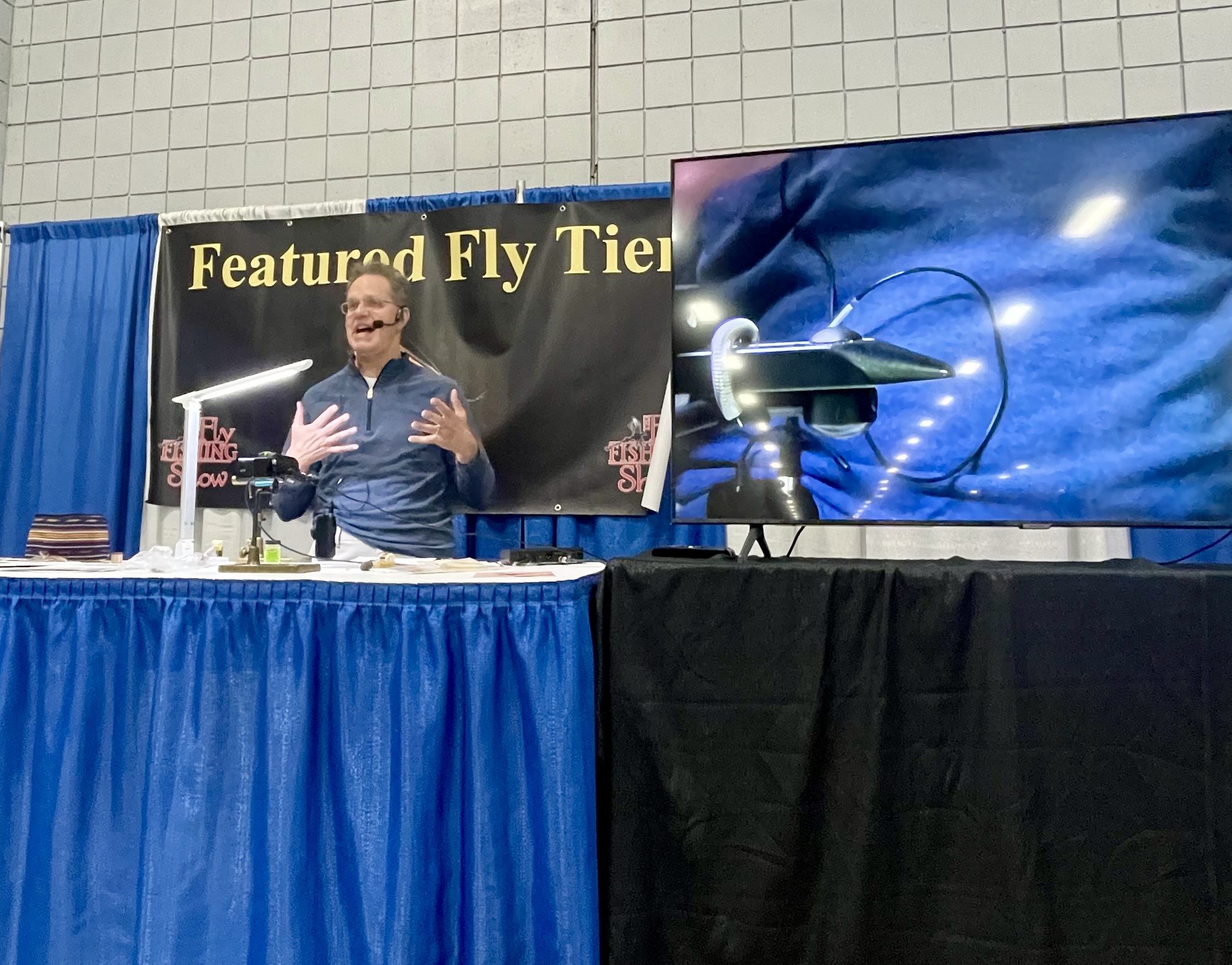
After a delicious banquet Saturday evening — complete with a wonderful fly tying swag bag from show sponsor J.Stockard — I was featured fly tier Sunday morning. The subject was Farmington River Favorites, and we managed to get through each of the four food groups (nymph, wet, dry, streamer). Again, many thanks to everyone who attended. I truly appreciate your support.
But the highlight of the show for me was formally becoming a member of the Regal Pro Staff. I’ve been tying on a custom Regal Revolution for years, so this was particularly gratifying. Those of you who know me know that I don’t endorse anything on these pages that I don’t use and love, and I’ll be talking more about my Regal vise in future posts.
And now, me too! There are so many incredibly talented tiers in this group, and I’m honored to be a part of the team.
Finally, I’m back on the book for a bit: page proofs are in! These are basically an e-version of the layout of the book, complete with photos and other visual reference. I go through it, make minor corrections as needed, send it back to the publisher, and the whole shebang goes to press early next year. Exciting times! People stopping by the table showed a lot of interest in the book, and even if you don’t fish the Farmington a lot, I’m comfortable telling you that much of it — fly patterns, how to, hatches — is applicable to southern New England trout streams.
If you want to be a rock star, you can’t just hang out with Aerosmith for the weekend. But if you tie flies, and want to get better, here’s your chance to do the equivalent with some of the best tiers in the world. You know a lot of the names: Tim Cammisa; Barry Ord Clarke; Tim Flagler; Cheech Pierce; Jeff Rowley; Son Tao. Those are just six of the dozens of work-class tiers who will be there. There are tying demos, seminars, and tying classes. But in its best, purest form, IFTS lets you walk the show floor and meet and greet and watch and learn and talk with all of these people.
If you want to become a better tier — or just learn a few pro tips — go hang out with my buddies Lou DiGena and Bart Lombardo. They’re two of the nicest, most skilled tyers in the world, and they’ll both be at the IFTS this year.
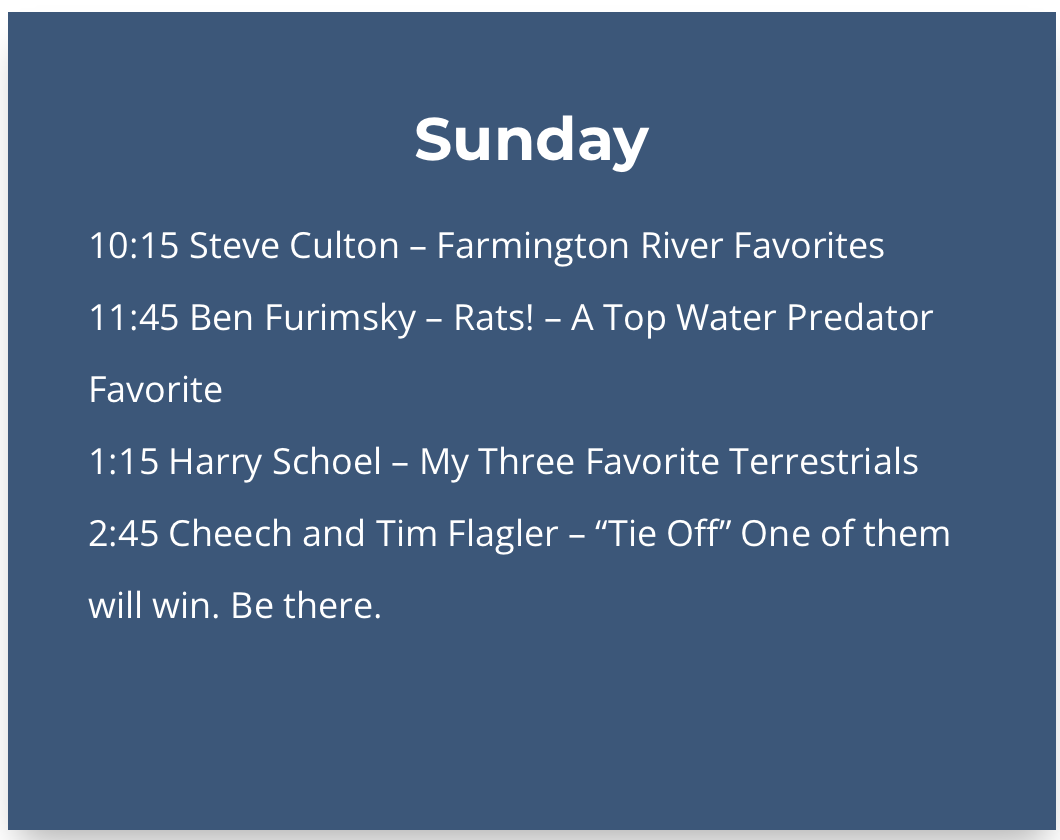
I’ll be on the show floor tying — please come say hello — and I’m honored to be doing a Seminar and making a Featured Tier appearance. The seminar is Saturday, Nov 15 at 1:45pm — Tying and Fishing Wet Flies. It’s free with your show admission. Sunday Nov 16 at 10:15am, I’m Featured Tier presenting Farmington River Favorites. That’s also part of your admission. I don’t mind telling you that I’ll be giving away some flies to a few random attendees over the weekend, so there’s some more incentive for you to attend.
If you’re not fishing LaFontaine’s Diving Caddis, you’re missing the chance to rack up impressive numbers. I’ll show you how to tie this and other high-confidence patterns at this year’s IFTS!
And did I mention the vendors? Every year I come away from this show with some hard-to-find material (s). Bring a shopping list! Naturally, if you’re there, please come say hello. It’s always gratifying to place faces to names.
The first thing I’d like you to do after reading this opening paragraph is head over the ASGA website and sign their official letter calling for major reductions to the menhaden harvest. It will take you less than five minutes, and it’s an excellent use of your time. Long story short: Atlantic menhaden are a critical bait and ecosystem fish; they’ve been grossly over harvested; that needs to stop now. Please do this, even if you don’t fish for striped bass. We need all the voices we can get.
Galley copy for the Fly Fishing Guide to the Farmington River has been reviewed by yours truly and sent back to the editors. This was simply my review and comments on their edits. I was pleased to discover that the edits weren’t substantial, and book flowed from one subject to another like…a river? There. I’ve made my unfunny joke of the day. Maps were also reviewed, and I really like the artwork. If you don’t know the river, you’ll find them highly useful. Next steps: the whole shebang gets put into page layout, then reviewed. That should happen in November. We’re getting closer!
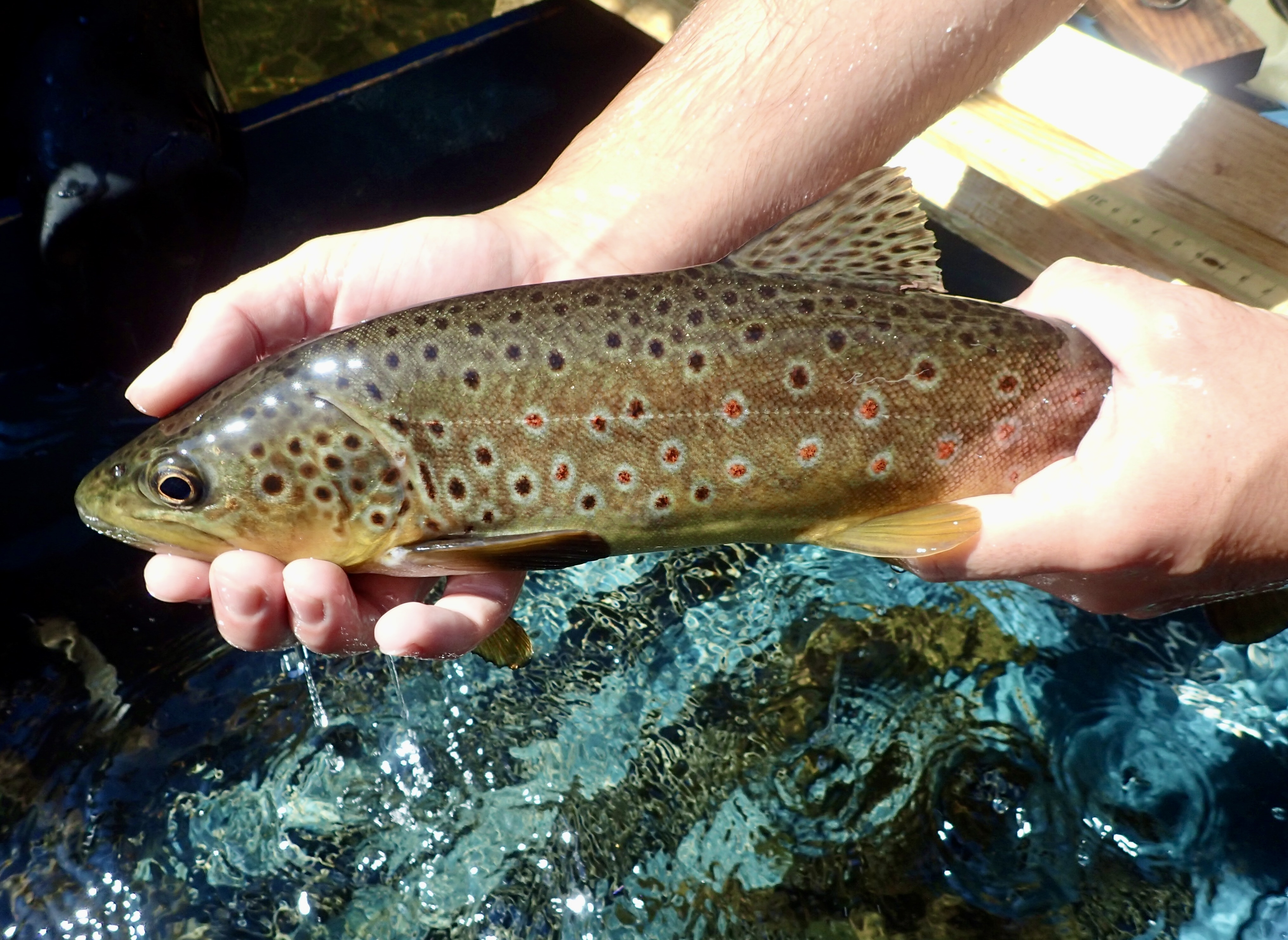
A successful spawn means more of these. This fish was sampled by DEEP last September during broodstock collection for the Survivor Strain program. If you see a redd and canoodling trout, be like The Beatles and let it be.
Speaking of the Farmington river, the spawn has begun. If you’re fishing, please be on the lookout for redds! They are generally lighter, oval-shaped patches surrounded by dark substrate. Keep a safe distance. And of course, never target spawning fish. That’s just bad form.
A reminder that the International Fly Tying Symposium is November 15-16, now just over two weeks away. I’m doing a wet fly seminar on Saturday and a Farmington River tying demo on Sunday. More on those coming soon.
Right now is a good time to not go fishing for wild trout on small streams.
As you already know, most of the state is abnormally dry, and the northwest hills are officially in drought. Don’t let the recent rainfall kid you — our small streams are running at a CFS fraction of what they should be.
While nature finds a way, the stresses of summer heat and trickle flows no doubt took a toll. That alone would justify giving small streams a break. But right now is pre-spawn and spawn time. I ventured out yesterday and was stunned by the severity of the low water. The spawn is a stressful time for fish, exacerbated by the dire conditions of late summer. With so much of the stream bed exposed, wild fish will be challenged to find spawning gravel. I didn’t see any redds yesterday, and it may be that the fish are so stressed, and have so few gravel options, that on many small streams we won’t see a successful spawn this fall.
Learn how to identify a redd: typically oval in shape, small gravel, lighter in color than surrounding bottom. There may or may not be fish nearby. It goes without saying, never target fish on a redd!
You don’t have to be a fisheries biologist to reckon that if that is in fact the case, it does not bode well for future wild fish populations.
So here’s how you can help: for the time being, don’t fish small streams. Give the trout a break. Once we get back to normal flows, enjoy — but please be on the lookout for redds and spawning gravel (dime and pea-sized substrate). Most of all, stay out of the stream bed — no wading! — until late March. It’s good for fish. And good for everyone who loves fishing small streams.
Is this exciting, or what?!? At least, I’m excited. I hope it meets with your approval, if not favor. I’m continuing to plug away at the copy edit review, so this will likely be my only currentseams post this week. I hope some of you are getting out on the water. And we need rain — let’s see those rain dances!
I did two lessons last week on the Farmington. On Tuesday, I took Joe on a wet fly excursion. We stuck to the lower river; at 140cfs, it had the most water, and the weather was cool enough that the water temp never got higher than 66 (3pm). The fishing was predictably slow; we found success by moving around (we fished three different marks) and targeting the deepest, fastest-moving water we could get into. Joe was a strong wader, and sometimes that’s the difference between fishing and catching. Trout love to hang out in places that are difficult for land animals like humans to navigate. Joe stuck four and we put three in the hoop. In difficult low-water conditions, that was pretty darned good.
Joe having at it. As you can see, the clarity of the water was excellent, and when the flows are low, that usually works in favor of the fish. But Joe kept at it, was enthusiastic, and figured out where he needed to put his flies to catch fish. Great job, Joe!
Friday was a different story. We had rain Thursday night, which had me all fired up because it would mean higher flows and a little color in the water. While those conditions manifested, the fishing stunk out loud, which depressed me no end. I guided Dan and Sean, and we spent the bulk of our time nymphing. We stuck to water just below the PTMA; our reward was not another angler in sight. Although we bounced around — we fished four different marks — we could only manage two touches. Bah-phooey on those trout. The good news was that both Dan and Sean showed tremendous improvement over the course of four hours. When you actually see clients getting it, and making better casts, presentations, and mends, it’s very gratifying. Both deserved better than what the river gave them, but they’ll hit right in the future and reap the rewards of their lesson.
~
I’m back on the book, so this will be my only currentseams post this week. The publisher has sent me the galley copy, which is all of their edits in a document, paged format. My job is to read and review and comment. That’s over 300 pages of reading, so I need to hop to it. I’ve only made it through 20 pages, but it’s a happy feeling when you still like what you’ve written so many months ago, and the edits are generally light. AFAIK, The Fly Fishing Guide to the Farmington River is still on track for a June 1 2026 release. Natch’ , I’ll keep you updated with any news as it comes in.
The International Fly Tying Symposium is the world’s largest show dedicated to fly tying. And what a show it is! Vendors with all kinds of good stuff (bring a shopping list — I always come away with some nifty items); some of the best-known fly tyers in the world (like Tim Cammissa, Tim Flagler, Barry Clarke, Cheech Pierce, and Son Tao, just to name a few) all ready to meet and greet and answer your questions; live tying demos (free with admission, and I’m doing one of them); seminars (ditto free and me); and tying classes led by experts (you must pre-register here).
My wet fly seminar on Saturday the 15th is unique to the Symposium, so there’s your reason to come. I’ll talk about materials, tying, wet fly styles, and when, where , and how to fish them. It’s the next best thing to a private lesson.My Sunday 11/16 demo will do two things: show you how to tie four proven, high confidence patterns for this highly technical river, and get you home in time for Sunday afternoon football.
I’ve said it before and I’ll say it again: events like this are a tremendous opportunity learn new techniques, improve your skills, and catch more fish. Please stop by my tying table, or come see me talk, and be sure to say hello.






 currentseams.com