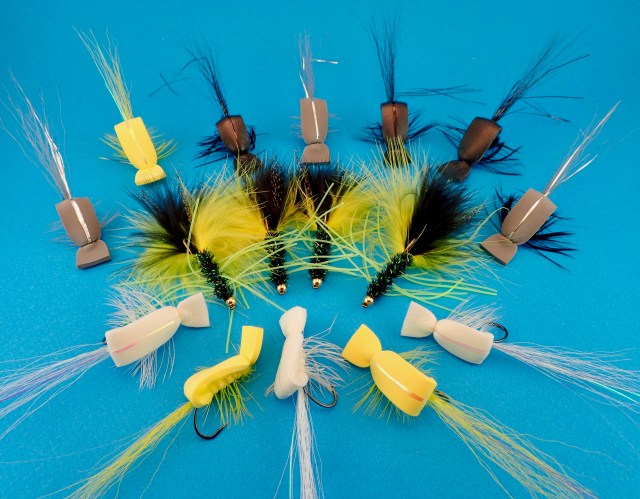
Get fired up for steelhead: “The Steel Deal — How to catch Great Lakes Steelhead in the Fall”

“The Steel Deal — How to catch Great Lakes Steelhead in the Fall” first appeared in the Oct/Nov 2018 issue of Field & Stream. It’s a great introductory primer for Great Lakes steelhead fly fishing anglers, and even veteran chrome hounds will find some valuable nuggets. Written, of course, by yours truly, with insights from legendary Great Lakes steelhead guide Matt Supinski. In case you missed it, the link to the article is up top. And here’s a bonus link to the 60-Second Redhead, one of my favorite steelhead patterns.

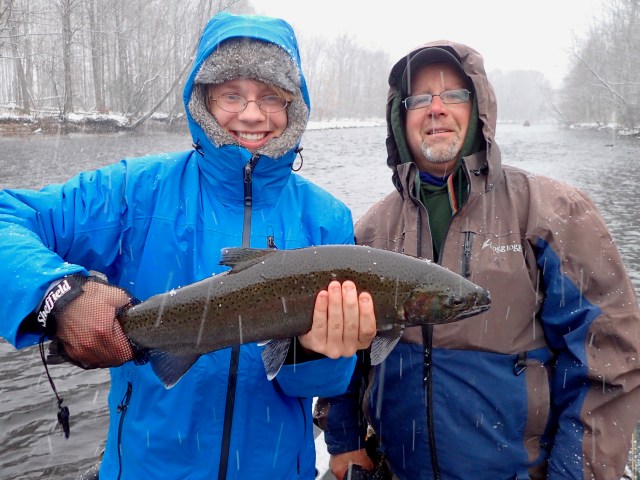
Subfreezing temperatures? Stinging sleet? Frozen fingers? Suck it up, baby, and go steelheading! Here’s Number Two Son Cameron and my favorite Salmon River guide Jim Kirtland enjoying a little “Salmon River sunshine.” Is it all worth it? Just look at those smiles.
OLYMPUS DIGITAL CAMERA

The Pitfalls of Buying Fur and Feather Online

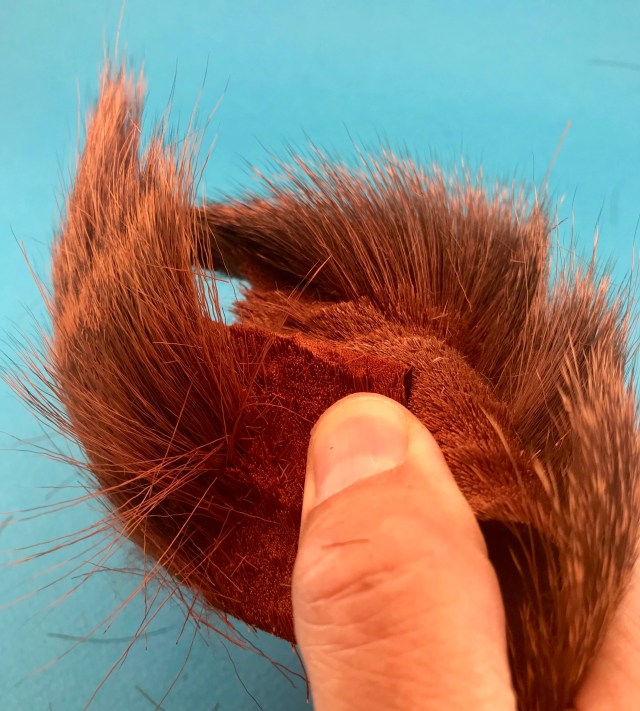
You’d think I would have learned by now. But no. I still make stupid mistakes when it comes to buying fly tying materials online. Latest failure: ordering a Hareline Premo Deer Hair strip sight unseen.

Wrong. The hair is short, stiff, and coarse, totally unsuited for my needs. If I’d seen this item in a shop I would have quickly rejected it. Oh sure, I’ll find a use for it some day, but for now it only serves as a reminder to never buy large fur patches sight unseen unless you have a reliable description and a trusted source.

This is not to say that Hareline products are lousy: I have dozens and dozens of great Hareline items in my bins, and the replacement deer hair patch I found — which is spectacular — is from Hareline.

Two deer hair patches from Hareline. The one on the left is gorgeous — beautiful, long hair fibers. The one on the right is garbage. When it comes to buying fur, saddles, feathers, and skins online, sight unseen, caveat emptor.

Deerhair

Steve Culton Fall 2019/Winter 2020 Speaking Engagements

Fall means BTS — Back To School, and Back To Speaking. I’ve got four gigs lined up so far, one more potentially lined up for 2020, and of course the show circuit — details on that front when I get them. In the meantime, come one, come all, come say hello:

Tuesday, October 15, 7:00pm, “West Branch Farmington River,” Thames Valley TU, North Franklin Fire House, 5 Tyler Drive, North Franklin, CT. Here’s the TVTU website.

Wednesday, October 16, Capital District Fly Fishers, 140 VFW Road, Albany, NY. Presentation Subject TBD. The link to their Facebook page is here.

Thursday, October 17, “The Little Things 3.0,” Farmington Valley TU, Whinstone Tavern, Stanley Golf Course, New Britain, CT. You can find their website here.

Tuesday, November 19, Nutmeg TU, 7pm, Port 5, Bridgeport, CT. Presentation subject TBD. You can find their Facebook page here.

I’m working on “The Little Things 3.0” quite possibly as you read this.

FishMousePad

~

More events/appearances: the South Shore Fly Casters in Hull, MA, are looking to bring me in sometime in the winter.

It looks like I will once again be doing the Fly Fishing Show in 2020, in Marlborough, MA and Edison, NJ. We’ve discussed the possibility of me doing a class as well as talks. Stay tuned.

In the meantime, I really need to go fishing. You know?


Save Our Stripers: Public Hearings and eMail Comments on ASMFC Draft Addendum VI

Now is your chance to make your voice heard on the future of striped bass. No, really! Public comments have been acknowledged by ASMFC commissioners as not only being read, but also helping to influence new policies that will shape the future of our striped bass fishery. Here’s what you need to know:

You can find the public hearing schedule for individual states, and the email/snail mail address to send comments to here. It is critical that you, at the minimum, send an email comment. If you can attend a public hearing, all the better. If you email, you must use the subject line Striped Bass Draft Addendum VI.

What to say? You, of course, will have your own opinion. It should be noted that in this situation, there exists the awesome power of similar numbers. The more of us that push for a similar opinion — and outcome — the better. You know I am a champion of the American Saltwater Guides Association (ASGA). They have carefully considered the options, and their position on Draft Addendum VI can be found here.

If you haven’t done so already, sign up for ASGA email updates, and, even better, make a contribution. They’re truly doing good work.

I didn’t get anything remotely close to her size this year. Together, we can change that.

OLYMPUS DIGITAL CAMERA


Big Tailwater Brown on the Countermeasure

The Countermeasure strikes again, this time on a fat tailwater truttasaurus. Look at the fins on that beast of a buck! Many thanks to currentseams follower Ken for sharing his success. You can read more about the Countermeasure pattern here.

CountermeasureBrown

Smallmouth, you’ve been warned

Gartside Gurglers and TeQueelys, coming soon to a stream near you.

A little light reading –or photo perusing — on Labor Day weekend. A smallmouth bass bug fly tying binge is good for the soul.

OLYMPUS DIGITAL CAMERA

Tying a batch ‘o Gartside Gurglers

In the middle of Gurgler tying land, I noticed that I tend to render my bugs far sparser than most of the ones I see in bins. No surprise there — sparse is how I usually roll — but it’s also because I learned to tie them from Jack Gartside’s website. You can see how the pattern’s creator tied them here.

These ones below are just like the ones I use for smallmouth bass. They’re the same as Jack’s original recipe, save for the hook. Instead of a long shank, I’m using a Gamakatsu B10S stinger hook which is light, strong, and sticky sharp out of the box.

Gartside Gurglers lovingly rendered in white. I can’t say that color is critical, but I will choose different colors based on light level and water clarity, and sometimes for my own visual reference. It’s a high confidence pattern, and is often on everyone’s Top Ten list when it comes to topwater smallmouth flies.

OLYMPUS DIGITAL CAMERA

Hook: Gamakatsu B10S size 2
Thread: White UNI Monocord 3/0
Tail: Very sparse bucktail or marabou plumes overlaid with 5-6 strands of Flashabou or Krystal Flash
Body: Closed-cell foam with five evenly spaced segments. Foam should be 1/2″-5/8″ wide (this is 9/16″) and at least 1/8″ thick (this is 3mm)
Rib: Solid color or grizzly saddle palmered between segments
Carapace: Same foam as body pulled over and secured just behind the hook eye. Trim foam leaving an excess protruding about 1/2″ beyond eye.


Stand by for the ASGA’s position on ASFMC Draft Addendum VI

The ASGA (American Saltwater Guides Association — the good guys who are making an impact when it comes to striped bass conservation — and if you haven’t yet, visit their website/make a donation here) will have an official position on ASMFC Draft Addendum VI this week.

What’s important about this is that we — as conservation-minded anglers who care deeply about the future of the striped bass — will benefit greatly from showing a unified front, in particular in letter or email form

As soon as I have that position, I’ll let you know. Of course, if you’re signed up for ASGA email updates, you should hear from them too. Carry on, enjoy the last full week of August, but get ready to make your voice heard!

More breeder-size stripers need to swim away to procreate another day.

OLYMPUS DIGITAL CAMERA


Farmington River Sampling/Survivor Strain Broodstock Collection This Week

As I write this, the Farmington is chugging along at a low 120cfs or so within the permanent TMA. Cooler-than-normal temperatures have been a blessing during these extended low flows.

The MDC will be cutting the flow to double digits on Tuesday August 27-Thursday August 29 so that DEEP crews can sample the Farmington River and collect broodstock for the Survivor Strain program. (Here’s another nifty article on the Survivor Strain program, complete with elastomer color codes.) They will be focusing their attention on some popular pools and runs within the permanent TMA. You can still fish the river — you are merely asked to yield to the crews as they work. Better still, volunteer to work on  the crew — there’s no better way to discovery where the lunkers live! You can contact the DEEP here.

She’s a big mamma jamma. Just as fine as she can be. Not a Survivor Strain (note intact adipose) but a fine example of the potential of the Farmington River.

DCIM100GOPROG0013068.


A little Leisenring, a little Culton, a little North Country Spider

Soft hackles and wingless wets ready to swim. Clockwise from upper left: Pale Watery Dun, Grey Watchet, Old Blue Dun (and a random Partridge and Rusty Brown), Squirrel and Ginger, Pale Watery Wingless AKA Magic Fly.

OLYMPUS DIGITAL CAMERA