I’m putting the finishing touches on a brand new presentation called Beyond Cast & Strip: Presentation Flies For Striped Bass, and you can be one of the first to see it at the International Fly Tying Symposium, Sunday, Nov 13 at 11am. It’s one of two seminars I’ll be doing — the other is Tying and Fishing Wet Flies, also brand new. You can see that one on Saturday, Nov. 12 at 10:30. Both seminars are included in the price of admission to the Symposium. Beyond Cast & Strip is all about tying flies that create the illusion of life, even when at rest — flatwings, bucktails, soft hackles — all proven patterns that I use every season. I’ll also be sharing some insights on how and where to fish presentation flies. I’m excited about this one, folks. See you there!
The International Fly Tying Symposium is happening this November 12-13 in Somerset, NJ. When I’m not doing my seminars, I’ll be at my tying table, or teaching a class, Tying Soft Hackles, Winged, and Wingless Wets.
I wanted to briefly make another point about using floating lines for stripers. If I could change minds on one aspect of using a floating line for stripers from the shore, it might be the notion that one must have weight (fast sink tips, etc.) incorporated into the system — and/or that you’ve somehow got to get the fly down into some imaginary strike zone. Certainly, there are times when stripers are grubbing. But bass are usually looking straight ahead or up. I rarely use sink tips or weighted flies with the floater. That 20-pounder from last month came on a totally floating line setup, and the take came where a wadeable reef drops off into substantially deeper (overhead) water. Not surprisingly, the bass found my fly near the surface.
An oldie but goody from Block Island. I’m standing in thigh-deep water, but I was casting into water that was probably over my head. The bass are usually looking up. Using a Rio Outbound 9-weight floating line with a 7 1/2 foot leader.
A shout out to the Squan-a-Tissit Chapter of TU (northern MA) for virtually hosting me last night. We Zoomed and boomed and I presented The West Branch Farmington River: Southern New England’s Blue-Ribbon Trout Stream. A reminder to all the long and longer-distance fly fishing clubs out there: Zoom is great way to get acquainted. If you”re in charge of booking speakers, here’s a link to my current presentation menu.
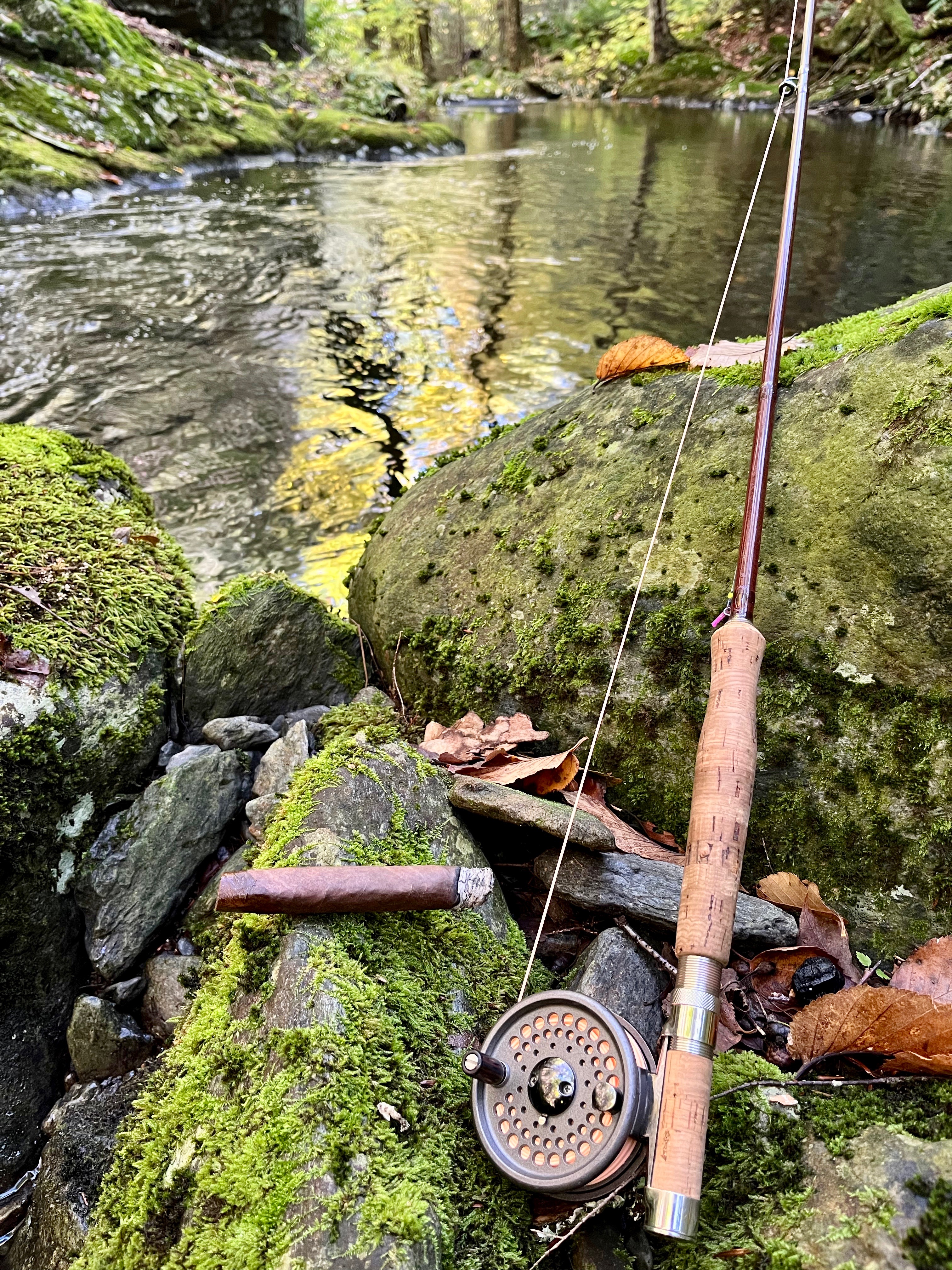
The question of the day is certainly a fun one. I don’t think I’ve ever had this one before last night. You may find it tongue-in-cheek, but I took it seriously, and there’s a little bonus wisdom in the answer. Q: What’s your favorite fishing cigar and do you find that certain brands help you catch more fish?A: Without getting into specific brands, I like fuller bodied cigars that have a lot of taste complexity. I’m an espresso/dark chocolate/spicy/earthy flavor profile kind of guy. Now, this next bit is true. If I’m having a tough go when I’m fishing wets or streamers (or striper fishing), sometimes I’ll tuck the rod under my arm, leave the fly dangling in the water, and get out a cigar. Several times a year, I hook up when I’m lighting the cigar, doing nothing else. That’s clue #1. Clue #2 is that sometimes when you’re dealing with a riser that won’t bite, rest the fish. Take out a cigar, cut and light it — or, if you don’t partake, take couple minutes to organize your box — and then make a cast and see what happens.
It takes a rare talent to enjoy a cigar while you’re doing battle with a steelhead. OK, not really, but I do enjoy the connection between partaking and hooking up. Sometimes it seems that the cigar is the wild card that gets the bite going. I can’t explain it, but it happens an awful lot.
I guided Jon yesterday from late morning to mid-afternoon. We had abundant sunshine, the air was crisp and chilly, and we had a bit of a breeze to contend with. But by far the most challenging part was the sheer volume of leaves in the water. It was never-ending. Still, the trout have to eat. The trick is to keep at it, and I like to use flies that offer some contrast to all the yellow and orange and red in the water. We fished four marks in the lower river, which was running about 225cfs, a very respectable height, and far better than the double-digit CFSs we’ve had to suffer though in the Permanent TMA.
So: Jon is a beginning fly angler. We spent the session drop-shot nymphing under an indicator. Jon did a great job sticking with it despite all the infernal flora. And what do you know? The indicator dipped, the hook was set, the battle won, and…Jon’s first Farmington River trout was wild brown! Way to go, Jon!
Sparse spotting, lovely halos, perfect rays on the fins, no edge damage to the fins, intact adipose — and a stubborn unwillingness to come to net — all hallmarks of a stream-born wild brown. It was especially gratifying to find this fish in an area of the river that got torched this summer. Nature finds a way (again). A tremendous first Farmington River trout for Jon.
Surfcasting Around The Block II — Forty Years of Striped Bass Surfcasting Stories, Articles and Legends from the Islands of Block and Aquidneck is on the shelves! Dennis Zambrotta’s much-anticipated follow-up to his out-of-print classic Surfcasting Around The Block is actually a group effort with multiple contributing authors — many of them Block Island surfcasting legends. Although the focus is on fishing the island with spinning gear, the astute fly caster will be able to glean a treasure trove of information on fishing the island.
Sitting in my favorite reading chair, looking for intel from Campo, McKenna, Abate, Winters, and that Zambrotta guy…
And yes, there are two chapters devoted to fly fishing Block Island authored by yours truly. The first part is a story about a particularly memorable Block Island All-Nighter. The second covers gearing up for fly fishing on Block Island. Where can you get Surfcasting Around The Block II (ISBN979-8-218-07120-2)? The Saltwater Edge. The Island Bound Bookstore. And The Surfcaster. Happy reading!
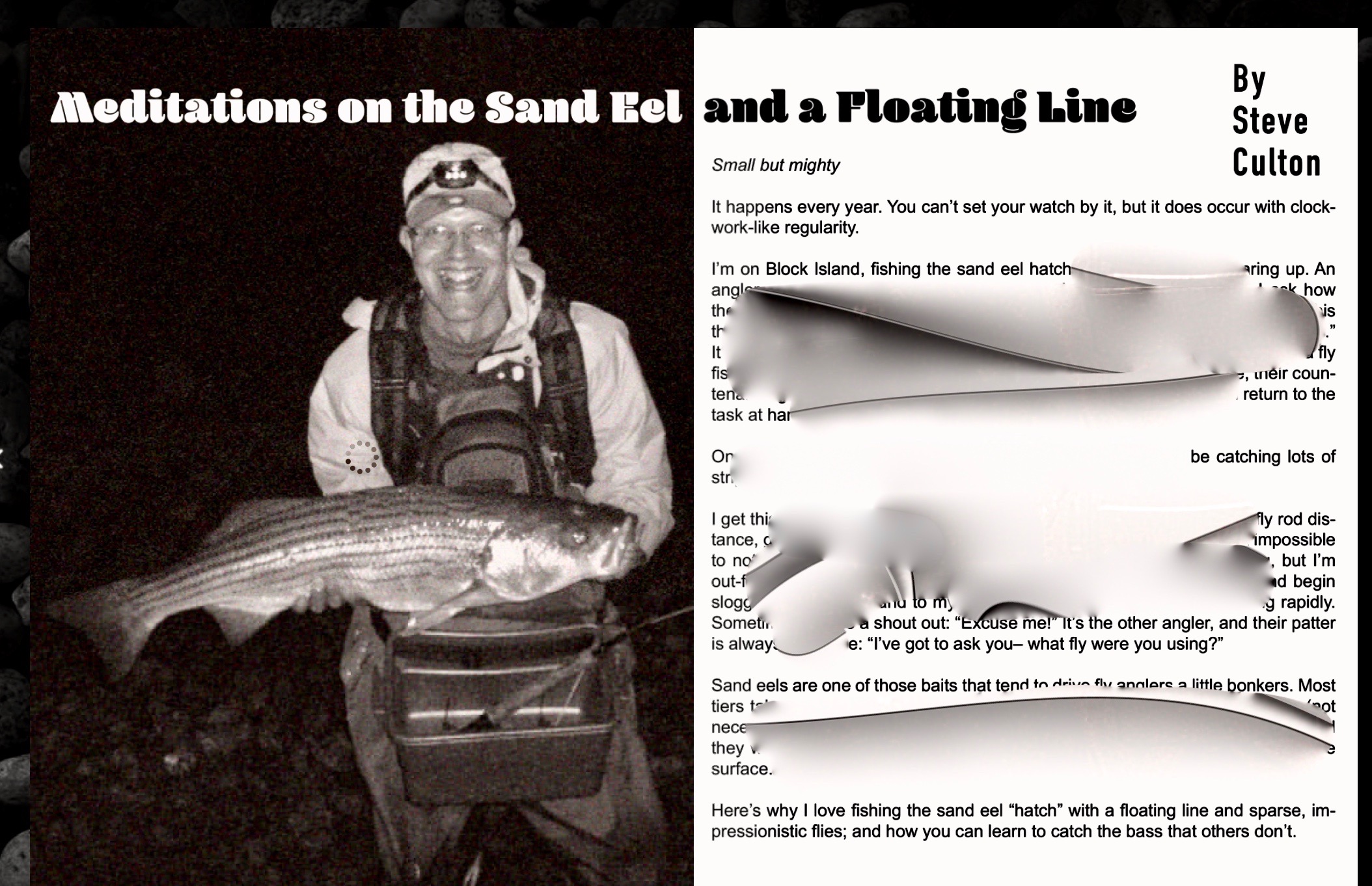
What a football of a Block Island bass! This is a really good story. I think you’re going to like it.
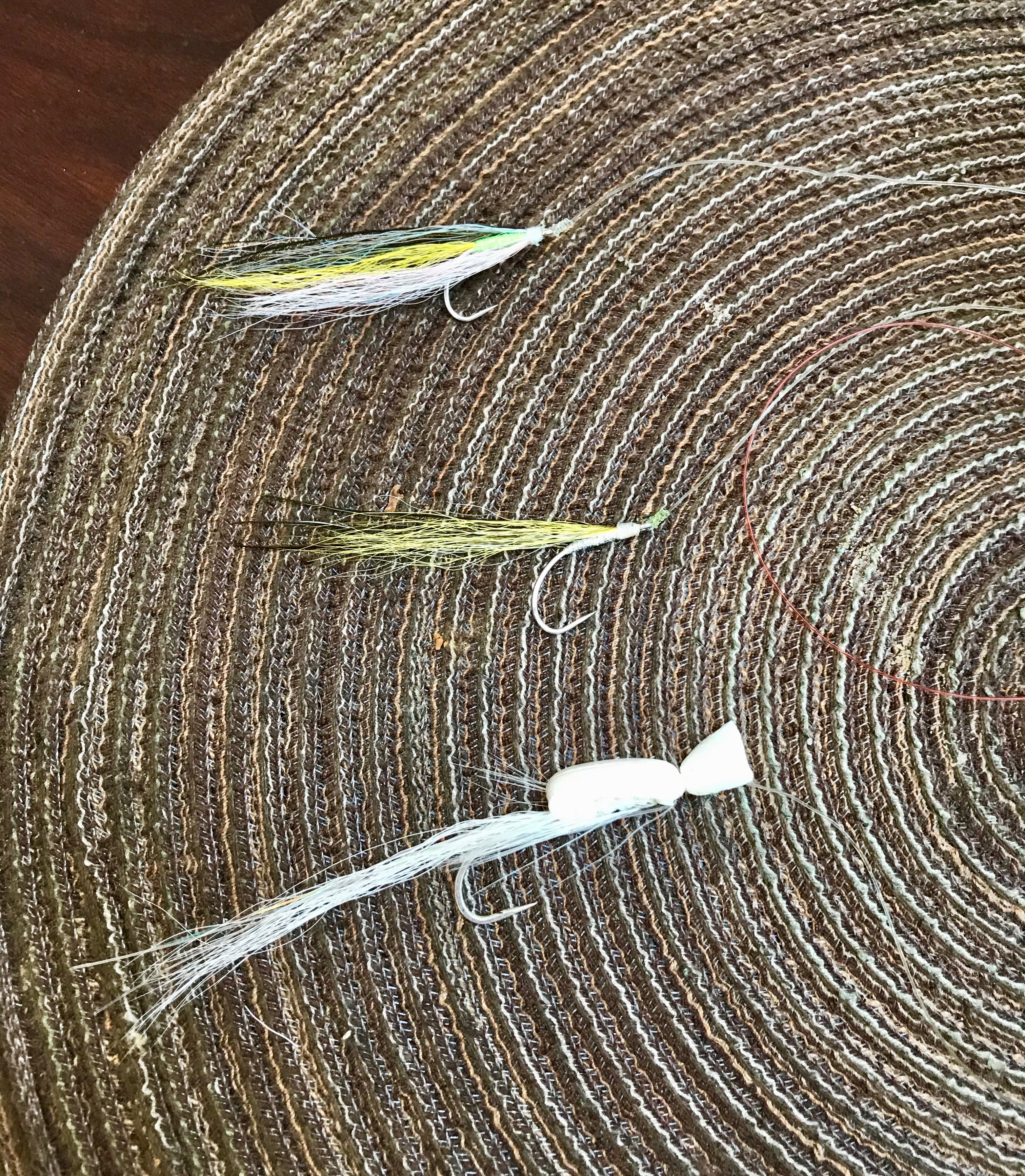
I’m delighted to have piece in the diamond issue of Surfcaster’s Journal. Meditations on the Sand Eel and a Floating Line is exactly what it sounds like: my thoughts on fishing this important bait using traditional patterns and salmonid tactics — and catching more striped bass. Most anglers I see targeting stripers feeding on sand eels use intermediate lines and weighted flies. They’re missing out, and typically only catching the stripers that are willing to chase. Some of the answers to the mysteries of “How come I can’t catch those bass?” when they’re feeding on sand eels are unveiled within.
Surfcaster’s Journal is an online e-zine. If you’re not reading it, you should be. Although the focus is primarily on using spinning gear, there is some in-depth fly casting content (like this piece) — and there is plenty of invaluable information that may be gleaned from the traditional surfcasting articles. It’s only 20 bucks for a year. You can subscribe here.
I remember this night like it was just a few months ago: Block Island, July, and a school of 15-20 pound bass were in close harassing sand eels for several hours. The stripers were very willing to jump on. But what about those frustrating nights when you can’t buy a hit? Read Meditations on the Sand Eel and a Floating Line and become a closer.
Mini-striper report 10/16/22: I fished for several hours last night with surfcaster extraordinaire Toby Lapinski. He was plugging and I was on the 2H fly rod. Conditions appeared to be perfect, but the neither the bass not the bait got the memo. Toby managed two school bass and yours truly took the skunk. Toby had a trenchant analysis of the evening, which, as you have not yet heard it, I will now precede to relate: “Bleaaahhhh.” That’s a direct quote.
The spawn is taking place on some northeastern wild brook trout streams. I recently fished a brook on consecutive Thursdays, and the changes over the course of a week were dramatic. Seven days ago, there were only a few leaves in the water and no visible signs of spawning activity. A week later, the brook was congested with foliage and several redds were apparent. I spotted a large hen on one, and a few active fish on another.
In case you don’t know, a redd is a spawning bed. The fish select an area with enough water and current and the right size gravel, then clear the area of debris and other sediment before depositing eggs and spreading milt. (This is why spawning and post-spawn fish often present with scraped bellies and frayed fins.) Redds are fairly easy to spot; they look like light colored patches contrasting against much darker substrate. On a small stream, redds may be anywhere from a couple of square feet in area to significantly larger. A distinct light colored patch with fish darting about on the bottom nearby is a sure sign that you’ve discovered a redd.
Every small stream angler should know how to identify a redd, or spawning bed. Here’s a classic, can’t-miss-it redd: A dramatically lighter patch of gravelly stream bottom surrounded by darker substrate. There were a few fish milling about, but they scattered when I stood up to take this photo.
Maintaining the integrity of redds and protecting spawning fish is vital to the future of any wild trout stream. The stocking truck is not coming to replenish what humans destroy! Here’s what to do if you see a redd: First, leave it and the fish that are near it alone. Don’t try to catch spawning fish. Let nature take its course. Next, make a mental note of the location. Chances are that the fish have been using the general area to spawn for dozens or hundreds or thousands of generations. Finally, stay out of the water near the redd for the remainder of the fall, winter, and early spring. If you crush the eggs or the developing fry, that would be bad.
Besides, it’s pretty cool to simply sit on a rock and watch the beginnings of the next generation of Salvelinus fontinalis.
Steve Culton will be making his first appearance at the 2022 International Fly Tying Symposium, November 12-13 in Somerset, NJ. (I know, sounds like a press release, but this kind of is.) In case you haven’t visited, and are looking for more information, the Symposium site is live. There was a glitch yesterday in the class registration link; that has been fixed. So, if you want to attend my class, Tying Soft Hackles, Winged and Wingless Wets, Saturday Nov 12 from 1pm-3:30pm, you can register here.
I’m currently working on two new seminars that will debut at the Symposium. The first, on Saturday at 10:30, is Tying and Fishing Wet Flies. This will cover some basic wet fly construction, theory, and how to present and fish wet flies — and you’ll also get to see some of my favorite patterns. On Sunday at 11am, it’s Beyond Cast and Strip: Presentation Flies for Stripers. I’ll be covering fly design, use of natural materials, sparseness in design, and — drum roll — presentations other than cast and strip. If you want to attend either or both, you just show up, and I’m hoping for a good turnout from currentseams followers. And of course, I’ll be at a tying table when I’m not teaching and presenting.
If you’re just casting and stripping, a spinning rod is a much better tool for that job. Find out why I tie striper flies the way I do, the secret ingredient in all my patterns, and how to present them — at this year’s International Fly Tying Symposium.
I hit a hidden gem last week that takes about 2 1/2 hours to get to. That may seem like a lot of effort — you’ll get no argument from me — but it’s usually worth it. And on this day, it was.
Over the years, this brook has seen its ups and downs. I’ve been moderately disappointed by it my last few outings, especially by the size and number of the fish. But you get what you get, and the fact that it still has native char, like it has for thousands of years, is a true blessing. So: I won the weather lottery. A warm, sunny, gorgeous, Indian summer day. After the rains, the water level was spot-on perfect, running cold and clear. In terms of numbers, the fishing was off the charts. I landed dozens (despite my best attempts not to, in order to reduce stress) and pricked dozens more. No beasties in the mix — you like to get a couple in the 9″+ class — but I did dredge up a few 7-8-inchers in the deeper pools. The brookies were everywhere. I started with a dry/dropper, which was moderately successful, but when I switched to subsurface (a tungsten bead head nymph/worm thingy) I couldn’t keep the char off the fly. What a wonderful day to be out in the woods.
This was typical of the size of fish I was landing. I also had dozens of smaller char attack the fly, the vast majority of which did not result in a hookup. I’ve mentioned this before, but I’ll repeat: please try to limit the number of fish you photograph. The less time they spend out of the water, the better their chances for survival. It goes without saying that you’re wetting your hands and using barbless hooks, right? What precious gems, our beloved Fontinalis. Life is mighty good when you’re taking a shot like this one. Another word of caution: we’re getting close to the spawn, so be on the lookout for redds. They’re fairly easy to spot, usually a lighter patch of gravel beside darker surroundings. If you notice a redd, make it your policy to stay out of the water, period. And of course, be a good sport and leave any fish on or near a redd alone to do their thing. Remember, the stocking truck isn’t coming back to replace what gets wiped out. Thank you for your consideration. 🙂
This is a very late report from last week. After a hot, dry, droughty summer like the one we experienced in 2022, I like to head to a few small streams to get a handle on how the natives fared. This trip was last Friday, well before this week’s much-needed soaking. As I suspected, the water level on this brook was on the low side of low. Much of it was unfishable. But there was plenty of good news.
The water temperature was bracing and cold, certainly colder than it ever was this summer, but this brook has many places for the char to go to escape the summer heat, even in low water. I saw dozens and dozens of fish, many of which looked to be young of year. I also found a few pods of bigger brook trout — nothing really huge, but in the 7-8″+ class. On an outing like this, I do get to do some fishing, but a lot of it is more inspection-oriented, with the intent of spooking fish. Often, with the water so low, the natives want nothing to do with the sight of you or your rod waving around. I got no interest of the dry fly, and pricked two with a weighted jig-type fly.
Then, yesterday after the rains, I visited a different stream. What a bounty! But you’ll have to wait a couple days for that report…
At a normal level, the flow should be covering the rocks you see center photo. This pool is usually good for a couple of hungry swipes; on this day it was a barren brookie wastleland. A reminder as we get near spawning time: be on the lookout for redds. Consider not wading into brooks at all. Redds are pretty easy to spot; usually a lighter area a foot or two in diameter against a darker gravel bed.





 currentseams.com