Farmington River Report 7/21/14: Just the facts

Borrowed from L.A. Confidential (just finished watching it for the Xth time), whose writers borrowed it from Dragnet, so I might as well borrow it for a fishing report.

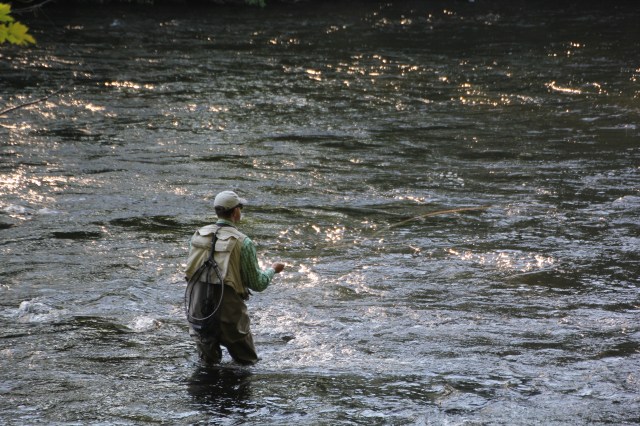
Where: Upper TMA, 476cfs, 58 degrees

When: 5:45pm-9:00pm

Hatches: Size 16 BWOs (fairly heavy). Size 14 sulphurs (a few). Size 10-12 March Browns (even fewer). Size 16 tan caddis (some). Size 18-20 summer stenos (fairly heavy).

Hello, old friend. I missed you. You’re here on July 21st right when you’re supposed to be. Summer stenos are the hatch I hate to love. I can’t think of another hatch that has caused me so much pain — and joy.

Summer Steno

Who: Ran into Steve Cook, a gentleman who took my wet fly tying course this winter. He did well, hooking trout after trout. We were also in the company of the illustrious Grady Allen, owner of UpCountry Sportfishing. Grady was there with his friend Ron. We shared the water with a half dozen other anglers, but we all had a generous amount of space to operate in, and no shortage of fish to present to.

Flies: Started with a size 16 Magic Fly, then switched to a 20. The 20 worked best. Ended the evening with the size 12 Light Cahill Catskill, until I couldn’t even see that.

Feeding: Weird. For the bulk of the evening I had no consistent risers in front of me. Most of the active fish from late afternoon to early evening were JV salmon. Most of the active fish were behind me, along a shallow bank, until dark, when the deep water switch got thrown. I took two nice browns, one a small wild fish, the other a low teens holdover, just by prospecting along the bank. All the other trout I hooked were actively feeding. The fish were mainly on emergers; I witnessed dozens of rises followed by an escaping mayfly that materialized from the disturbance. At dark it was spinner central, with dozens of backs visible as the trout porpoised.

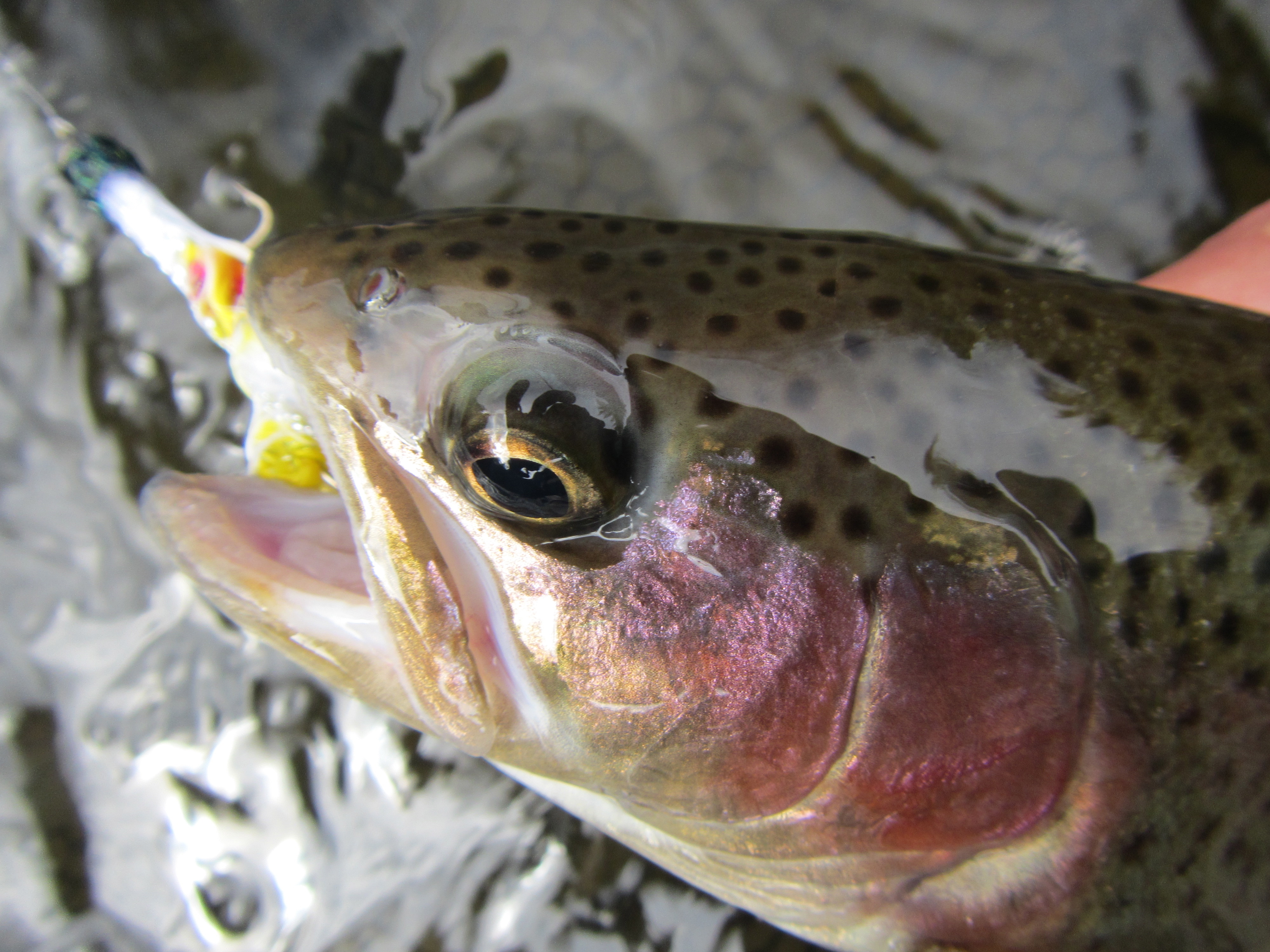
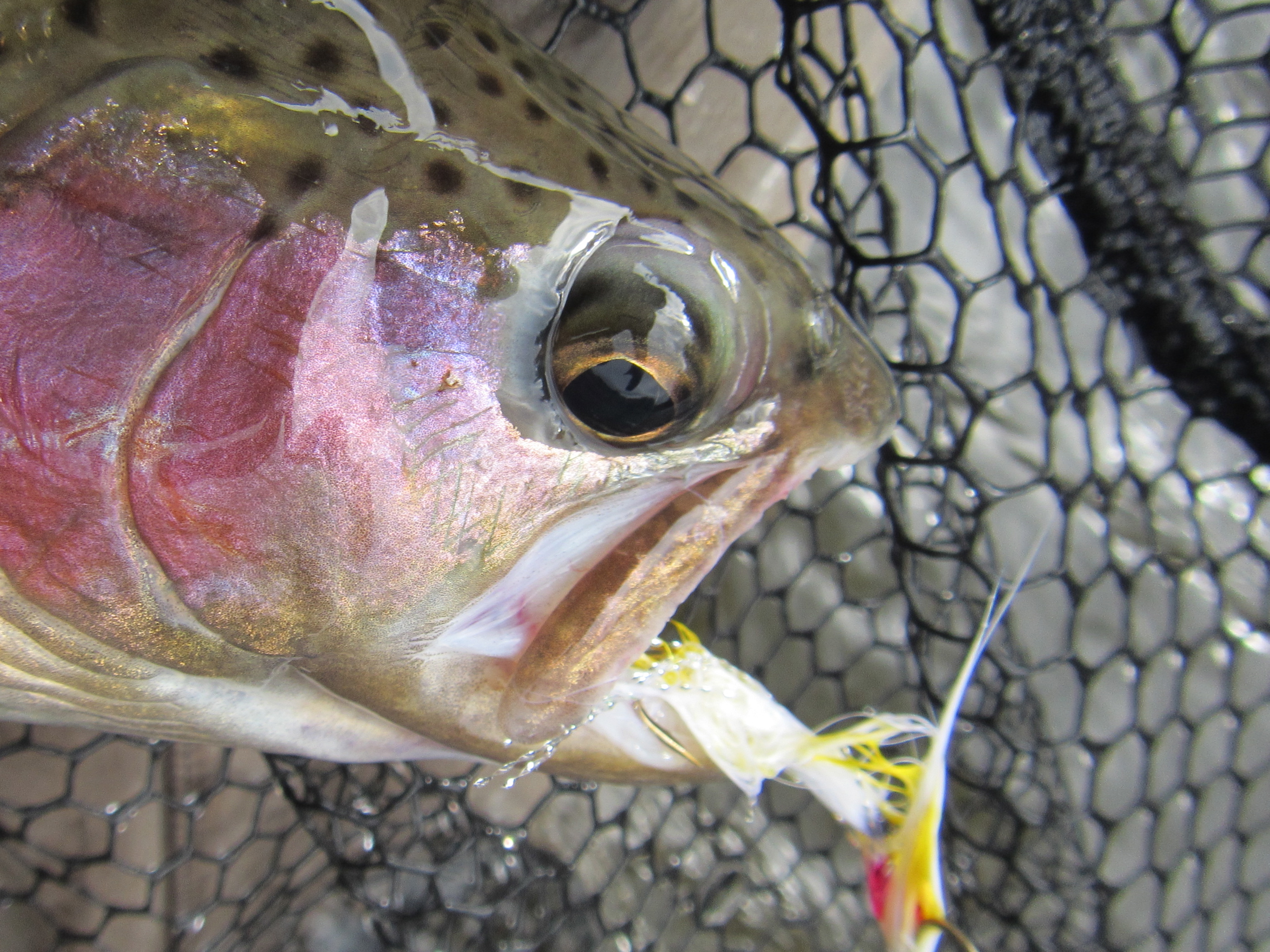
Best fish: See below.

This is the biggest brown I’ve taken on a dry in a couple years — high teens long, thick, ham-like shoulders and a few pounds on her. She was feeding in about two feet of water ten feet off the bank. I’ve been trying to learn to play larger fish with the bamboo rod, the click-and-pawl reel, 6x tippet and small dries for years — losing plenty of bruisers in the process — and last night was the first time I felt like I wasn’t going to mess it up.

Big Brown on Magic Fly


Introducing Currentseams Q&A

I get a asked lot of questions about fly fishing: from clients on the river, people in forums, club members I speak to, followers though email, etc. I’m happy to answer them, and flattered that someone thinks I might be able to help. In the spirit of help, I’d like to introduce Currentseams Q&A. When I get a question that I think might have broad appeal, I’ll post it and my answer here.

We’ll kick things off with a striper question.

Q: I finally will be getting to fish salt a few mornings next week up in Maine.  It’s an area I’ve fished a fair bit, but most often, using fairly substantial 5-8” flies – like the Grocery Fly (a harbor Pollack imitation), bigish deceivers and clousers and my favorite, a big Ray’s Fly.  How big?  6-8” on a 2-3/0 gami hook. That said, normally I’ve gone out a few times and have some hands on “data”… this year… no luck.  So, my “research” has been scanning surf talk threads in the maine/nh forum… which results in what looks like a likely ticket right now – 3-3.5” sand eels. So, I humbly ask…  Big Eelies and variants or small bucktails/deceivers, or even small “candy” like flies? If you’re open to it, I’d love to hear your thoughts on solid flies in smallish sizes. Point blank, for some reason in the surf I have a brain block on tossing little stuff… It’s a big ocean man, how will they see it?

A: Stripers are not humans. What you or I might find hard to see can be a billboard to a striper. I couldn’t possibly count how many striped bass I’ve caught on 1-2″ long grass shrimp flies (in murky water) or sparse (30 bucktail hairs and couple strands of flash) sand eels tied on #8 hooks. Bass also eat things like crab larva and isopods that are a fraction of an inch long. They find them just like you’re able to find M&Ms. The Big Eelie is a good bet, as is anything that is sparse and thin and matches the profile. Try Eelies: two thin saddle hackles over 30 fine bucktail hairs and a braid body. 2-3″ long. Maybe a couple stands flash. Small Ray’s Flies to match the bait. Play around with colors: the stripers will always tell you what they like. Ray Bondorew has a small sand eel fly made of marabou. Simple. No eyes. And effective. I fished hard/epoxy/tube bodied sand eel flies for years. I caught fish on all of them. But they all seemed to me like they were trying too hard to be an exact replica of the bait, right down to the detailed eyes. I haven’t fished a sand eel fly with eyes in years. Impressionism is more my style and energy, and I like to fish flies that don’t give the bass credit for being anything other than the primitive animal they are. (Thanks to Bill McMillan for that last line.)Have fun, experiment, and fish with confidence.

Here’s a sparse sand eel I call the Golden Knight. Two-and-a-half inches long, 30 fine bucktail hairs, a few strands of blue flashabou and black Krystal flash. This one is tied on a hook for small streams; for stripers, I use a TMC 7999 Atlantic salmon hook. This is a very effective fly to imitate small sand eels; I like to fish it as a team of flies near the surface, suspended between a corkie and a floating fly like a Gurgler.

Sparse Golden Knight

L&L Special Big Eelies. No matter what colors I tie the Big Eelie in, stripers love it.

L&LBIg Eelie

Things you can catch on sparse sand eel flies. This girl is nearly 40 inches long. Look at that tummy spilling over my right hand! Also dig the Jimi Hendrix guitar-on-fire psychedelic halo. The bite was incendiary that night.

900x900px-LL-8da1a41d_38incher-1


Farmington River Report: Wet, dry, hot, cold

On Saturday I guided Randy and John from noon to evening. We spent the bulk of our time walking a long stretch of the upper TMA swinging wets. The fishing was great — we barely saw another soul (contrast to Church Pool, populated by a good dozen-and-half anglers when we drove over the bridge). The catching, not so much. Despite the cloud cover and the threat of precipitation, the BWO hatch never really got going. We pricked a few fish, and John lost a pig in a secluded side stem, but other than that it was a lot of casting and wading. That we had such a good time anyway is a testament to my two clients: they fished hard, they fished well, and they realized that some days the bear eats you.

John exploring the nooks and crannies of one of the Farmington’s many side stems.

IMG_2259

Randy working the seams, ready for a take that never came.

IMG_2261

On to Plan B: catch the evening rise. We found some lovely dry fly water at 5pm that we had all to ourselves. By 7pm it looked like we had been teleported to Church Pool. Where the heck did all those people come from? Our focus was on fishing wets like dries, particularly the Magic Fly. The bugs certainly cooperated: sulphurs (size 14 and 18), March Browns, 16-18 BWOs and some size 16 tan caddis. For two-and-a-half hours, it was JV salmon city. Then the trout came out to play. When our time wound up, John and Randy graciously shared the water with your humble scribe. I was fortunate to connect with four lovely wild browns, cookie cutter in their length (10-12″) and unique in their markings: one had an odd scarcity of spots; another was rainbow-like in the density of his spotting; yet another still had faint traces of parr marks. Exquisite.

~

Sunday night I ventured to a different spot to check out the summer steno situation. They did their part, but sadly the trout didn’t cooperate. I had fair enough action from about 5:45pm-7pm (size 16 sulphurs hatching). Past 7pm it was total shutdown, even during the magic hour of 8-9pm. The summer stenos were out in force, but the trout weren’t interested. Massive spinner fall at dark with nothing on it. Perhaps when the water warms and drops a bit more (last night 57 degrees and 516 cfs).

An abundance of spent mayflies on the surface Sunday night, but a strange lack of sippers.

IMG_2268

Conversations on a small stream with Gordon

Gordon: How much farther is the river?

Me: Not too far. It’s not really a river. It’s small, so we call it a stream or a brook.

~

Me: Stop for a minute. What do you hear?

Gordon: The brook?

Me: The brook.

Gordon: It’s coming from down there.

~

Gordon: The water is cold.

Me: Yes. Do you know why?

Gordon: I don’t know.

Me: Well, is the brook in the open sun?

Gordon: No, it’s in the dark woods.

~

Gordon: I don’t think I can jump over to that rock.

Me: I think you can. It’s OK if you get your feet a little wet.

Gordon: It was shallow. I only got a little wet.

~

Me: Look how flat and glassy that water is in that pool up there.

Gordon: Can we go up there?

Me: Absolutely.

~

Me: Do you remember what “the cafeteria line” is?

Gordon: Where that white stuff is on top of the water.

Me: The foam.

~

Me: Where did we hook all our fish today? In fast water or in the slow water?

Gordon: In the fast water.

~

Me: Are you hungry”

Gordon: Yes.

Me: I think we should get a burger at Five Guys. What do you think?

Gordon: I think that’s a good idea, daddy.

~

Gordon (no relation to Theodore) patiently presenting his dry fly over a pool. We didn’t bring any brookies to net today, but we pricked five. Not bad for one hour in the middle of a sunny day in July.

Gordo Small Stream


Fishing with my mind

The calendar said soccer tournament for the weekend, but I packed my gear anyway. We were staying in North Kingstown, RI. Any number of prime striper waters would be just a short drive. The only question was, would I have the energy — or the desire — to get out after a day of schlepping around soccer pitches in the hot sun?

The answer was yes. Saturday night, I headed to one of my favorite spots, My Father Le Bijou 1922 Belicoso in hand. I fished for about two-and-a-half hours. The thing was, I never wet a line.

I stood on a dock and searched for signs of life. There were horseshoe crabs, blue crabs, silversides, and jellyfish. But no stripers. I walked along a rock wall and watched the swirls and eddies formed by the last of the incoming tide. I peered over a bridge and marveled at the dessert-plate sized blue crabs swimming across the outgoing tide, faster than such seemingly un-aquadynamic creatures had a right to, as they hunted silversides.

When I returned to the dock, the stripers had moved in. I watched one fish for a half hour. He was about two feet long, and fat. He travelled in the same counter-clockwise circle, approaching from down current, sweeping along the bottom slowly and methodically, then cutting sharply to the left, accelerating, and disappearing into the void before materializing below a few minutes later. On rhythm. Perfectly.

It was magic.

A few of his friends made slashes on the surface, neither timed nor spaced.

I thought about getting out my rod. More than once. But I knew that was not the right thing on this night. I was doing what I was supposed to be doing. Just like the stripers.

The next time I go back, I’ll catch some. They will understand.

Dockofthebay


It’s sum, sum, summertime on the Farmington

Now that we’re well into July, the Farmington has settled nicely into its usual summer patterns. The fish are spread out, and we’ll start to see some of the bigger guns moving into the fast water. Terrestrials are a good bet in daylight hours, for prospecting, or during periods when there is no hatch activity. Nymphing deep pockets and fast water can be very rewarding. This is the time of year when I love to walk the river and lazily swing wet flies over fishily-looking lies, or drift them hard against the riverbank.

Current hatches include tiny BWOs, smaller sulphurs and other yellow/creamy bugs (16-20), the omnipresent tan caddis, and for those of us who enjoy fishing minuscule patterns that blend in perfectly with the river bottom, Needhami. In my experience, sparser is better with the Needhami — I use a fly that’s basically some fine thread on a 22-26 hook with a CDC puff wing. At the opposite end of the fly size spectrum, it’s a good time to crack open the hoppers box, or swing and strip big streamers after dark. (And let’s not forget the mouse patterns.) If you’re going the after dark route, be sure to stay off MDC property. They can and will ticket you.

Now, if I could only get out there.

A big ‘ole Farmington River summertime brown, taken on a March Brown hackled wet.

IMG_0865

Block Island Mini-Report: We’re back, baby

Just returned from a week on my favorite island, and I’m pleased to report that after three sub-standard years, the Block is back! The traditional Block Island Diary will of course be written, but until then here’s a snapshot of the action:

Seven nights (even Friday as Arthur scurried away)

One skunking (thanks, Arthur!)

One broken rod tip (stupid human error)

Two one-bass nights (one of the fish a 15-20 pounder)

Two under-a-dozen-bass nights

Two off-the-charts-dozens-of-bass nights.

Sand eels were the predominant bait, about 2-3″ long, and very fragile. Biolume in the water, which was 63 degrees. New moon to Q1. Fished both incoming and outgoing tides. Fished open ocean and the pond. Fished some new secret spots. Had more water to myself than I’ve ever experienced. A most excellent week.

The Yellow Kittens, Old Glory, and a Fourth of July rainbow.

Kittens Rainbow

Block Island All-Nighter VIII: All by my(our)self

This year’s Block Island All-Nighter played out a little differently than in years past. Once I found out I would be flying solo, I decided to ask my 11 year-old, Cam, if he would like to go. He was all over it. I think he liked the idea of heading off for an overnight as much as he did the chance to go fishing. But I really didn’t care what his motivations were. It would be nice to have his company.

The last two BIANs were busts. My intel on the Island had warned me of epically slow fishing in the last week — “Be prepared to tour the Island to find fish” was the mandate. For a time, it looked like BIAN VIII would crap out. Then, a trickle of fish. And suddenly, the heavens opened and the light — hell, it was more of a beacon — of good bass fortune shined upon us. Here’s a little timeline and some photos from our adventure.

6pm-8:30pm: Take the six o’clock boat over to the Island. The surface is flat as a dinner plate. Speaking of dinner, no better way to start a BIAN off than with the fried scallop platter from Finn’s, washed down with an IPA draft.

My stash for the evening. You’re thinking, “Steve, why would you bring so many cigars?” Just in case. Someone might ask for one. Someone might deserve one for sharing the water. Or, on a dead-calm night like this one, I might forget my bug spray and be inundated by millions of biting no-see-ums. There’s no mention of cigars as bug repellant in the Boy Scout Manual. But this ex-scout was indeed prepared.

Image


No Fisherman’s IPA this year, so we went with Loose Cannon. Another hop bomb with some nice fruity notes.

Image


8:30pm-11pm: We arrive at the spot. It is mobbed. Like, we get the last place to park mobbed. Not to worry, I tell Cam. It’ll empty out in short order. Witnessed: The largest, longest school of sand eels I’ve seen on the Block since 2007. The bait was smaller than normal for this time of year: matchstick to 2″ long. But scads of them. And then some. The water looked like it had a moving, breathing oil spill beneath its surface. Cam fishing with a 1/2 oz. bucktail jig bangs up some fluke. Dad goes touchless. We walk to another spot. Dad’s proven fish-producing spot. There, Cam, you see? A couple bass rising. We display our wares to them. Nothing. Hmm. Not usually how things play out on the Block. We borrowed some bug spray for Cam, but he’s still getting pummeled. Cam announces he’s tired and is ready for nap #1. We start the long walk back to the truck. Looks like it’s going to be one of those nights.

11pm-1am: The stars! What a galaxy we live in. The air so calm I can blow smoke rings. The ocean is still mirror flat. So flat that I can easily see those rise rings thirty feet off shore. Multiple active feeders. I tell Cam his nap plans have been placed in a holding pattern. I’m going to cast to some fish. They seem oblivious to my fly. No wonder. There are enough sand eels here to feed every striper in Rhode Island. I connect with a few, and let Cam reel in a couple. At midnight he decides to call it. I keep fishing and catch a half-dozen or so more. This is already better than most of the last two years.

And I have no idea what’s coming.

Tight lines with the long rod. Cam has a knack for getting stripers in quick. No wonder. Look at the angle of the rod. I may have reinforced fighting the fish off the reel and the butt, but he basically taught himself. 

Image


One of Cam’s prizes. Most of the bass from the first part of the evening were in the 18″-24″ range. Block Island remains the only place I’ll put a sub-double-digit pounds striper on the reel.

Image


1am-3am: I’m walking along the beach, trying to decide where to fish, when the decision is made for me. A squadron of seagulls are milling about the water’s edge, chattering excitedly. Bass have the sand eels trapped and are picking them off with gusto. The gulls are cleaning up the leftovers. All I need to do is choose a rise ring, lay my fly over it, then start stripping. Sometimes the fly barely has a chance to get wet before the glassy surface is shattered and I’m on. It is a school of good stripers, ten-to-fifteen pound range, and every one of them came tonight to eat. For the better part of 90 minutes, the action is non-stop. It’s like striper fantasy camp. It’s so intense that I wonder how much longer it — or I — can go on. One fish obliterates the fly — this one’s over 30 inches — and as it rolls on the surface it spooks what look like another dozen stripers the same size.

Best of all, what I predicted earlier has come to pass. There isn’t another soul on the beach.

A 15 pound Block striper, classic big shoulders, belly full of bait. I know, fish on sand is not ideal. I risked this one for a photo; all her sisters were lipped and released within safe confines of the ocean.

Image


The white cavern, the last thing a sand eel sees before it disappears into the void.

Image


3am-6:30am: This time of year, the first glimmer of light appears in the east around 3:45am. I fished hard in those first forty-five minutes because I could sense I was running out of steam. I continued to walk along the beach, targeting active feeders. The bass seemed to get more aggressive as the sun’s disc neared the horizon; several times I had fish on as soon as the fly hit the water. By five I was done. I chatted up a a few anglers on the walk out, and presented a fly to a gentleman who proudly told me that today was his 81st birthday. After rinsing down our equipment, we headed into town to wait for Ernie’s to open. Breakfast is going to be glorious.

The pre-dawn crescent moon accompanied by the morning star. If you look closely just to the left of center, you can a see the remnants of a rise ring.

Image


Geez Louise. I gotta be more careful with that belt sander.

Striperthumb

6:30am-8am: Breakfast. Three pancakes for Cam. Pancakes and eggs for dad. Bacon for both. Off to the dock. Delirious from lack of sleep. Or all those stripers.

I can’t remember which.

Cindy Loo-Who has been punching my car ticket for decades now. Our meetings are always bittersweet: “Hello, old friend,” combined with the melancholy of leaving my favorite Island.

Image


“A Team of Three Wets” in the current issue of Mid Atlantic Fly Fishing Guide

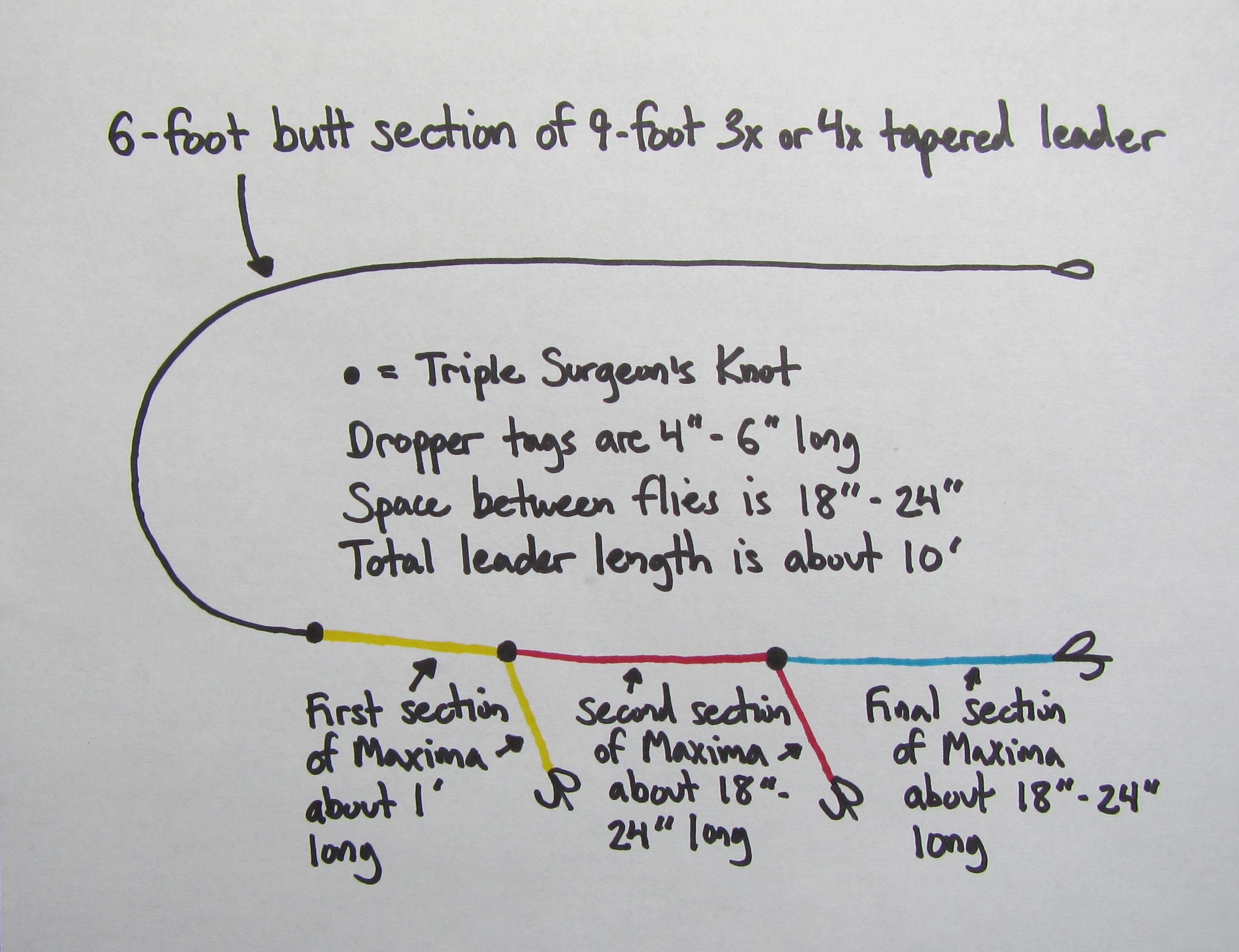
Calling all wet fly junkies! This article discusses the how and why of fishing a three-fly team of wet flies. It includes a diagram that shows you how to build a three-fly leader. MAFFG is distributed free in fly shops all over the — well, Mid-Atlanctic area. Who knew?

This magazine is an underrated gem.

Image

Farmington River Report 6/18/14: Thank goodness for 7pm

Kevin and Aidan took my Wet Flies 101 class yesterday evening. The upper TMA was a perfect height, 375cfs, running crystal clear and 55 degrees. A little stream side classroom, then on the water at 5pm. The sulphurs made a showing along with some caddis, but there was nothing rising. We gave the spot 90 minutes, then decided to move. Right call. We found some river that was a good transition point between classic wet fly and classic dry fly water. It had bugs coming off and fish rising. Best of all, it was unoccupied(!?!). The hatch was strongest from 7pm to around 8:15. Plenty of size 16 sulphurs with the trout keyed on the emergers — I didn’t see a single dun taken off the surface. I rigged Kevin up with a Magic Fly for some wet-fished-as-dry action (we started off with an 18 but downsized to a 20) while Aidan stayed subsurface with the swung wet. Both guys did a great job targeting active feeders, and both connected with trout. Around 8pm I rigged Aidan for wet-fished-as-dry and he stuck several fish. Great job, gents. We won the hatch and weather lottery.

Kevin battling a wild brown who fell for a Pale Watery wingless wet.

Image


A good number of trout were enjoying the sulphur hatch as much as we were.

Image

Attentive anglers catch more fish. Aidan focusing on his drift, ready to strike.

Image

After the gig, I took a break and waited for the dark of night. It was not a good night for me to forget my headlamp — it’s an adventure stumbling across a boulder-strewn riffle or trying to stay on the path through the woods in total darkness. Not quite on the darkness, really. The fireflies put on a spectacular light show. I’ve never seen so many, so active.

I fished from 9:45 to midnight, throwing big streamers in hopes of connecting with a big ol’ brown. Not tonight. I did get three bumps, but no hook sets. Oh. And a beaver stalked me in one of the pools I fished. That’s always fun. I was glad I didn’t hook him. Though if I did, it would serve him right.