Farmington River Report 1/5/17: Ice cold (the weather, too)

In my experience, sudden changes in temperature — especially a drop — are usually bad for business. So it went today. I fished three spots within the permanent TMA, nymphs and streamers, and blanked. Okay, I did have a firm tug on a streamer (solid enough to make me wonder why hook point never found mouth) but that was it. Hatches were virtually nonexistent, and ice was a problem all day. It’s not supposed to get much warmer for a while, and today was my day to get out, so I can live with the skunk.

Note: as I drove past the entrance to Greenwoods/Boneyard, I noticed the dirt road is not plowed and is covered with ice. I wouldn’t plan on trying to navigate it unless you’ve got really good tires and a reliable 4WD. Good luck if you head out, and remember: the fish don’t know that it’s cold.

Shaving cream — be nice and clean — shave every day and you’ll always look keen. Actually, this stuff was frozen solid. It also reminded me of baked Alaska.

OLYMPUS DIGITAL CAMERA

Farmington River Report 12/28/16: Lockjaw

That was the general consensus up and down the river. Theories abounded, from snowmelt lowering the water temps to a grey, blustery day where the air temperatures never really spiked. I’ll throw in a pitiful amount of bugs and be done with it. I nymphed within and above the permanent TMA from 9:30am-2:30pm. Water was a cold 34 degrees, there were a few minor snow showers, and the river was running at the princely sum of 175cfs. Lots of folks out fishing today. Many thanks to those who kindly shared water.

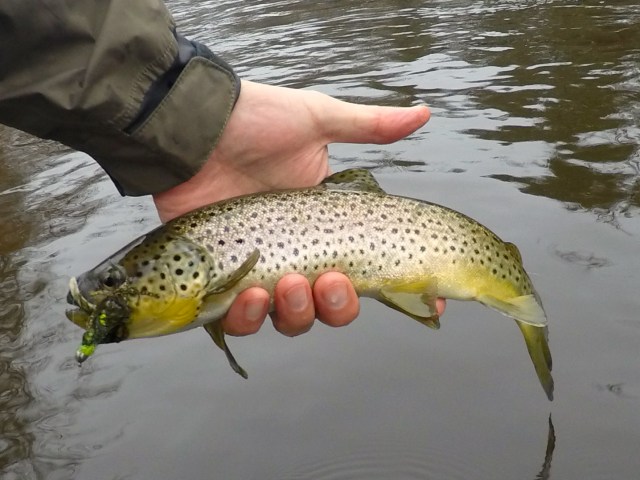
There was a 15-minute window of consistent sunshine in the early afternoon — enough to get a few bugs going — and that’s when I had my only touch of the day. I often tell people that I’ll always sign up for one fish in the winter, and when it’s a tank of a high-teens brown, all the better.

The winning fly, a Frenchie variant, on the day-saving fish.

OLYMPUS DIGITAL CAMERA

Farmington River Report 12/13/16: Subsurface spectacular

Going to be mighty chilly later this week, so I thought I’d get my licks in today. Good call. I fished within the permanent TMA from 9am-1pm, and found very cooperative fish in two of the three runs I fished — not to mention precious solitude. Here are the day’s notes:

Nymphing was incredibly productive for me. Those of you who are currentseams regulars know that I am a huge fan of indicator nymphing, especially in winter. However, in this low (100cfs and falling) and cold (34 degrees) water, I’ve gone away from the indicator to a basic short-line approach. The trout are beginning to stack up in their winter lies, and since the water is so shallow, those lies are very accessible via the long rod. I still like the indicator for covering water and for fishing faster, deeper runs, but in these conditions I’m doing better with the short-line approach. Still using the drop-shot rig, only I’ve added a yellow sighter.

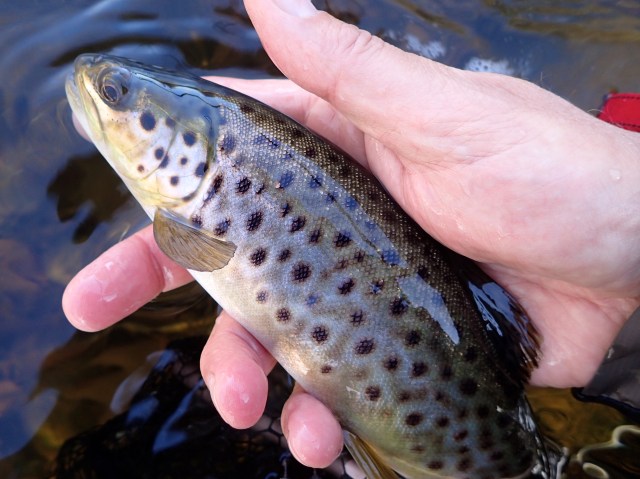
Most of today’s trout were foot-long wild fish like this beauty. I did manage a well-fed rainbow and a mid-teens brown. 

OLYMPUS DIGITAL CAMERA

~

I fished two flies today: a size 16 2x short Frenchy variant on point and a size 16 March Brown wingless wet dropper. The trout were just about evenly split on both. But it’s interesting to note that my first half-dozen fish came on the top dropper. This came in advance of another strong morning W/S caddis hatch. It could have been that the trout were keying on emergers 1-2 feet off the bottom, or simply that they were looking up. Regardless, droppers continue to be the fastest way to find out what the fish want.

A fascinating mix of strike styles today. Some were oh-so-subtle pauses in the vertical line, others were sharp tugs. Good stuff.

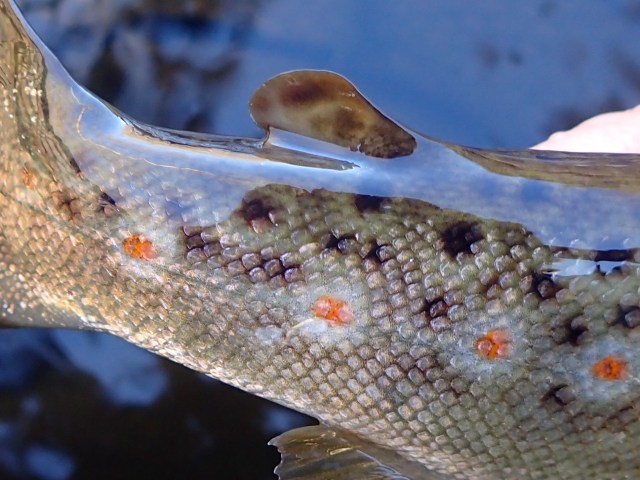
Don’t let the exquisite red spots and delicate parr marks mislead you: this fish fought like a badass. I’d like to rumble with him again in a couple years.

OLYMPUS DIGITAL CAMERA

~

Finally, support your local fly shop. UpCountry Sportfishing is a good friend of currentseams, and they have a tremendous selection of just about anything you’d need for fly fishing or tying. Make sure Santa knows where to find that new rod, reel, vise, or whatever it is you don’t have — or need more of.

Housy Mini-Report 12/8/16: Lots of water — action, not so much.

I missed my annual October/November Housy streamer trips this year, so I went yesterday. The HRO website declared that at 860cfs, it was a good time to fish big streamers on a full sink line. I concurred. Sadly, the trout did not. I fished five familiar, favorite pools and came up blank. Not a touch. Oh, I nicked the bottom many times, and sacrificed three streamers to the river gods, but ’twas not my day. Fast water, slower water, pocket water, shallow and deep — bright colors, muted naturals — fast retrieve, slow retrieve, no retrieve — nada. On the positive side, I had the entire river to myself, always a bonus. We’ll get ’em next time.

With both air and water temperatures in the 30s, this is sound advice.

OLYMPUS DIGITAL CAMERA

Farmington River Report 12/6/16: Wet fly action in…December?

Trout blasting wet flies on the swing with a water temp of 36 degrees? Yes, indeed.

I fished the permanent TMA today from 9am-1pm. I was rigged for nymphs, and I spent the first 30 minutes bouncing along the bottom, desperately trying to ignore the growing number of trout slashing at W/S caddis. After the second or third time of telling myself that I was acting like an angler throwing Clousers at a school of stripers feeding on the surface, I disengaged the shot and re-tied the point fly to match the dropper: size 18 soft-hackled pheasant tail. It was by no means a proper wet fly rig, but what the heck — I’m lazy. Second cast, whack! A lovely late fall  wild brown. Next cast, ker-pow! (Those old enough to have watched will recognize the channeling of my inner 60s Batman TV show memories.) And so it went until the hatch waned.

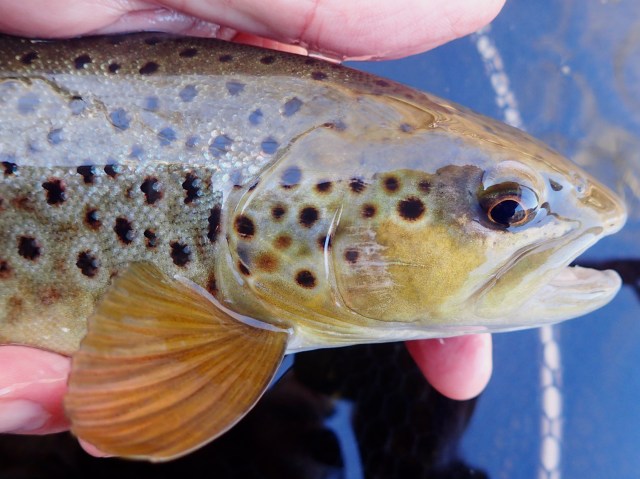
The first fish of the day is always memorable, made even more so when it sports such finery.

OLYMPUS DIGITAL CAMERA

~

I got out to warm up, and after ten minutes the slashing resumed in earnest. Only this time it was tiny BWOs they were after. The fish proved to be more difficult to catch during this hatch; they wanted the fly on the dangle (if they wanted it at all). By now the sun was up good and proper, and the trout were for the most part hugging the shade line of the eastern side of the river. I had to work hard for the two I landed, but when you’re swinging wets and it’s December and you’ve never had this much success with that method this late in the year, you’re squarely in a no-kvetch zone.

One of the BWO trout, a low teens wild thang.

OLYMPUS DIGITAL CAMERA

~

But wait, there’s more. We also had a five-minute-blizzard of a midge hatch. I switched to dries for this, and fooled two on a size infinity Griffith’s Gnat, but sadly didn’t stick either fish.

And at this point, I won’t even bother writing about how I blanked on streamers.

On the way out I spoke with fellow guide Mark Swenson. Mark was Euro nymphing and had done quite well (in fact he landed one while we were chatting). He was also fishing small stuff, size 18s.

But for over two hours, I had the river all to myself. Just me, the trout, the bugs, and a December sunshine that made me feel like summer could come any day now.

Stripers en Espanol

Last week I had the pleasure of guiding Asier and Moncho. They wanted to learn more about linea engrasada (greased line) fishing for striped bass. What was remarkable about the session was that they came all the way from Spain to do it. I’d like to tell you we slayed legions of bass, but we saw only one fish caught in the two hours we were on the water.

But if there ever was an outing where catching was truly secondary, this was it. Moncho speaks limited English (and I know even less Spanish), so Asier served as an able translator. We talked fishing, greased line, Ken Abrames, asked and answered questions, drew diagrams in the sand, exchanged flies and hooks and cigars, laughed at our communication gaps — what an appropriate way to spend the the day after Thanksgiving.

Asier recently posted this in the comments section of my guide service link. I am both honored and humbled by his words. “We come from Spain to learn with Steve, we only spend two hours with him… much more than enough to convince me he is the kind of guide always wanted, the knowledge, the philosophy, attitude, positivism, and of course the way he teach… How much he teach us in two hours in the sea, I can´t imagine how much he can teach in the river…. I really would like to come back and…. let’s try… more!!!!! Thanks Steve, people like you make sense to fishing.”

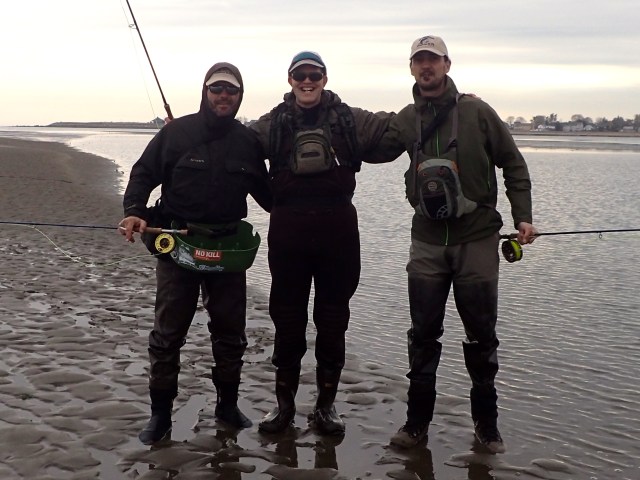
Three amigos. Moncho is on the left, Asier on the right.

OLYMPUS DIGITAL CAMERA


Farmington River Report 11/30/16: What’s all that wet stuff?

Not since the heady days of July have we seen this much water in the Farmington. 240 cfs! I fished in and out of the permanent TMA for 3 1/2 hours today. The water was somewhat stained — the closer to the Still, the greater the color — and 40 degrees. I saw midges and some really small BWOs, and even a few risers in some of the classic dry fly water. Streamers were the plan today, and things began well with several bumps and one mid-teens wild brown to hand. Then it got slow. Real slow. The last three places I fished were all blanks. I must confess to being a little surprised, given the warmth of the day, the height and color of the water, and the deep overcast. But such is life on the streamer edge.

For those who care about these things, I celebrated blowing off responsibility with an El Rey Del Mundo Flor de Llaneza. Like the fishing, it did not suck.

More rain is on the way, so whatever rain dances you’ve been doing, please carry on. I had most of the water to myself, but I would think that will change this weekend.

Excuse me, do I have something on my lip? The Deep Threat in olive/grey comes through again. The trout hit the fly three times over the course of two casts before delivering the kill shot.

DCIM100GOPROG0013600.

Reacquainting Yorkshire with Pulaski

It’s been another one of those steelhead seasons. Call it what you will — slow? Or maybe just a down year. But those years are now coming in bunches. That’s why I’m going with the Great Steelhead Recession. We’re chasing a fish that, in the best of times, is hard-earned. But the last three years have raised the emotional stakes to levels that will test an angler’s resolve. You can see it in the beleaguered eyes of the skunked. Hear the bitter tinge in their words (“Three days. Nothin’.”). The parking lots from Altmar to Pineville bear mute testimony to the current state of the fishery. November 9. Afternoon. Prime time. Three cars in the Ellis Cove lot, one at Lower Sportsman’s, none at the Refrigerator.

But, when you’ve booked a trip, you go. Prepare for the worse. And hope for the best.

~

I didn’t get a good hook set on the first steelhead. Fresh chrome — that was evident even in the tea-stained waters. But steelheaders live by their drag, and some die by it, like me, who had it screwed down way too tight for that first run. Pop! Stonefly thus liberated from metallic mouth. Hot, burning ownership of blame consumed me. And now I had to live with the thought that that might be my only touch of the day.

Into the seventh hour of fishing. The sun was out now, and I noticed a few whispy midges freeing themselves from their watery prison. Since it was time to change flies, I rummaged around in my box for the smallest, midgeiest, most emergerly fly I could find. There it was. Snipe and Purple, soft hackle, size 10. I’d tied it up years ago, then stuck it into a corner of my fly box. And there it sat, forgotten, waiting patiently for this moment.

I turned to Jim, my guide, and announced, “I’ll bet none of your clients have ever caught a steelhead on a Snipe and Purple soft hackle.”

There comes a time during every drift when the angler decides it’s over. On this particular one, I began to lift the rod just at the moment when the fly would have started swinging up from the bottom. The steelhead had been holding there, perhaps feeding on nymphs, when he saw the bug coming at him suddenly dart toward the surface. He made a decision. I want that.

Jim saw the flash just as I felt the sharp tug. Even has he was saying, “What?!?” I was driving the point of the small wet fly hook home. This time I remembered to set my drag.  Multiple runs, two dramatic aerials, then the net. And in the midst of hard times, we were celebrating our newfound wealth.

Sun reflecting off cold, hard cash, not too long from Lake Ontario.

sr11_10_16

~

Purple silk, gold rib, and a land bird hackle. That’s the actual fly at lower right. You can find the full article I wrote about these Yorkshire-inspired steelhead patterns here.

Steelhead Spiders

Meanwhile, up north in Pulaski…

…my spies tell me it’s good news/not-so-good news. The good: after a couple very down years, the 2016 salmon run has been strong. Here’s a quote from a local guide: “I thought that it would be a good run this year but it has far exceeded expectations.” More good: the watershed received several inches of much needed rain last week. The river jacked up to 2K; current level at Pineville is just over 700cfs. Everyone’s different, but I like higher water for this fishery. A strong salmon run means more eggs and rotting carcasses in the system, so right now is a good time to be tying up some egg and flesh patterns (and of course your favorite nymphs).

Now to the not-so-good: where are the steelhead? Those of us who remember the cruel disaster than was last year’s “run” are eager to return to the halcyon days of prodigious numbers of pre-spawn chrome. So far, that has not happened. Hopefully the next few weeks will see a big push of fish. Otherwise, we may be in for another long, cold, lonely winter.

Come back, baby!

OLYMPUS DIGITAL CAMERA


Midnight on the Water in Rhode Island

No sightings of the ocean’s daughter. But I did spend some time watching a small pod of stripers move and feed on the tide change. We’ll get to that in a minute.

In the space of three hours, I managed to fish: skinny water on the incoming and outgoing; under a bridge (I love shadow lines at night); the inside of a salt pond; an estuary on a ripping incoming tide; and a snotty beachfront from a jetty. I fished hard and I fished well, and I dearly wish I could tell you that I slayed ’em, but all I could manage was one dink and a few courtesy bumps.

The outside beach continues to vex me. Conditions off the jetty last night were just about perfect:  a good SSW breeze, substantial breakers, surging whitewater wash. But no predators. This particular spot is a serial disappointment; it used to be an I-need-to-catch-a-striper-so-I’ll-fish-here destination. 2016 makes it 4 consecutive years I’ve blanked at it.

The bridge, the estuary, and the salt pond were good places to fish if you wanted to hook weeds. I did not want to, but managed a prodigious haul of vegetal flotsam.

My only bass came on my second cast of the evening on the incoming. After, I drove around to explore the other places, then spent the last hour alternately casting to and watching a small pod of school bass drift into position at the turn of the tide (it was easy to see them in the bright moonlight). But the bait wasn’t there in any volume, and the stripers didn’t bother to stick around.

And once the clock hit the wee small hours, neither did I.

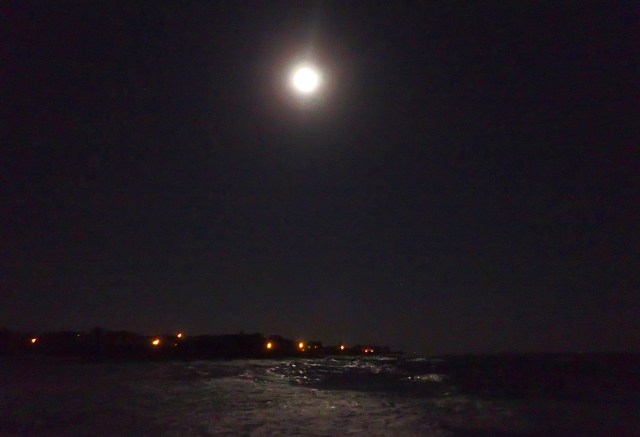
There. That’s what I’m talking about. Failed experiment in night photography aside, that whitewater wash bottom center is prime real estate for casting your fly. The jetty allows you to fish into the pocket formed by the rocks and sand, not to mention a good parallel shot to the trough just off the beach. When the bass are in there, you find yourself in tight line territory pretty fast.

OLYMPUS DIGITAL CAMERA