Fear and loathing in fly fishing

Legendary ad man Bill Bernbach once handed each of his employees a card printed with the words Maybe he is right. The idea was to encourage his staff to give new or foreign ideas a fair shake.

I think fly fishing needs an equivalent. Especially striper fly fishing.

The populist culture is that of the nine-weight rod, the intermediate line, the rapidly sinking single fly, and the cast-and-strip presentation.  Deviate from those paths, and you are greeted with alarm by the collective. Conformity is encouraged. It is your safety net. Without it, you’ll be sorry. You’ll see.

This pack mentality is frequently observed on internet forums. Mention fishing for stripers with more than one fly, and you can almost see the eyes glazing over and the heads spinning. Tangles! Hard to cast! Is that even fly fishing?

Thankfully, striped bass don’t read internet forums. Unlike people, they are immune to fear (it won’t work) and loathing (I’ll look stupid).

There are so few absolutes in fishing. There are, on the other hand, many, many ways. So if you don’t aspire to fish like everyone else, open doors. Ask questions. Find out. Try new things. How does that guy fish? Does he catch a lot? Does it look like fun?

Maybe he is right.

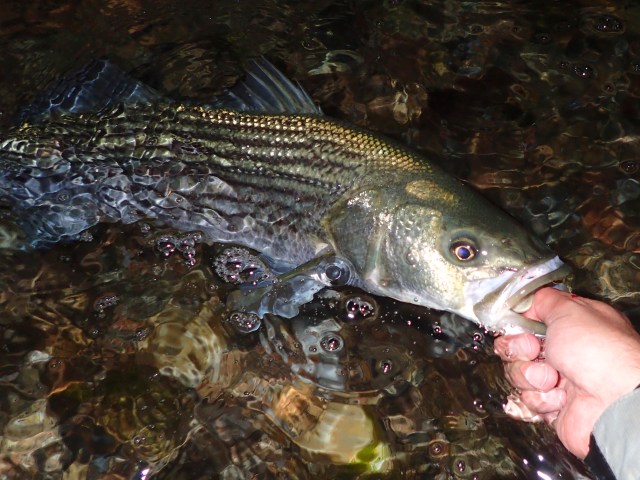
No wrong answers. Only the right ones for you. On this night, the striped bass repeatedly picked out the middle dropper, a chartreuse and olive Eelie between 2″-3″.

Block Island Bass

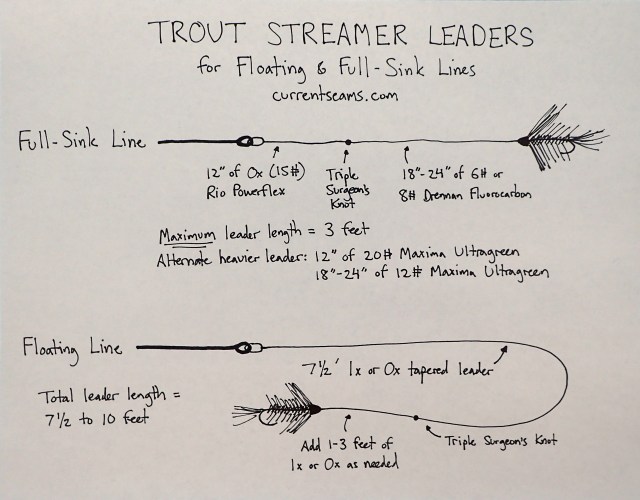
Trout Streamer Leaders for Floating and Full-Sink Lines

One of the most frequent questions I get asked is, “What’s your streamer leader formula?” The answer depends on two factors: the kind of line I’m using, and what I want the fly to do.

When I’m fishing streamers for trout, I fish two kinds of lines: either an integrated full-sink line or a floater. Let’s start with the full sink.

OLYMPUS DIGITAL CAMERA

Here’s a pdf: Trout Streamer Leaders

I use the full sink mostly in winter. Sometimes I’ll use it during warmer weather if the river is running high. I choose the full sink when I want the line to help the fly get down; consequently, the leader is kept short, three feet or less. Anything over three feet and you begin to defeat the purpose of the full-sink line. Don’t worry about the fly being so close to that heavy, dark string — the last thing a predatory brown is focusing on is your line.

There are a few deep holes in the Farmington that I like to dredge in winter. Unfortunately, bottom structure — snags — is often part of the cost of admission to those lairs. That’s when I’ll use the lighter of the two sinking line leader systems, simply because it’s easier to break off the snag from hell.

As you can see, the floating line system is likewise simple. A standard-issue Ox or lx tapered leader does the job nicely. This is what I’ll use for the vast majority of my streamer fishing, or when I am fishing a big floating fly like a mouse pattern. I’ll add tippet material that matches the terminal end of the taper if the leader gets too short. I will also add tippet material if I want to get my fly down deeper. A floating line gives you the ability to mend, and consequently harness the power of the current or sink your fly. So, about 7 1/2 feet for most applications, and about 10 feet to help get the fly deep.

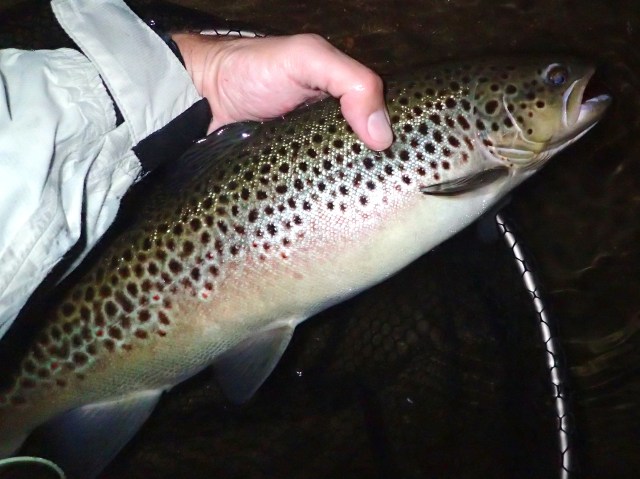
Big trout don’t care about that heavy black string snaking through the water ahead of your fly. Taken on a Deep Threat streamer and a full-sink line.

OLYMPUS DIGITAL CAMERA

~

A floating line, a 7 1/2 foot leader, a presentation near the surface, and all is right in the streamer world.

Big wild brown hen 8-2015


Winter Fly Fishing on the Farmington River

“Winter Fly Fishing on the Farmington River” first appeared in the February 2015 issue of Mid Atlantic Fly Fishing Guide.

The best part about winter fly fishing on the Farmington is not that on any given day, you have a good chance of catching trout. It’s that on any given day, you have a good chance of catching trout on a dry. Or a wet. Or a nymph. Or a streamer.

A classic tailwater, the West Branch of Connecticut’s Farmington River starts at the Hogback Dam in Barkhamsted, and flows some 60 miles to its confluence with the Connecticut River in Windsor. Between Barkhamsted and Unionville are dozens of miles of blue ribbon trout water, much of it open to anglers year round.

Resident salmonids include brown trout, rainbow trout, brook trout, and juvenile Atlantic salmon. In addition to stocked and holdover fish, there are substantial numbers of stream-born trout and char in the Farmington. (The 2013 DEEP census placed wild fish at 50% of the trout population.) Because the Farmington is a tailwater, it remains cool and trout-friendly in the warm summer months. It also means that during the unforgiving bitterness of winter, the source water is well above freezing. That’s good for trout. Good for hatches. And of course, good for fishing.

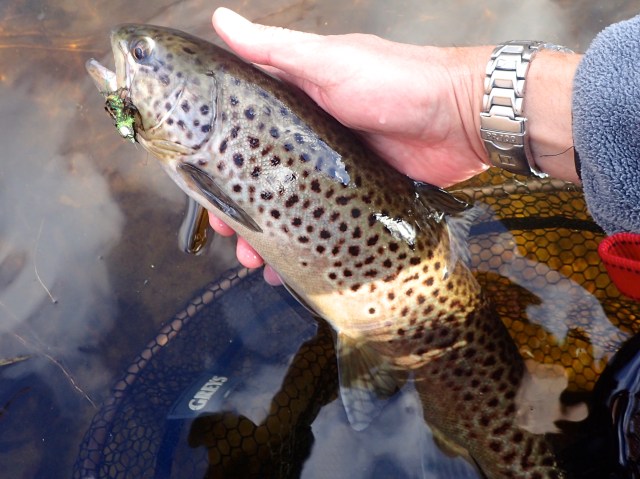
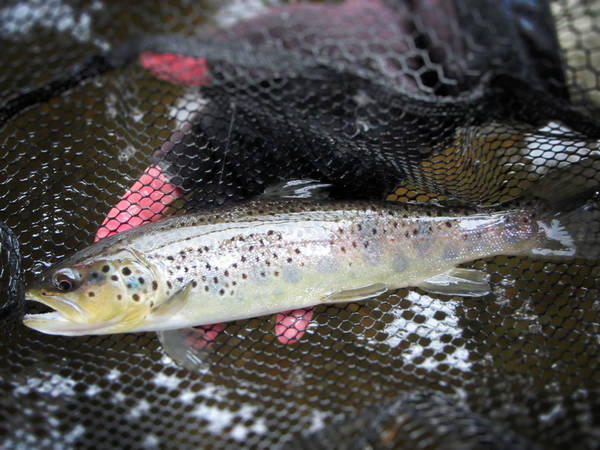
Small flies catch big winter browns on the Farmington. This buck was taken on a size 18, 2x short bead-head Pheasant Tail.

Culton_Winter_Brown2

~

Winter access and gear

Often, the most challenging part of a winter outing on the Farmington is finding a place to park. Only a handful of lots are plowed. Dirt roads are not plowed, and many are gated until spring. During snowy winters, the pulloffs that line East and West River Roads along the TMA are buried beneath an impenetrable hedge of snow and ice. A four-wheel drive truck with good tires and ground clearance will help you negotiate spots a sedan can’t manage. The river in winter doesn’t draw close to the crowds it sees in summer. Still, on a mild day, popular places like Church Pool are likely to be busy.

If there’s an extended cold snap, some of the slower pools will build up shelf ice along the shore. Never attempt to walk across shelf ice to get into the water. While I like to target days when the mercury is above thirty-two degrees, be aware that runoff generated by some of the warmer thaws can send water temperatures plummeting. Extended periods of consistent weather often mean good winter fishing. Conversely, a sudden cold snap is usually bad for business.

Dressing for winter fishing is a matter of common sense: know the weather forecast, and know your body’s limitations. I tend to run cold, so my best friend is my 1,000 grain insulated boot foot 5-millimeter neoprene waders. Breathable layers and hand and toe warmers are essential gear. I highly recommend studded boots and a wading staff – falling in the river is never fun, even less so in January. Remember to get out of the water and walk around for a few minutes every hour to avoid frozen leg/feet syndrome.

An angler patiently waits for risers on a cold February morning.

Culton_Winter_Greenwoods

~

Winter Dry Fly Fishing

Just because there’s snow on the ground – or in the air – doesn’t mean you won’t find a pool that’s simmering with rise rings. The Farmington River has a fairly consistent winter midge hatch. Some of those midges push the size 18 envelope, but when planning your fly selection, think small, smaller, smallest. The tiny blue-winged olives (size 22-28) of late fall often carry over into December. But the real hero hatch for winter dry fly aficionados is Dolophilodes distinctus, the Winter/Summer Caddis.

In the winter, I don’t usually arrive on the river much before 11am. An exception is the W/S Caddis hatch, which is usually an early morning event. Distinctus is appropriately named. They rise to the surface as pupae, size 18-24, then scoot across the water to the shore where they complete their emergence. During this scooting phase, they are highly vulnerable to feeding trout.

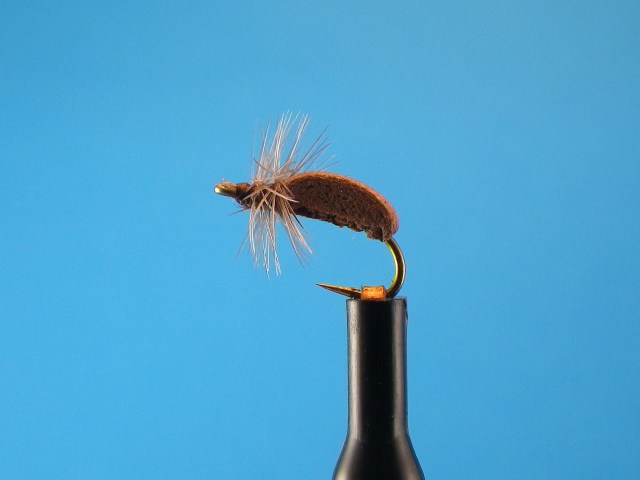
This W/S Caddis Pupa pattern is a favorite of Farmington River dry fly anglers. So simple: dark grey foam body and dark dun hackle, size 18-24.

Culton_Winter_WSCaddis

The trout will always tell you how they want the fly presented during a W/S Caddis hatch. Hedge your bets by targeting actively feeding fish. If you’re not getting any takes with a classic drag-free drift, try going down a size or two. If that doesn’t produce, try waking the fly, replicating the pupal dash across the surface. Sometimes that movement is the feeding trigger.

Winter Streamer Fishing

For years, I never considered fishing a streamer on the Farmington in the winter. Then, one January day, I saw a spin angler take trout after trout on a small jig-head soft plastic. I returned to the pool he was fishing the next afternoon with a full sink (7ips) integrated line and a tungsten cone-head streamer. Needless to say, I went home happy, and now there are days when I am committed solely to the streamer cause.

Deep, dark pools with water moving at a walking pace or slower are the first places I’ll start. Getting the streamer down, and a slow-to-moderate retrieve have produced the best results for me. I stay out of the faster runs, although I sometimes do find willing customers in the transition water at the heads of pools. In shallower runs, I like to let the streamer swing and dangle like a wet fly before I begin my retrieve.

Winter Nymphing/Wet Fly Fishing

Swinging a team of wets through the current seams of a boulder field is a sound spring, summer, and fall strategy. But as the winter cold slows trout metabolism, the dead drift in slower, deeper waters – and the seductive upward swing of the flies – becomes the higher percentage subsurface play. That’s why I like to fish a nymph and a wet on my two-fly indicator setup.

Two flies give the trout a choice: color, size, species, and life stages. Because what is hatching this time of year is typically small, I like at least one of the flies to be in the 18-20 range. Eggs and attractor nymphs certainly work, but I prefer to stick with more natural colors and patterns. Don’t be afraid to include larger (6-12) stonefly patterns in the mix. Because the soft-hackled fly straddles the line between nymph and emerger, I’ll rig that fly higher on the leader so it will always be closer to the surface than the nymph. Keep it simple. A soft-hackled Pheasant Tail or Hare’s Ear will serve you well.

I’m a big fan of indicator nymphing in the winter for two reasons. One, it lets me cover more water. Two, the takes of winter trout can be nearly imperceptible. Sometimes those micro-twitches, shudders, or stalls are the only sign of the take. Look for a reason to set the hook on every drift. As you complete the dead drift phase of your presentation, let the flies swing up. If an emergence is taking place, aggressive feeders will often chase and strike.

An exquisitely parr-marked wild Farmington brown that chased a nymph on the upward swing.

Culton_Winter_Brown1

Where to fish

The Farmington River Anglers Association (fraa.org) has updated its popular book A Guide to Fishing The Farmington River. The guide includes comprehensive river maps and pool descriptions. For daily reports, weather, and water flows, visit UpCountry Sportfishing at farmingtonriver.com.

The Master Splinter mouse fly on the J.Stockard Fly Fishing Blog

The Master Splinter is an impressionistic mouse pattern I put into heavy rotation this summer. You can read all about it on the J.Stockard blog by clicking here.

Mouse flies like the Master Splinter bring out the worst in big Farmington River browns.

Big wild brown hen 8-2015

Shakespearean Steelhead in the Fall 2015 Issue of The Drake

A little angst and black humor, something any steelheader can relate to. It’s called “Steelheading: A Tragedy in Several Acts,” and you can read it in the current issue of The Drake. It makes the supposition that Shakespeare may not have really been writing about Danish princes, Roman emperors, and star-crossed Italian lovers….

Did Shakespeare chase chrome? Let’s find out.

Drake Cover Fall 2015

“Soft Hackles For Striped Bass” in American Angler

The November/December 2015 issue of American Angler hit the newsstands and fly shops last week. “Soft Hackles For Striped Bass” covers some salty soft hackle basics, and features six patterns: three from Ken Abrames, and three from yours truly.  I interviewed Ken for this piece, and there are plenty of good quotes to dig into. As always, I try to go beyond straight how-to and inject a little fun into things. I hope you enjoy reading it.

You can find “Soft Hackles For Striped Bass” by Steve Culton in the Nov/Dec 2015 issue of American Angler.

Nov/Dec 2015 American Angler

“Ten Things Every Beginning Steelheader Should Know” in the October issue of MAFFG

The October 2015 issue of Mid Atlantic Fly Fishing Guide is out, and with it the latest article from the currentseams wordworks. I had a lot of fun with “Ten Things Every Beginning Steelheader Should Know,” and it mixes humor with practical advice. Worth seeking out if you can find it.

The Mid Atlantic Fly Fishing Guide is distributed free at fly shops or available by subscription. It is an underrated gem.

October 2015 MAFFG

~

Cam is still a beginning steelheader, but he does a lot of things right. For example…

Steel Cam 11-24-214

Douglas Thompson talks. The American Fisheries Society listens — and responds.

“The Cost of Trout Fishing,” a recent op-ed piece by Douglas Thompson in the New York Times (Thompson 2015), included several inaccurate statements and fundamental misunderstandings of fisheries management and aquaculture.

Those words are taken from an article recently published by the AFS. Here’s a pdf of the entire article. Note a source citing  some of our own DEEP folks.

AFS Responds to an Op-ed in the New York Times 2015-2

A beautiful winter Survivor Strain brown. Thanks, DEEP, for your excellent work on the Farmington River.

2:14 SS Brown

How to built a wet fly leader for a team of three flies

One of the most frequent questions I get is, “How do you build a wet fly leader?” This material originally appeared in my article “Wet Fly 101: Take the ancient and traditional path to subsurface success” (American Angler Nov/Dec 2013) but I wanted to give it its own place here on currentseams.

At first glance, building a multi-fly dropper rig looks complicated. But basically, you’re just tying three triple surgeon’s knots. You’ll need a 9-foot, 3x or 4x tapered leader for the butt section, and some 4 or 6-pound Maxima (I prefer Chameleon [AUTHOR’S NOTE: I used UltraGreen four-pound in 2014 and it worked just as well as Chameleon]) for the droppers. I’ve tried a lot of different leader materials, and Maxima is by far the best because of its stiffness. I use the 4-pound in lower, clearer flows. 

Wet Fly Three FLy team

Here’s a pdf of the diagram: Three-fly wet fly leader

Step 1: Cut off the bottom three feet of the tapered leader. Discard this bottom section.

Step 2: Knots are not worthy of your trust. Wet every knot before you pull it tight, and test every knot by giving it a good tug. The heat of battle with a trophy trout is a bad time to discover you tied a substandard knot.

Step 3: Tie just over a foot of Maxima to the tapered leader with a triple surgeon’s knot. The bottom of this section will form the first dropper. Trim both tag ends.

Step 4: The ideal length between wet flies is somewhere between 18 and 24 inches; I prefer my dropper tags between 4 and 6 inches. If you’re going to build a dropper rig with the flies 24 inches apart and the tags 6 inches long, you’ll need a 30-inch section (24 + 6 = 30) of Maxima for the next step.

Step 5: Take the first, shorter section of Maxima (the one you tied to the tapered leader) and hold it 6 inches from the end. This will be your first dropper. Join the 30-inch section to the shorter section at this point with a triple surgeon’s knot.

Step 6: Trim the excess of the second section above the knot (the part you trim is on the butt side of the leader). You should now have a dropper tag about 6 inches long, pointing away from the butt, and about 30 inches of Maxima below it.

Step 7: You’re in the home stretch. This is basically a repeat of step 5. Grab the second section of Maxima 6 inches from the end, and join another 30-inch section of Maxima to it with a triple surgeon’s knot. As with Step 6, trim the excess above the knot.

Step 8: You should now have a rig that looks like the one the diagram: two shorter tags, to which you’ll tie dropper flies, and a longer end section, to which you will tie the point fly.

~

Good things happen when you give the trout a choice.

20

Quote of the day: Casting vs. Fishing

If Ray Bergman came back today and saw the endless discussions about casting and distance on internet message boards, he would never stop throwing up.

Bergman knew that it was more important to be a good angler than a good caster. Of course, the two are not mutually exclusive. And it is true that it’s hard to be a good angler if you are a poor caster. But I’ll let Ray take it from here. This is from his book Trout:

“That you cast so well that others compliment you for your skill is not so important, but that you handle the flies in some particular and almost indescribable way may be very important indeed. You may gather from this that I am not particularly interested in perfect-form casting, and that is very true…If you become a perfect-form caster while achieving the necessary results, so much the better; but it is best to concentrate on the other points, rather than on form, and the casting will usually take care of itself. In this connection let me say that some of the best fishermen I know could not be called “pretty” casters, but they do cast their flies so that they act the way they should and catch the fish.”

Fish don’t examine the tightness of your loops, your line speed, or how far you cast. This twenty-pound striper certainly didn’t.

Block Island All-Nighter 20 pounds