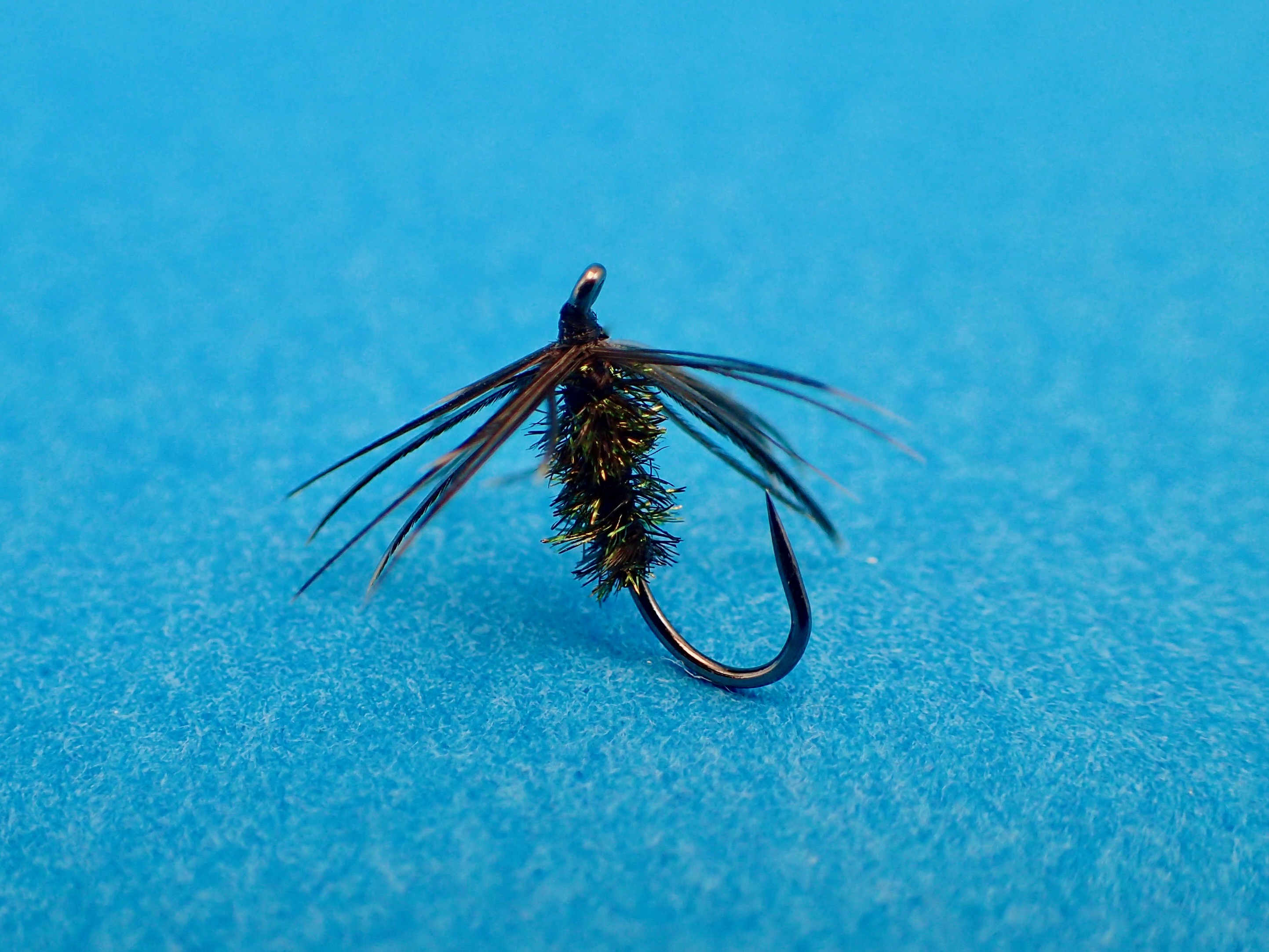
The Breaking Skein Glitter Fly is a Crystal Meth variant created by Joe Montello. I first learned of the fly in John Nagy’s book Steelhead Guide. If you haven’t read it, Steelhead Guide is loaded with productive steelhead fly patterns. Although its focus is on Erie tribs, I can tell you that the Ontario steelhead like the Erie flies just fine.
I’ve changed a few things from the original recipe; you can see what I use in the video. Here are Joe’s original specs:
Hook: Mustad 3366 size 12
Thread: UNI peach 6/0.
Tail: 3 strands pearl Krystal Flash
Body: Fluorescent orange or pearl sparkle braid ribbed with regular white Estaz between each loop of sparkle braid
Many, if not most, modern fly lines come with a factory welded loop for an easy leader connection. The problem is that if you’re using a straight shot of leader material that’s under 40lb. test, the diameter of that leader can cut into the the welded loop while fighting a big fish, trying to free a snag, or inducing any other stress that puts extreme pressure on the connection.
Solution: create a short mono butt section to act as a buffer between your welded loop and leader. I’ve been using a foot-long length of 50lb. or 60 lb. mono. Just tie a perfection loop (here’s a great tutorial from Animated Knots) at both ends, and you’re good to go! I’ve been using this system with my two-handed shooting head for over a year.
The best colors for the Crystal Meth fly are the ones the steelhead want to eat…or the ones in which you have the most confidence.
Debates on the best color for Crystal Meths, egg patterns, and beads for steelhead and trout are never-ending. Everyone has their theories. Everyone has their favorite colors. Everyone can prove you wrong. So I stand by my opening statement. In case you don’t know what a Crystal Meth is (besides one of the best fly names ever, right?) it’s a sparkled-up version of a Sucker Spawn. You can tie them with or without a bead and a Krystal Flash tail. When the steelhead are feeding below salmon redds — and even when they’re not — the Crystal Meth can be a very productive fly. And since they’re firmly in the junk/guide fly category, you don’t fret when you lose one to the bottom gods.
Our Lady of Blessed Crystal Meth — chartreuse — accounted for my only fish on this painfully slow day.
So, what are my favorite colors for the Crystal Meth? Here’s a handy-dandy photo reference chart. I use them all, but if I had to choose a top three, I’d go chartreuse, fluorescent blue, and fluorescent fire orange. YMMV.
Do I guide for striped bass? The short answer is yes. But, these sessions are non-traditional in the sense of a typical guide trip/lesson. The focus is rarely on catching stripers in the moment; rather, it is to prepare you to catch stripers in the future. Depending on time/tide/conditions/season/luck, we may indeed catch some bass. But there is also a high probability that we won’t see a fish.
There are several reason for this. For starters, I do not guide at night. No exceptions. That leaves us with daylight hours, which in the abstract usually means fewer hookups. We’re also in the midst of striper downturn — there are far less fish than there were, say, 15 years ago. I can’t take you to Block Island or Cape Cod, which typically have an in-season abundance of stripers — you’d have to pay for my time and travel, and that would be cost-prohibitive. I’m shore wading only, so we can’t quickly zip off in a boat a few miles away to find the next blitz. Finally, my lessons are usually two hour sessions. Tides and time being ever-changing, that means we may not hit a strong bite window (if we do, good on us!). So, if you’re OK with trading immediate gratification for success down the road, read on.
What do I teach? A lot of good stuff you won’t find anywhere else. Most of you know me as a guide who fishes for stripers in a traditional and (in modern popular practice) unconventional manner. I primarily use floating lines. You should have one, too. My focus is on rigging, presentation, fly selection, and more presentation. You might want to spend a couple hours with me if you’re interested in learning traditional trout and salmon presentations like the greased line swing; how to tie and fish dropper rigs; fishing with multiple flies at or near the surface; reading water; fishing with your two-hand setup (sorry, I can’t supply you with a rod); and plenty of little things that sometimes make the difference between fishing and catching stripers.
I hope this clarifies what I do. My rate will vary depending on location. If you’re interested in setting up a trip, or need more information, please call me at 860-918-0228 or email swculton@yahoo.com.
Not all Gurgler-type flies are meant to be stripped. I caught this handsome Block bass on a dead drift — the Gurgling Sand Eel was point fly on a team of three — and showing you how to do the same is just one of the things I teach.
You’re now at Countermeasure Central on currentseams! Here you can watch the tying video (below); see the original post/recipe; and read the Guide Flies feature piece from On The Water magazine. In case you’re new to this pattern, the Countermeasure is a riff on several proven streamer designs (like the Zoo Cougar and Zonker). It’s loaded with bite triggers, and it’s one of my favorite smallmouth bass bugs. Oh! Big trout love it, too.
I decided to fish the mouth of the Hous for a couple hours simply because I could…and because it seemed like that time of year. I had the place to myself for about 30 minutes, but no love taps were forthcoming. The terminal rig was a Soft-Hackled Flatwing in R.L.S. Easterly colors on an 8-foot leader. It didn’t compute that there were no fish around, so I decided to make an adjustment.
This is the kind of little thing — I know you’ve heard that phrase somewhere before! — that can have huge impact on your fishing. If you know or suspect the fish are there and you’re not catching, do something different. So I swapped out my leader for a 6-foot section of T-11 and a three foot leader. Still nothing. Then, I added a 3/0 shot to the leader just above the fly. Next cast, bang! Then another two casts later. This made me happy.
Sometimes it’s the little adjustments that make the biggest difference. This single shot, clamped on with pliers, resulted in an immediate hookup.
You might think that this is how the story (happily) ends. But no. After those two fish, I went a good half hour without a tap. I have to confess that this kind of fishing holds little interest for me, even less so when the bite is off. But since we’re talking about adjustments, how’s this: go from dredging the bottom to skating on top.
Many years ago old friend Ed Simpson exclaimed, as we fished a spot not too far from where I was wading, “Make ’em come up!” Off came the full sink tip and shotted fly, on went the longer leader and a Gartside Gurgler. First cast, splash, boil, whack! Then another. And another. These fish were sporting the colors of bass not fresh from the sea, but rather those of winter residency. Not very big, but I love any striper that displays that marauding spirit. Many anglers think of fishing surface bugs as an active presentation, with the fly in constant motion, but every one of my hits came on the pause (see this post for more on varying your strip cadence).
My last adjustment came as the action and tide waned. I noticed a far sexier rip, abutted by a slick, 150 feet downriver. So I waded down, made some casts, and caught some more. And that, dear reader, brings us to our happy ending.
One of my goals with currentseams is to help you become a better angler — and hopefully catch more fish. So if I could somehow distill a “Top Ten Tips” out of my brain’s fly fishing storehouse, one of them would certainly be: Learn presentations other than cast and strip. Especially if you want to catch more stripers.
When I see questions like, “How fast do you retrieve the fly?” or “Do you strip with one or two hands?” — and I see these questions a lot — I despair. Rarely does anyone ask the question, “Does it have to be a retrieve?” The answer would open many doors to greater fish-catching glory.
Even if you were going to fish for stripers using only retrieves — and there are many outings over the course of a season where I do just that — there are an abundance of retrieve options that are rarely used or discussed. For example, for sand eels, I like a hyper short (1-2″) rapid pulsing strip. For a large squid fly like the Mutable Squid, I like a slow hand-twist retrieve. Last week I fished a large deer-hair head fly with a fast strip-strip-strip-strip….pause….wait for it….then strip action. And there’s always the surface popper trick of landing the fly with a splat….then doing nothing. Once the landing rings dissipate, give that bug a twitch. You could present in randomly timed, spaced, and distanced strips, creating the drunken action of wounded prey. The list goes on. And the stripers will always tell you when you get it right.
Ultimately, you’ll need to learn presentations other than cast-and-strip for those outings where the stripers will not chase. One of my recent trips included a puzzle where school bass were cruising and feeding, but would not move to a stripped fly. The answer was found within traditional salmon presentation tactics. Those willing to invest in the floating line — I’m not talking money, but rather in taking the time to learn how to harness its power and master a few basic presentations — will see their catch rates soar. And while you’re at it, pick up a used copy of “Greased Line Fishing for Salmon [and Steelhead] by Jock Scott.
Fly fishing is all about line control. So take charge. Presentation is not difficult to learn. Remember that a fly rod and line is only, as Ken Abrames once observed, “a stick and a string.”
Learn presentation and start bringing your fly to the fish — not vice versa.
You may have noticed this year that there weren’t many Housatonic River smallmouth reports on these pages. It wasn’t for a lack of effort from your humble scribe. I believe I fished more days this summer for smallmouth than I have since I started seriously pursuing them (in 2016). So why did I go dark? Part of it was people — and anglers — everywhere. And anywhere. I ran into anglers in places where I’ve never seen a soul. Finding a parking spot was, at times, impossible. Part of it was the drought, which made for challenging conditions. And part of it was that in terms of size and especially numbers, this was by far the worst year I’ve had fishing smallmouth on that river.
One late July night illustrates this last point. I fished a favorite mark that was, to my delight, devoid of other anglers. I hit the White Fly hatch perfectly — in fact, I’d rate this as one of the top three blizzards I’ve ever experienced. The surface should have been boiling with frantic rises — dozens per second. Instead, I could easily pick out an occasional lonesome rise ring here and there. The lack of bass on the bugs was both extraordinary and discouraging. What’s worse, what was rising was small. Not a bruiser in the bunch.
At least the dragonflies had a good meal.
Since the fishing was awful, and — this is important — every year is different — I decided that I would embrace different. So I explored. I fished new water. I tried new flies (like Wigglies and Barr’s Meat Whistle). And I tried new methods (like indicator nymphing and dead drifting crayfish patterns along the bottom). These efforts will pay off handsomely in the future. So, 2020 wasn’t the year we wanted it to be. But we can take comfort in the hope and promise of 2021.
I mentioned earlier this week that the short film Striper Moon — A Legacy will soon be available on Amazon Prime. I’ve been busy with some video projects as well. On Wednesday, we shot home interview and fly tying footage for director Matthew Vinick’s film on Farmington River dry fly fishing. We covered stuff from hatches to our day on the river to the Survivor Strain program, and I also tied up a classic Catskills Light Cahill dry. I’ve seen a rough cut of my segment, and it doesn’t suck! I’m very excited to be involved with this project.
The title of the film is Summer on the Farmington. Matthew Vinick and John Kosmaczewski are partners on the project. Here’s a low-res still, taken from video, of me doing battle with a high-teens Survivor Strain brown. That’ll put a bend in the old cane pole.
~
Last but not least, I recently shot footage for a step-by-step video on the Countermeasure. Just gotta edit and do voiceover. Coming soon!
Hot on the heels of yesterday’s scathing menhaden management commentary comes a shout out to the Connecticut members of the ASMFC. This is from a post made by Charles Witek on Facebook: “The New England states are worried about lobster bait. Virginia is worried about Omega. Everyone is worried about cutting fishermen’s income. It’s probably no coincidence that–with the exception of Connecticut and Rhode Island–the states seeking a larger cut in menhaden landings were southern–North Carolina, Georgia and Florida–which have neither a lobster fishery nor a big menhaden fishery. Connecticut made a noteworthy effort to convince the Management Board to do the right thing, and Rhode Island has long been a leader for better menhaden management. Folks in those states–particularly in Connecticut–ought to thank their fisheries managers if they get the chance.” Huzzah! If you want to send them a thank you email, you can find their contact info here. Please comment here if you send an email!
On to striper fishing. I’ve spent a significant amount of time this fall learning a new mark. The going’s been slow, but on Tuesday night I finally had some action — about a dozen hits, and the water was so calm I could also see several follow-the-fly wakes. Nothing big, but the big fish potential remains. Then there was last night. Specifically, the fog. It came in on big galumphing herds of elephant feet. We’re talking horror-movie density fog. I hate fishing in fog. With a few notable exceptions, it’s always been a bite killer. And so it was last night. Still, I got to stand in the ocean and fish and smoke a cigar and you know, that ain’t all so bad…
If there is a defining line between heavy fog and actually rainfall, I think we reached that threshold.