If you’re heading away for the weekend, I’ve got you all hooked up for some drive time listening. Or maybe you just want to sit back at home and listen. Long drive to the river on Saturday? Whatever! You can listen to “How to Swing Soft Hackle Wet Flies With Steve Culton” here. My segment starts at 42:39. Many thanks to Orvis and especially to Tom Rosenbauer for letting me play. This was a lot of fun, and I hope it helps.
This is the cover shot from a presentation I made last November at the International Fly Tying Symposium. That bug is about as soft hackle as it gets.
Wicked sarcasm aside, I am delighted to report — in case you have not yet heard — a major victory for striped bass conservation. We — those who understand the calamitous state of the striped bass fishery and the need to manage the resource sustainably — won, and won big. This week the ASMFC’s Striped Bass Board approved two historic actions to conserve the prolific 2015-year class and to improve the probability of rebuilding the striped bass stock by 2029. The Board initiated Addendum II and enacted an Emergency Action, which will implement a 28-31” slot for the entire coast effective as soon as possible and no later than July 2nd, 2023.
A hale and hearty thank you to all who have been sending in letters and emails and making their voices heard!
Here are more details, taken from a release from our friends at the American Saltwater Guides Association:
“The Atlantic States Marine Fisheries Commission’s Striped Bass Board Takes Decisive Action to Ensure Striped Bass Rebuild by 2029
ASGA applauds The Striped Bass Board’s unprecedented action to implement emergency action to address 2023 fishing season.
Arlington, VA—Earlier today, the Atlantic States Marine Fisheries Management Commission’s Striped Bass Board approved two historic actions to conserve the prolific 2015-year class and to improve the probability of rebuilding the striped bass stock by 2029. The Board initiated Addendum II and enacted an Emergency Action, which will implement a 28-31” slot for the entire coast effective as soon as possible and no later than July 2nd, 2023. Development of Addendum II will progress throughout the summer, but the included language has great promise. Had the Board not acted today, the odds of rebuilding would have remained unacceptably low at around 11-15% due to the dramatic increase in recreational harvest in 2022. While the road to striped bass recovery is still a long one, the Board’s strong conservation-minded action today can give the entire striped bass community hope that this stock will rebuild and that the Board can make the hard but necessary decisions to manage striped bass.
ASGA is incredibly thankful for the thousands of anglers, brands, and fishing guides who spoke up for the health of the stock and called on the Striped Bass Board to take action. The Striped Bass Board was not required to make any changes today—the Board’s action today represents an incredible moment for conserving and effectively managing the striped bass fishery.
“The conservation community spoke, and our voice was heard”, said Tony Friedrich, ASGA’s VP and Policy Director. “Fisheries management is a long arduous process. Science informed us that there was little to no chance of rebuilding the stock under the current system. We unified the community with one voice that demanded a better future for the resource and our children. Thanks to every angler, brand, and guide who spoke up and to the conservation-minded Striped Bass Board members who voted for the health of the resource.”
Over the next few months, ASGA will continue to monitor and provide updates on the ASMFC’s work on Addendum II. Rest assured, the striped bass stock is in a far better place today than a month ago, but it is far from rebuilt and out of the weeds. Thank you to everyone who shared their voice throughout this process and to those on the Striped Bass Board who took the bold step to ensure this iconic species remains on track to rebuild. ASGA will be following every step of the Addendum II process this summer and keep the entire striped bass community updated.
I’m excited to tell you that today I’m going to be recording a future episode of the Orvis Fly Fishing Podcast with Tom Rosenbauer. I’ve only recently met Tom, but I’m a little beyond thrilled to have this opportunity. We’re going to be talking about tying and fishing wet flies. Of course, I’ll let you know about the release date. Off I go to prep…
That’s all the time I had. But there’s a certain comfort in having a time limit. It forces you to keep moving. To spend more time with your flies in the water. And if you feels the pangs of regret over pools not covered and fish not caught, there’s always next time.
It was a lovely, sunny afternoon, albeit with a slight chill in the air. The water was perfect: dropping after the weekend’s downpours, just a tinge of color, nice and cold. There were the ubiquitous midges, BWOs sz 14-16, and some caddis. I fished with a dry/dropper and a small tungsten bead jig. Although I had a few slashes (and one landed) on the dry, the natives showed a clear preference for the jig. I had great success in deeper, darker holes, and along shaded cutbanks.
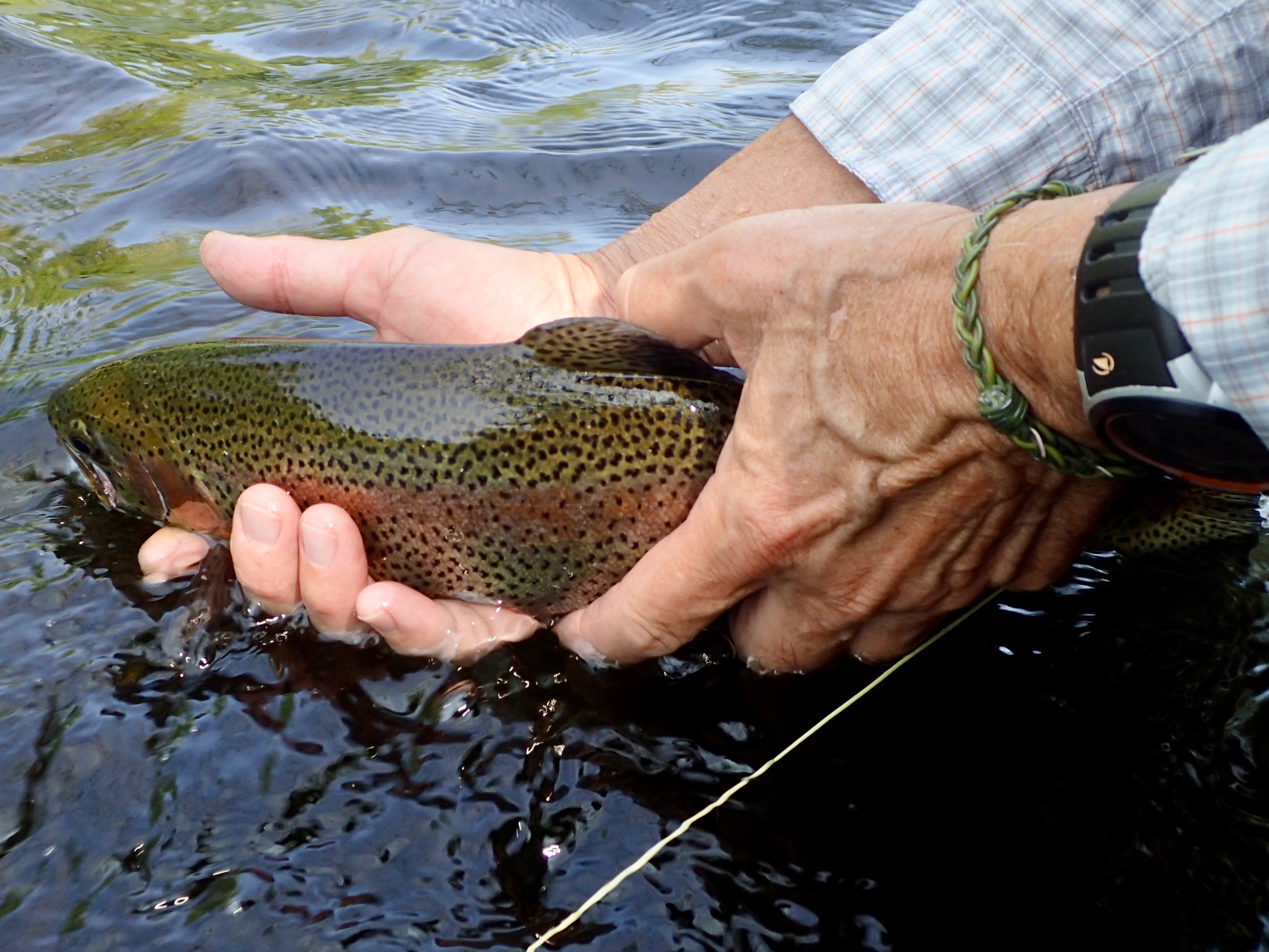
When I began, it was all BWO duns. But by the end of the trip, I started to find spinners. I love finding the same mayflies on small streams that I see on bigger rivers. Now, to find some risers…The skunk cabbage is asserting itself in the moist bottoms of the woods. I ran across these on my hike out. Anyone know what they are?The less photos you take, the less stress you place on the fish. I encourage everyone to Take The Wild Trout One Photo Challenge when fishing small streams. You get bonus points if you keep the fish’s gills submerged.
Apologies for the short notice, but this needs your attention today. It only takes a couple minutes. Here is the link to sign. And below is a simple outline of the issue from the ASGA.
It is clear that some areas experienced excellent striped bass fishing last year. The good fishing was a result of one of the most prolific year classes on record reaching maturity. This translated into over 35 million pounds of striped bass harvested coastwide.
ASGA had deep concerns that the slot limit would fully exploit the robust 2015-year class when it was proposed. These concerns are now a reality. The 2015-year class is the last robust recruitment year. While the 2017 and 2018 year classes are average, there are four consecutive years of the lowest recruitment in recent history following. This leaves the stock and those that depend on a healthy striped bass population in a very dangerous place.
Amendment 7, which was just approved and implemented in May 2022, clearly states that the stock must be rebuilt within 10 years. This current rebuilding plan has failed. The 2022 MRIP harvest numbers showed that harvest doubled and decreased the probability of rebuilding to 14%. This is unacceptable to our community and clearly violates Amendment 7’s rebuilding provisions.
The American Saltwater Guides Association will be submitting an official letter (PDF link) to the ASMFC Striped Bass Management Board on Tuesday, April 25th.
We are asking only that the Striped Bass Management Board follow the rules it established. A new rebuilding plan that has a minimum of a 50% chance of success must be initiated, and those regulations need to be in place by the 2024 season. Addendum II would develop and institute new regulations, providing a better chance of rebuilding the stock by 2029.
I guided Jordan and Chris on Thursday and we started off on the lower river. Given the recent cold, dank weather, I was hoping the morning sunshine would kick-start some bugs, but that was not the case. We plugged away with nymphs, fished drop-shot under an indicator, and although both anglers hooked fish, I wasn’t happy with the action. So we moved upstream to the PTMA.
Jordan landing his first real Farmington River trout. He did well, prospecting in a seam adjacent to the one I’d shown him. It was a spunky rainbow that ate a size 14 Frenchie variant.
The next task was getting Chris into some fish. I took him to the same slot where my client Jason had had success the day before, and the fish were still there. Chris did a good job getting his nymph rig where it needed to be, and he was rewarded with multiple hookups. Around 2:30pm, creatures began stirring. This was to be the first major Hendrickson event of the year for me. I hustled down to Jordan’s position and re-rigged him for wet fly with a simple two-fly team. Our Blessed Lady of the Soft Hackle smiled upon us, and Jordan banged up a hefty brown on the dangle. I left Jordan to swing away, and rigged Chris for dry fly. I tied on a Usual, one of my favorite Farmington River patterns, and we got to witness one of those epic Hendrickson dry fly eats: a perfect drift in the feeding lane, the trout committing to the fly, white mouth agape, and the turn with the hook buried in its jaw.
While there were plenty of stocked rainbows and browns in the mix, there’s something about the Hendrickson hatch that brings out the wild things. Here’s a lovely some-teen wild brown with unique spotting on the pectoral fins, taken by Chris on a dry fly. Nice work, fellas!
Friday was play day for me. I found some space in the lower end of the PTMA, which delighted me no end because Friday was sunny and warm and the kind of day that especially draws a crown this time of year. Unfortunately, it was also blustery, and the gusts sent a torrent of tree seeds into the water. To make matters worse, the seeds were about the size and shade of a female Hendrickson, so I made sure my wet fly team had darker flies. It was a bittersweet afternoon for me because I ended up in some water that was a netherworld of activity. Plenty of rises below me — but two anglers, too. Plenty of rises above me — but same angler density. I managed to take several fish on wets using an upstream presentation (and I slipped in a couple downstream victories as well). What was significant about this was the fly the fish ate. On my three fly team (Squirrel and Ginger top dropper, Dark Hendrickson soft hackle middle dropper, Dark Hendrickson winged wet on point) the only pattern the trout ate was the middle dropper. When the hatch indicated that I should switch to dry (the trout will no longer show interest in the subsurface fly) I had one of those days where there were so many duns on the water, I had trouble getting the trout to find my fly. I consoled myself by watching the sheer number of naturals that didn’t get eaten. And the trout that I did hook made those successes seem sweeter.
The version I used had a brown partridge hackle fiber tail, rusty brown thread dusted with DRC spectrum dubbing, and a brown partridge feather.
Many thanks to everyone who shared the water (Jack and Dennis, you should have stayed a bit longer!) and to those who came to say hello. I hope the flies I handed out served you well.
Yesterday and today saw a strong showing of Hendricksons in the lower end of the PTMA. On both days the duns started to come out in force around 2:30-2:45pm. On both days the best of the action was over by 3:30. As always, savvy anglers will fish under the hatch until the wet fly no longer gets eaten. The trout will tell you when it’s time to switch to the dry. A more detailed report to come this weekend…
Given the cold, blustery conditions, cloud cover, and total lack of hatch activity (well, OK — I did see one tiny BWO and we witnessed one rise), Jason picked a good day to cover drop-shot nymphing under an indicator. We fished two marks within the PTMA and one below it, and fishing trout that wanted to eat was a challenge. Jason was a great student and asked plenty of questions. He’s going to do well. As always, when the nymphing is tough, you’ve got to move around, cover water, manage your drifts, and figure out where the fish are holding. Look for a reason to set the hook on every drift. Set hard, sweeping low and downstream. I can be discouraging when you’re doing everything right and have nothing to show for it. But, the generally persistent generally make out. Well done, Jason!
A bent rod and a focused angler, or: Things a guide likes to see. Things really haven’t picked up this week, but hopefully the warmer weather on Friday will give the bite a boost. I had Jason test-driving a new nymph today, and I’m happy to say that it worked.
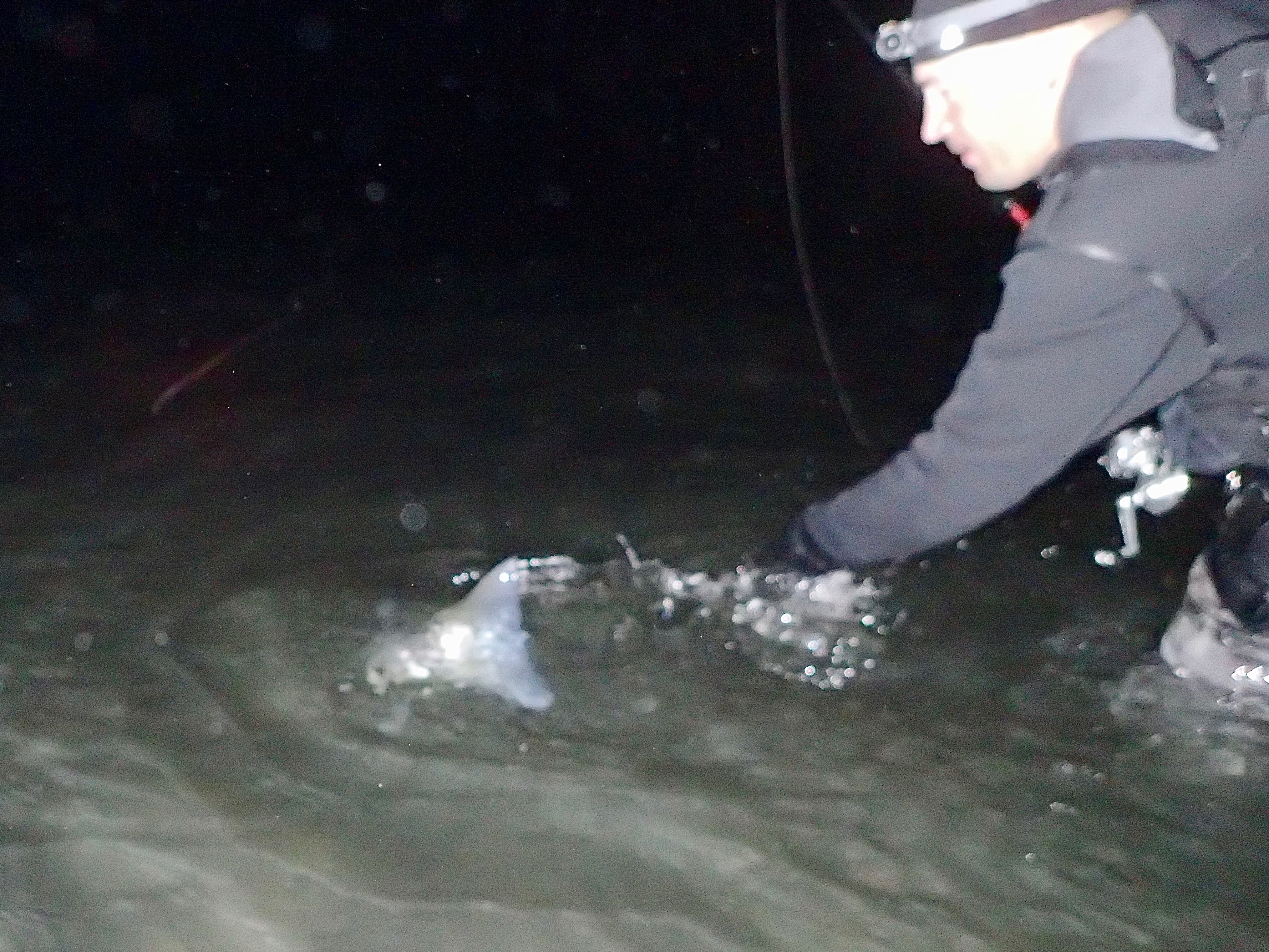
On Sunday night I fished with surfcaster extraordinaire Toby Lapinski. We were after stripers that were after herring. I had a bump after a few casts. After a few more, I had a take with some head shaking and thrashing, and after a few seconds I had…nothing. No big deal as the fish didn’t have any size. I’d like to tell you that the night ended happily ever after, but that was it for me save a snagged herring. Toby got into a window of opportunity and connected with a few bass, landing one that was sub-slot, and one that was well over slot. Nice! I’d decided to fish elsewhere, so I missed it. Why should my spring striper luck change now? To add to my woes I stayed out way too late. Glory days are coming. But when? Yes. I know. After.
I’m guiding tomorrow, so today I bounced around the Farmington River looking for fish. I was on the water from noon to about 4pm. I hit five marks in the PTMA down to Unionville-ish and hooked up in three of them. However, it was a fish here, a fish there, and long stretches of nothing. It was hours before I saw a bug, and the bite was correspondingly slow. The cold air and rain showers and gusty wind didn’t help. I didn’t see another angler hook up all day. I saw a handful of small caddis, a few size 14 BWOs, and a couple stray Hendricksons. No risers.
Thanks to the currentseams readers who said hello today! This is good time to remind everyone to please come say hello. You’re not bothering me, and it’s good feeling to put faces and voices and smiles to names.
Today’s method was drop-shot nymphing under an indicator. I fished a BH Squirrel and Ginger size 14 on point with a size 18 Starling and Herl dropper. Every fish came on the BHS&G until the sun came out…and then it was every fish on the S&H. Droppers are a wonderful way to give the trout a choice.
A check of my records confirms it. By this date in 2018, I’d already landed a double-digit number of bass 10 pounds or greater. (And some of those were significantly greater.) This year, not so much. Not at all, really. I have yet to land a striper. I’ve only hooked one. The rest have been random nips and swipes from dinks. Where have all the big striped bass gone?
I have a couple theories. The first is that they (nor their smaller brothers and sisters) never settled into this mark for over-wintering. That explains the painfully slow fishing from January through now. The second is that absent any substantial number of over-wintering fish, there would now need to be a reason for them to be there. (Read: bait.) And the herring are in late this year. Wednesday night was the first time I saw any signs of those wonderful oily baitfish, and the stripers hadn’t yet got the memo. It’s not just my mark. I have a reliable report of another herring factory estuary that is currently infested with Alosa and there are — wait for it — zero bass on them. So we’ll wait for the next tide cycle for the chance to catch bass that can be measured in pounds.
Greased line swing fans take note: the only action I’ve had has come when I’ve been stripping the fly in at the end of the drift. Small bass will chase. Large bass won’t.
It’s been six months since I did something like this. (Insert heavy sigh here.) Photo by Toby Lapinski.
My smallmouth season doesn’t typically start until sometime in May. Not this year. Yesterday I went to explore a tributary of the Connecticut River, two marks I’d fished once, and one new one. Even though the water is fairly low, there was substantially more of it than the one time I fished it last June. The first mark gave me little current and stained water; no bites. The second held a few ginormous carp swimming around in lazy circles. Still a light stain, but more current. Easily some 20-pounders in the mix. It was at this mark that I hooked my first smallie of the year, about 13″. The last spot was not only a trying-to-catch expedition, but also to see if any fish had come up to prepare for the spawn. I know, a little early, but nature is always right on time. I didn’t see any signs of beds; I saw one smaller fish, and hooked another. I felt like that was a good way to spend two hours.
I hope you’re enjoying the weather. Me, it’s a yard work weekend. So I’ll be out, but not really enjoying it…