Turning Gray-Green Water Into Red Wine

There was nothing miraculous about it. I simply switched liquids. Let me explain.

I had an invite to a casual gentlemen’s (gentlemen being used in only the broadest terms) dinner at my brother-in-law’s Friday night. He was baching it for the weekend, and a few of us were gathering to enjoy the pleasures of food and wine. Since Ye Olde Striper Spot was on the way, I figured I’ve give it an hour before I made my way to Kevin’s house.

A cold front had moved through, bringing with it torrential rains and a biting easterly wind. The water was the aforementioned colors, stained, high, and chopped to pieces by the broadside gusts. To make a long story short, I saw one striper landed in 55 minutes of fishing, and that by a spin angler who was bombing casts a ‘way out there.

So, I decided, if I cannot catch stripers this evening, I shall now drink spectacular wine.

First, you need a brief introduction to Kevin. Kevin is passionate about wine the way I’m passionate about fishing. Which is to say it rules his life. I am likewise vino-infected, but only fractionally compared to Kevin. He has a stupid good wine cellar, and the only thing Kevin loves more than his wines is sharing them. Luckily, I am on the A-List.

The first wine we made love to was a 1999 Opus One. I certainly can’t afford it, but it is opulence in a bottle. If you’ve had it, my next sentence will blow you away: It was my least favorite wine of the evening. Of course, that’s like saying Giselle Bundchen isn’t as attractive as Brooklyn Decker. It’s all a matter of personal taste.

Image

Next on the decadence docket was a 1997 Niebaum-Coppola (yes, as in Francis Ford) Rubicon. Utterly spectacular. We all thought that there was just a little more there-there than the Opus. Sorry, Bob and Phillipe.

Image

I have to tell you at this point that I make a Tuscan-style steak that most definitely doesn’t suck. How much does it not suck? One of the guests had told Kevin that he wasn’t coming unless I was going to be manning the grill. (Isn’t that right, Joe?) It’s a simple combination of NY strip and flame and garlic and salt and pepper and olive oil and fresh rosemary and lemon juice. The wine we drank with it was a 2001 Fontodi Flaccianello. Wine Spectator only gave this bottle a 97 — churls — but if there is a more perfect bottle-to-food pairing, I have yet to experience it. The bite of the lemon and the rosemary and the texture of the beef melt seamlessly into the wine as it fills your mouth. I have goose bumps just thinking about it now. Absolutely stunning wine. My favorite of the evening.

Image

Last but not least, a humble little 1998 Ornellaia to go with our pasta and sausage and veal. Since I can’t afford this bottle either, it was wonderful to create the illusion between sips that I was independently wealthy and dining in a private little restaurant in Bolgheri.

Image

I don’t recommend that you drink several glasses of fine red wine and then go fishing. But the other way around — now that’s something I can heartily endorse.

Industrial-Strength Wild Browns

Not all trout streams are created equal. There may have been a time when this one could have been called pristine. But that was a good industrial revolution and dozens of deserted factories ago.

This river may have hit every branch on its way down the ugly tree, but it is not without its charms. If you can get past the cinder blocks, broken glass, and discarded aluminum siding, you’ll find ducks. Plenty of invertebrate life. And wild brown trout.

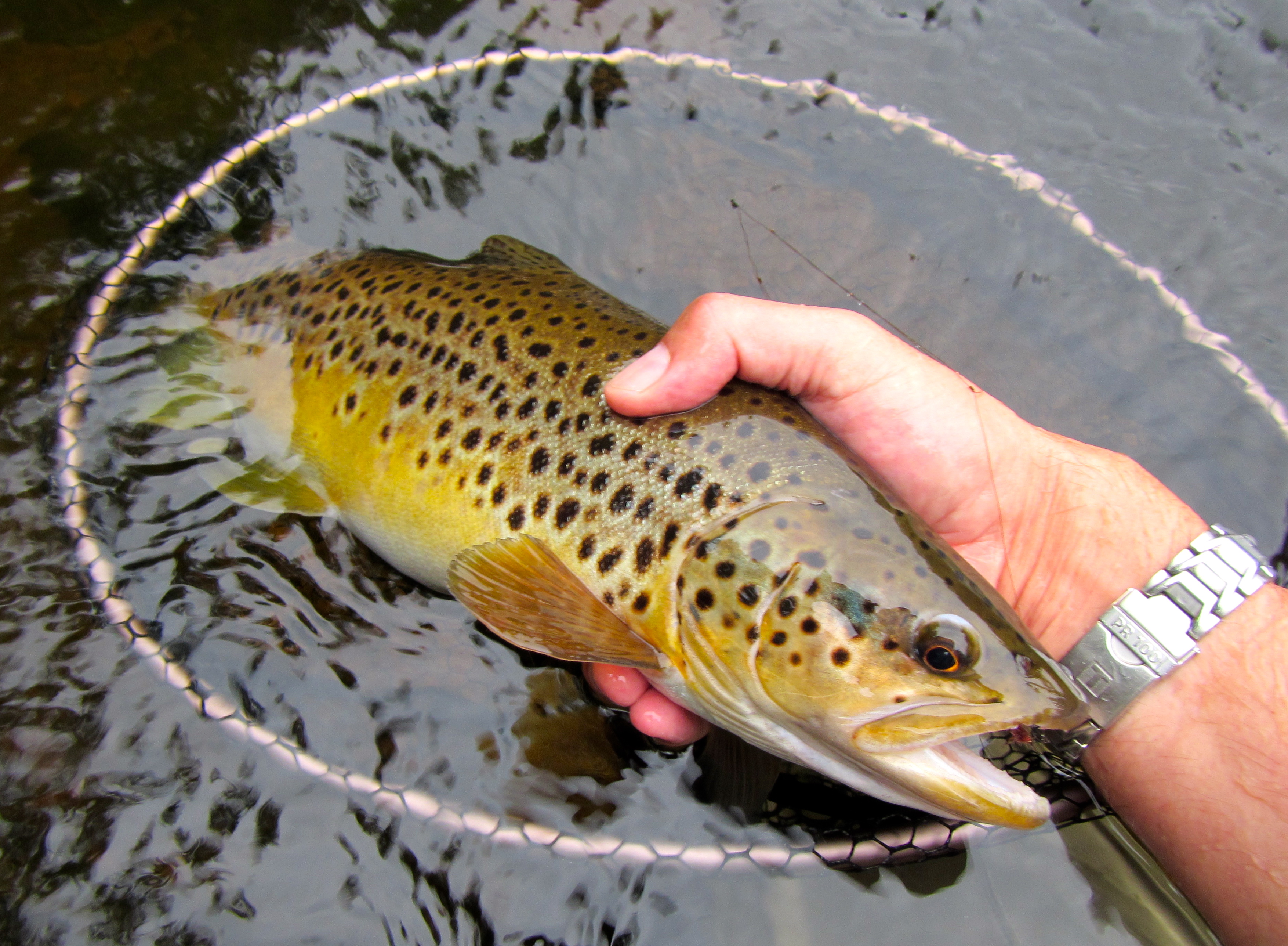
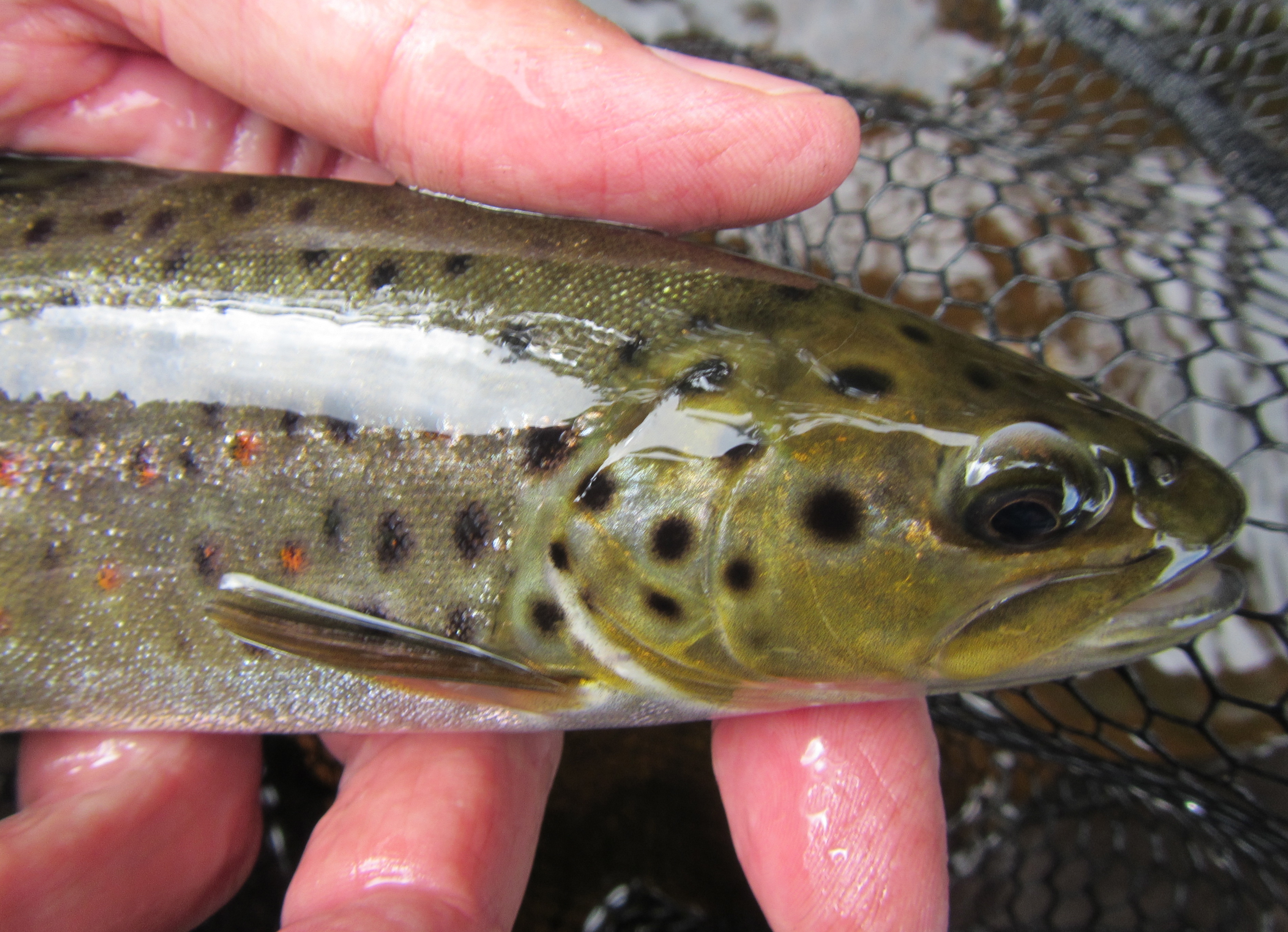
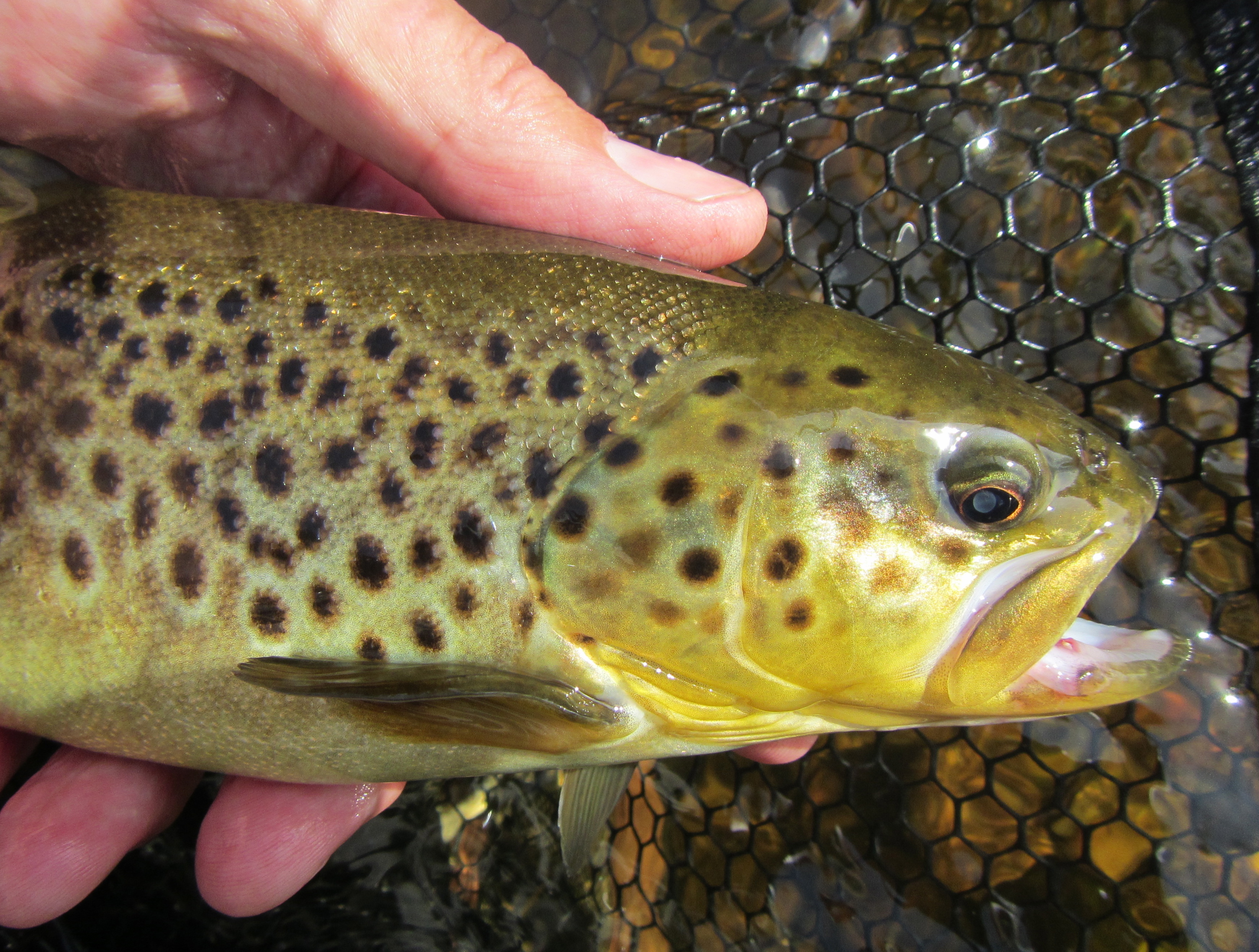
Just look at those pecs. Someone’s been working out. My best fish of the day.

Image

I had originally planned to go striper fishing today, but unfavorable reports, unavailable cohorts, and a nasty south wind put that idea to rest. Still, I needed to fish. So I decided to head over to a Class 1 WTMA. Before this past March, I hadn’t fished this stream in years. Buoyed by my success 10 days I ago, I thought I would explore it a little further.

Nothing says “wild trout” like urban factory blight. You could hit this building from the stream with a good enough cast.

Image

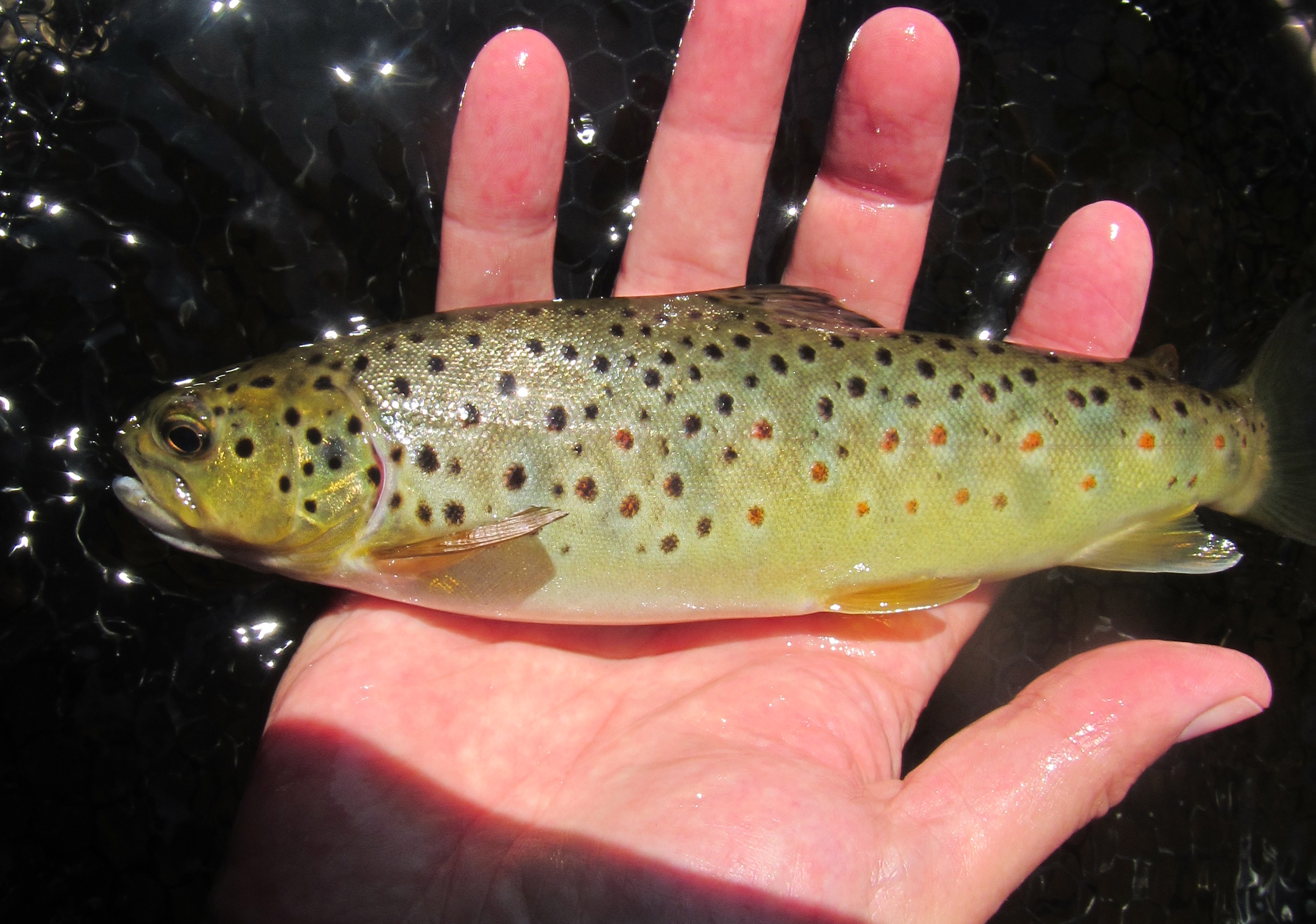
Second cast, and I was into the fish pictured above. Today’s fly was a white beadhead min-bugger, and this lovely brown clobbered it on the downstream strip. It’s funny how you find fish in the same sections of river over the years. This one was sitting in — where else? — a current seam. I took a few more smaller fish in parts below, then headed up to another section.

I find that old heater hose gives any fly fishing experience that romantic je ne sais quoi. Don’t you?

Image

That was a mistake. Most of the river was densely overgrown with saplings that made even roll casting impossible. The bottom was covered with fly-eating branches and in one pool, some kind of evil magnetic-to-tungsten bead flies metal grate.  By the third snagging encounter, I decided to pack it in.

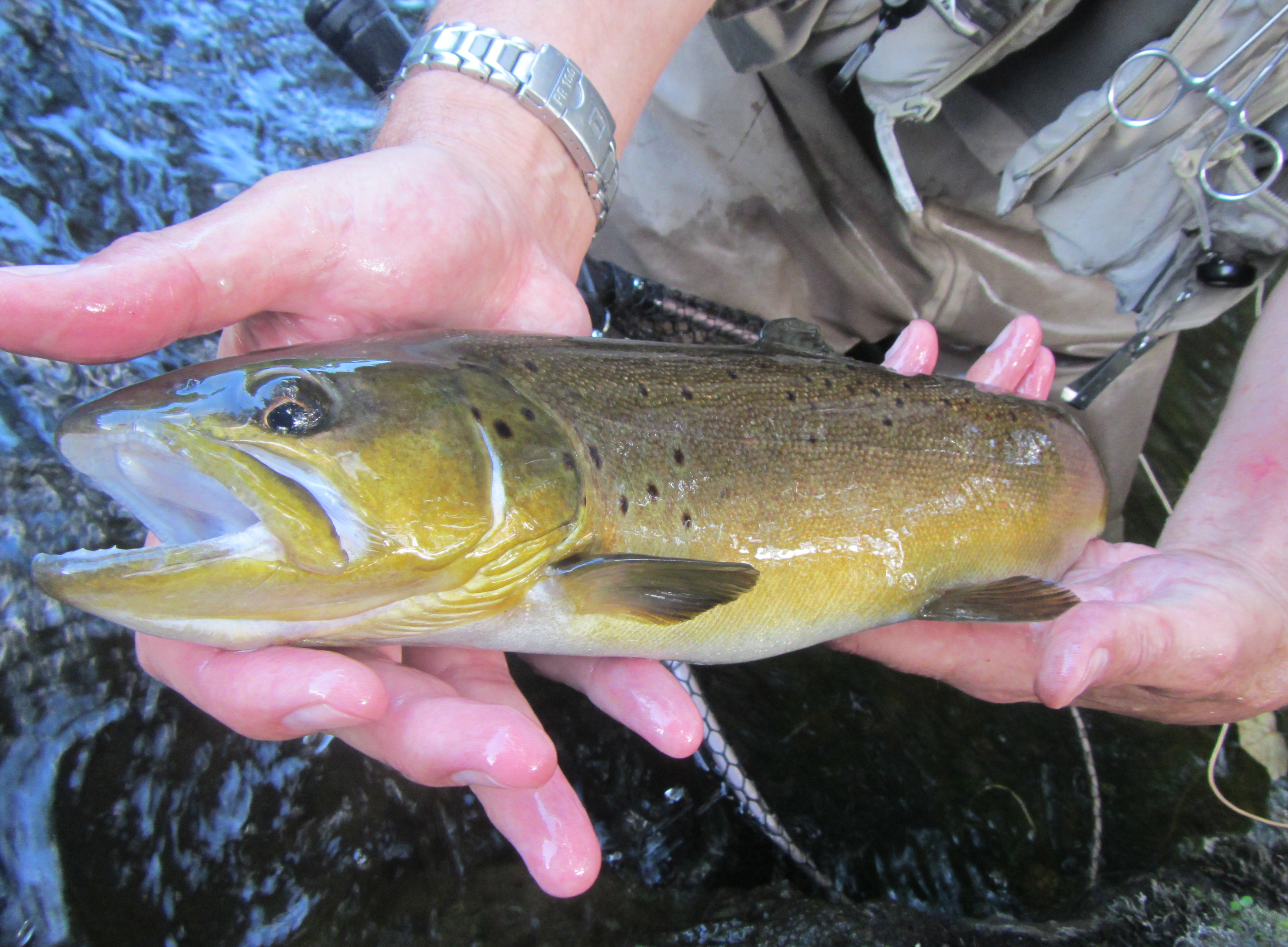
I did notice that the suckers were in for spawning. There was also a strong midge hatch. Most of all, there were gloriously-colored wild browns, alive and well in living in their own little version of paradise.

Beauty truly comes from within.

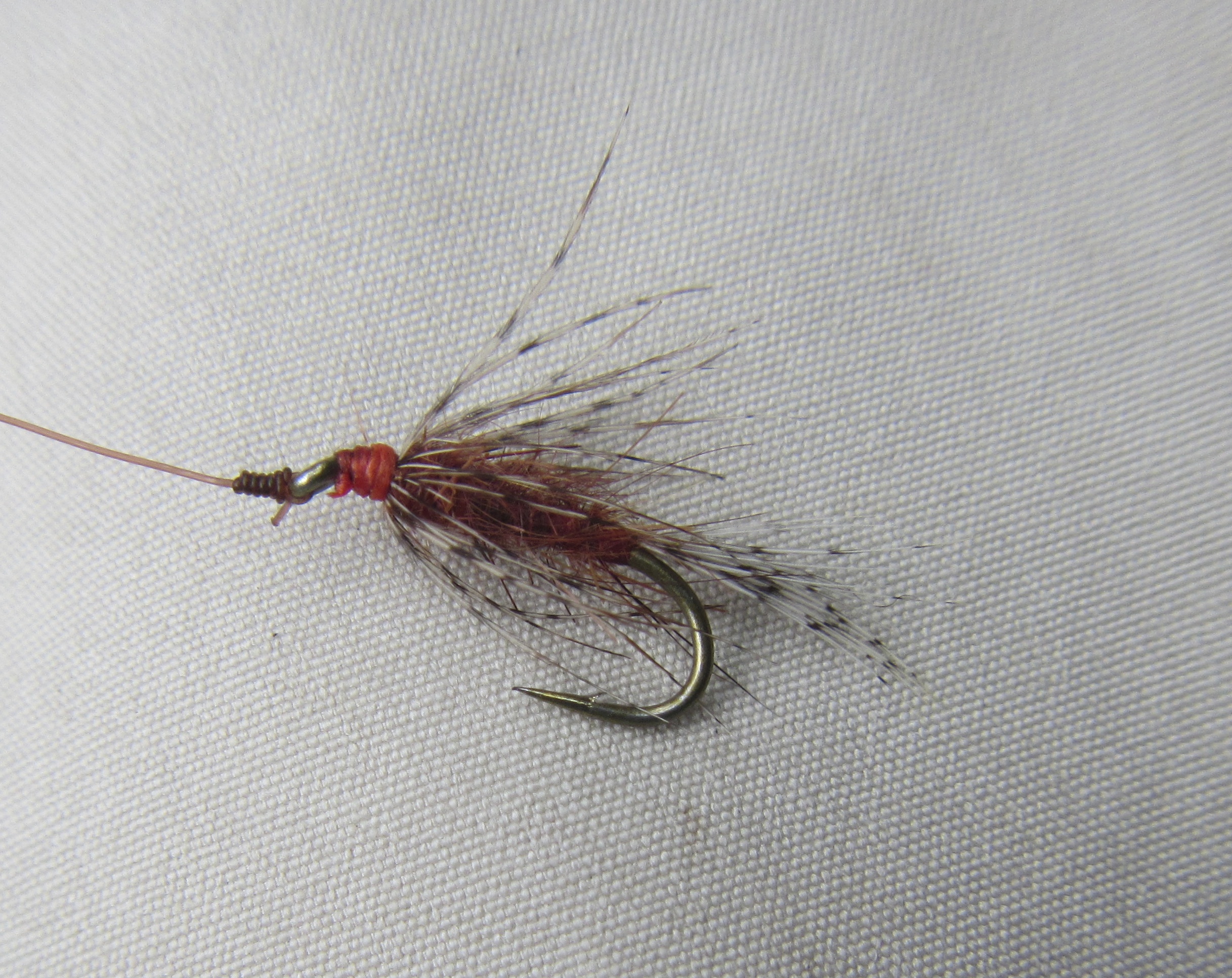
The Squirrel and Ginger Caddis Emerger

When it comes to soft-hackles, feathers get all the juice. That’s perfectly understandable. But certain furs – like fox squirrel – make excellent hackling material. The results are often deliciously buggy.

This humble creation is something I made up a few summers ago. I took the Ginger Caddis Larva fuzzy nymph and swapped out the standard wet fly hook for a 2x short scud hook. Added a flashy rib. And replaced the rabbit fur thorax with a hackle of fox squirrel.

The first time I fished this fly was on a brilliant July day that was devoid of hatch activity or rising fish. The sun was high, the air was steamy, and felt a little foolish for making the drive to the Farmington. Until I started hooking fish after fish on this little caddis emerger. It was the middle fly in a team of three, and the trout stated in no uncertain terms that this was their favorite.

The Squirrel and Ginger is a fine introduction to fur-hackled flies. It is fairly easy to tie. Best of all, it’s a wet fly you can have confidence in.

The Squirrel and Ginger

Image

Hook: TMC 2457 (2x strong, 2x short scud) size 12
Thread: Orange or hot orange
Body: Ginger Angora goat
Rib: Green Krystal flash
Hackle: Fox squirrel fur
~

The Squirrel and Ginger Rogues’ Gallery

7/8/13, Farmington River

Brown Buck 7:8:13

4/24/13, Farmington River

Bigbrown hen

7/31/13, wild brown, Farmington River

WIld Farmy Brown 7:13

4/29/15, 17″ holdover brown, Farmington River

Fat Farmy Hen 4:15

Two-handed casting practice.

You don’t know if you don’t go, so this morning I headed to Ye Olde Spring Striper Spot to see what the outgoing would bring.

I can’t remember the last time I saw ice in saltwater, but there it was, a hoary reminder of last night’s unseasonable cold.  Water was slightly off-color and a sparkling 41 degrees. A most unbenevolent 10-15mph wind lashed at my face, turning the water into a frenzied chop that made riplines hard to see. The four fly anglers who had been fishing were retiring for the day, and the two spin guys weren’t very far behind.

Yup. Didn’t look like it was going to be my day.

On the plus side, I got to re-acquaint myself with my old friend the sea. My morning cigar was splendid, though the wind made short work of it. And I got to shake some of the rust off my two-handed casting (to be fair, there was enough oxidation there to want a wire brush). I test-drove the four-foot T11 sink tip I made over the weekend, and discovered that I could easily get my fly to the bottom in current  with some strategic mends. Best of all, I had the whole place to myself.

So, not yet. But soon. And, like Ah-nold, I’ll be back.

How to take better photos of your flies

“I hate the way my pictures of my flies come out. How do I make them look more professional?” This question recently came up in one of the forums I participate in. Like the person who asked it, I was frustrated for years with the fly photos I took. I’m no pro, and I’m still learning how to make my shots wonderful. But, here’s a little of what I’ve learned: some basic steps to better fly photography.

1) Lighting is everything. To create consistent lighting, I use a light box. The front of a light box is open; that’s where the camera goes. The top and both sides are cut out and have translucent panels (in my light box it’s old t-shirt fabric) to diffuse the light I’m generating (three shop lights with natural spectrum bulbs). The back of the box holds my background, a sheet of light blue artist’s craft paper. I made my light box for about $30 or so in materials. At some point I will post my setup, but the meantime there’s plenty of online reference. Just google DIY lighting box.

2) Use the right camera and camera setting for the job. 
A good camera helps, but small, more inexpensive digital cameras have come a spectacularly long way in the last few years. I use one camera (nothing special, a Pentax W90) for smaller flies because it has a narrow field of focus. I use a spiffier SLR camera, a Canon Rebel XSi, for larger flies. In both cases, I use the macro setting, although I don’t have a macro lens for the Canon. Gotta get one, though.

A Herr Blue bucktail shot with the SLR in the light box

Image

A smaller Kate McLaren shot with the standard-issure Pentax, again in the cozy confines of the light box. The camera’s nothing special, but the detail here is pretty darn good.

Image

3) Use a tripod and the timer shutter function. Vibration/motion = bad. Again, you don’t need a high-tech aircraft-grade aluminum professional model tripod. As long as it has three legs and is stable, you’re good to go. I have a cheap plastic portable tabletop tripod that I use for the lion’s share of my photos. With the timer function, you eliminate the movement of your finger on the shutter button. Sometimes it’s the little things.

4) Edit, edit, edit your work. Take ten shots to get one great one. Be ruthless in your editing. If the shot comes out sucky (and a lot of mine do), I don’t ever use it. I will often use the zoom function in my photo editor to make sure the focus is tack-sharp, even at an extreme close-up.

5) Learn to use your photo editing app. I’m a Mac guy, so I use iPhoto. Learn how to crop, straighten, and play with other effects. Having said that, a good photo should require very little desktop manipulation.

Peepers. But sadly, no stripers.

I usually fish for stripers twelve month a year, but somehow January and February escaped me in 2013. March nearly got away, too. But I took care of that last night.

Met old fishing buddy Dr. Griswold to catch the bottom of the tide at one of our old haunts. The conditions were certainly favorable. A strong moon tide, good water level, and a water temp of 46. But alas, no stripers for either of us. I swung. I greased lined. I nymphed. I stripped. I jigged. I fished deep, on top, and all points in between. But, you can’t catch what isn’t there.

On a positive note, Bob didn’t lose his Christmas gift. Every year I tie some flatwings for friends as a present, and every year Bob loses his fly on the bottom or in a tree within the first five minutes of fishing it. Not last night. Well done, Bobber.

What Santa brought this year: the Rock Island flatwing

Image

I was also able to coax ninety minutes out of an E.P. Carillo Golossos while on the water. Terrific cigar.

And when I got home, the choir was singing. Spring peepers. Their first performance signals that the over-wintering bass in my local rivers are getting ready to move.

Not tonight. But soon.

Small Stream Wild Browns For Lunch.

No, no. Not the kind you eat. The kind you use as an excuse to avoid that pitfall of adulthood: Responsibility.

Back when I had a salaried job, I was fortunate to work within short driving distance of two Class 1 WTMAs. Many were the warm spring days when I’d take an elongated lunch to wet a line. Well, just because I’m working from home now doesn’t mean I couldn’t do likewise. And so today, I did.

I hadn’t been to either of these streams in years. “Hello, old friend,” I said to the first as I stepped out of the truck. The water was a perfect height, clear, 44 degrees, and there were midges and small grey stones flitting about. After last summer’s drought I wasn’t sure what to expect. So I decided to hedge my bets by fishing a size 14 beadhead white mini-bugger. I never met the wild trout who didn’t like a flashy streamer in early spring.

Hello, Mr. Stone. You successfully navigated to this rock without falling prey to Mr. Trout’s jaws. Fly and be free!

Stonefly

It felt both familiar and comforting to cast, mend, and swing that fly across my old stomping grounds. Nothing in a few of my favorite pools, then – bump – was that a fish or the bottom? Next cast I’m on with a lovely little brown, about five inches long. A fish to hand is currency, and with that trout my trip was bought and paid for. More nothing as I waded downstream. Then, near the tailout of a languid pool – was that a rise? You betcha. Small fish, smutting, and the best solution I had in my box was a size 20 Winter/Summer caddis. First drift, up he comes, but the hook point found no purchase. And that was that. Try as I might, I couldn’t coax a reprise.

With my time budget melting like the remaining snow pack, I motored over to WTMA number two. Fished a run where I’d had some early season success before, but drew a blank. I was just getting ready to leave when I talked myself into venturing about 50 yards downstream. There, in some shallow riffles, I hooked another small brown who liberated himself as I pulled him out of the water. Then, in the run below, bang! Classic hit on the strip. A stunning brown about ten inches long, his tummy the color of aged cheddar and pectoral fins the size of kayak paddles.

So what if I would have to work tonight?

A Fuzzy Nymph: The Ginger Caddis Larva

Ever heard of a guide fly? In case you haven’t, guide flies have two qualities: They can be tied quickly, and they are high-confidence fish magnets. The Ginger Caddis Larva is such a fly.

It’s one of those flies that, if you saw it in the bins at your local shop, you might not give it a second look. But the trout certainly will. Angora goat is one of my favorite tying materials. It takes on a translucency underwater, and the fibers trap miniature air bubbles much like an emerging or diving caddis might.

The Ginger Caddis Larva is a quintessential fuzzy nymph; I fish it as nymph, bouncing it along the bottom, then as a wet, letting the fly swing up toward the surface. I’ll also fish it as a straight wet in a team of three flies. If I don’t get a strike, I let the fly sit there at swing’s end.

This pattern lends itself to dozens of variations. Try it in Insect or Highlander Green. Get some black or brown Angora and make it a little stonefly. Add a soft hackle (like partridge). Give it a bead head. Swap out peacock herl for the hare’s ear thorax. You get the idea.

Back to the guide fly thing. Two years ago I passed this fly out at one of my wet fly classes. It was a slow day on the river, but what little action we saw came on this fly (we were fishing teams of three flies, so the trout had a choice). A few weeks later, I ran into one of my students outside the local fly shop. “Steve,” he says, “I need some more of those Ginger Caddis Larvas and I can’t find them anywhere.”

He bought every single Ginger Caddis I had in my box on the spot.

Image

Hook: 2x strong, size 10-18
Weight: 8-12 turns undersized wire
Thread: Orange
Body: Ginger Angora goat, very spikey
Thorax: Dark hare’s ear

Tying notes: To make it spikey and rough, try chopping the hairs up with scissors and winding them on a dubbing loop. Angora goat has long, unruly fibers that become problematic on smaller flies, so the chopping remedies that. I use high tack wax with Angora, like Loon Swax. I like to underweight this fly. Underweighting doesn’t mean that you’re putting wire under the body – you are – but rather, it refers to using lead wire that is thinner than the diameter of the hook wire. The goal is to help the fly sink, not suck the life out of it.

The Magog Smelt Striper Bucktail

Long before breathable waders and UV-cured resins, fly anglers began fishing the salt for stripers. They brought with them their corpus of freshwater knowledge – and also their flies. Saltwater fly fishing (and therefore saltwater fly tying) was in its infancy. So it only makes sense that they would borrow tackle and tactics and flies from whence they came.

I have a particular interest in traditional fly fishing and tying methods, whether for trout or stripers. For several years now I’ve been tying and fishing these legacy striper patterns, and I’d like to share one of my favorites with you: the Magog Smelt Bucktail.

The Magog Smelt Striper Bucktail

Image

The Magog Smelt is an old landlocked salmon fly. It takes its name from Lake Memphremagog, located between Vermont and Quebec. It was the favorite striper fly of an old Rhode Island sharpie named John Abrames, who taught his son, Ken (you may have heard of him) to fish for striped bass with it. Ken in turn told me about the Magog Smelt, and now it’s one of my favorite bucktails and color schemes.

Hook: Eagle Claw 253 1/0
Thread: Black
Body: Silver braid
Throat: Red marabou
Wing: 30 hairs white bucktail, under 2 strips silver flash, under 30 longer hairs yellow bucktail, under 25 hairs longer purple bucktail, under 5-7 strands peacock herl
Cheeks: Teal flank tip

Tying notes: I tie the Magog Smelt Bucktail the Ray’s Fly format, from three to five inches long. The fly here is about 3 ½ inches. Keep each group of bucktail nice and sparse, and make each progressively longer. I treat the teal almost as a veil over the body braid. Back in the day, the old-timers painted white eyes with a black pupil on the head, but you could use jungle cock or leave it blank as I did here. I’ve never tied this fly with eyes, and the stripers love it au natural.

Farmington River Mini-Report 3/21/13

The best time to go fishing is when you can, and all that. So even though I wasn’t stoked about overnight lows well below freezing, snow showers, and a NNW wind of 15mph, I made the command decision to ignore the piles of work on my desk and head to the river. Surely two hours on the Farmington beats the tar out of eight hours behind a desk.

Given the forecast and the fact that it was a weekday, the river was fairly crowded in the Upper TMA. Water was 35 degrees, clear and running about 435cfs. I had ice on my guides for the first hour. Then the sun came out, and with it some midges and an unidentified mayfly that looked to be about a 20 or a 22.

My suspicions about the weather knocking the bite down were confirmed. None of the other anglers I spoke with today had so much as a tap. Saw only one trout caught in two hours, and I’m delighted to report that it was at the end of my line. A standard-issue holdover brown who found my bead head, fur-hackled caddis nymph to his liking. Funny thing: I had been watching all my drifts up to that point like a hawk. On the one drift where I’m daydreaming, the indicator goes under. How often has that happened to you?

In a few weeks, the air and water will be warmer. And so will the fishing.