If you’ve followed my previous Block Island Diaries, you know that the last two years of fly fishing from the shore have been – ahem – underwhelming. Used to be, a good night on the Block was a dozen stripers. An off night, two or three, with an odd visit from the skunk tossed in to keep you honest. But in 2011, I took only six bass in seven nights. Last year, a measly four bass. Buoyed by a strong 2012 fall run in Rhode Island and an equally impressive 2013 spring migration here in Connecticut, I ventured once again to the magical land of the Manisses.
Saturday: Red Right Return
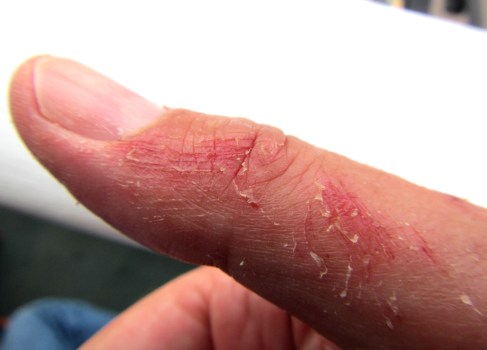
There’s a reason Luke Skywalker doesn’t blow up the Death Star at the beginning of Star Wars. Unfortunately, you don’t have the luxury of manufactured drama in non-fiction. You get what the fates throw at you. And what I got tonight was a good old-fashioned summer blockbuster climax. It was so humid it felt like you could grab handfuls of air. Low clouds and fog banks whipped past, accentuating an already mysterious setting. Five casts in, and I had my first bass of the trip, a porcine twenty-one-incher that went immediately on the reel. Twenty minutes later, I’d already caught more stripers here than I did all last year. Halleluiah! These bass were gathered for one purpose: to eat with extreme prejudice. Sand eels were the entree, and I could hear them plink-ploinking through the water as I waded. There were stripers everywhere, and they attacked my fly, a Big Eelie in a Crazy Menhaden color scheme, with undisciplined fury. Missed strikes were frequently followed by punishing returns. Without a sealed drag, the moisture in the air and an occasional dip in the water reduced my reel to a shadow of its locked-down-tight self. Once hooked, the bass were off to the races, and I did my best to palm the reel. My knuckles took a beating as the handle repeatedly whacked them, but it was a good hurt, and I laughed at my clumsiness. The commotion I created sent several spin and fly anglers scurrying over to join the fray. By some perverse twist they all caught few or no fish. Some muttered as they left, and others departed with a palpably grim silence. Twice I told myself I would give the spot a rest and seek my pleasures elsewhere. Twice a fifteen-pound fish talked me out of it. The action slowed only when Mr. Boating Dipstick 2013 set a course for the wrong side of the channel marker – despite his blazing, brilliant spotlight – and momentarily hit the sandbar. But that was the only wrinkle in an otherwise flawless night. When it was over, my thumb looked like a pound of ground chuck under cellophane. My fly had been surgically reduced to a couple hackles and some forlorn strands of bucktail. Even when I tried to stop fishing, I couldn’t. I caught a legal fish just reeling in my line. One of the stalwart souls still on the beach called out to me. “Are you leaving?” Yep, I’ve had enough. “How many did you get?” I don’t really know. I stopped counting after fifteen. “You had some big fish there.” At least a half dozen in the 15-pound range. “Can I see what fly you were using?” Absolutely. “Wow. That’s it? It doesn’t even have eyes” Nope. Here, take this fly, and this one too. Color doesn’t matter. Good luck to you! Then I began the long walk back to the truck. As I trudged through the sand, I switched on my headlamp, and basked in the warm red glow of an absolutely righteous return.
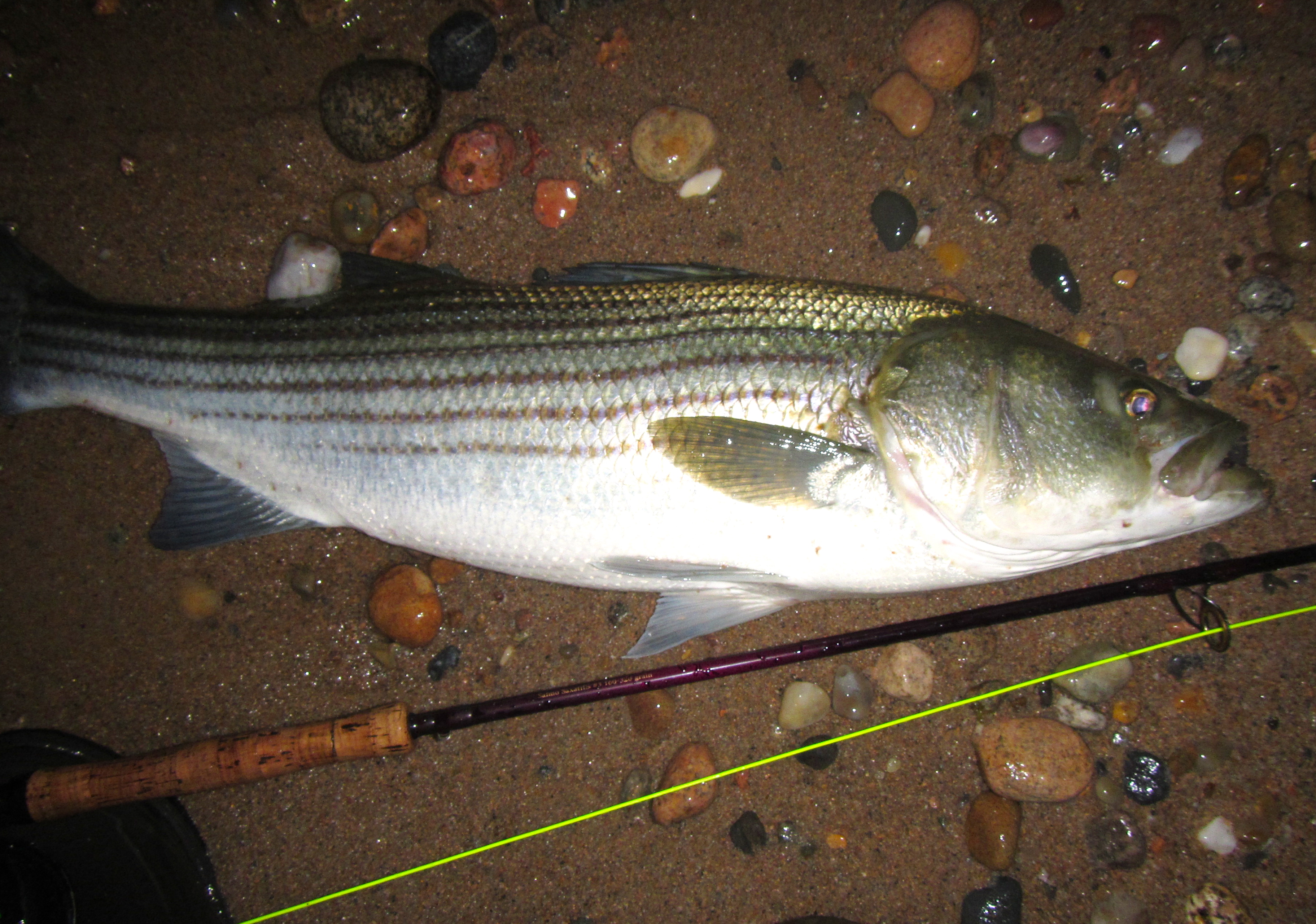
Any night filled with ten to fifteen pound stripers doesn’t suck. I know, I know, it’s not the most fish-friendly photo. If it makes anyone feel better, I lipped the rest.

That’s gonna leave a mark. The price of admission for a dozens-of-bass outing.
Sunday: The five most feared words in fly fishing
My friend Bill arrived on the Island today, and I’ve been regaling him with tales of gluttonous bass, buckets of bait and thumb-wrecking action. Word travels fast about a good bite, and the parking lot is mobbed. The weather and the wind are a carbon copy of last night. All we have to do is wait for dark and a little more of that flood tide. Unfortunately, there are more anglers than bait. Or stripers. Plenty of skates, though, in thick and beaching themselves, wings flailing away, frantically slapping against the sand. The wind picks up in intensity, and brings with it brief tropical downpours. I can see a light grey band in the skies over Block Island sound, then a foreboding line of India inkiness over the mainland. In the end, the bite never materialized. I managed a single bass by moving around and fan casting with a black, blue, and purple Big Eelie I call the Bruiser. I couldn’t blame Bill when he bailed after the second squall came through. As he walked off I called out to him, “You shoulda been here yesterday!”
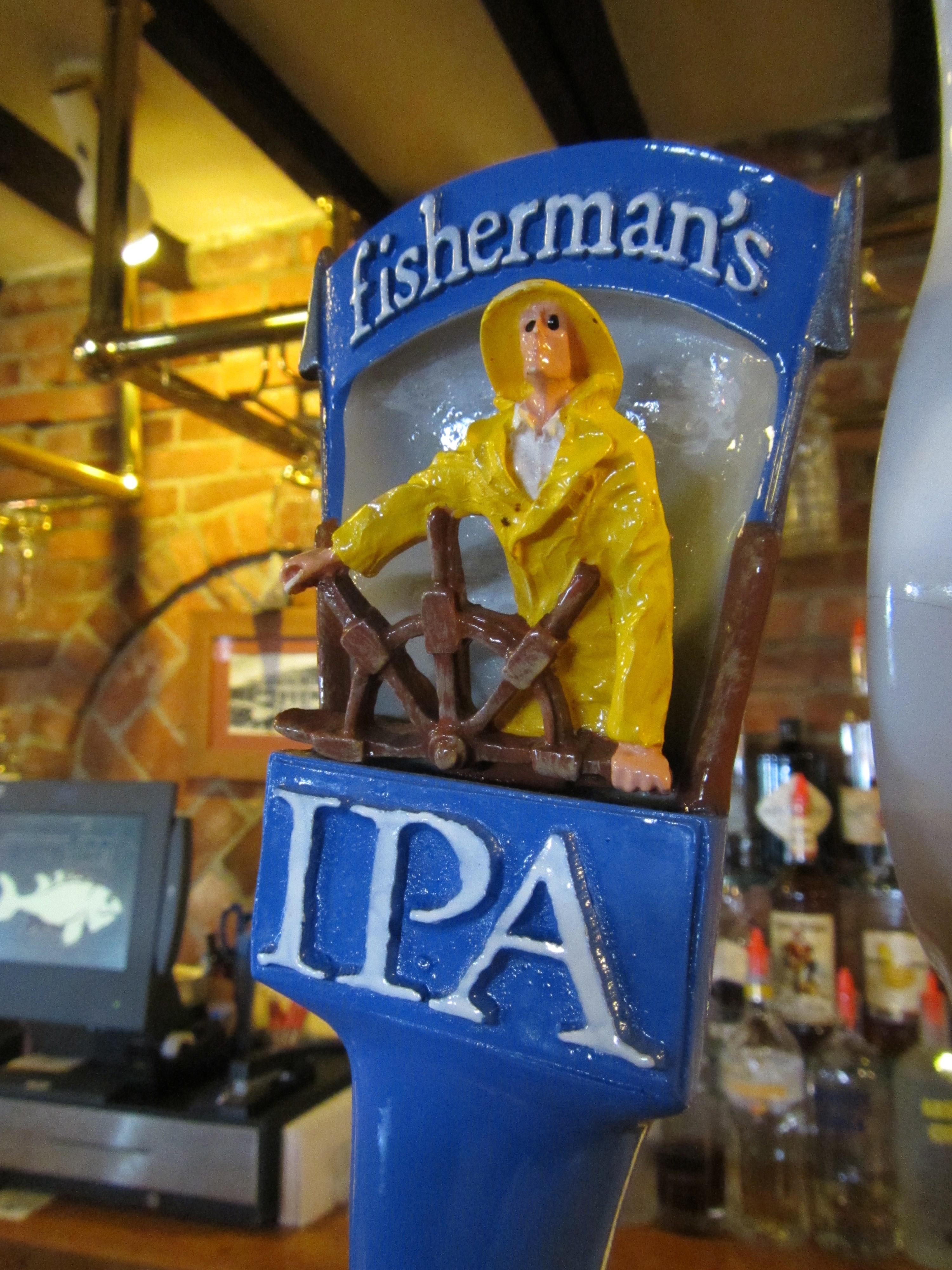
Until someone brews up Silver Stoat Stout, Todd’s Norway Ale, or Flyrodder Lager, I’m still the only dude in my crew with his own label. (“The Fisherman” is my internet forum nom de voyage.)

Monday: Gettin’ jiggy wid it
The wind is banshee bitch, even more so than the previous two outings. The fishing’s about the same as last night, possibly a degree less of suckiness: three fluke in about 90 minutes of fan casting over an expansive flat. Einstein’s definition of insanity being what it is, I decided to go for a wade along some shallows that border rocky structure. I spooked a fluke, then saw some suspicious upheaval on the surface about 50 feet away. I climbed up onto a rock to investigate. Three casts and two bass later, I had my answer. The fish were standard-issue Block Island mid-twenties schoolies, which is to say that they were rotund, powerful swimmers that went on the reel. Not much else going on, and I was in bed by 2am. While I was sleeping, Ravi, who works at the Block Island Fishworks, was jigging for squid in New Harbor. At 3:30am, he hooked a squid, which moments later was swallowed by a 31-pound cow. He said her stomach was full of calamari, from 2” to over a foot long. Now, which box do I keep those Banana Squid flies in?
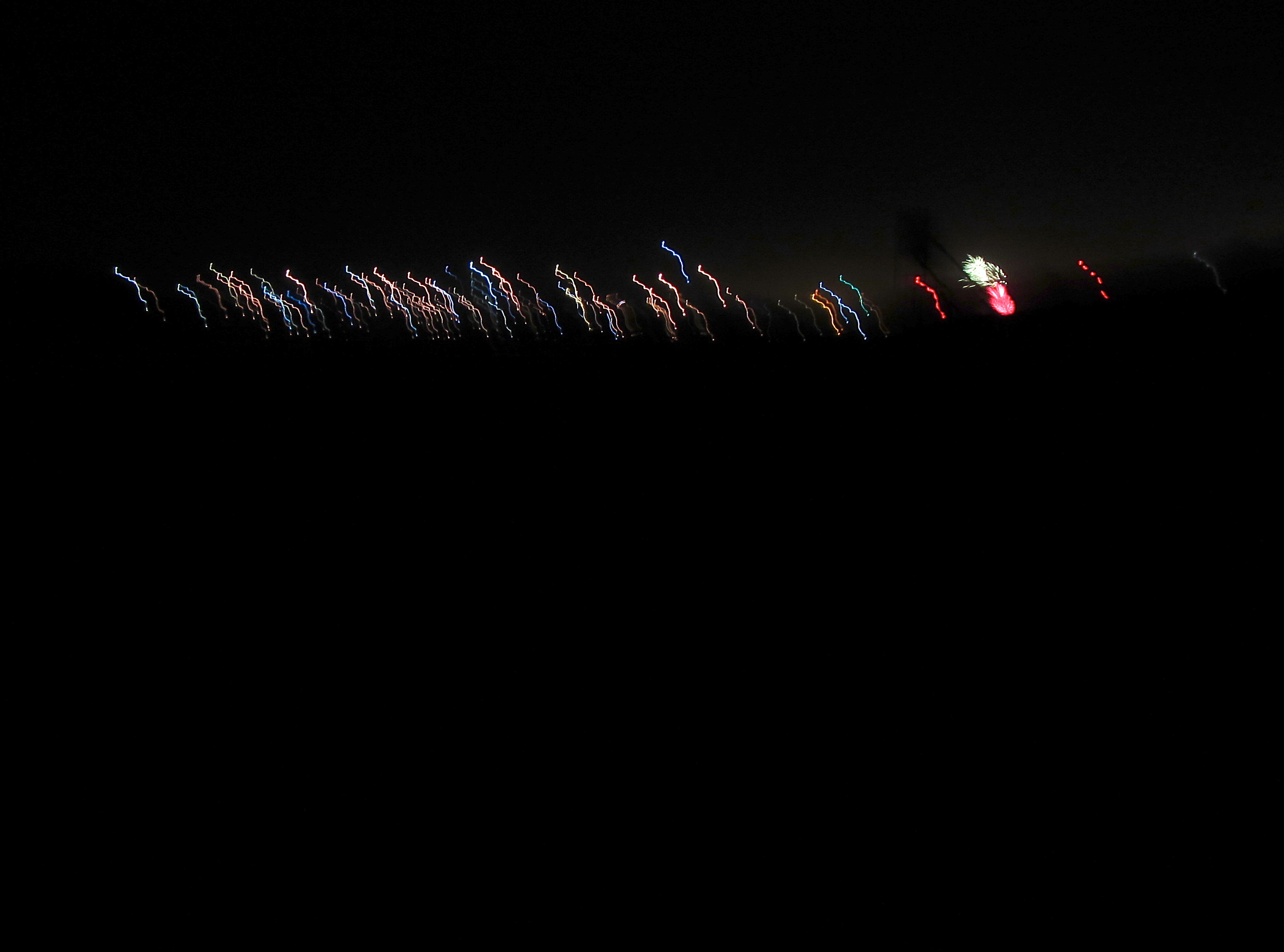
When the fishing’s slow, you look for ways to amuse yourself. Here’s my attempt at an abstract: a long exposure of boat masts swaying in the wind, accentuated by a rogue fireworks shell burst.

Tuesday: A very deep trough
Nothing. I fished the snot out this Island tonight, and nothing. Nothing at the Saturday night heroics spot. Nothing at my favorite jetty. Nothing at Charlestown Beach. (Not that five minutes of beleaguered casting in hellacious 20mph crosswinds counts for much.) Bill came back out tonight, and I talked him into trying a spot on the west side I’d never fished before. We were sheltered from the wind by a kindly bluff, but it’s generally a bad idea to wade out into unknown waters at night, even if you scouted them from the shore in the daylight hours. Bill gave it 15 minutes, but he just wasn’t feeling it, and after he left I got the standing-in-the-ocean-at-night-by-myself-catching-nothing blues. The visibility was so poor that I couldn’t even make out the horizon. All it took was one good gut-high wave to knock me off the rock I was standing on. Off to more clement waters, where, of course, I caught nothing. There was the mystery of the glow-in-the dark shooting basket to keep me entertained, though. I noticed that at odd intervals, the inside of my basket would glow a dull red. It was a puzzlement until I realized it coincided exactly with each draw I took on my cigar.
Yup. That about sums it up.

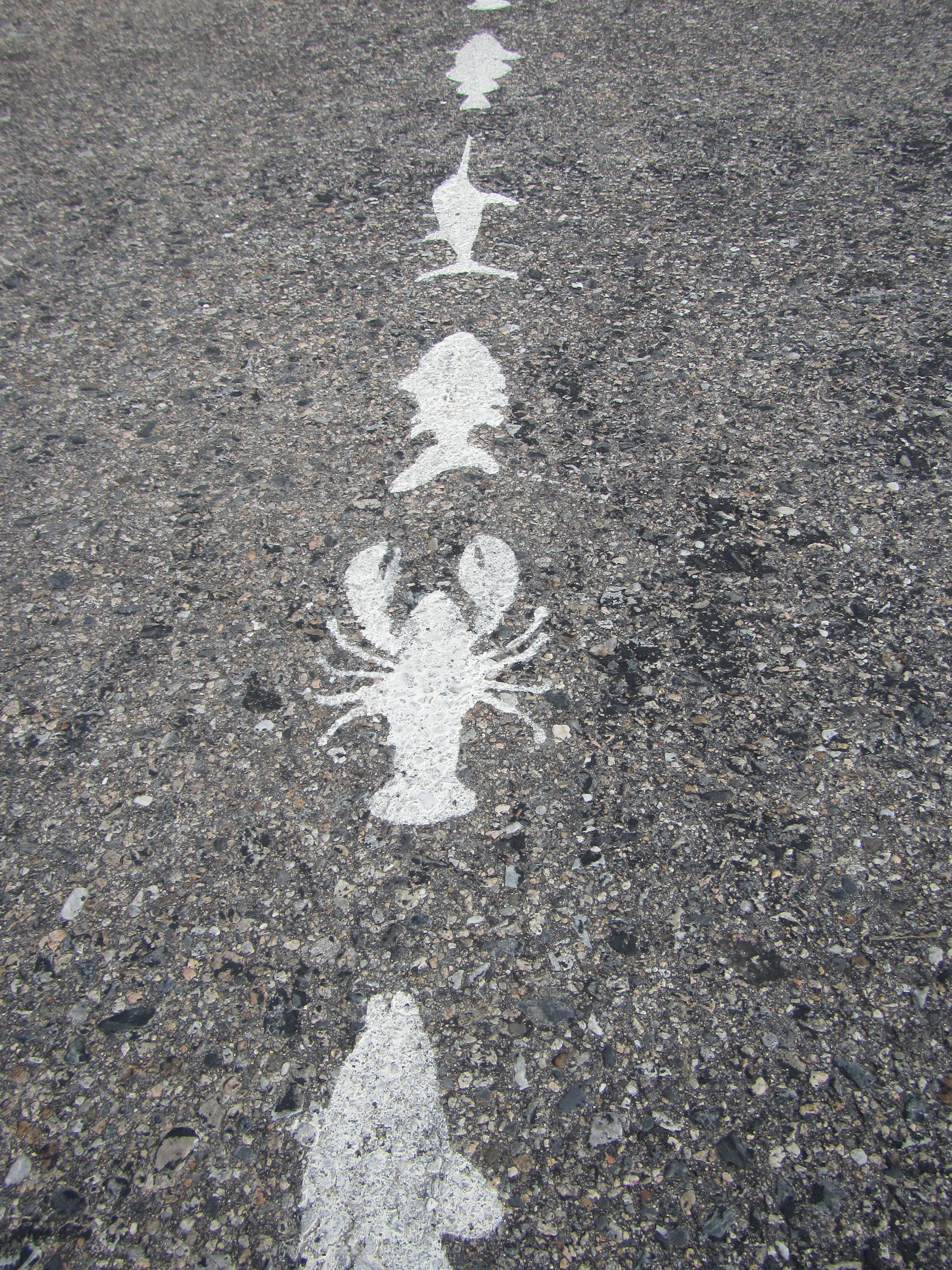
Follow the fish. If only finding stripers was this easy.

Wednesday: The natural
Tonight I’m taking my 10 year-old out with me. Last year was Cam’s first time night fishing for stripers, and although we didn’t catch any bass, he aced the outing. Whether it’s because I’m with my new fishing buddy or I’m attuned to some angling sixth-sense, I feel like we’re going to see some saxitillus tonight. Cam is fishing a 4” jig-head Sluggo, and lands a fluke in short order. We move to a different spot where Dad hooks a bass. It’s a standard-issue schoolie, but Cam is more than happy to land it on the fly rod in the misty twilight. Our last stop is the jetty. We experience our first double, although it is curiously strange that we have both hooked skates, Cam’s from the bottom and mine on the surface. We go out in a blaze of glory when I tie into a keeper bass about 70 feet away. I set the hook, and hand the rod over to Cam, who’s never fought a striper that large before, let alone on a fly rod. I take a quick picture, then clamor down the weed-covered rocks, telling Cam to let the fish run when it wants, reel it in when he doesn’t, and take his time until I can get down into the water. I’m standing at the bottom of the jetty, about to tell Cam to start getting the fish in, when I see a splash at my feet. Cam’s already beaten the striper, and there it is, waiting to be lipped. I got goose bumps when I realized that he’d landed his first keeper bass a lot quicker than his old man did.
A portrait of the artist as a young man, focusing on the job at hand and doing his father proud.

Thursday: Fireworks cancelled due to fog
And the bass followed suit. At least for me they did. We all put our waders on one leg at a time, and tonight I’m living proof. Everything that could go wrong did. Everyone caught a striper but me. It’s not much fun when you’re going through it. At least afterward you have the comfort of humorous remembrance. Things started poorly when I drove a spot on the east side that was on lockdown – and they were catching fish. No room at the inn, so I drove to the west side where my line repeatedly insisted on wrapping itself around my rod. Literally sprinted a hundred yards down the beach after an angler reported blitzing fish on a sand bar – and found nothing. To make matters worse, I was wearing my stubborn hat tonight. I stayed out way too late. At least the birds weren’t singing by the time I drifted off into the fog of sleep.
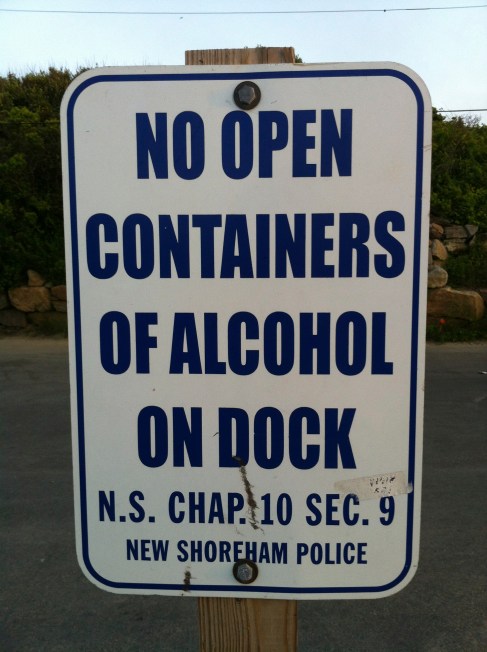
Fortunately, there’s nothing in Chapter 10, Section 9 about carrying a cold one out on a jetty.
Friday: Right where he’s supposed to be
It’s good practice for any serious striper angler to know a spot – and know it cold. I’ve fished the Island long enough now to have a certain level of competency. I have a mental index of where to fish at what tide, wind direction, moon, etc. Tonight I had my heart set on catching a striper at X. There were a few problems with my plan. X is generally a two-hours-either-side-of-the-flood spot. Tonight was fireworks night with the family. That would put me there well into the third hour of the dropping tide. The best I could do would be to have the truck pre-loaded so I could make tracks even as the finale’s last boom! was echoing across the hills. There was enough bait in the water to keep me hopeful, even after a fruitless fifteen minutes of casting. Then, bump! Missed him. Mortal depression. This being such a mercurial week, that might be my only touch of the night. But somewhere out there, in the rapidly fading twilight, I could hear the mischief of a bass feeding. I couldn’t quite place him; there was enough wind chop to make sighting the rise rings impossible. Bump! He hit it again. I let the fly sit there. Gave it a short strip. Bump! What gives? Must be a small fish. Another strip. Whack! Got him now, a silvery ten-pound striper that was the perfect fish in a perfect place at a perfect time. As I’ve gotten older, I’ve tried to embrace the concept of, “I don’t need to be right.” But oh my goodness, sometimes it feels so damn good when I am.
A perfect fish. Just what I needed to close out the week. As tradition dictates, taken on a Big Eelie in the original colors.