New class forming: Wet Fly 101 at UpCountry Sportfishing

Join me Saturday May 18 from 9am-2pm as we explore the wonders of wet fly fishing on the Farmington River. Wet flies have been taking trout for centuries, and the fish aren’t getting any smarter. Wet Flies 101 will cover basics like rigging, fly selection, and presentation. Flies will be included. Cost of this 5 hour class is $100. I like to keep my classes small, so space is limited to 3 people. To enroll, please call UpCountry at 860-379-1952. Hope to see you there!

And of course, I am also available for private instruction and guided trips. For more information, please see the Fisherman LLC part of my site.

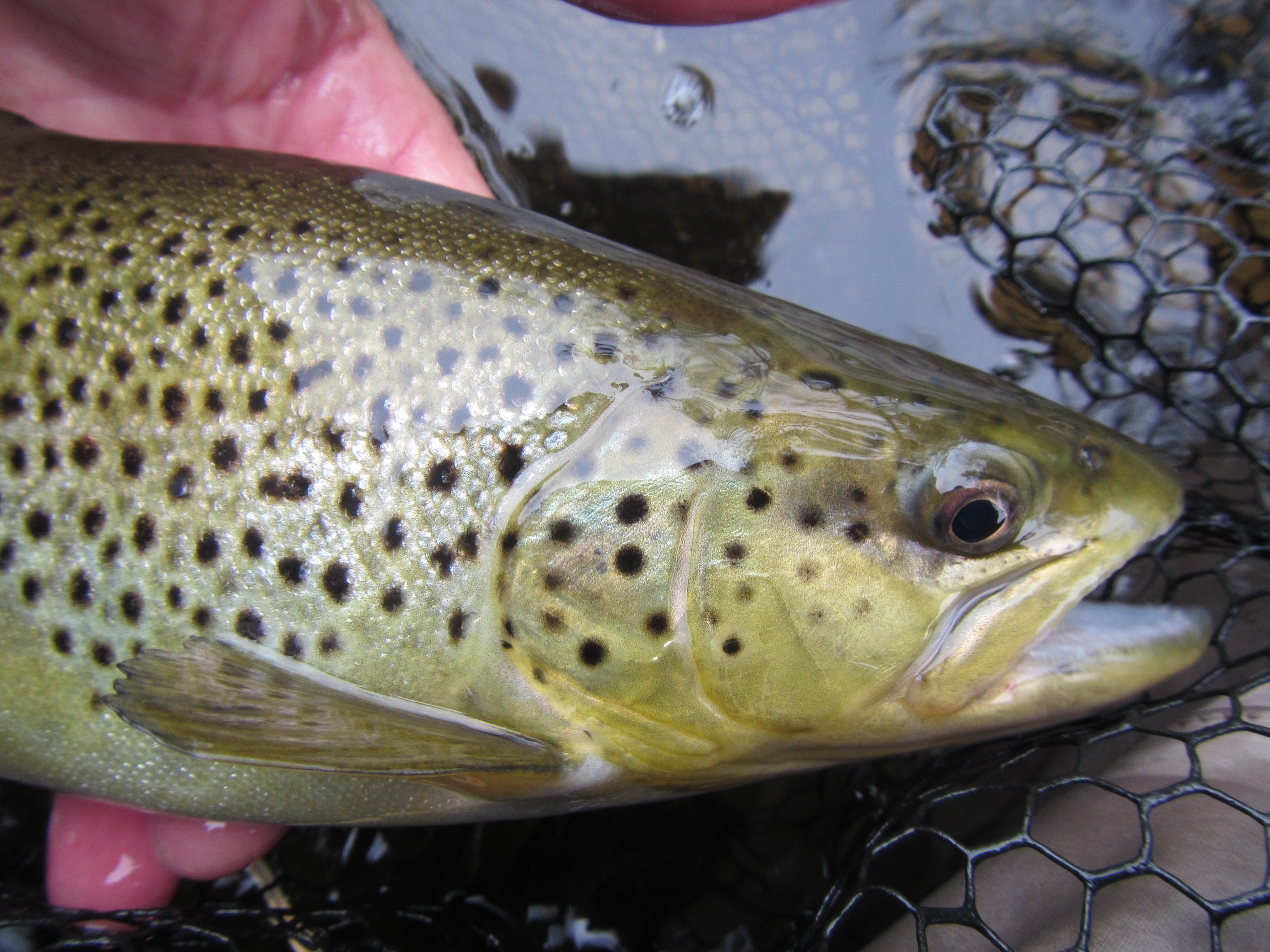
This fine, fat brown took a Dark Hendrickson wet a couple weeks ago on the Farmington.

Image

A Fuzzy Nymph: The Ginger Caddis Larva

Ever heard of a guide fly? In case you haven’t, guide flies have two qualities: They can be tied quickly, and they are high-confidence fish magnets. The Ginger Caddis Larva is such a fly.

It’s one of those flies that, if you saw it in the bins at your local shop, you might not give it a second look. But the trout certainly will. Angora goat is one of my favorite tying materials. It takes on a translucency underwater, and the fibers trap miniature air bubbles much like an emerging or diving caddis might.

The Ginger Caddis Larva is a quintessential fuzzy nymph; I fish it as nymph, bouncing it along the bottom, then as a wet, letting the fly swing up toward the surface. I’ll also fish it as a straight wet in a team of three flies. If I don’t get a strike, I let the fly sit there at swing’s end.

This pattern lends itself to dozens of variations. Try it in Insect or Highlander Green. Get some black or brown Angora and make it a little stonefly. Add a soft hackle (like partridge). Give it a bead head. Swap out peacock herl for the hare’s ear thorax. You get the idea.

Back to the guide fly thing. Two years ago I passed this fly out at one of my wet fly classes. It was a slow day on the river, but what little action we saw came on this fly (we were fishing teams of three flies, so the trout had a choice). A few weeks later, I ran into one of my students outside the local fly shop. “Steve,” he says, “I need some more of those Ginger Caddis Larvas and I can’t find them anywhere.”

He bought every single Ginger Caddis I had in my box on the spot.

Image

Hook: 2x strong, size 10-18
Weight: 8-12 turns undersized wire
Thread: Orange
Body: Ginger Angora goat, very spikey
Thorax: Dark hare’s ear

Tying notes: To make it spikey and rough, try chopping the hairs up with scissors and winding them on a dubbing loop. Angora goat has long, unruly fibers that become problematic on smaller flies, so the chopping remedies that. I use high tack wax with Angora, like Loon Swax. I like to underweight this fly. Underweighting doesn’t mean that you’re putting wire under the body – you are – but rather, it refers to using lead wire that is thinner than the diameter of the hook wire. The goal is to help the fly sink, not suck the life out of it.

Classic Bergman Wet Flies Tied With Jungle Cock

Last week, someone used the search term “wet flies tied with jungle cock” to find currentseams. I found that intriguing because I had never tied a wet fly with jungle cock in my life. Sure, I’d done classic steelhead patterns. And untold numbers of flatwings and bucktails for stripers. But not a single wet with that most enchanting of feathers, the enameled nail from the cape of the male junglefowl.

Well, if someone took the trouble to navigate all the way to my humble site, they must have been disappointed when their search came up empty. And so, lonely internet sojourner, I took to the vise just for you. I have no idea who you are. But I hope you come back some day and find the little gift I left for you. And I thank you for the one you gave to me.

Here are four wets from Bergman’s classic, Trout. Clockwise from upper left: Silver Jungle Cock, Dr. Burke, Lord Baltimore, and Secret Pool No. 1. They are all tied on a size 8 1x short, 2x strong hook, the Orvis 1641.

Image

(upper left)
Silver Jungle Cock
Tail: Golden pheasant crest
Body: Silver tinsel
Shoulder: Orange floss, palmered with grizzly hackle
Wing: Jungle cock
~
(upper right)
Dr. Burke
Tail: Peacock sword
Body: Flat silver tinsel with oval silver tinsel rib
Hackle: Yellow
Wing: White with jungle cock
~
(lower right)
Lord Baltimore
Tail: Black quill
Body: Orange floss with black floss rib
Hackle: Black
Wing: Black with jungle cock
~
(lower left)
Secret Pool No. 1
Tail: Golden pheasant tippet
Body: Peacock herl butt and shoulder with gold tinsel center
Hackle: Claret
Wing: Slate with jungle coc

Tying notes: Some tie the Silver Jungle Cock with a longer shoulder; I kept mine more thorax-like. I think this would make a great steelhead fly. It was the easiest of the four to tie.

You can tie the Dr. Burke with as many or as few peacock sword hackles as you like. I chose four for this size. Trivia: Dr. Burke is Dr. Edgar Burke, the man who painted all the files in the color plates at the beginning of Trout. Dr. Burke is credited with creating the Secret Pool No. 1 pattern.

The Lord Baltimore is the first Bergman-style wet I tied with a quill tail. It was far less intimidating than I imagined.

I didn’t have any claret hackle for the Secret Pool, so I used wine marabou. I also tend to use more golden pheasant tippet fibers in my tails; again, that’s an individual choice for each tyer. No matter how many fibers you use, I like to show the second black band.

The Peter Ross Wet Fly

The next time you fish the Peter Ross, be grateful that his name was not Aloysius Karbuncle. The Peter Ross is a traditional Loch style fly that dates back to the late 19th century. Ross based his pattern on the Teal and Red, another stillwater fly.

This fly is also a popular sea trout pattern, and you can easily see why. I like the contrast of the red, the black, and the dramatic barring of the teal. With its silver body, I’m thinking small baitfish or fry. Perhaps even something shrimpy. Something that looks alive and good to eat. I’ve already used it for steelhead, and I’m going to try it as the point fly on a team of three wets this spring.

The Peter Ross

Image,

Hook: 8-16
 (this is an Orvis 1641 size 10)
Thread: Black
Tail: Golden pheasant tippets
Body: Rear half silver wire, front half red angora goat
Rib: Fine silver tinsel
Hackle: Black hen
Wing: Teal flank

Tying notes: When you’re tying a small wet that calls for a body of “half this, half that,” it’s easy to mess up calculating how much area you need on the shank for each section. (Ask me how I know). You end up with a body that’s two-thirds one and one-third the other. Remember to take the head of the fly into consideration. Then, divide the remaining space between where you think the head will end and the end of the shank. There are many ways to tie in waterfowl wings. Some like to create an effect like a quill wing. Others like to fold the wing several times on top of itself, dull side in. Another way, the one I used here, is to tie the wing in small folded sections. For this size fly, I used three sections of teal flank about ¼ to 3/8 inch wide, folded them once, dull side in, and tied them on top of each other.

Thank you, UpCountry Sportfishing and today’s wet fly class

Another great class today at UpCountry Sportfishing in New Hartford, CT. UpCountry is my home shop, and it’s always nice to be tying along the banks of the Farmington River. We covered the same basics as yesterday’s class, took a few new directions, but the result was the same. We all learned something, and a splendid time was had by all.

Steelhead Spiders or Soft-Hackles

Image

Next up: flatwing demo Thursday night at the Saltwater Edge in Newport, RI.

Thanks to everyone who attended my wet fly class at River & Riptide.

I love tying flies, but teaching others how to tie runs a close second. I am fortunate enough to be able to do it at a number of area fly shops. Today’s was at River & Riptide in Coventry, RI. Great group of guys, all eager students. It’s amazing watching the transformation that happens in someone’s tying in just a few hours. Our focus today was on wet flies. We covered basic soft-hackles, wingless wets, winged wets, and fuzzy nymphs. Thanks to R&R for letting me teach, and thanks to everyone who made the afternoon so enjoyable.

Drowned Ant Soft-Hackle

Image

I’ll be doing the same class tomorrow at UpCountry Sportfishing in New Hartford, CT.

Thanks to everyone who attended my wet fly demo at the Compleat Angler

I think the biggest fears of someone who’s giving a presentation are that no one will show up — or no one will care what what you’re talking about. We were about as 180 degrees from that today as possible. I was overwhelmed by the number of people who attended, and grateful for all the questions that were asked. So, thanks to Scott and Scott and Bob for hosting (and for the sandwich — man does not live by soft-hackles alone). And thanks to everyone who helped make the day so much fun.

The Catskill Wet Fly

I first learned of the Catskill when I read Ray Bergman’s classic, Trout. While it lacks the garish palette of the majority of the flies that appear on the color plates at the beginning of the book, the Catskill is nonetheless an attractive fly – albeit in a rather understated way.

There’s something seductive and buggy about wood duck. The soft brown hen hackle will collapse and pulse in the current, contrasting nicely against the orange floss body. It’s easy to imagine this as an over-sized caddis. Or at least as something that looks alive, and good to eat.

I tied it large, but I can see going down to about a 16 or so with this fly. Although I have not yet fished it, I already have supreme confidence that it will be a fish catcher.

You can, too.

The Catskill

Image

Hook: 1x short, 2x strong size 8-16 (this is an Orvis 1641 size 10)
Thread: Black
Tail: Wood duck
Body: Orange floss under brown hen, palmered
Wing: Wood duck

The Kate McLaren Wet Fly

Ah, Kate-O, my little not-so-yellow friend.

Every year, I’m on the lookout for new flies to tie and fish. My friend Jon, who’s been wet fly-fishing forever, also happens to be from the UK. So he’s been exposed to a broad cross-cultural mix of patterns. When I asked him for some suggestions, he immediately offered up the Kate McLaren. It’s fair to say that I liked Kate the moment I laid eyes on her.

The Kate McLaren is a Scottish loch fly, intended to be the top dropper (or bob fly) on a team of three. While its traditional use is on still water, I’m going to be fishing this on rivers. And while I might give it some time as a top dropper, it’s going to get the lion’s share of action on point.

There’s something about the contrast of the golden pheasant crest tail and the dark body that I find magnetically appealing. Golden pheasant crest almost glows when wet. Who knows what a fish will think this fly is – perhaps a flash of spotted salamander, or a chubby stonefly – but I can’t wait to feel that first take.

Kate McLaren

Image

Hook: 8-14 (this is a 1x short, 2x strong Orvis 1641 size 10)
Thread: Black
Tail:  Golden pheasant crest
Body: Black seal fur (I used angora goat)
Rib:  Fine oval silver tinsel
Body Hackle: Black rooster (I used soft hen)
Head hackle:  Brown rooster (ditto on the hen)

Tying notes: Technically, this is a Kate McLaren variant since I used soft hen instead of stiffer rooster hackle. Since I primarily intend to fish this fly subsurface, I wanted the action the soft hackle would provide. When finishing the body, I tied the black hackle in near the head, leaving the thread at the tie-in point, and then wound the hackle backwards toward the tail. I then secured the hackle with the tinsel, and wrapped it forward to the thread. Also note that the black hackle is smaller than the brown. Some of the Kates I’ve seen have a longer tail, but I like the proportions of this one. I got lazy on the head and left it rough. As Dave Hughes said, trout aren’t interested in neatness.

Rescheduling of 2/16 Wet Fly Tying Class

The Wet Flies and Fuzzy Nymphs class at UpCountry Sportfishing in New Hartford, CT originally scheduled for last Saturday has been rescheduled for Sunday, February 24, 9am-2pm. There are a couple spaces still available. Contact the store at 860-379-1952 to enroll.

Speaking of wet flies, I have a few new patterns to post. I’ll try to get them up soon.