Unless you’re a setback player, you’re very likely puzzled by the author’s intriguing choice of a headline. For you non-card-types, a smudge is a bid where you declare that you will not only make all four points, but also win every trick (when each player reveals a card they’re holding). Smudges are rare, and if you’re lucky to make one, you get five points.
So, if catching three different species of fish is a hat trick and four is a grand slam, what’s a five different species? Pentachamacallit? So smudge it is. And on my second day of fishing the Kootenai (pronounced KOOT-en-ee by the locals), I scored a smudge.
This was a day that I fished solo, under the capable guidance of my guide Jeff from Dave Blackburn’s Kootenai Angler. We floated a different section of river, starting below the town of Libby. While the river is still wide and overhead-deep in many areas, there’s a lot more gravelly structure, pocket water, and whitewater pools. I far preferred it over the section we’d fished the day before. We did a little bit of everything: wet flies, dry-dropper, nymphing, streamers. It turned out to be a smudge-tastic day.
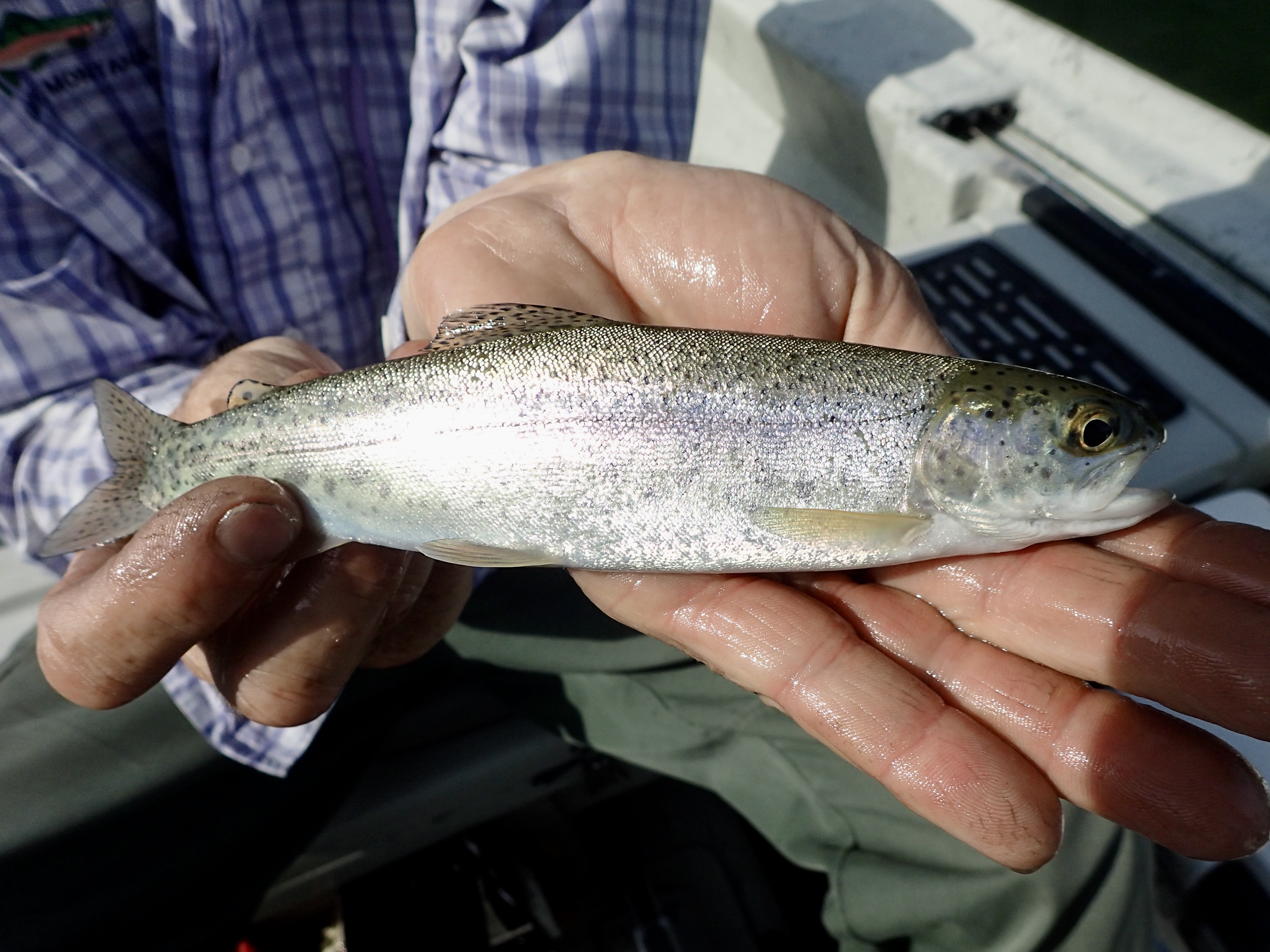
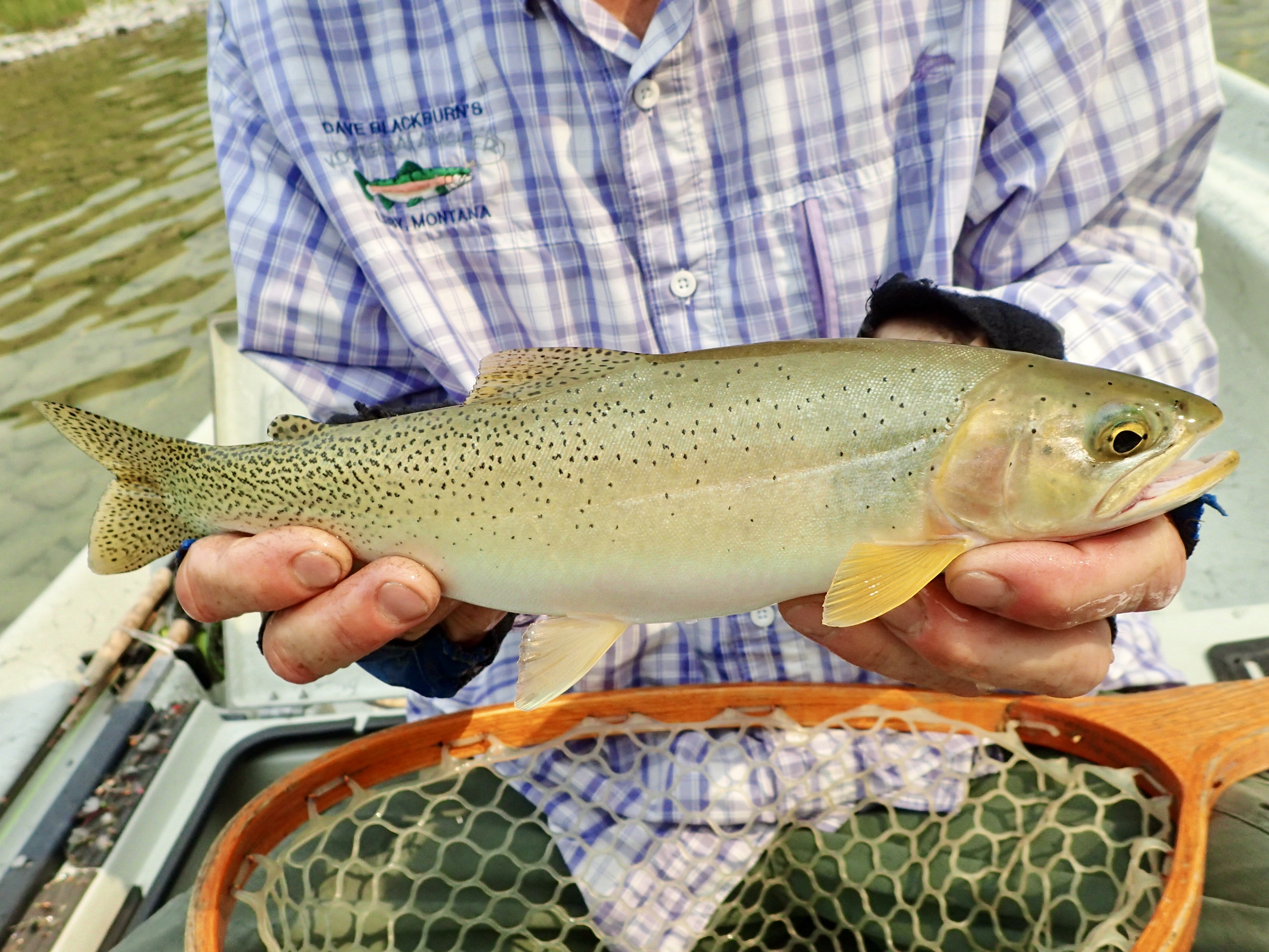
Let’s start with our new old buddy, the Kootenai Redband Rainbow trout. The ones I connected with — and they were plentiful — were generally under a foot long. Nonetheless, they were spunky and frantic when hooked, and I can’t even begin to describe their breathtakingly beautiful flanks adorned with delicate parr marks.It’s a sucker! It’s a bonefish! No, wait. It’s a northern whitefish, native to these parts. Despite their appearance, whitefish are a salmonid. Every one I hooked was taken on a nymph. This was the biggest one by far, and she gave me a good tussle. Two down.On this day, I hooked and landed my first cutthroat trout. Consider me a fan. Another native fish, these are beautifully colored and look like someone took a fine point black Sharpie to their sides as an exercise in minimalism. This fish was an epic eat. We were fishing western style, pounding the banks with a hopper-dropper, when we approached a grove of trees with overhanging branches that nearly touched the waterline. Naturally, the sweet spot of the run was beneath the branches. I made a cast, and began mending, dropping my rod tip nearly into the water so the floating line would clear the branches. Three…two…one…and whack! She ate the hopper right where we thought she’d be. That’s one take I wish I had on film.A few minutes later, I asked Jeff what that green thing in the water was. As we got closer, we could see it was a hopper going for a swim. We fished him out of the water and put him on the oar to dry off. We were going to use him for a science experiment, but before we could send him on his way, he decided to go for another swim. I haven’t seen many hoppers in the water, but this was proof that it does happen — and the way this thing was struggling, it’s not surprising that they get eaten. My fourth species was a pikeminnow. Sadly, no photo. But before you laugh at the noun “minnow,” you should know that they grow over two feet long! Mine was about 18″. Pikeminnow are a member of the dace family.If you look under the maxillary, you can see the reddish band that gives the cutthroat trout its name.Ooh. Ahh. Ohh. To complete the smudge, I offer you the cutbow. As its name suggests, it’s a cross between a rainbow trout and a cutthroat trout, with characteristics of each. I was fortunate to be able to tangle with a half dozen of these gorgeous creatures. Is it time to go back to Montana yet?
I guided — we’ll call him “Bob” because he’s in incognito mode — last Thursday. We did a little dry fly and a lot of wet fly. The Farmington can be a highly technical dry fly arena, and sometimes it comes down a perfect drift and a little luck. But a good starting place is a long leader. I was happy to see that Bob was using a 13-foot minimum line-to-fly leader/tippet length. We added a couple more feet of 6x and had at it. Unfortunately, we missed the Trico spinner fall, but we did manage some practice, and by the time we made the decision to go to wets, Bobs drifts were noticeably better.
We spent the next six hours on classroom, then banging around the PTMA, as well as above and below it. Like many people who take a wet fly lesson with me, Bob had to learn to wait a few beats — “Are you still there?” — after the hit to let the trout hook itself. We missed a handful of strikes, but stuck four and landed three, which was pretty darned good under some tough conditions. Low water/seasonal hint: all of our hookup came in fast, bubbling water.
A lovely wild brown from the PTMA, taken by Bob on my Drowned Ant soft hackle. And on the first cast! At first, Bob thought he was hung up on a boulder. But boulders don’t shake their heads…
Which brings us to the conditions. We’re out of meteorological summer, and the water is running clear and low. Because of the drought, the trees are behaving like it’s fall, turning color and especially shedding leaves. On windy days from now until the trees are bare, expect organic matter to be blowing into the river. Leaves were a constant challenge for us on this gusty day. The trout and bugs are also in a transition. Most of what’s hatching is very small (there are exceptions, like Isonychia). The trout are getting into pre-spawn mode. This adds up to more frequent windows where fish are much harder to catch. Bob was the only angler I saw land a fish on Thursday, and we encountered multiple anglers who were astonished by our success. Well done, Bob!
But wait, there’s more. Normally, the slug of rain we received over the weekend would mix things up a bit. However, Tuesday through Thursday this week, the CT DEEP will be drawing down the dam release to do their annual broodstock sampling. You can still fish the river, but vast stretches will be rendered as rock gardens. If you do fish, please give the sampling crews a wide berth. Things should be back to normal by Friday.
However, that normal will still mean challenging fishing — which makes every trout you land even sweeter. Catch ’em up!
Hopefully, you noticed I didn’t post last week. Maybe you even missed me a little. I was way out west — Montana, Idaho, Wyoming — on a family vacation. Oh, you betcha there was fishing. I’ll get to that in greater detail later this week, but for now, I fished the Kootenay in NW Montana, Hebgen Lake in southern Montana, and the Madison and Henry’s Fork rivers in Montana and Idaho. We drove around Yellowstone and Grand Teton for a couple days, but (sadly) no fishing in either location for me.
I’ve never been to this part of the country, let alone fished it, so it was all new and wondrous. The water I fished was unlike anything we have back here.
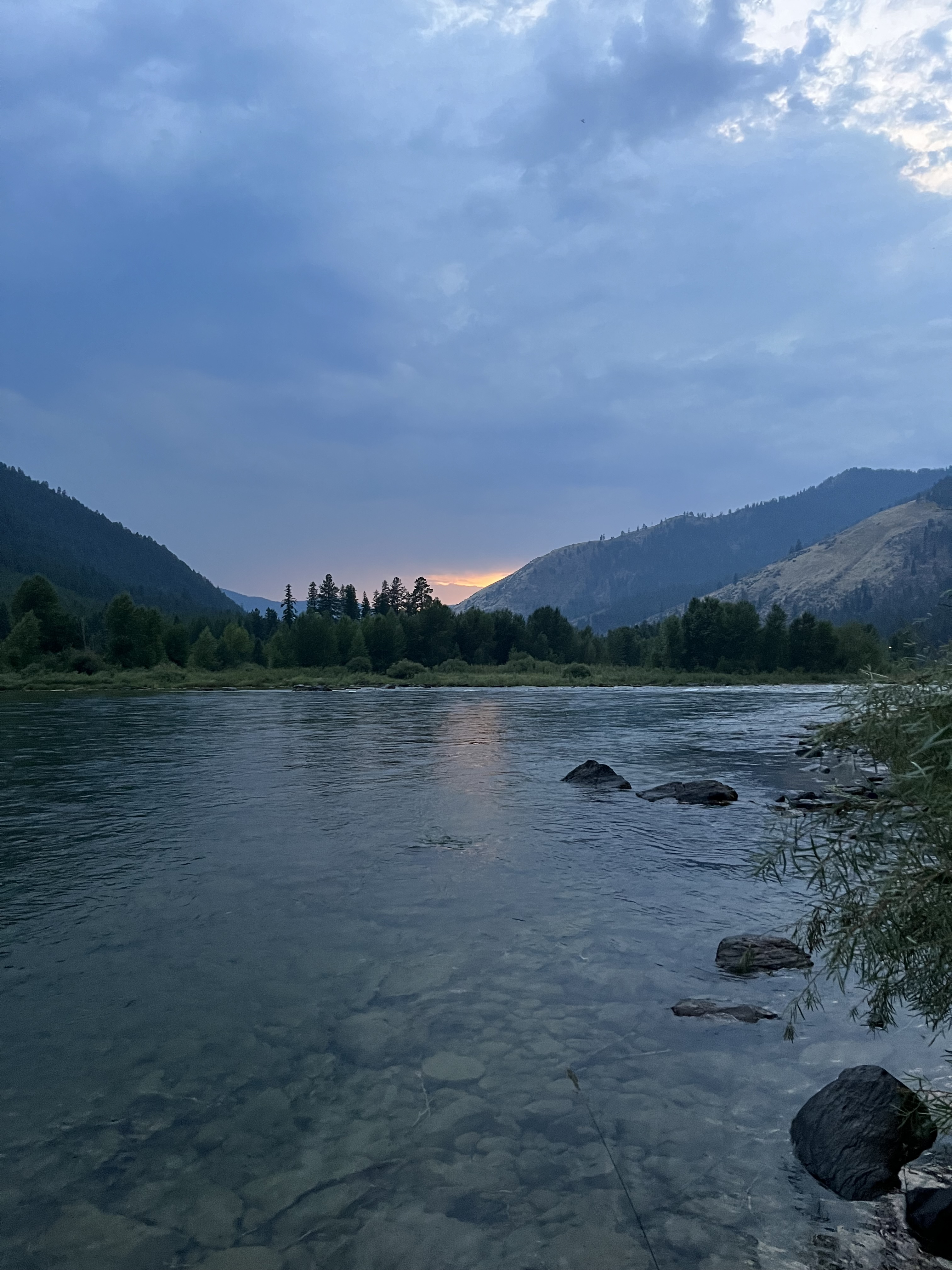
You’re kidding, right? We stayed in a private cabin on the banks — really, as this is the view just a few feet from the back porch — of the Kootenay River in northwestern Montana, a ‘way up near Canada. That far north, and at the western edge of the Mountain Time Zone, it gets dark late. This photo was taken at 9:24PM!
~
Before I left, I finished a piece for Surfcaster’s Journal on fishing small flies for striped bass. This will be essential reading for anyone who’s interested in fishing a three-fly team in marshes with small bait-imitating flies, or sight fishing with smaller patterns on beach fronts or flats. I’ll let you know when it comes out.
~
I just received the first pass on rendered maps for the Farmington River book, and I think they look great! My goal was to have a graphically simple, eye-to-brain-friendly design for you, dear reader, and the artist hit it out of the park. There’s a large overview map, and then five detail maps that focus on the 22-mile stretch from Hogback to Farmington.
~
On the home front, the Farmington is running at a fantastic, cool, trout-friendly summer level, reminiscent of yesteryear when the MDC wasn’t toying with the flows. Tricos are the big little hatch right now, which horrifies night owls like me. Get on it, early birds, while you can.
~
Finally, I have some availability the rest of this month and through September for guide trips/lessons. If you’ve been hemming and hawing about getting out with me, this is best time to do it for the rest of the year. I used guides on my trip out west, and even I learned a ton — I’m a better angler than before I left. You know where to find me.
Although I’ve been fishing for over five decades, I didn’t start keeping a fishing log until the summer of 2004. At this point in my life, I was seriously devoted to fly fishing. Being an autodidact, I reckoned that I’d learn more, quicker, and retain more if I could journal and reference my outings. I wasn’t wrong.
Since then, I have logged every fishing trip and every lesson I’ve given. I’ve filled six 192-page books with all kinds of data: place, time, date, water and air conditions, and then a journal-style description of the outing: what worked, what didn’t, what I think I could have done better, etc. What were the hatches/bait, and how strong were they? How were other people doing? What did I do well?
My O.G. log entry about a Farmington River outing with old pal Paul Kingsford. I didn’t even know some of the proper names of the pools; that’s Hawes, aka Bikini Rock, that I called “the big rock boulders/cliffs.” I haven’t changed the format all that much in the last 20+ years.
About 10 years ago, when life seemed to get exponentially busier, I got into a good/bad habit: voice recording my outings, then transcribing them into the journal. It was good because I didn’t have to write it all down immediately; the recording was made minutes after getting off the water, so everything was fresh in my memory. Later, during transcription, I might remember additional details. The bad habit part began when I would get lazy and not fill the pages with reports for weeks. I beg to report that my sloth has gotten so profound that I am now two years — you read that right — behind on my transcriptions. I’ll be getting to that shortly after I post this.
Some of you may wonder why, with today’s e-tech, I even bother handwriting it. Fair point. But I’m an analog guy at heart, and there’s something about my own script that adds humanity to what would otherwise be a cold, antiseptic printed document. Besides, I like my leather-bound hardcover books.
These books are more than a nostalgic preservation of memories. They’re a detailed roadmap to success. I can watch my progression as a fly fisher. I can observe how my best practices evolve. Not everyone’s a writer, but my journals were an invaluable resource when I was writing my Farmington River book. And these journals serve as a bittersweet reminder of what we’ve lost: the epic blitzes on Block Island, the prodigious power of the W/S Caddis hatch, the 50 smallmouth nights on the Housatonic. I still have it all at my fingertips.
I like to say during a lesson or a presentation that I’m not right. But I’ll stand by this statement: if you want to become a better angler — and catch more fish — you should be keeping a log.