Late February notes from a small stream

Last week I made the decision to fish a small stream. My logic was sound. First, I had no interest in dealing with what would surely be a crowded Farmington River. Second, due to some arcane fishing regulations, I wouldn’t be able to fish this brook until early April. Finally, and perhaps most of all, I wanted to see what was going on. Here’s what I found out.

Up solitude! Not another angler for miles. My introvert shone through.

What a workout — no need to do a treadmill cardio session later. I had not planned (foolish on my part) for shin deep virgin snow. I was perspiring gallons after a hundred yards of snow/bushwhacking.

On days like this one (upper 30s, bright sun) you never know what you’re going to get. With all the snowpack, there was certainly going to be a significant melting event. Would that influx of cold water kill the bite? It’s happened before. On this day, sunshine held the trump card. I saw midges and small stoneflies everywhere, and even witnessed char taking emergers in the film.
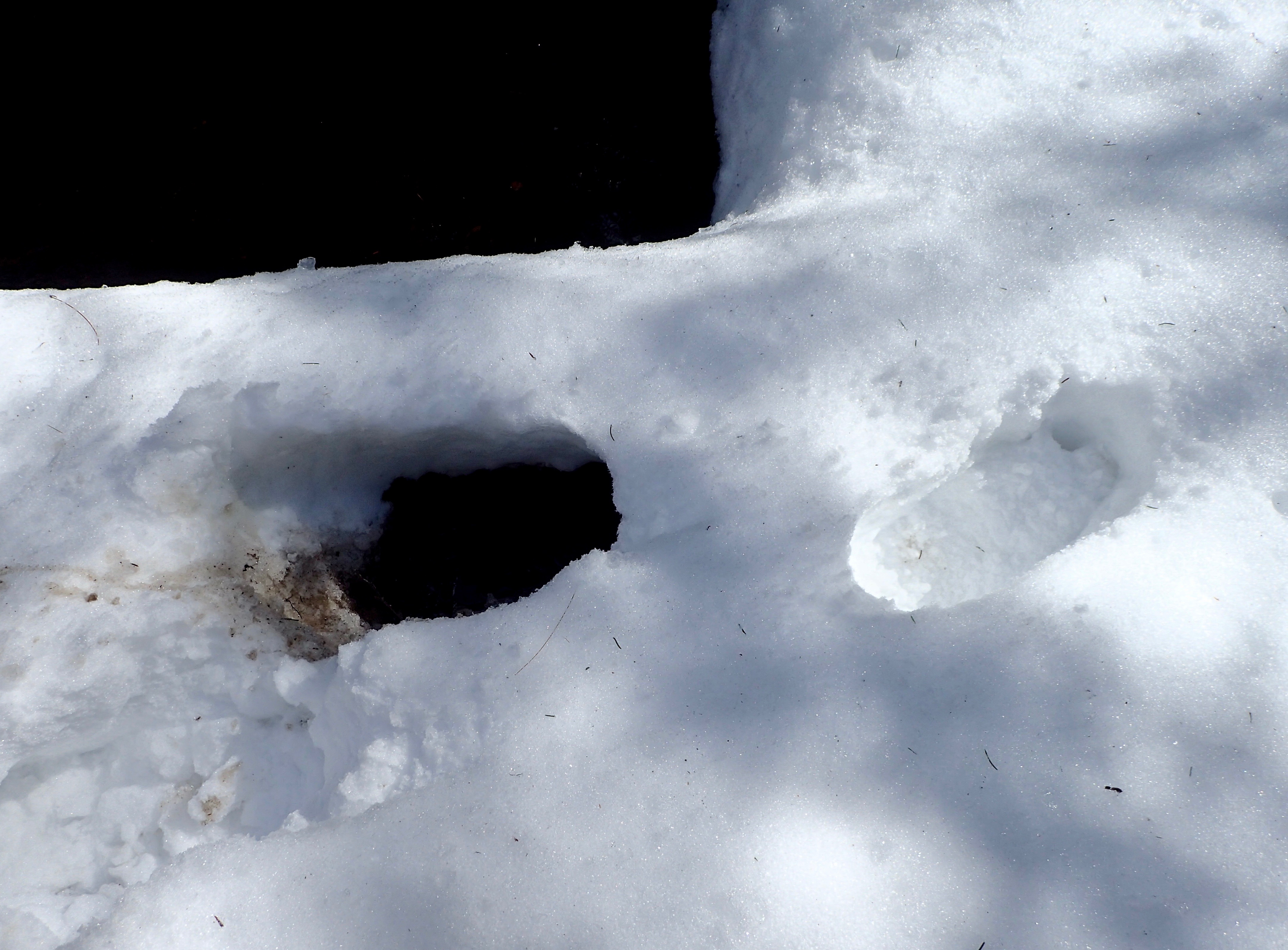
Lesson re-learned: be careful where you walk. Shelf ice, of course, is never to be trusted. But also be wary of snow pack that hides dangers like this. A step on solid footing, then one through the snow and into the void. Thankfully, no damage, but (if you’ll pardon the expression) you get my drift.

In 90 minutes, I pricked six fish. A few of them were repeat offenders who could not get their mouth around the hook. After a couple of attempts, I let them be. For me, it’s all about fooling the fish.

Since my goal was searching (rather than catching), I stayed with a bushy dry the entire time. I was very surprised at the number of customers. The fish have started to wander from their winter lies, and I did my best business in shallower glides and riffles. Of course, that makes sense given the method — you wouldn’t expect to draw dry fly strikes from fish hanging on the bottom of deeper pools. But 60 days ago those fish were not even present in the shallower water.

Currentseams Tuesday Night Zoom 3/2, 8pm: “Transition Trout: Late Winter/Early Spring Tactics”

The transition from late winter to early spring often means hard times for the erstwhile trout angler. This Currentseams Tuesday Night Zoom will focus on some of the conditions and bugs you may encounter, and how to best unlock those pesky salmo jaws. If you haven’t been getting the Zoom links — I send them out Tuesday late afternoon — please check your spam box. If you’re sending a request to get on the list, please don’t wait until 7:45 p.m. Tuesday night…I won’t be checking my email that late. Thanks!

“Early Season Tactics: Hunting Transition Trout” in the current issue of The Fisherman

Like the title says, you can find my latest piece in the March 2021 issue of The Fisherman magazine. Early Season Tactics: Hunting Transition Trout is about the rough patch of fishing we face in the next month or so. It’s loaded with useful strategies and tactics to help you catch more fish, and includes a guest appearance from UpCountry Sportfishing‘s Torrey Collins. You can read the article here.

Quality content like this usually isn’t free; The Fisherman is kind enough to allow public access to the article. Why not support them with a subscription? You can do that here. Many thanks to my editor, Toby Lapinski, for giving me the opportunity to write about fly fishing subjects that matter.

You can read about how I caught this gorgeous creature in the article. Photo by Toby Lapinski.

Presentation is everything in fly fishing.

Presentation is so important — the only thing that’s more important is a sharp hook — that I thought I would share some of the critical points from last’s night’s Zoom. Thanks to everyone who attended — we had a great turnout. In no particular order:

The wrong fly presented correctly will always out fish the right fly presented incorrectly. I showed a video that demonstrated this.

When you’re deciding on which line, leader length and size, and fly pattern, ask this question: What do you want the fly to do? The best answer should reflect what the fish are eating and how they’re eating it.

Fly fishing is all about line control, and a floating line gives you, by far, the most control over your presentation in current. The importance of mending cannot be overstated. Even slight, nearly imperceptible mends that produce a more natural drift can mean the difference between fishing and catching.

A sinking line and a weighted fly are usually a poor choice for catching fish feeding near the surface. Would you toss a Tungsten cone head Woolly Bugger to trout feeding on Hendrickson emergers?

This 15-pound bass came on one of those nights where anglers leaving the mark complained about fish busting that they couldn’t catch. They were using the wrong line, the wrong fly, and the wrong presentation. Learn the value of presentation, and watch your catch rates soar!

A longer leader will give you a better dry fly drift, and allow you to make more mends without disturbing the natural track of the fly.

“The difference between fishing and catching is a single split shot.” Attributed to Joe Humphries. Regardless of the originator, it’s good advice when you’re nymphing. Adjust your weight to get the most productive drift.

See you next Tuesday.

Currentseams Tuesday Night Zoom, Feb. 23, 8pm: Presentation — Why It’s So Important

You can be in the right place and the right time with the right fly. But if your presentation is off, you can still blank. Presentation is everything — that’s our mantra for this Currentseams Tuesday Night Zoom. If you haven’t been getting the Zoom links — I send them out Tuesday late afternoon — please check your spam box. See you then!

Tip of the Week: Target water near shelf ice when you’re winter streamer fishing

Shelf ice can be a problem when you’re out on a river — NEVER walk across shelf ice — but it can also be a difference maker when it comes to catching, especially on a river like the Farmington. The Farmington River has hatches of W/S (Winter/Summer) caddis. These bugs emerge, then scoot across the surface of the water towards the shore to mate. Trout know this — not in a cognitive sense, but rather in a programmed-by-nature way. If the water is deep enough, and there’s enough current, you can often find Farmington River trout hanging out near bankside structure in winter, especially ice shelves.

That makes these areas a priority target when I’m winter streamer fishing. If I find an ice shelf over deeper, moving water, I like to pound that water with my bugs. Sometimes I’ll even land the streamer onto the ice shelf, then gently pull it off into the water. The trout will tell you if they want the presentation to be a dead drift, slow retrieve, fast(er) retrieve, or swing.

You can’t really see it in this video, but I’m actually landing my streamer on top of an ice shelf that extends several feet off the bank. On this day, the only hits I had came from using this tactic.

No Tuesday Zoom tomorrow 2/16 — what do you all want to hear about next time?

I have a private gig with the Ottawa Fly Fishers tomorrow night, so no public Zoom. We’ll go for normal resumption of services (I like the way that sounds) on Tuesday Feb. 23. In the meantime, I’d like to hear from you. What subjects would you like me to talk about? If I see something that looks like it has wide appeal — and it’s something I feel comfortable talking about, I’ll certainly consider it. Last week’s Small Stream talk was well-attended, so I many do another variation on that theme. The ball’s in your court.

I received a question the other day about cinder worms in CT: when/where, etc. They can be impossible to predict, but I find that when the Connecticut state flower is in bloom, and the moon is new or full, that’s generally a good time to look for them in your local estuary.

The Big Eelie featured in On The Water’s “Guide Flies”

This is my third (I think) year participating in On The Water magazine‘s “Guide Flies” column, written by Tony Lolli. You’re familiar with he concept of a guide fly — a pattern that is typically simple to tie and can be relied upon to produce day in and day out. (Or night after night, as it were.) The Big Eelie delivers the goods. Developed by Ken Abrames, this pattern imitates larger sand eels. Part flatwing, part soft hackle, the Big Eelie is understated elegance at its finest. I think what I like most about the Big Eelie is that its template — four pencil-thin saddles and a marabou collar — lends itself to as many color combination as your inner artist can conjure up. My Rat a Tat Big Eelie, based on Ken’s larger flatwing, is just one example. Have at it and hold on tight!

Here’s a link to a PDF of this page:

New Zoom Tying Event: “Favorite Nymphs” Saturday, Feb 20, 1pm

My third winter fly tying pay-per-Zoom event is Saturday, February 20 at 1pm. Like the others, this will be about 90 minutes of fly tying/tie-along instruction. The cost is $10. To “register,” you send 10 bucks to me at PayPal (ID is swculton@yahoo.com) and I’ll send you the link to the meeting. Favorite Nymphs will cover some basic, useful patterns that are proven producers. Again, the focus is on template and technique. You should have different color threads, different hooks, beads, tools, etc. You should have at least one hen hackle/hen cape — Whiting makes a good basic hen hackle — or some other kind of soft hackle, whether it’s grouse, starling, partridge, etc. The “right” color is not critical, but if you want to go all in you should have grey or brown or black. The point is, if you don’t have a specific color hackle, you can find it later. Questions? You know where to find me.

Many of you will want a complete materials list, so let’s plan on these patterns: Soft-Hackled Bead Head Pheasant Tail, Bead Head Squirrel and Ginger, Frenchy Variant, Blue Glass Bead Midge. You’ll need 2x short scud hooks (anything from sz 12-16 for the first three and a size 18 or smaller for the last); metallic beads, your choice color, to match hook size; blue glass seed beads (mine are the Mill Hill brand; you can find them online or at a fabric/craft store, sized to your hook, and if you can’t find them you can substitute a tiny metallic bead of your choice); small copper wire; extra small silver wire; pheasant tail; ginger/orange dubbing (I like Angora goat); a squirrel skin if you have one (if not you can substitute a small soft hackle); bright contrasting color Ice Dub, your choice of color; high tack wax (like Loon Swax). Again, if you don’t have some of these specific materials you can substitute/make do as we are just learning some basic patterns and techniques.

I also like the Rainbow Warrior variant, a high confidence pattern. Scud hook, silver bead, PT, opal tinsel, rainbow sow scud dubbing if you have it. Maybe if we’re ambitious we’ll get to this one, too.

Currentseams Tuesday Night Zoom, Feb. 9, 8pm: Small Stream Fly Fishing

Small streams and wild trout are a passion, so tomorrow night I’ll be talking about thin blue lines and the exquisite gems that live in them. If you haven’t been getting the Zoom links — I send them out Tuesday late afternoon — please check your spam box. See you Tuesday night!