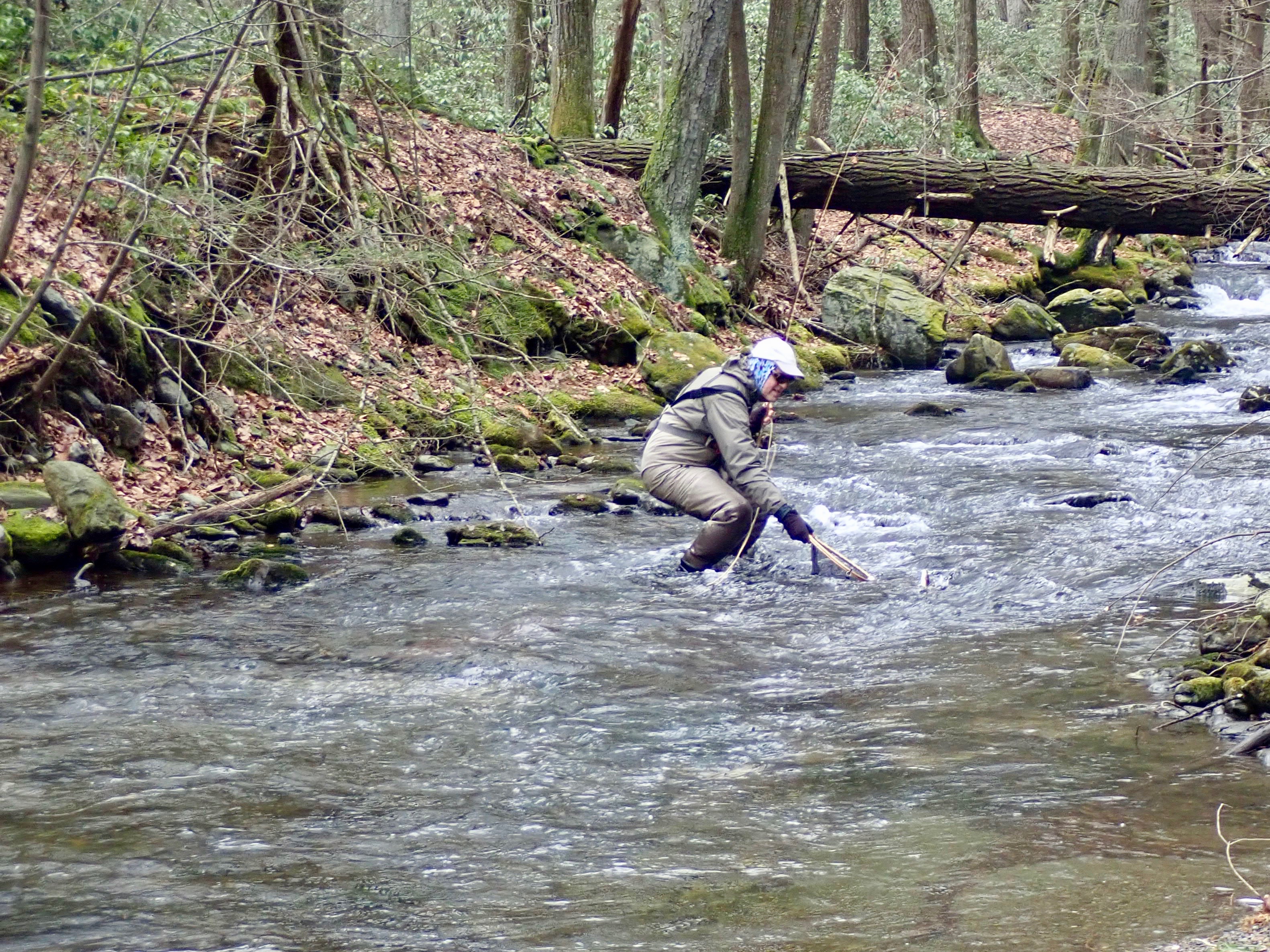
Let’s give small stream wild fish a break

Right now is a good time to not go fishing for wild trout on small streams.

As you already know, most of the state is abnormally dry, and the northwest hills are officially in drought. Don’t let the recent rainfall kid you — our small streams are running at a CFS fraction of what they should be.

While nature finds a way, the stresses of summer heat and trickle flows no doubt took a toll. That alone would justify giving small streams a break. But right now is pre-spawn and spawn time. I ventured out yesterday and was stunned by the severity of the low water. The spawn is a stressful time for fish, exacerbated by the dire conditions of late summer. With so much of the stream bed exposed, wild fish will be challenged to find spawning gravel. I didn’t see any redds yesterday, and it may be that the fish are so stressed, and have so few gravel options, that on many small streams we won’t see a successful spawn this fall.

Learn how to identify a redd: typically oval in shape, small gravel, lighter in color than surrounding bottom. There may or may not be fish nearby. It goes without saying, never target fish on a redd!

You don’t have to be a fisheries biologist to reckon that if that is in fact the case, it does not bode well for future wild fish populations.

So here’s how you can help: for the time being, don’t fish small streams. Give the trout a break. Once we get back to normal flows, enjoy — but please be on the lookout for redds and spawning gravel (dime and pea-sized substrate). Most of all, stay out of the stream bed — no wading! — until late March. It’s good for fish. And good for everyone who loves fishing small streams.
Back in the Small Stream Groove

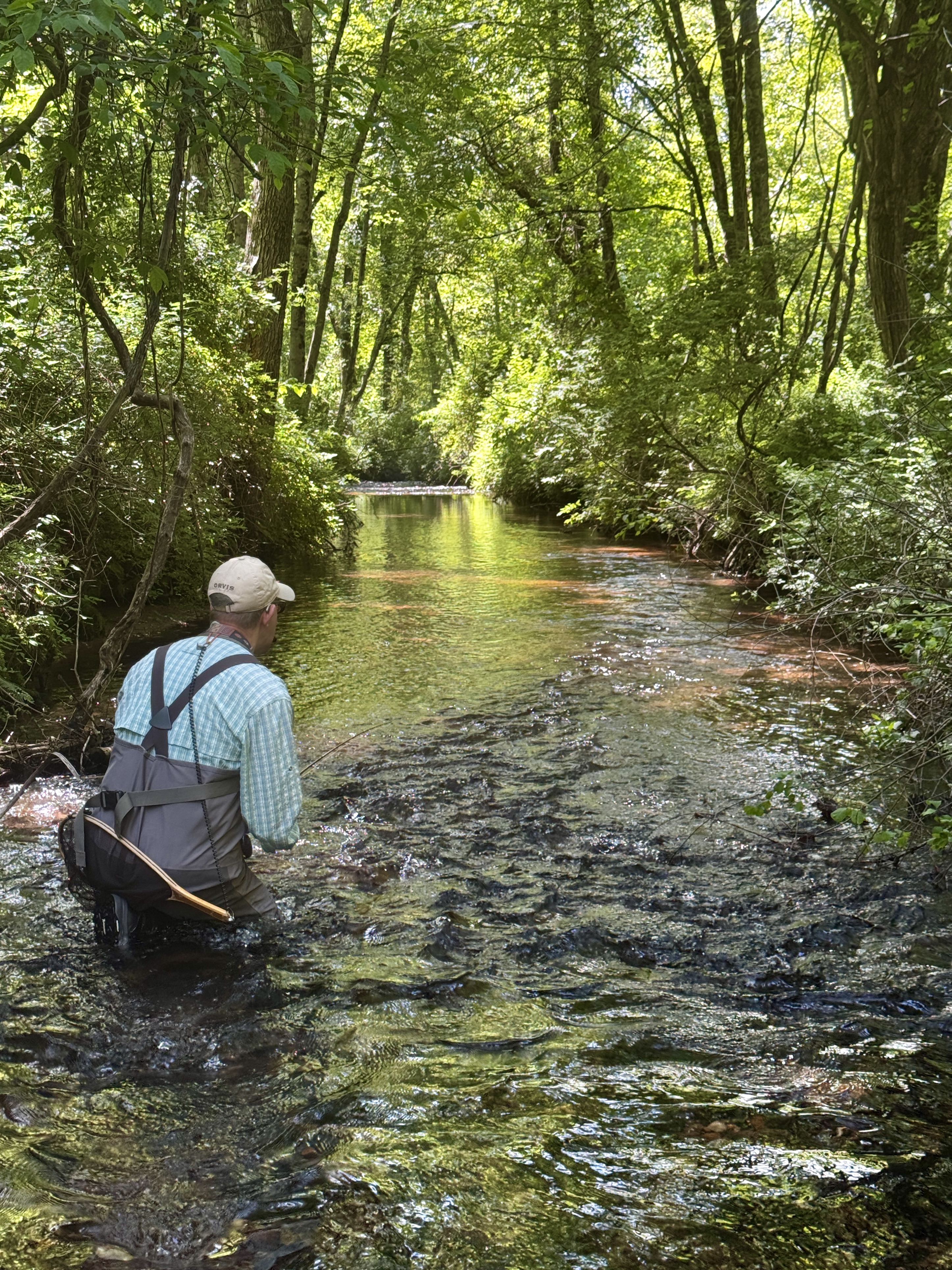
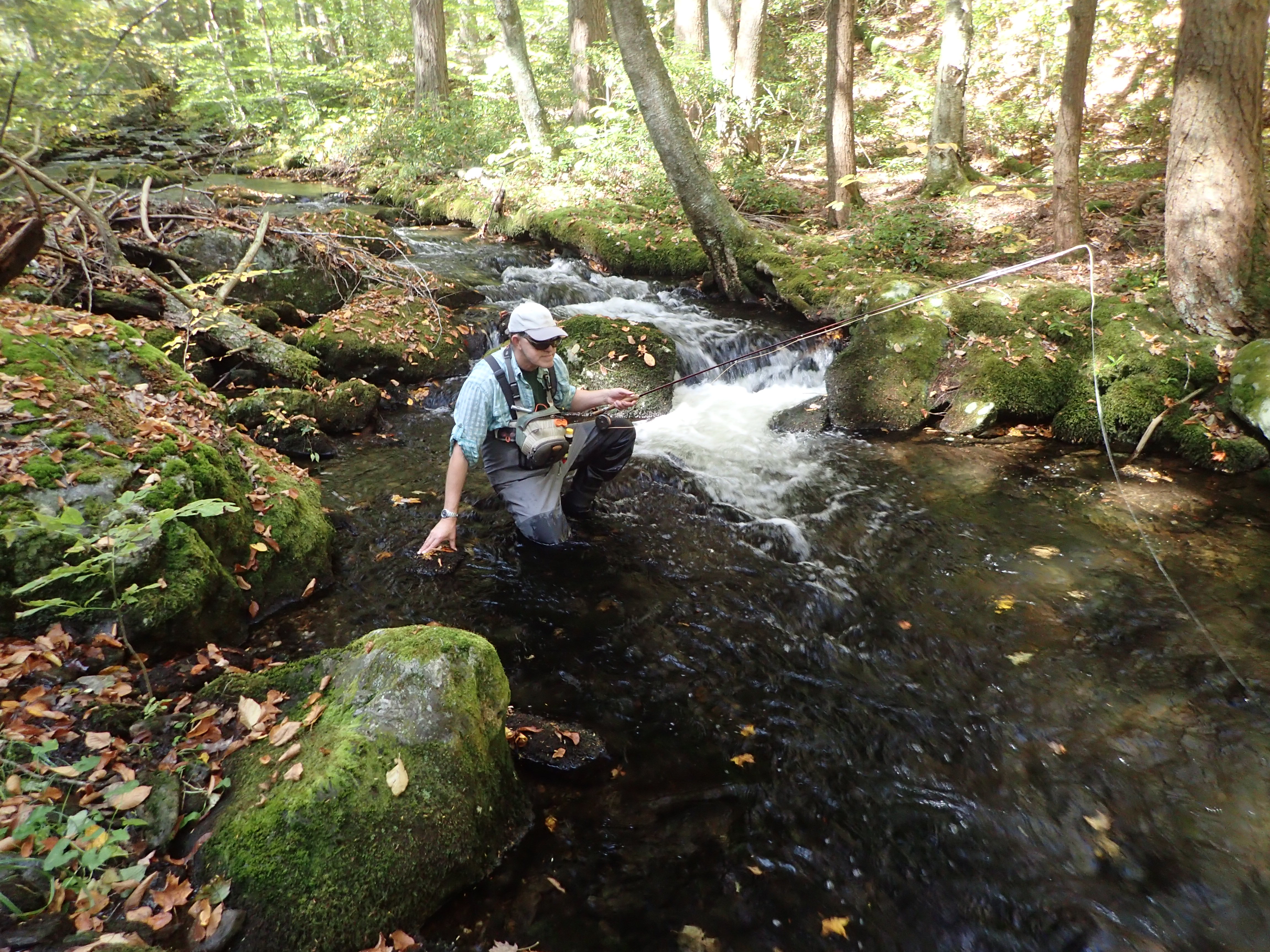
What a treat to be able to fish a small stream again. It’s hard to believe that this was my first fishing-for-fun-only outing of 2025. Surfcaster extraordinaire Toby Lapinski and I spent a few hours last week exploring a woodland gem. Although we fished mid-afternoon, dense canopy blocked the sunlight and the water was surprisingly cold. Water height was on the low side of medium. Although I fished a dry dropper system, the local char showed a clear preference for the dry. Toby fished a size 10 hopper, and they attacked it with wanton ferocity. We pricked a bunch, landed several, and left feeling happy.

I could get used to this. I really, really could. Toby Lapinski photo

Given the daylight and shallower water, I found it curious that the fish weren’t that interested in subsurface offerings. Besides the dry/dropper, I also fished the Squirmy Jiggy Thingy. I felt many nips and tugs, but those were clearly generated by smaller fish. (By the way, we saw/spooked dozens of fingerlings, which portends for a bright next year.) The moment of the day, however, was when we witnessed a 3-foot long northern water snake capture and kill an 8″ brook trout. I’d never seen anything like it. The snake took the fish out of the water, and clamped down on its “neck” to suffocate it. There’s a theory which states that on small streams, terrestrials become a huge part of the trout’s summer diet. Apparently, the tables are sometimes turned.

“Fly Fishing CT’s Small Streams” Thursday 9/12 7pm at Hammonasset Chapter TU

I’m kicking off my 2024 fall/winter speaking season Thursday night, September 12, 7pm, at the HCTU meeting in Meriden. The topic will be Fly Fishing CT’s Small Streams, a subject that I’m really passionate about. We’ll talk when, where, how, tackle, flies, tactics, conservation, and more. The meeting is open to the public, so I hope to see you there!

Fishing small streams returns you to the very soul of fly fishing.

Small Stream Report 2/27/24: The kids are all right

I didn’t really have the time yesterday, but since my default setting is when in doubt, go fishing, I did. The venue was a small woodland stream, and the time frame was 3:45pm-5:30pm. It was mostly cloudy and very warm for February, with a water temp of 48 degrees. The stream was running medium-low and clear. No hatch activity, although I did see one lonesome sz 600 midge flitting about.

I’ve written before that I’m a massive creature of habit, but on this outing I decided to explore about 100 yards of new water. I was glad I did, as that turned out to be my most productive stretch. I fished mostly subsurface with the Squirmy Worm Jiggy Thingy, but I did get a hysterical swing and miss on a bushy dry for the 5 minutes I fished it. All told, I pricked about 18 and brought probably a third of them to hand. I did catch the same beautifully spotted hen I took in January at the same hole. She really clobbered the fly.

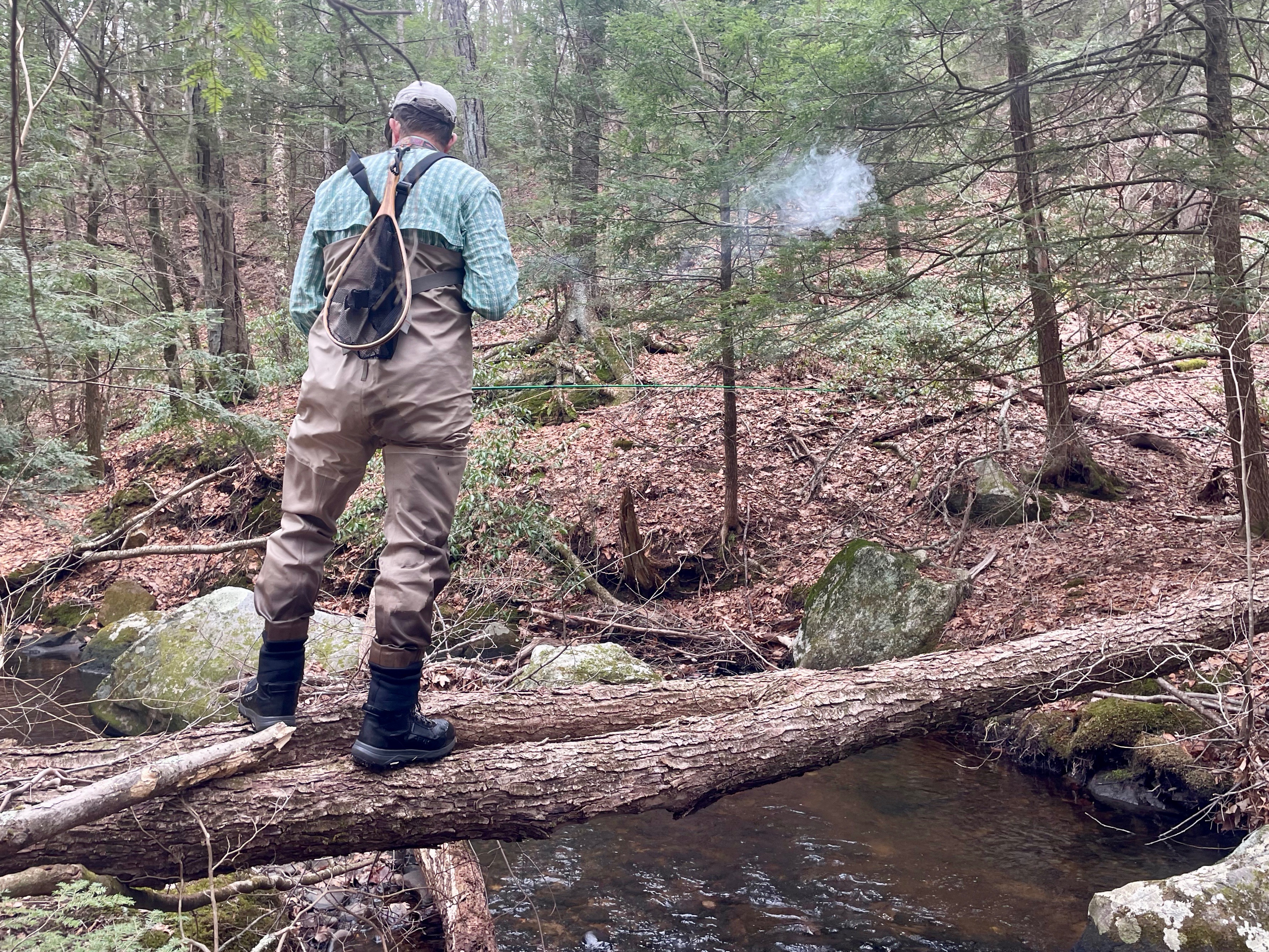
A few of my favorite things: a cigar, a glass rod, and a small stream, and if I can get them all at once that’s even better. What a glorious day to play hooky for a few hours and lose myself in a babbling brook.

More Pre-Spawn Small Stream Action

What a treat to spend a day fishing with #2 Son Cameron on a small woodland stream. The water was on the high side of medium, 55 degrees and crystal clear. Although the spawn has not yet begun, some of the resident char were sporting their ready-to-get-jiggy finery. The leaves are beginning to tumble down, and although they were not an issue, I would expect that they would start becoming one this week. Like my previous trip, the fish were unimpressed with the dry fly; anything subsurface was immediately bull-rushed and nipped at. If you’re heading to a small stream from now until April, please stay out of the water and be on the lookout for redds!

It was another work day of sorts, shooting video and still photos for presentations and social media and other stuff. This would be the “crouching low against the landscape while staying out of the sunlight,” or the “dangling the fly in the current downstream to provoke a strike” shot. Photo by Cam Culton
We all know brookies for their brilliant colors, dots, halos, fins, and vermiculations. One of the things I love about the species is the way they adjust their coloration to their surroundings. Sandy or light-colored substrate means the char will have a lighter flank. Dark horses like this often live in remote, isolated plunges that never see direct sunlight and very little light in general. The photo doesn’t do this brook trout’s dark coloration justice. I nicknamed him “The Chocolate Brookie.” Photo by Cam Culton.

Take the Wild Trout One Photo Challenge

Anglers wielding cameras have killed more small stream wild trout — intentionally or not — in the last 10 years than in the previous 100. You can blame it on the convenience and portability of digital devices. You can blame it on social media. You can blame it on anglers. Or narcissism. Or all of the above.

Whatever the root cause, I still see far too many images on social media of mishandled wild trout. Fish being held in dry hands. Fish thrashing around in landing nets, airborne, nowhere near the water. Fish photographed laying on grass, twigs, leaves, rocks, and other substrate no wild trout that’s going to be released should ever touch.

Let’s assume for a moment that I’m not talking about you. You’ve visited keepfishwet.org. You know the drill for ensuring more favorable catch and release outcomes. I applaud you. And now, I’d like to ask you a small favor.

Stop taking so many pictures of wild trout.

We all agree: wild trout are beautiful. The delicate parr marks, breathtaking halos, and butter-yellow hues of wild browns. The intricate, Faberge Egg-like designs and vivid colors on wild char. They’re all a wonder, and a marvel to look at. But do we need to see a photo of 2…4….6…and more… wild fish from your most recent small stream outing? The answer, I believe, is no.

So next time you’re on your favorite brook, take the Wild Trout One Photo Challenge: You photograph one fish, and one fish only. That’s it. All the others go quickly back into the stream, and you get bonus points if those non-photo subjects never leave the water. Think of how many wild fish you’re not subjecting to additional stress. It’s a win for you. It’s a win for the next angler. And most of all, it’s a win for the fish. Remember, the stocking truck isn’t coming back to replace what wild fish we kill, accidental or not.

I truly thank you for your consideration.

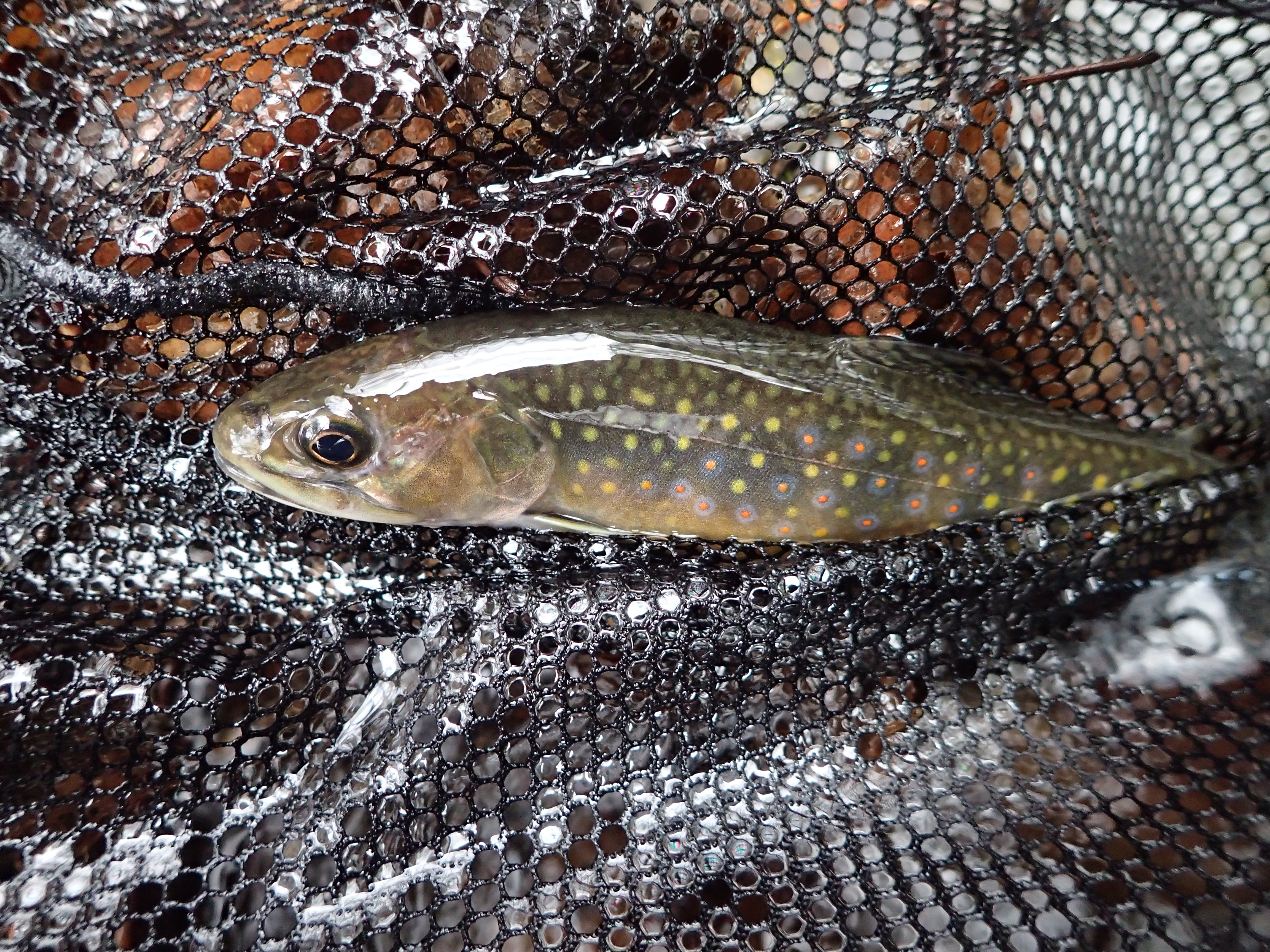
I don’t know how many wild brookies I landed on this day, but I do know that this was the only one I photographed. 1-2-3-lift-shoot, then back into the water. Less isn’t always more, but it usually is when it comes to small streams and wild trout.

The Responsibilities of Chasing Wild Trout

If you love and value wild fish — especially native fish — you have a responsibility to preserve and protect the resource. Yes, fishing is a blood sport. Yes, no matter how careful we are, some of what we catch may perish. But there are ways to dramatically minimize loss. And there are certainly ways to ensure the next angler has the opportunity to enjoy the stream as much as you.

So, I’m declaring this “Wild Trout/Small Stream Week” on currentseams.com. As you know, small stream fishing is an experience that is sacred to me. My goal this week is to educate and inform as much as possible. And this wonderful essay by a Pennsylvania angler named “Fly Tier Mike” is a good place to start. In The Responsibilites of Chasing Wild Trout, Mike outlines four best practices for those who fish for wild trout on small streams: Proper wading techniques (staying off of redds); proper fish handling; minimizing damage while taking photos/videos; and the pitfalls of social media that can lead to over-pressuring a stream.

Anyone who fishes for wild trout should read it, if only as a refresher. Thanks for your consideration.

I was gratified and encouraged to see someone else taking a stand for small streams and wild trout. Way to go, Mike!

Small stream recon, or: This is how I do it

Having not gone fishing for weeks, I sought the cure for my ills in a small stream outing this past Wednesday. I was going to visit an old favorite, but instead I decided check out a new section of stream that I’d never fished before. So, armed with my camera and pack and rod and cigar, I had at it. While the fishing was great, the catching was non-existent. So thought you might be interested in how I approached some of the water.

Let’s start here. Why was the fishing so poor? It could have been any or all of these: a cold front approaching; far cooler temperatures than the previous week; trout not yet spread out in the system; complete lack of hatch activity or visible feeding; low, clear, spooky water; or just nobody home. (Sometimes when I ‘m fishing new water for the first time, I’ll stand up and make dramatic movements in an attempt to spook fish I might have missed. In two hours, I rousted only one 3″ char.)

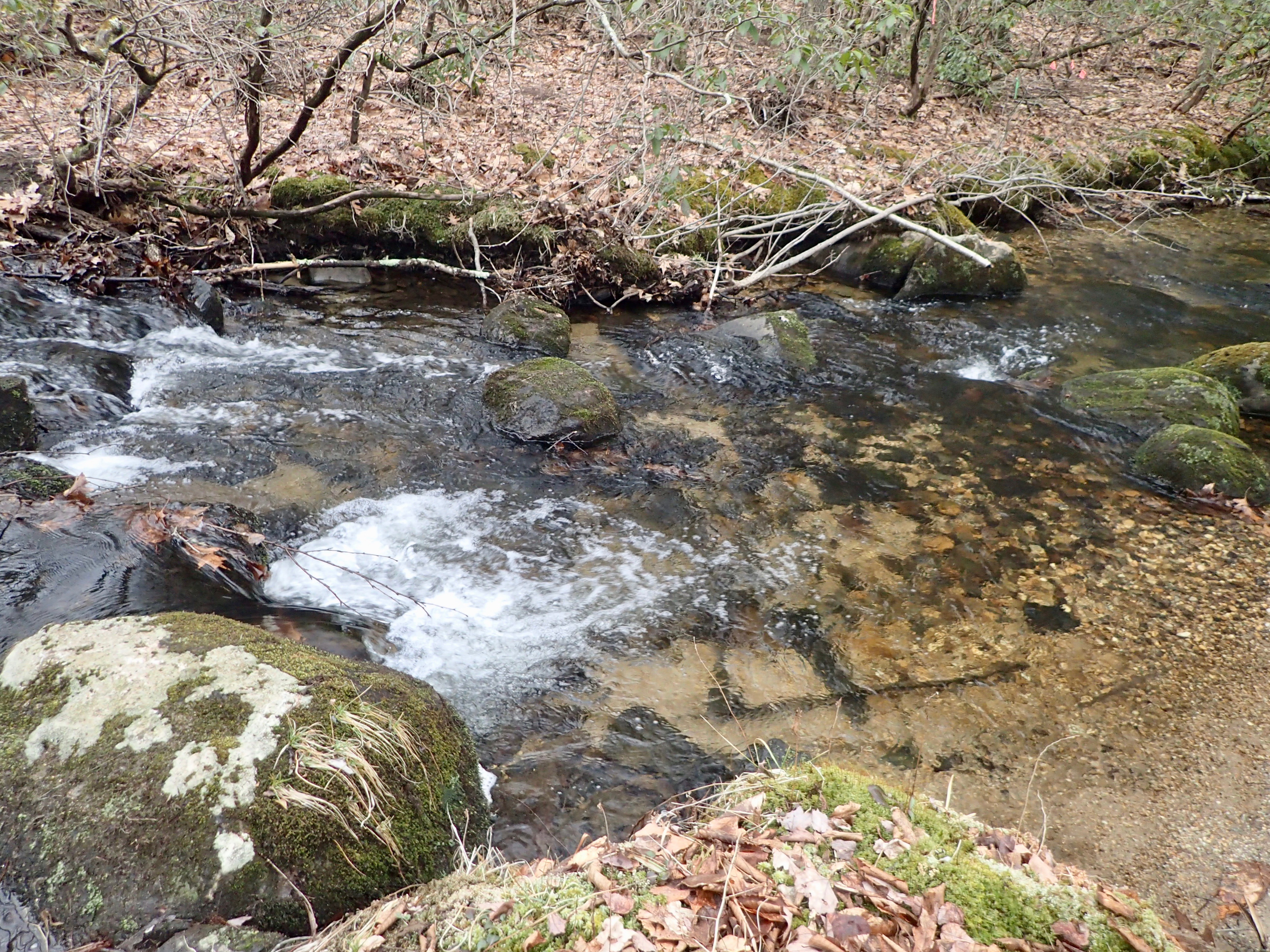
Exhibit A: the long flat pool. This brook had earth banks, so it was essential to walk very slowly and softly near the water. Always assume that stealth is critical. Also, stay out of the water! I began on my knees along the bank in the upper left side of the photo, drifting my flies (dry/nymph dropper, almost never a bad idea for searching) through the wrinkled water to the right of the rock with the large flat face. Looks can be deceiving; the water depth to the right of the rock was over a foot, plenty deep for char to hide out. Having blanked there, I crawled up behind the large rock and had at the main current seam. Still, nothing. Note the cut banks on the left side of the photo; I pounded those and was stunned that I got no love. Perhaps next time. I purposefully fished this pool from an upstream position, as I didn’t want to spook any fish with a fly line landing on the water. Presenting downstream means that any fish will always see your fly first.
Exhibit B: the small, wrinkled plunge. This pool is immediately below the previous pool, and I had high hopes for it. To start, many times in low, clear flows, fish will be far more willing to show themselves in moving, wrinkled water, and especially whitewater. (Insert “You Lose” game show buzzer sound here.) Once again, not a touch. I didn’t fish from this position, which could easily spook any wary char; rather, I fished it from just above, again on my knees and using only bow casts to deliver the flies. Late April sounds about right for a return, or perhaps before if we get a good rainfall and the river is up and lightly stained. One thing’s for sure: it’s a very pretty stream.

“Fly Fishing CT’s Small Streams” at the CFFA Expo, this Saturday Feb 4 at 12:45pm

The best little fly fishing show in New England is back! The CFFA Fly Fishing Expo returns this Saturday, February 4 from 9am-3pm. Same town (South Windsor), new venue (Nomads, 100 Bidwell Avenue). I’ll be tying flies on Tyers Row for a few hours, and then I’m doing a seminar, Fly Fishing Connecticut’s Small Streams, at 12:45pm. The seminar is included in your admission price of $3. Please come say hello, and let’s support this very cool little show.

Connecticut’s small streams are a wonderful resource. I’m going to talk about fishing them, and perhaps more importantly, preserving and protecting them.
Another weekend, another show. I just got back from Edison, which was fantastic, and I’ll tell you all about it in a future post.

Small Stream Report: First foot instead of last blast

As a creature of habit, I lovingly cling to my routines. So I was as surprised as anyone when I decided to not go small stream fishing on New Year’s Eve. Logic trumped tradition; by delaying a few days, the water would be a little warmer and hopefully any residual ice would be long gone. On the drive up, we did see some sheltered woodland streams where mini-glaciers abounded. But when we (myself and surfcaster extraordinaire Toby Lapinski) arrived at the stream we were relieved to see that frozen water was almost non-existent.

The water was barely into the high side of medium, which is just about right for winter fishing, and the brook was running clear and cold. Overcast skies didn’t hurt, nor did temperatures in the low 40s. Toby started out bottom bouncing and jigging, while I went the dry/dropper route. The action far exceeded our expectations. As you can imagine, going deep won the day, but I had enough action on both the dry and dropper that I kept them on for hours. (If reading this is getting you fired up for small streams, I have a presentation tonight in Danbury, The Eastern Brook Trout; later this month, you can see me present Finding Small Stream Nirvana at the Marlborough Fly Fishing Show, and a week later in Edison.)

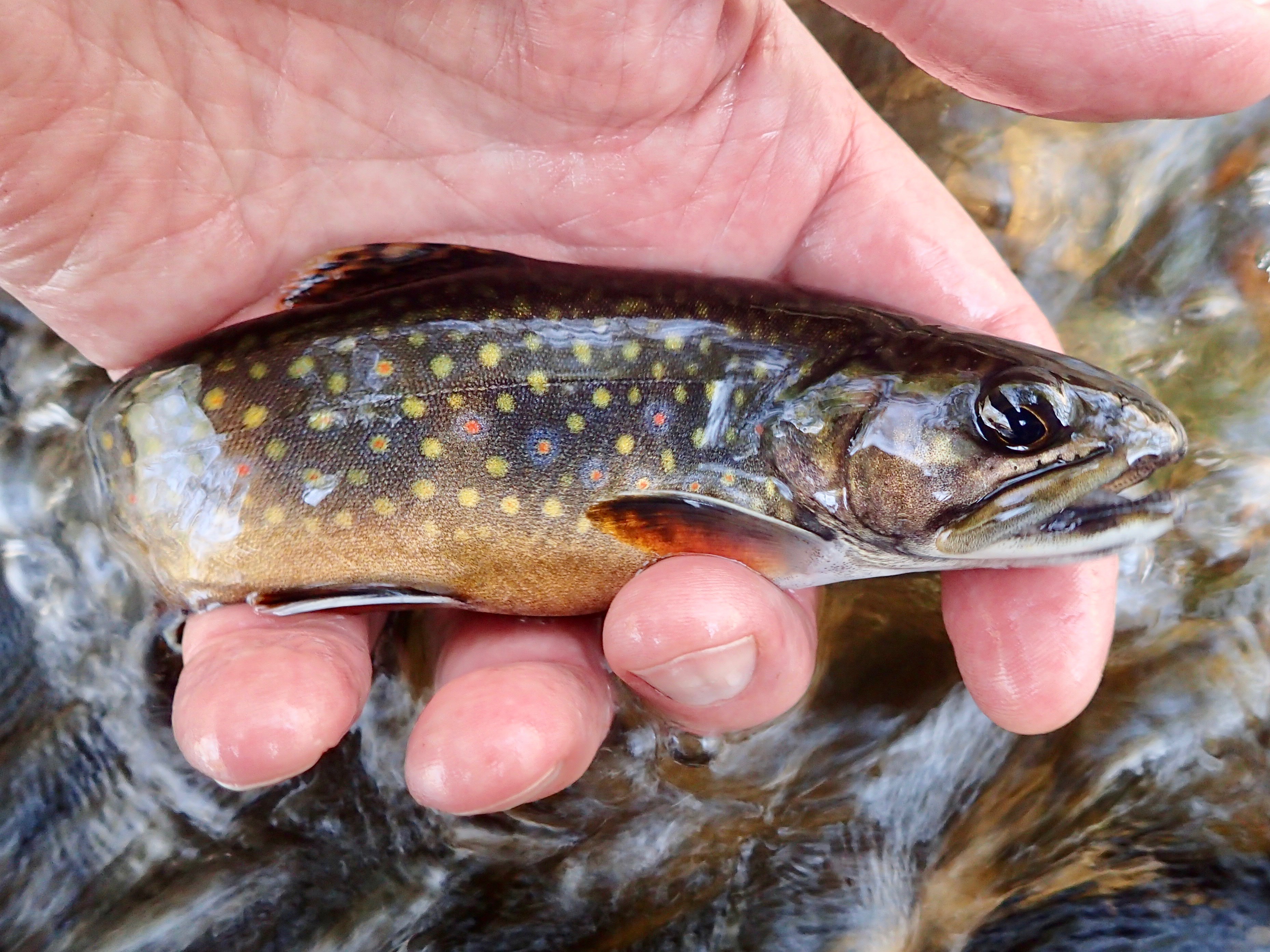
The first fish of any year is noteworthy, even more so when it’s a stunning display of nature’s paint box. Taken on a size 14 Improved Sofa Pillow.
When I was a kid, I ruefully wondered why tropical fish had all the cool colors. Cut to 55 years later when I now know better. Since fish like this aren’t ever getting replaced by the stocking truck, it bears repeating: barbless hooks only; keep photos to a minimum (I landed dozens and took shots of only three); make sure your hands are wet; keep fish in the water in your net until ready to shoot; never expose fish to air for more than a few seconds; and never lay a fish down on rocks/gravel/leaves/grass. Thank you. (Photo by Toby Lapinski)
Small stream fly fishing for native trout may be fly fishing in its purest form. (Photo by Toby Lapinski)
Halo, I love you (again). Besides pulchritude, this fish is noteworthy because its thinness indicates a spawned out fish — and therefore a redd may be nearby. It’s a good idea to limit walking within the stream bed from mid fall to mid spring; the last thing anyone wants to do is tread on a redd and make all those future brookies dead. (Yes, I know it.) (Photo by Toby Lapinski)