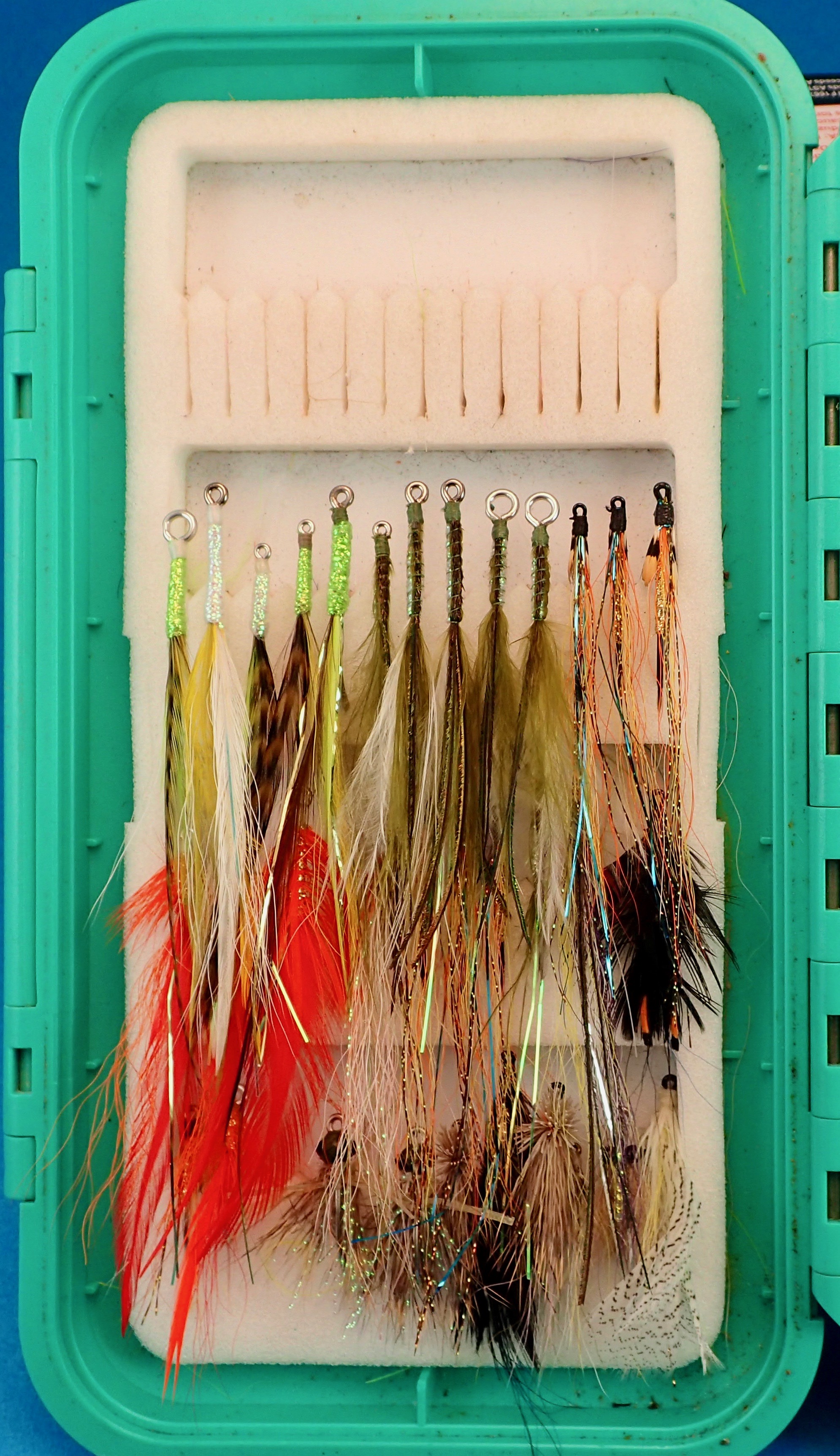
I received so many comments and emails about my recent post on my striper fly box that I thought it deserved a follow-up. Having taken to the vise, my next step was to fill in the blanks. The box is sand eel-heavy, and that’s by design since I like to fish summer marks where sand eels are the primary forage.
I populated the third row with small stuff like clam worms, shrimp, and mostly small baitfish and sand eels. The second row gets all sand eels, from left to right: Eelies and Eelie variants, Ray’s Marabou Sand Eel, and the Golden Knight bucktail. Those flies are all 2 1/2″-3″ long. The big-eye hooks were gifted to me by some friends in Europe; I’m not sure of the name or size, but they look strong, have a wide gap, and are very light.To the main event! Big Eelies get top billing since they are my workhorse (and favorite) pattern. The original is far left, followed be all kinds of variants: Olive Fireworm, Crazy Menhaden, a couple as yet un-named, L&L, Bruiser. (You can find recipes for most of these on my site.) Spares will go on the right side, along with squid and some experiments I’ll be test driving this summer and fall.
I’m pleased to say that I’ve completed and submitted my chapter to Dennis Zambrotta’s followup to Surfcasting Around The Block. I like what I wrote. Dennis likes what I wrote. I’m hoping you will, too. You’ll have questions, of course, like when’s the book coming out (don’t know) and can you tell us what you wrote about (nope, you’ll have to wait, but it’s a really good story). Speaking of writing about stripers, I just finished a piece for Surfcaster’s Journal magazine. It’s something I wrote a very long time ago, revisited, re-wrote (about 10 times), polished up, and now you’ll finally get to read it. It’s another good one (he said modestly). Now, if I can only find some time to fish…
Here it is: a map that shows all my secret Block Island fishing spots.
As I continue to pore through Gary LaFontaine’s masterwork Caddisflies, I’m reminded of the sheer volume of universal concepts that apply to fly fishing. So, even though he’s talking about fishing for trout that are feeding on caddisflies, LaFontaine could easily be talking about stripers feeding on sand eels or grass shrimp. A true maverick, he isn’t afraid to think or act differently, to challenge conventional wisdom, or conduct experiments to prove his theories. (Listen to the science. You’ve heard that one before) The more you fish for trout and stripers, the more you begin to see patterns and similarities between the species and how you should be fishing for them. Here are three themes in Caddisflies from which I think striper anglers and fly tyers who want to dramatically elevate their game could benefit.
Realism is the least important factor in fly design. I don’t have the actual stat, but I’m comfortable in saying that nine out of ten striper baitfish patterns feature glued on, ultra-realistic eyes. (Other than on these pages, when was the last time you saw a squid fly without big googly eyes?) If realism, from eyes to full-bodied profile to opacity to exact coloring, etc., is so important, how come my baitfish flies (and yours, and everyone else’s) continue to catch stripers long after they’ve literally been ripped to shreds? It’s a rhetorical question, but I’ll answer anyway. It’s because the bass are keying on certain bait or environmental characteristics that serve as bite triggers, and those triggers are still present in the remnants of the fly. LaFontaine knew that making a favorable impression on the fish — by showing them at least one primary feature or action that identified the fly as something that looked like what they were eating — was far more important than rendering a carbon copy.
I get this all the time: “That doesn’t look like a squid.” But Ken Abrames‘ Mutable Squid isn’t designed to “look like a squid.” It’s designed to create the illusion of life. I don’t know what stripers think it is, but they’ve eaten this fly enough times for me to know that they think it’s something good to eat.
Energy efficiency is the reason for selective feeding. Fish, especially bigger ones, are essentially lazy. So when they’re glommed onto grass shrimp in a feeding lane, you can engage in the futile activity of ripping and stripping a big fly past them, or deliver what they’re eating to their waiting mouths. This is why there is no one-size-fits-all “go-to” striper fly — and why learning presentation with a floating line is so important. Match the hatch, learn its nuances, make it easy for the stripers to feed, and you’ll catch more bass.
Fish are not intelligent. There is no such thing as an educated striped bass. Fish cannot reason. They are programmed for survival, and these primal forces have nothing to do with fly fishing or why you can’t fool that lunker. The fish is simply doing what’s it’s doing, and it’s up to you to crack the code.
I’m not in the habit of counting fish. But steelhead, being what they are — well, they’re just different. Trying to catch them is also different. I’ve been through all this with you before: you can do everything right and drop the fish. You can do (most) everything wrong and land the fish. Life isn’t fair, and neither is steelheading. The conditions you’re fishing in can be demanding, if not downright brutal. So when you get a decent flow and warm sunshine and bluebird skies and, most of all, a little luck, you thank the steelhead gods very much and you certainly don’t question any of it. I’d been stuck on steelhead #97 since November — my March trip was a blank — so here I was a month later, hoping something good would happen.
Tuesday April 13. I got to the river around 3pm. My float trip was scheduled for the next day, but I figured I should take advantage of the opportunity to fish. I hit a popular mark on the lower end of the river, one I was familiar with. As I was walking down the path, I saw an angler playing a steelhead, so this gave me hope. That was short-lived. For the next two-and-one-half hours, a total of eight anglers on the run hooked zero fish. I had a touch at one point, but my hookset didn’t even produce a head shake. I decided to save my chips for the next day, so I left disappointed, but clinging to the hope that sooner or later my lousy luck had to change.
If you need something spell-checked, you’re on your own.
Wednesday April 14. At first I thought it was the bottom, but it didn’t quite figure. No head shake, and I came away with air, but the more I thought about it, the more I realized that it had to be a steelhead. A dozen casts later, indicator down, hook set, fish on. It was a nice-looking drop-back, holding in some faster water, and now ripping line off the reel. True to form, the fish stopped at the bottom of the pool. I regained line, then another run and some aerials, too. Line regained, process repeated, and now this fish is whipped. Reel cranking, cork upstream, rod bent, steelhead just about 20 feet from the boat, Jim with the net ready. Here comes number 98. Doink! There goes number 98. This is the type of loss that vexes me no end. I had a good hookset, and I played this fish no differently that the last 50 I’ve landed. A few four-letter words provided only a moderate salve to this grievous wound. Is this how today is going to be?
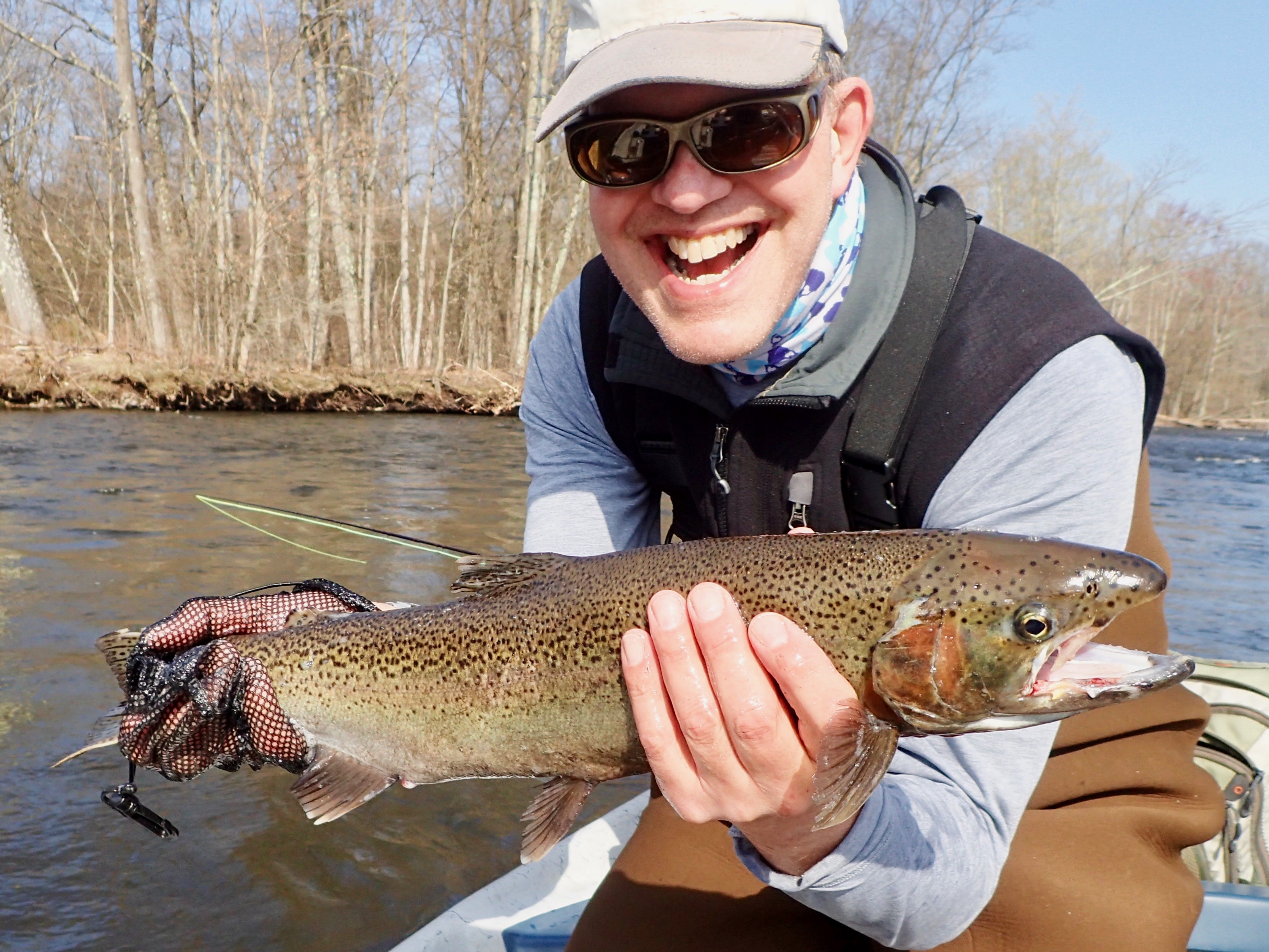
An hour or so later, we bagged number 98. This relieved some of the pressure, even more so after 99, pictured here, went into the hoop. Now I felt like this was really going to happen. And if it didn’t, at least I’d made a significant dent — two steelhead was twice the number I’d landed in my last four days. The conditions were pretty darned good: water temps in the upper 40s, a little color to the water, flow 350cfs, and, best of all, a warm sunny day to help me forget that day in March when I was flicking ice out my guides for eight hours. Then, suddenly, it was over. I landed my 100th steelhead. Cue Howie Rose saying, “Put it in the books!” Not the prettiest specimen, but beautiful and perfect in his own way. What an eventful journey. I’d like to thank everyone who encouraged me, shared water, helped wrangle and land or net a steelhead, and especially my guide James Kirtland who has provided me with so many pro tips over the years. I’ve learned so much from him. Jim’s ClackaCraft was a great choice for low water. Jim’s a skilled oarsman, not to mention a pro with a landing net. This also seems like the appropriate time to give a shout out to Ken Abrames. Ken’s Salmo Saxatillis rod, taking a break after doing yeoman’s work, is a truly exceptional steelhead rod. The final tally for the day was five-for-nine. We also landed four steelhead smolt and a brown trout. We saved the best steelhead for last, this pug-nosed double-digit-pounds hen we nymphed up fishing western style. To revisit the “steelheading isn’t fair” theme: I had a lousy hookset, I mishandled my line, the run was laden with submerged logs and I still landed her. I’ll take all the luck I can get! And so, dear reader, if you’re counting along, this is number 102. Only 98 more to get to 200.
I’ve got stripers on the brain, and so we’ll be talking about the traditional-style striper flies I like to tie and fish: sparse bucktails, soft-hackles, and flatwings. The discussion will include materials and hooks I use, and I’ll throw in a tying demo of something tbd. If you haven’t been getting the Zoom links — I send them out Tuesday late afternoon — please check your spam box. If you’re sending a request to get on the list, please don’t wait until 7:45 p.m. Tuesday night…I won’t be checking my email that late. Thanks!
Thanks to the Ottawa Flyfishers, I am now officially an internationally-known fly fishing speaker. We had a most excellent time last night via Zoom. I talked for an hour about “The Little Things,” my original presentation in the series, that can make a big difference in your fishing success. We did Q&A — I love Q&A — for a few more minutes, then wrapped it up with social pleasantries. A wonderful group of dedicated, enthusiastic anglers. Thank you very much!
Kenney’s in the house! Ken Abrames is doing a series of talks on YouTube: “Kenney Abrames begins a video talk series with this short audio where he discusses his connection with nature.” I know as much about it as you do at this point. I have not yet listened to the first but I’m sure it will be loaded with keen observations. You can find the first talk here.
Finally, I had to switch the time for this Saturday’s “Favorite Nymphs” Zoom tying class to 3:30 p.m. There’s still room if you want to attend. Once again, the day is the same, Saturday, February 20, and the new start time is 3:30pm. The cost is $10 and you register by sending me the fee through PayPal. This also seems like a good time to thank those already enriolled in the class for being so gracious when I had to change the time. I’m lucky to have so many good people who are part of this website!
I did not get to fish Leisenring’s favorite nymphs last year as much as I would have liked. There’s always 2021…
This is my third (I think) year participating in On The Water magazine‘s “Guide Flies” column, written by Tony Lolli. You’re familiar with he concept of a guide fly — a pattern that is typically simple to tie and can be relied upon to produce day in and day out. (Or night after night, as it were.) The Big Eelie delivers the goods. Developed by Ken Abrames, this pattern imitates larger sand eels. Part flatwing, part soft hackle, the Big Eelie is understated elegance at its finest. I think what I like most about the Big Eelie is that its template — four pencil-thin saddles and a marabou collar — lends itself to as many color combination as your inner artist can conjure up. My Rat a Tat Big Eelie, based on Ken’s larger flatwing, is just one example. Have at it and hold on tight!
A good virtual crowd last night for my Tuesday Night Zoom, “Good Reads.” In case you missed it, I shared a dozen books that have had a major influence on my fly fishing approach/philosophy/success. I had several requests for the list, so here it is: Trout Fishing by Joe Brooks. Trout by Ray Bergman. The Soft-Hackled Fly and Tiny Soft Hackles by Sylvester Nemes. Wet Flies by Dave Hughes. Two Centuries of Soft-Hackled Flies by Sylvester Nemes. Trout Lessons by Ed Engle. Striper Moon and A Perfect Fish by Ken Abrames. Steelhead Fly Fishing by Trey Combs. Steelhead Dreams by Matt Supinski. Nymph Fishing by George Daniel. Tactical Fly Fishing by Devin Olsen.
Some of the language in Trout is a little moldy, but Bergman still nails certain truths that have withstood the test of time.
It occurs to me that each of these books deserves its own review. I’ve already formally reviewed some of the newer ones on these pages, but I’ll be starting a series featuring the others very soon. Last night’s Zoom was so well received that I’m going to do another on Good Reads (Son of Good Reads? Good Reads II? Attack of the Good Reads?). The well of influential material is deep!
There’s still room in Saturday’s (January 30) class, Tying Wingless and Winged Wet Flies. We start at 1pm, and you can literally sign up for it any time before then. Here are the details.
One of my goals with currentseams is to help you become a better angler — and hopefully catch more fish. So if I could somehow distill a “Top Ten Tips” out of my brain’s fly fishing storehouse, one of them would certainly be: Learn presentations other than cast and strip. Especially if you want to catch more stripers.
When I see questions like, “How fast do you retrieve the fly?” or “Do you strip with one or two hands?” — and I see these questions a lot — I despair. Rarely does anyone ask the question, “Does it have to be a retrieve?” The answer would open many doors to greater fish-catching glory.
Even if you were going to fish for stripers using only retrieves — and there are many outings over the course of a season where I do just that — there are an abundance of retrieve options that are rarely used or discussed. For example, for sand eels, I like a hyper short (1-2″) rapid pulsing strip. For a large squid fly like the Mutable Squid, I like a slow hand-twist retrieve. Last week I fished a large deer-hair head fly with a fast strip-strip-strip-strip….pause….wait for it….then strip action. And there’s always the surface popper trick of landing the fly with a splat….then doing nothing. Once the landing rings dissipate, give that bug a twitch. You could present in randomly timed, spaced, and distanced strips, creating the drunken action of wounded prey. The list goes on. And the stripers will always tell you when you get it right.
Ultimately, you’ll need to learn presentations other than cast-and-strip for those outings where the stripers will not chase. One of my recent trips included a puzzle where school bass were cruising and feeding, but would not move to a stripped fly. The answer was found within traditional salmon presentation tactics. Those willing to invest in the floating line — I’m not talking money, but rather in taking the time to learn how to harness its power and master a few basic presentations — will see their catch rates soar. And while you’re at it, pick up a used copy of “Greased Line Fishing for Salmon [and Steelhead] by Jock Scott.
Fly fishing is all about line control. So take charge. Presentation is not difficult to learn. Remember that a fly rod and line is only, as Ken Abrames once observed, “a stick and a string.”
Learn presentation and start bringing your fly to the fish — not vice versa.




 currentseams.com