The 2024 International Fly Tying Symposium has come and gone, leaving in its wake many fond memories, new tying swag, and new acquaintances made. The event runs from Saturday to Sunday; Saturday is typically the busy day, with crowds dwindling by Sunday afternoon (it’s hard to compete with the NFL). If you’ve never been, you should, because it’s a tremendous opportunity to watch some of the best tyers in the world in action. You can meet them, watch them, talk to them, ask questions — I do all of that when I take a break and walk the room. There are private classes where you can receive personalized instruction. There are seminars that are included in the price of your ticket. And four times a day, featured fly tyers who tie and present to a small audience.
On Saturday night there’s a banquet, and everyone who attends gets a goody bag of fly tying swag. Thread, tools, materials…it’s all good stuff. Post-dinner, I hosted a little wine party attended by several luminaries in the fly tying world. Properly hydrated, Sunday went off without a hitch. Here’s some of the weekend in photos. Check out my Instagram @stevecultonflyfishing for more, soon.
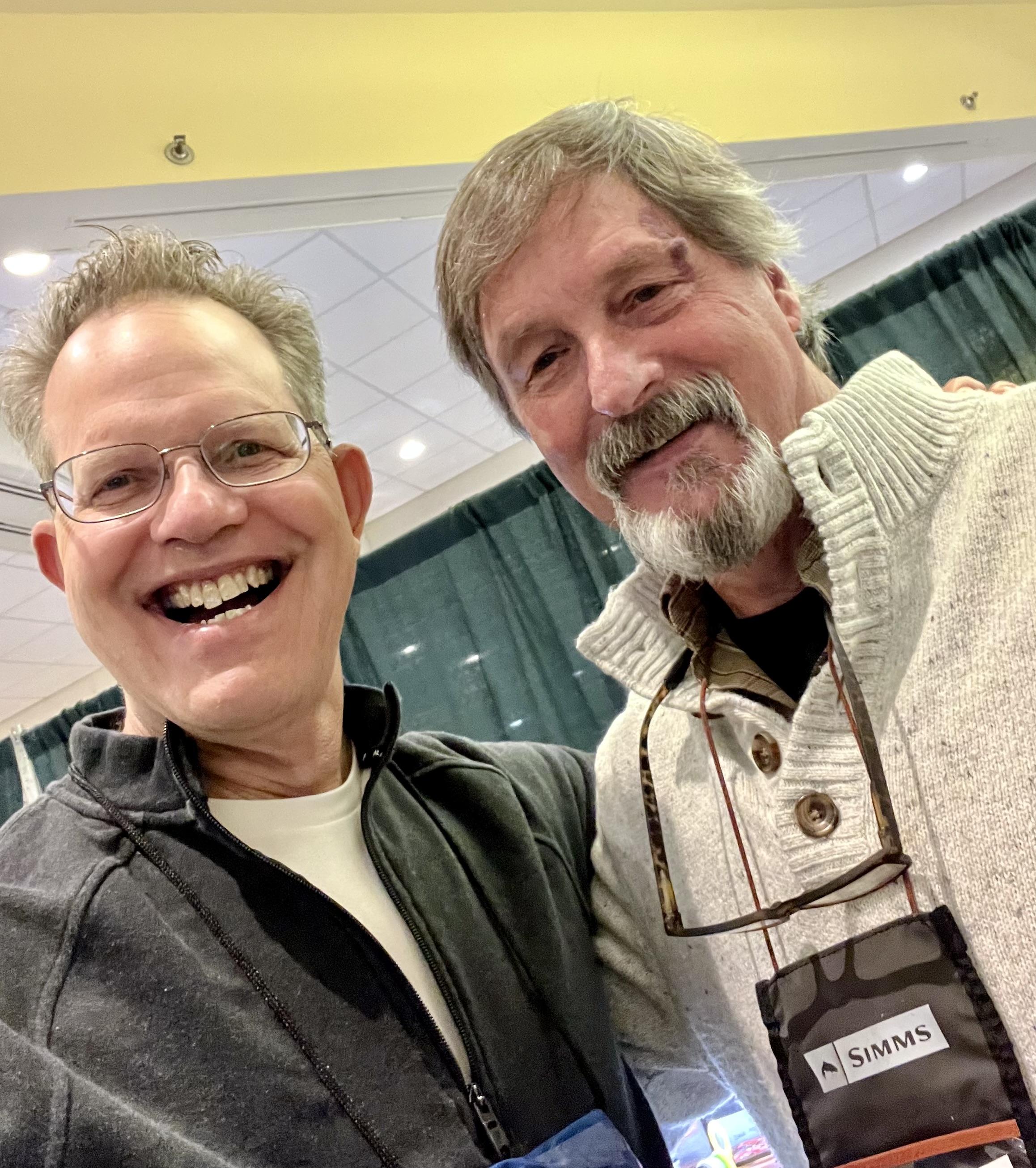
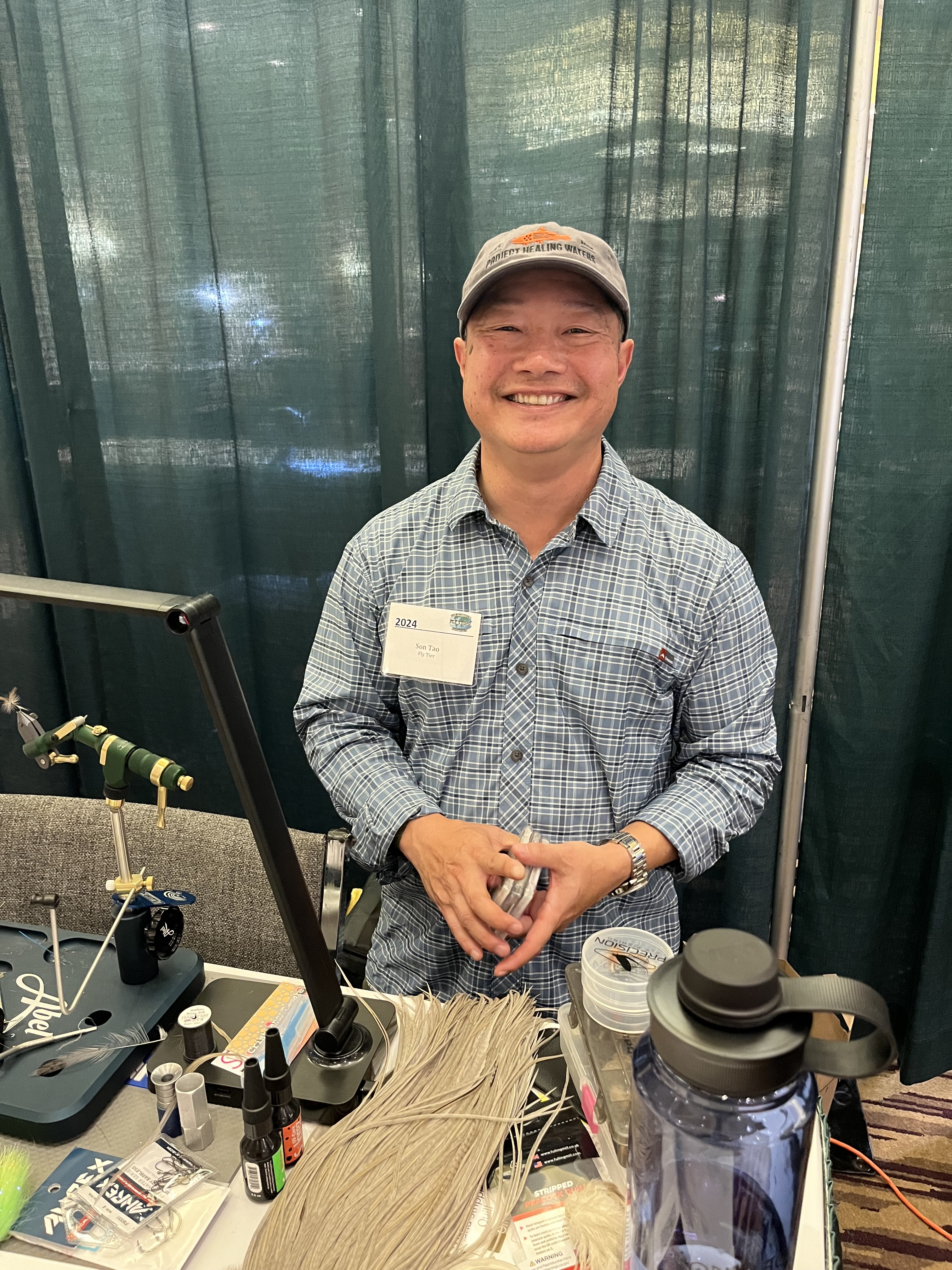
The first thing I did Saturday morning was put on my fanboy hat and go meet Jeff Blood. Jeff’s the originator of the Blood Dot Egg, my favorite steelhead egg pattern. Jeff was warm and welcoming and it was invaluable to be able to discuss steelheading and Lake Erie trib fly fishing with him. Jeff gave me some braid we use to tie the White Death Zonker, another favorite pattern of his. Later, I returned to my tying station to find two dozen Blood Dots and another package of White Death braid on my chair. Wow! Thank you, Jeff! I’ve also wanted to meet Son Tao since I read about his Caddis Emerger pattern in Pat Dorsey’s book Favorite Flies for Colorado. I shared a table with Bob Lindquist, Delaware River guide extraordinaire (and contributing photographer for my upcoming Farmington River book). Son was one table down the aisle, so it was easy to chat. He is one heckuva skilled tier. Also a shout out to David White who sat at the table next to me. Great to meet you!Not too shabby company! I was so honored to be included in this roster. This was my first time as Featured Tier in the Symposium, and my session was very well attended. If you were in the group, thank you for participating. Thank you also to everyone who stopped by my table to watch and ask questions and talk fly fishing. Tying LaFontaine’s Diving Caddis. Thanks, Phil, for the wonderful photos. It’s hard to believe that I’d never met Bob Clouser before this weekend. Bob was FFT just before me, so that seemed like a natural time to say hello. Whether you’re a presenter like me, a vendor, or an attendee, Bob’s kind nature is typical of the overwhelmingly positive energy you’ll get from everyone at the show. You’re with your tribe. People want to talk to you. So…you’re coming next year. Right? Or to the Marlborough and Edison Fly Fishing Shows in January. Right?
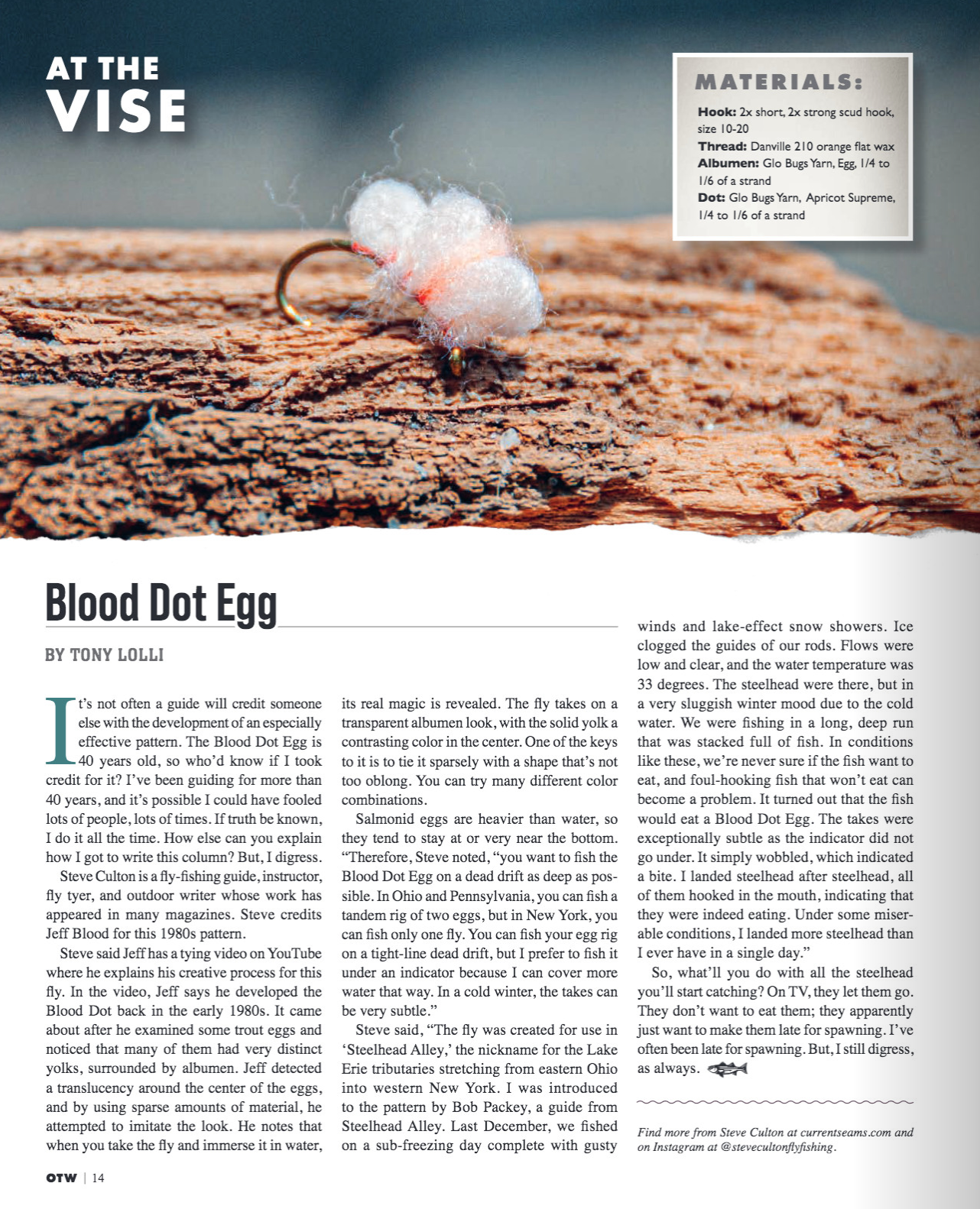
Ok, so it’s not my pattern — it’s Jeff Blood’s pattern. But the Blood Dot Egg is a classic guide fly, and I was delighted to share it with the readers of On The Water magazine‘s “Guide Flies” column, written by Tony Lolli. (Thanks again, Tony, for letting me play!) This is the single best egg pattern out there, and it’s so ridiculously easy to tie that you won’t fret when you sacrifice one or three or a dozen to the bottom gods. Steelhead season is upon us. Now, if we can only get some rain.
Shorter days, longer nights, cooler weather…I’m definitely in the mood, baby! We do need some rain, but as you read this, Great Lakes Steelhead are staging at the mouths of rivers and creeks. I think this thought train all started when I saw that Jeff Blood was going to be one of the tyers at the International Fly Tying Symposium (you’re going right?) on November 16-17. Jeff’s Blood Dot Egg has been my new favorite egg pattern since steelhead guide extraordinaire Bob Packey introduced me to it three years ago. It works on both Erie and Ontario steelhead (not to mention trout in CT). I’ll stand by the title of the article linked here: The best egg pattern for steelhead might be Jeff Blood’s Blood Dot.
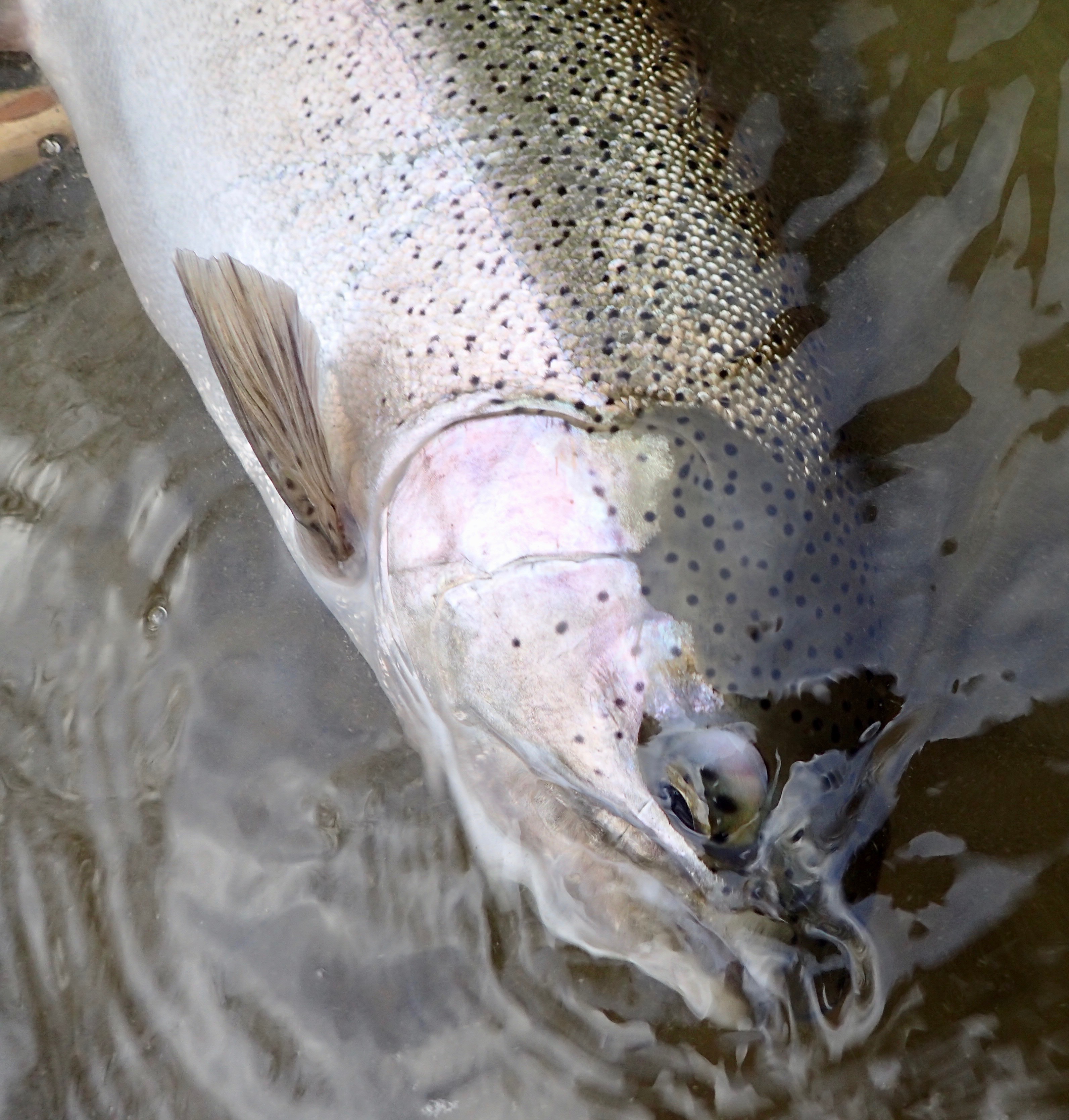
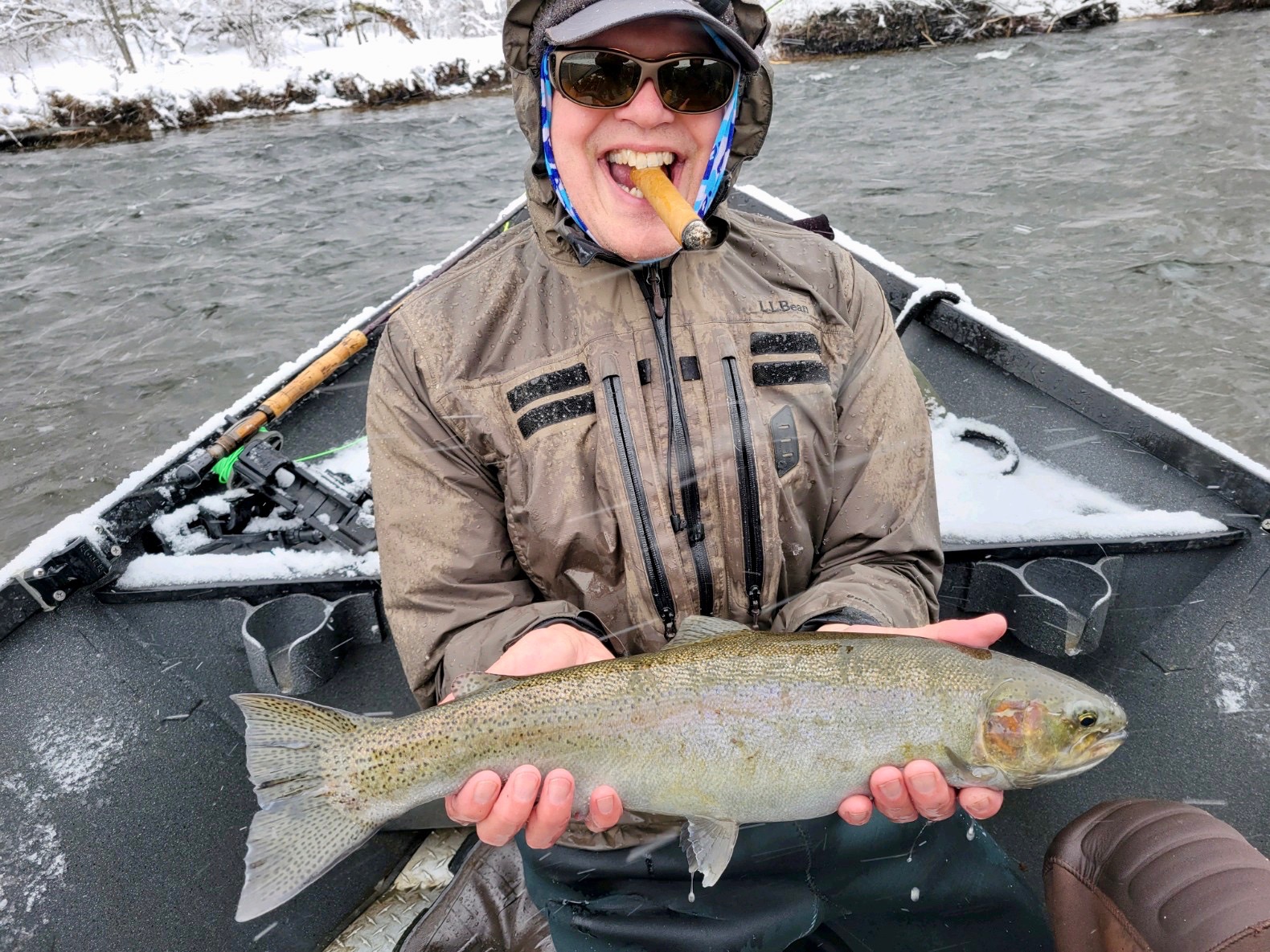
Give that man (Jeff Blood) a ceegar! This is a Salmon River fish from last November taken on Jeff’s fly.
After fishing two Erie tribs in OH and PA last December, I knew I would have to get back there. Soon, nine-ish hour drive be damned. I had to wait a full 10 months to do it, but it was so worth the wait.
Unlike the northeast, Steelhead Alley has seen very little rain this summer and fall. The timing for my trip could not have been better, with a decent slug of rain before the weekend that marked the true start of the fall run for many tribs. Still, the water was on the high side of low — if that makes sense — meaning that 90% of the fish would be in 10% of the water. The spook factor would likely be very high, along with angler traffic.
Adding to my challenges was that I had zero experience fishing public waters. So I hired the guide I used last year, Bob Packey of Solitude Steelhead Guide Service. Bob focuses on fishing private water — an absolute treat — but that would do me no good when it came to public water. So we formed a game plan: fish Wednesday morning on private water for a few hours, catch a few fish, then bounce around to some public access marks so I could learn some spots. Since Bob has deep domain experience on Erie tribs, I knew I’d be in good hands.
The dread cold front hit the night before day one, putting the steelhead in winter mode. We saw runs and slots that held dozens of steelhead, but even with precision casts and presentations, they were just not having it. Once the sun rose and the water inched up a precious degree or two, the natives decided to play. We had success with sz 14 Blood Dot eggs and sz 10 White Deaths fished as the point fly on a two-fly rig under an indicator. Switching to the White Death fly was a revelation, as fish that couldn’t be bothered with eggs suddenly opened their mouths and moved to take the fly. Bob is a terrific guide, and I’m learning so much from him about this unique fishery. Photo by Bob Packey.We had to work for our fish in the morning of day one, but beauties like this always make it a labor of love. I also stuck a big ol’ brown trout — funny how that’s considered by-catch when back home it would be a trophy. By 11:30am we were at a public access point on Elk Creek. Although there were plenty of anglers — “crowded” on Erie tribs is not the same as “crowded” on the Salmon River in Pulaski — we were able to find a half dozen highly productive marks because so many anglers were fishing in the wrong place. Cracking the Erie tribs fish-finding code is a major part of success. Once Bob showed me what to look for, finding the fish was much simpler task. The answer to the question, “Was that the bottom or a fish?” On all three mornings I fished, the steelhead were sluggish at first light. Once they turned on, there were far fewer fouls. When I foul a steelhead, I try to rope it in fast. I find I have very few breakoffs; most of the time, the hook comes away without breaking the tippet. I caught and released several fish that had hooks imbedded in their fins or bodies.What a rugby ball of a hen! She took the top fly on my rig, Clyde Murray’s Spider, size 12, in low light. My strategy on days two and three was to focus on a few marks and learn them cold (as much as I could in a few hours). Not all of the water was productive over the course of two days — steelhead are on the move this time of year — but I certainly had fun trying different flies and different combinations in different runs at different times of the day.So that’s why I lost that fish…Elk Creek living up to its name, a small window of wonder on an early morning when I was the only angler on the water for a few hundred yards. My final tally over 2 days and 3 hours was 20 steelhead landed, a bunch lost, and immeasurable fun. A little more rain, a little more flow, no bitter cold. Those are my hopes for December. Steelhead dreaming is a thoroughly enjoyable pastime.
About this time every year, my thoughts turn to steelhead, and of course, steelhead fly tying. I pull out my steelhead chest pack and the two fly boxes within its zippered pouches. The “big box,” as I call it (both boxes are, in reality, the same size) doesn’t change much from season to season — it’s mostly streamers and experiments and one-offs and flesh flies. The nymph and egg box, however, gets a serious going over and then a restocking.
But, things are a little different this year. I’ve got plans for two sorties to Steelhead Alley. These rivers and creeks are a universe away from a big, brawling river like the Salmon in upstate New York. They’re smaller, with different bugs and different water color and clarity and flow (very low right now) and different bottom structure. So I should be thinking differently with my flies.
What I’m currently tying up is generally smaller and more muted. I’ll give you a closer look next week. But right now, I’ve got corks to fill.
I first heard about Jeff Blood’s Blood Dot egg pattern years ago, but I’d never tied nor fished it until recently. Steelhead Alley guide extraordinaire Bob Packey of Solitude Steelhead Guide Service turned me on to it during last December’s smackdown on the OH and PA Erie tribs. I figure I caught about 90% of my fish on the pattern. Now, to be fair, it was also point fly on my leader the vast majority of time. But in some painfully low, clear flows, the Blood Dot proved itself over and over.
Then I took the Blood Dot to the Salmon River last month and again, it produced bites. When properly tied — and dunked in water — the fly does a wonderful job of transforming into a translucent, eggy mass with a suggestion of a yolk sac. It all stems from a very sparse tie using Egg colored GloBug Yarn with a contrast color dot. Here’s a tying video from the pattern’s creator, Jeff Blood.
Two dozen eggs, Blood Dot style. These all have a base color of Egg, with contrasting dots of Apricot Supreme (Bob Packey’s personal favorite), chartreuse, or blue. You can and should experiment with other color combinations. A classic steelhead guide fly. These are size 12.
Benjamin Franklin is famous for declaring the absolute certainty of death and taxes. I’d like to offer me with crappy weather for steelheading. It seems that no matter which days I choose months in advance, the conditions will suck.
I submit to the group this Tuesday and Wednesday. There are decent numbers of fish in the upper Salmon river, and the fly zones are absolutely polluted with steelhead. The bite has been, at worst, average. So what did we do? Dialed up a cold front and snow and wind for our two days. Thus endeth the bite.
There is a Christian tenet that says, “This is the day that the Lord has made. Let us rejoice in it and be glad.” Whatever religion you follow (or don’t) it’s good advice, especially if you’re a can-do kind of angler. There’s nothing we could do about the weather, so better be prepared for it, and be ready to adapt to conditions. I must confess, however, that I was not this happy by the end of the day. Thus endeth the lesson. (Photo by Gordon Culton)Yes, that’s wet snow blowing sideways across my jacket. After blanking for most of the morning, I stuck this fish in a soft water seam several hundred yards below the Altmar bridge. In fact, I set the hook so hard that I fell over into Gordo’s lap. Poor Gordo! He hooked and dropped a fish in some faster water just above this mark, and that was his only touch of the day. But he stuck it out and never complained. About a half hour after I landed this hen, I also dropped a fish in the same place where Gordo had lost his. Like son, like father?Both of my hookups came on size 12 Blood Dot eggs. If you don’t know that pattern, you should. (Photo by James Kirtland)We were so miserably cold on Tuesday that we called it around 2pm. Given the slow action, it was decided that if there was any open water in the LFZ on Wednesday AM before launch, I’d give it a few drifts. I don’t normally say exactly where I fish, but the mark opposite the boat launch is no secret, and it’s typically loaded with fish. As there was only one angler there, I waded in. Now, I’ve never fished this mark before, and it didn’t take me long to realize that I’d made a classic rookie mistake of wading too far into the river, too close to where I should drift. Once I adjusted my position, I started hooking up along the soft water edge. The problem was, the fish weren’t eating. I fouled four fish here, one in the tail (“Northbound train hooked on the southern end,” cracked Jim) and one on the dorsal. I didn’t see the third, and the fourth left me a souvenir of a scale. I really don’t like fouling fish — others where having the same experience — and I wanted to get Gordo fishing, so we buttoned up and began our float. (A fond note to Tom who was fishing above me, and was courteous and friendly and matey, and a boo-hiss to the churls below me who waded right where I was drifting, then couldn’t be bothered to move when anyone who hooked up above them had a fish roar down to their position. This is the dark side of crowded water, and it remains astonishing how rude some people can be.) (Photo by James Kirtland)Gordo had another rough day. He drifted an egg bag over a run with no love. Then I stepped up to bat and hooked up on my first cast with a Copperhead Stone. I stuck the fish good (I was really happy with my hookset speed, power, and direction on this trip) but it came off. A couple hours later, skippy here put a smile on my face in a fast-moving shallow glide/riffle. And that was it. Two-for-four for me on the trip, which isn’t a bad batting average, but I’d sure liked to have had more opportunities. I shouldn’t complain — Gordo executed dozens and dozens of quality drifts and had nothing to show for it. I’m proud of him for his perseverance.








 currentseams.com