Farmington River Report 10/3/17: On the edge of fishable

Once again, they’ve lowered the flow from the dam, giving us (with the help of the Still River) 75cfs in the permanent TMA. The water is plenty cold and the trout are still there, but it makes for some challenging fishing. David was up to the task, and we attacked multiple locations above and within the PTMA. While we found fish and had a few bumps, we were unable to bring any trout to net. David did a great job keeping up his enthusiasm — perseverance is a powerful asset when the fishing is tough. Short line and indicator nymphing were the methods. We saw a fairly strong caddis hatch above the PTMA at 10am. Most of the risers we witnessed came in the afternoon. The river was mobbed for a Tuesday afternoon in October — surprising given the conditions.

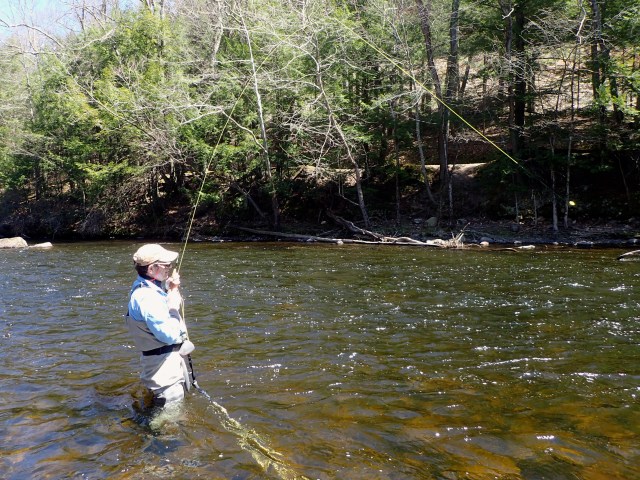
David fighting the good fight. We had a momentary rush of glory in this run in about a foot-and-a-half of water.

OLYMPUS DIGITAL CAMERA

Farmington River Report 3/21/17: Trout on the move

The fish didn’t feel that big, so I was surprised when I saw that it was a mid-teens brown. Almost immediately, its lackluster fight, dull colors, and ragged, undersized fins registered: this was a recently stocked fish that had already travelled several miles up or downriver. You see, I was standing in the middle of the permanent TMA, an area that hasn’t yet been visited by the DEEP tanker truck.

I fished two spots. I shared the first with another angler (thank you, kind sir!); he was Euro nymphing, and I went with a mix of tight line and indicator presentations with my trusty drop-shot rig. Despite the sexy water and a decent midge hatch, we both blanked. Off to spot two, where I hooked Mr. Recent Ward Of The State followed by two long-time residents. All fish came on the bottom dropper, a size 14 Frenchie variant.

The takes of the two wild fish were odd. The indicator made a little nudge, immediately followed by a dip. It was as if the nudge was the actual take, and the dip the trout retreating with the prize. I’m constantly trying to refine my technique: playing around with indicator positioning, drift speed, trying to figure what’s bottom and what’s not, ditching the indicator and seeing which takes I can feel and which I can merely see. Every day is different; once I knew what to look for with the indicator, I was ready for that little nudge, and on that second trout I was in the process of setting the hook after the nudge when the yarn went under.

The TMA was packed for a Tuesday in March. Most of the anglers I spoke to said the action was fair to slow. Water was 233cfs and 37 degrees. Runoff may have impacted the bite. Many road entrances and dirt pulloffs (like Greenwoods and Woodshop) were still inaccessible.

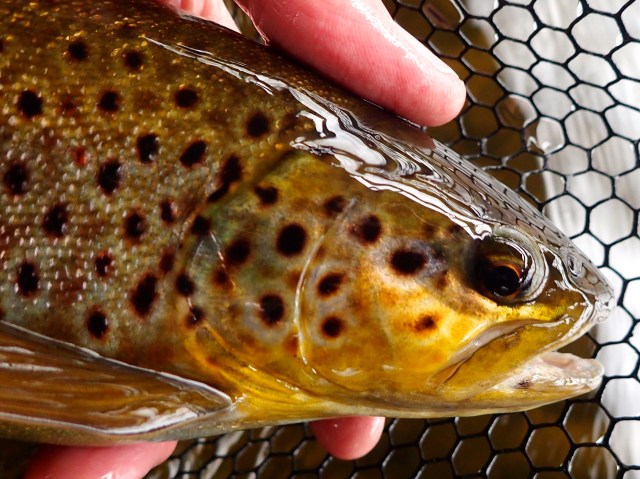
That’s more like it. An equinox wild brown with an impressive power train. Note the deep gold coloring from the underside of the mouth to the gill plate.

DCIM100GOPROG0013788.

Currentseams Q&A: Of droppers, drop-shot, and indicators

Currentseams reader Steve M. asked this question on the Farmy Report post below. I thought the answer deserved its own thread. Thanks for asking, Steve.

Q: How about a refresher on your dropper nymphing method? Specifically how you use/position the indicator? 

First, some semantics. Dropper nymphing setups and indicator nymphing are two different things. You can nymph with droppers and not use an indicator. Or do you mean drop-shot? Same deal: you can fish a drop shot rig without an indicator. “Droppers” refers to flies that are attached to the rig by tags of leader material. “Drop shot” is a method that uses split shot suspended by a tag below the bottom fly. A drop-shot rig can have droppers or just one fly. Hope that clarifies rather than confuses!

How I use and how I position the indicator are also different things. Generally, I use an indicator when:
I want to cover water/get longer drifts;
It’s cold and the takes might be subtle;
I want to fish the bottom in deeper holes;
I don’t want to feel like my arm is going to fall off after keeping it raised above my shoulder for hours.

I use my own yarn indicators, dense, bushy creations, and I’m fairly dialed in to their nuances. The indicator need not go under for me to want to set the hook. (Look for a reason to set the hook on every drift and you’ll catch more fish.)

The general rule of thumb is to set the indicator at 1.5 times the estimated water depth away from the bottom fly or shot. I’m not sure I follow that so much as I estimate the greatest depth I’ll be fishing and place the indicator on the leader where I reckon the drop shot will be ticking the bottom. It’s more feeling than formula. Specifically, I want to find this equilibrium: the shortest distance between the shot and the indicator, and enough distance to make a natural drift along the bottom. I want to see that indicator bouncing along. If you’re not catching fish and you’re not seeing those bottom return tells, you’re not fishing deep enough. Adjust your indicator (which you can now refer to as a depth regulator) accordingly.

I often check my indicator. “Checking” means that if I feel the indicator is leading or dragging the nymphs downstream at an unnatural pace, I’ll mend the indicator upstream, literally lifting it off the water and placing it where I want it. Remember that current at the surface moves faster than current at the bottom.

Finally, a word about weight. I like to use as little shot as possible. But sometimes you’ve got to go heavier. In winter, the water’s cold, and things slow down, trout included. I’ve been using two BB shot on my drop shot rig this winter — not because the water’s deep or fast, but because that extra weight slows the drift to a pace where a trout has to move less for the fly.

Hope that helps.

Steve’s secret weapon: home brew indicators made from acrylic macrame yarn and a #36 o-ring. I build them dense, and treat them with Gink or Loon Fly Spritz 2 before each use. This is a color I can see easily, and this indicator is about as big as I’d ever use on the Farmington. I know, you want a video tutorial on construction. The answer is yes — I just need to figure out the when.

OLYMPUS DIGITAL CAMERA

Farmington River Report 3/7/17: What’s all this, then?

Let’s start with some good news, where a picture is worth 200cfs:

FarmyDamRelease

Add to that 100+cfs from the Still, and we finally have a proper level in the permanent TMA, running clear and 34 degrees. Of course, we need to keep those rain dances at the ready. A little more snow in the Berkshires wouldn’t hurt, either.

To the fishing. Spot A was a blank, and friends, I want to tell you that I nymphed the snot out of that run for the better part of 90 minutes without a touch. Spots B and C were dedicated to the streamer cause but with the same result. At this point I paused to reflect upon the manifest iniquity of fishing — and to consider newly received intel that there had been a recent significant melting of ice shelves where I had been fishing .

La Aroma De Cuba Reserva Bellicoso in hand (well, mouth, too) I headed north.

And that’s where I found a whole bunch of trout that were most eager to eat my nymphs. They were fairly split between the size 16 Weisner’s midge dropper and the size 14 Frenchie variant. I used two BB shot to keep my drifts nice and slow. The takes were on the subtle side, but nonetheless my indicator received a good soaking. By 3pm the action had tailed off, and I called it a day.

Several of my fish were well-fed browns in the mid teens. No wonder this hen gave me a battle. Look at the size of her pectoral fin.

OLYMPUS DIGITAL CAMERA

~

Another fine specimen from the chilly waters of the permanent TMA.

OLYMPUS DIGITAL CAMERA


Farmington River Report 7/21/16: The best time to fish in summer is…noon?

Conventional wisdom holds that in summer, Farmington River trout will be most active early in the morning and late afternoons into dark. You won’t get any serious arguments from me. After all, I was plumbing the depths with my drop-shot nymph rig before 8am. Then again, I’ve always been fond of the old saw, “The best time to go fishing is when you can.” I stayed through 1pm, and my best fish of the day came at high noon under blazing, brilliant sunshine.

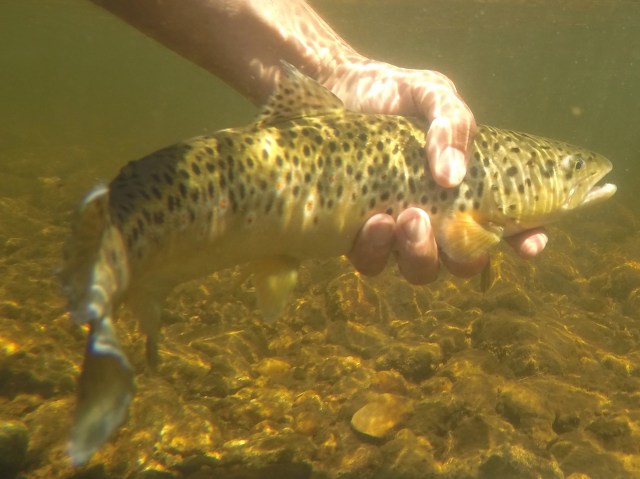
A Survivor Strain brown in the high teens, taken at noon of one of the warmest days of the summer in about two feet of water. Top dropper was the winning fly, a size 18 soft-hackled  Pheasant Tail.

DCIM100GOPROG0013432.

The action continues to be slow; I managed six fish in five hours. Of the dozen or so anglers I fished near yesterday, I saw only one hook up. I believe one of the keys to success this time of year is to aggressively cover water. I visited seven spots yesterday, blanking in two of them (the method was nymphing) and taking two on four casts in another. I also did some playing around fishing without my beloved indicator, using a section of 12-lb. yellow Stren as a sighter. (I still like the indicator better. So there.)

Observations from yesterday’s Farmington River outing

I nymphed in and out of the permanent TMA for several hours and found trout in every spot. Water was around 320 cfs, 56 degrees, and clear. Not much in the way of hatch activity, although there were some caddis and midges. Four things stood out to me.

— My fish were evenly divided between the top dropper (sz 14 March Brown wingless wet) and bottom fly (sz 12 BHSHPT). So it’s good to give the fish a choice.

— One of the fish was a juvenile salmon. When I was stripping him in, a big brown gave chase and bailed just as I was lifting the salmon out of the water. I think it’s time to tie up a JV salmon flatwing.

— The last fish, a substantial wild brown in the high teens, took the fly on my first cast after I witnessed a smaller fish clear the water and another boil at the surface. Clearly, there was a caddis emergence in that brief window, and I was not surprised that he took the top dropper (which looks very caddis-y — see point number one.)

— In one spot, there were several anglers fishing in the run above me. All of them blanked. It could have been that it was just a slow day, or it could have been that they were all standing in the same place, fishing the same water for 45 minutes. If you’re not catching, move and find the fish.


Farmington River Mini-Report 5/11/16: Hot and not

I fished below the permanent TMA yesterday from 11am-2pm. I started off indicator nymphing in a pool that was infested with rainbow trout. I caught a ridiculous number of fish in a half-hour — not a testament to any skill on my part, but rather to the aggressive nature of these trout. Most of the action was on the bottom fly, a SHBHPT. I was pleased to get one on the top dropper, a new fly for me, Liesenring’s Blue Dun Hackle (size 14). Then I went to explore some virgin wet fly water. Nice run, but I blanked with my team of three. Did likewise in two other favorite runs. (Harrumph. I covered a good third of a mile of river without so much as a tap. Nice day for wading, though.) Finished up nymphing and took one more fish. I have to say that while recently stocked rainbows are not why I fish the Farmington, some of these fish are fat and healthy and display tremendous fighting and leaping instincts. Lots of midges and a few small (size 16) caddis.


Farmington River Report 4/19/16: “I suck at nymphing.”

That’s how my client David summed up his subsurface skills on the phone.

It may have been true a few days ago. But not today. No sir.  Today, friends, David was a steely-eyed nymphing missile man. He put a hurting on the trout with a yarn indicator, a single BB shot, some Pheasant Tails, and a fierce resolve to overcome that northern banshee we call wind. I don’t usually count fish, but we surpassed the dozen mark today. Way to go, David!

It must be the height of Hendrickson madness if the UpCountry lot is full at 8:45am on a Tuesday. We fished two spots outside the permanent TMA, and did well in both locations. (You know it’s going to be a good day when you hook a fish on your first demo cast.)  We fished a drop-shot rig under one of my home-brew yarn indicators; the top dropper was a size 16 soft-hackled Pheasant Tail, and our point fly was a size 12 BHSHPT or an Eagan’s Frenchie (thanks, Pete!) We took fish on all three flies.

Wind was a constant challenge, but I think we’ll take unfavorable conditions if a good bite is part of the package. Hatches were meh. There was a micro burst of Hendricksons shortly before 3pm, but it was over in a matter of minutes. David capped off his day by swinging a team of wets and hooking his first trout on that setup.

Yup. Today did not suck.

A portrait of a dangerous nymphing machine.

OLYMPUS DIGITAL CAMERA


Farmington River Report 3/16/16: Ah, ah, ah, ah, stayin’ alive.

I had the good fortune to spend several hours in the permanent TMA today, and what the catching lacked in numbers was more than made up for in overall size. Three trout, one mid-teens wild brown, and two high teens Survivor Strain browns. You can always tell when you have a substantial fish on from the head shaking and the sulking along the bottom — and if those fish are stream-born or long-term residents, they come even less quietly.  The water was cool, clear, and running about 480cfs. Midges, early grey stones, and some un-IDed spinners about a 16-18. And, lest we forget, a magnificent Casa Fernandez Toro from Miami.

What the hellgrammite? I fished him out of the water as he was making his way downstream. As General Patton would say, you are one ugly sonuvabitch.

OLYMPUS DIGITAL CAMERA

~

All my fish today came on the top dropper, a size 14 Hare-and-Copper variant (you can see the fly here). This was my second Survivor Strain and the last fish of the day. No mistaking the takes today, as the indicator went under hard each time.

OLYMPUS DIGITAL CAMERA

~

Stayin’ alive. You can identify a Survivor Strain brown from its clipped adipose fin.

OLYMPUS DIGITAL CAMERA

~

Off you go. One of the more satisfying aspects of landing a nice fish is giving it the opportunity to swim away. When next we meet…because I know where you live.

OLYMPUS DIGITAL CAMERA


Farmington River Report 2/4/16: Ixnay on the Unkskay

There’s a time and a place to be an intrepid explorer, and that time was…Tuesday. Today I wanted to catch some trout. Winter fishing being like buying real estate — location, location, location — I headed for the retail district. Not too crowded, and people willing to share the water (thanks, Zach and friend).

So it wasn’t stupid good, but it was good enough that after 90 minutes I had enough house money to want to go spend it elsewhere. A few notes about the river and fishing:

The permanent TMA was about 400cfs and slightly off-color. The closer you got to the Still, the murkier the water. And it was cold. I’m guessing 34/35 degrees.

Indicator nymphing was the method. The water I fished was neither slow nor deep, but I decided early on to fish two BB shot on my drop shot rig to slow the drift. It seemed to work.

I took several trout in what I would describe as “softer water,” that transition zone between current seam and frog water.

The takes were on the subtle side. No indicator screeching to a halt, or dramatically plummeting to the depths; it was the equivalent of a trout sipping a midge off the surface. It was simply no longer there. Hook set downstream, and off we go.

All my fish today had an intact adipose and were in the 12″-15″ class. I fished a size 12 (2x short) SHBHPT on bottom, and a size 16 (2x short) new midge emerger/nymph thingy I made up last night on the dropper. I am mildly depressed to report that there was no interest in the new fly. But I’m confident that some day there will be.

OLYMPUS DIGITAL CAMERA


See you Saturday!