Cape Cod Mini Report: Get Shorty

I recently spent two long nights fishing the Cape and as is so often the case, it was good news/bad news: legions of stripers/99% of them shorts (some unworthy of trout size). But the company was fine, the midnight tea lovely, and I got the chance to play around with a line that actually worked on my new two-hander. (Of course, that line is no longer made.) Just getting back to a regular schedule now after 5am bedtimes.

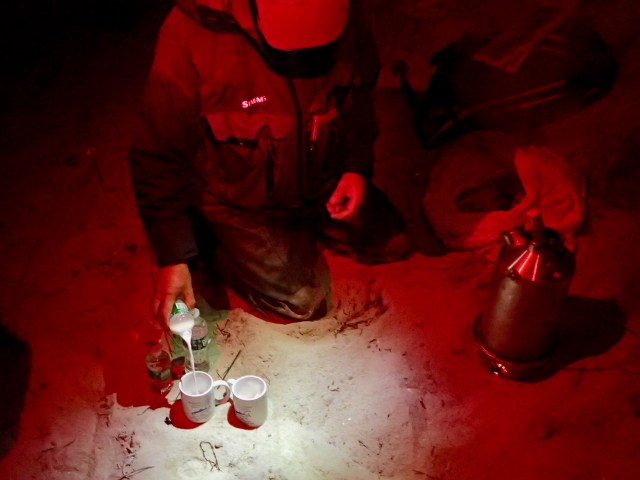
To (again) quote Colin from The Great Escape: “Tea without milk is so uncivilized.” British mate Mike Oliver does the honors, his world famous Kelly Kettle on the right.

OLYMPUS DIGITAL CAMERA

~

Used to be a September Night. I have no idea how many bass I caught on this fly. We fished moving tides, incoming and outgoing, with great success.

OLYMPUS DIGITAL CAMERA

Farmington River TMA Poachers and the TIP Line

Unfortunately last week I witnessed two incidences of attempted poaching within the Farmington River Permanent TMA.

Use the TIP (Turn In Poachers) line if you witness poaching. Other than the actual creeling of fish, warning signs include: those toting large plastic buckets (and not for storing gear); dragging trout up on the bank and taking a lackadaisical approach to hook removal (all trout are to be returned to the river without avoidable harm); building stone weirs to keep the fish alive and penned in until they make their move. You betcha, I saw all of this behavior, as well as the attempt to walk off with trout.

TIP Line: 1-800-842-HELP (4357). Program it into your phone. Don’t be bashful about using it.

A poacher’s MO from a few years ago. I recovered this after he broke it off on the bottom. Barbless hooks only in the permanent TMA!

IMG_1991


Small Stream Report: This never gets old

Our time together was all too brief. Really, I’ve got to do a better job of planning. Because a mountain brook loaded with native char is not a place to rush one’s self.

The day was overcast and cool — like so many others this spring. Bug activity was minimal. But the brookies were open for business. They ate my bushy dry, North Country spider, and micro streamers with equal fervor. The cigar was a Rocky Patel The Edge corona gorda, and it was a good as the fishing. I made the promise of “three more casts” three times. Depressingly, I followed through on the final declaration.

Sometimes being responsible sucks.

Even brook trout like the fontinalis fin. The old timers used to cut the fins off and use them for bait. This one remained on the fish, and he’s swimming around in the same pool I caught him in as you read this.

OLYMPUS DIGITAL CAMERA

~

I found a long run that held a few occasionally rising fish. I couldn’t see what was coming off, but I tied on a size 14 Winter Brown North Country spider and swung it along the length of the pool. I took several brookies, then prospected some deep plunges with weighted mini buggers and ICU Sculpins. This was my last char of the day. A perfect fish.

OLYMPUS DIGITAL CAMERA


Farmington River Report 5/29/19: Nymph them up

Wednesday was cool, overcast, and there wasn’t a lot of hatch activity (caddis and Light Cahills) until late afternoon. That didn’t stop Sam from sticking a bunch of trout between 10am-5pm. We fished below and within the permanent TMA, four marks total, and we found trout willing to jump on in all of them. Given the water height (880cfs lower river and 575 up north) we spent the entire day working on Sam’s drop-shot nymphing game, using a combination of tight line and indicator tactics. We landed a mix of rainbows and wild & Survivor Strain browns. Good job, Sam! You’re on your way to becoming a lethal subsurface threat.

Deep within the Amazon jungle, native wildflowers…nah. It’s just New Hartford, Connecticut. Darn pretty, though, and as lush and green as the rainforest.

P5291081.jpeg

~

Men at work: Sam getting it done with a tight line presentation. His reward was a lovely wild brown that came on a size 14 Hare and Copper.

OLYMPUS DIGITAL CAMERA

~

One of several Survivor Strain browns that made it to the hoop. This one came out of the Permanent TMA. Way to go, Sam!

OLYMPUS DIGITAL CAMERA

A Simple Drop-Shot Nymph Rig (Revisited)

After last week’s Nymph-o-Mania! post I received a lot of questions about drop-shot nymphing: how to build a rig, can you use it with an indicator, is it better for a tight line presentation, etc. Let’s start with the rig.

A drop-shot nymph rig with sighter for both indicator or tight line nymphing.

OLYMPUS DIGITAL CAMERA

And a PDF of the same diagram: SighterDropShotNymphRig

So: I’ve been drop-shot nymphing for quite some time now. Being the curious sort (and a confirmed autodidact and DIYer) I tend to change things around until I find what works best for me. What you see is my current default trout nymph rig. I’ve been using 6X for the drop shot tag to make it the weakest link in the system. I’m lazy, so I build a sighter into the system whether I’m going to indicator nymph or not. Maxima if the water is high or off-color, 5x if it’s skinny and clear. (Please, use your favorite material to build this rig. It will work whether or not you use Maxima, P-Line, or Stren.)

When to tight line and when to indicator? Chapters in books have been written on this. Here are some of my thoughts in brief.

When to indicator:

  • When I want to cover longer stretches of water
  • When I want to reach pockets and runs farther than a rod-and-arm’s length
  • When I want the nymphs to swirl around in a mixer-like pocket
  • In conditions where takes may be subtle/difficult to feel (winter, windy days, just to name two)
  • When the wind is blowing upstream

Note: The distance from drop shot to indicator on the leader is about 1.5 times what I estimate the deepest water to be. I use my own home brew yarn indicators almost exclusively. They are light, denser that store-bought kinds, don’t spook fish (it seems that every season I have at least one trout hit my indicator) and I am very dialed in to their nuances.

When to tight line:

  • When I’m fishing in close
  • When the water is low and clear
  • When I feel the indicator is difficult to manage/adversely speeding up the drift

Hope that helps. I’m sure there will be more questions and as always, I am happy to answer them.


Mother Nature has spoken: Light Cahills on the lower Farmington

I have not been to the lower Farmington to bear witness, but I know the Light Cahills are coming off because the first rose in my garden bloomed today. On top, a classic Catskills dry or a creamy Usual; subsurface, a legacy Light Cahill winged wet or a Partridge and Light Cahill soft hackle. All will serve you well.

Every year is different, but nature is always on time. This rose is called “Grenada.”

IMG_3551


Farmington River Report 5/23/19: Nymph-o-Mania!

You know it’s a great 2 hours of fishing when you lose count of the trout you land. Drop-shot nymphing was the method, straight line and indicator, and the action was hot from start to finish. Since the lower river was below 1,000cfs for the first time in a month, and I had limited time, that’s where I headed. I made it to three pools from 12:30pm-2:30pm. and in each of them the trout were eager to jump on: two produced fish on the third cast, the other the first. Despite a strong caddis hatch, I didn’t see any risers, and unfortunately I didn’t make time to swing wets. But if you’re ready to do some nymphing, and you’re looking to book a date, now’s a good time to do it. Thanks to everyone who said hello!

Indicator Nymphing Tips #1 & 2: An upstream wind is great time to indicator nymph, because it slows the pace of the indicator on the surface. Look for a reason to set the hook on every drift. If that indicator twitches, stalls, slows, deviates — it doesn’t need to go under — set the hook! This lovely rainbow was such a case. My yellow yarn was bouncing merrily downstream, then slowed for just a moment. Bam. Set. Fish on.

OLYMPUS DIGITAL CAMERA

~

When there’s a substantial caddis hatch, and you’re nymphing with two flies, it’s almost never a bad idea to make your top dropper a Squirrel and Ginger. About half my fish came on this pattern (point fly was a Frenchie variant).

OLYMPUS DIGITAL CAMERA

~

I also had plenty of dramatic takes on the indicator, as in: now you see it, now you don’t. Likewise when I was tight line nymphing. I felt every single hit. This guy, looking very wild, clobbered the fly and fought well above his weight class.

OLYMPUS DIGITAL CAMERA

Speaking Engagements for Fall and a New Presentation

I’m marking up my calendar with speaking engagements, and you should be too. So far, it’s a busy October.

OLYMPUS DIGITAL CAMERA

Tuesday, October 15 at Thames Valley TU (subject tbd).

Wednesday, October 16 Capital District Fly Fishers (Albany, NY, not confirmed but very likely, subject tbd).

Thursday, October 17 Farmington Valley TU (subject tbd).

Speaking of speaking, I will have a new presentation ready for fall: The Little Things 3.0. More seemingly insignificant things that can have a huge impact on your fishing. Giddyup!

…rehearsing and nursing a part, we know every part by heart… (Bonus points if you can ID the classic cartoon theme song that’s from!)

OLYMPUS DIGITAL CAMERA

Guide Trips and All This Damn Water

Many of you have reached out to me regarding guide trips on the Farmington, in particular learning how to fish wet flies. My advice remains the same: we should wait out this water volume. Yes, the Farmington is fishable at this level (850cfs and change in the Permanent TMA as I write this) and yes, I know of people who have been catching trout on dries. But if it were me, I’d be focusing on nymphs and streamers at this water level. So: if you really need to get out on the river, sure, let’s do it. There are a ton of fish to be had. But if you really want to focus on wet flies, let’s wait until the water gets to 500cfs or below. (Don’t even get me started on the lower Farmington — 1380cfs right now — or the Hous, a disgustingly high 2710cfs.) And of course, there are always small streams. You know where to find me.

Last year at this time it was sunny and the Farmington was — dare I say it? Wadeable.

DCIM100GOPROG0034989.


Small Stream B Comes Through; Big Stripers Continue Their No-Show

I wrote about my first springtime small stream outing last week. It was at a brook that has been on a bit of a slide in terms of numbers, and this disappointing trend continued. Small Stream B, however, continues to go great guns. I fished it for 75 minutes, first time this spring, and I pricked dozens. Fished a bushy dry on top and a size 14 Stewart’s Black Spider dropper for most of the trip, and the char went nuts for the dry despite the elevated water levels. Did a little micro streamer action, too, which is always fun. Bravo, Mother Nature!

Most of the action came topside, but this lovely gem fell victim to Stewart’s Black Spider.

OLYMPUS DIGITAL CAMERA

~

If you’re looking for a new way to have some fun on a small stream, try a micro Zoo Cougar. I usually tie these on size 2-6 streamer hooks, but I believe this is a 14. Chuck it or drift it (the deer hair head keeps it on the surface) down the pool, then make some drunken, frantic strips back. The fly will wake and dive and drive the brookies absolutely out of their minds. Color is probably insignificant.

OLYMPUS DIGITAL CAMERA

~

Now to the stripers. You’ve heard me say that every year is different, and with 2018 and 2019 goes the proof. Whereas last year was off-the-charts good for big bass, this year is not-so-much. I spent some time late last night greased line swinging a proven run that was dead as Julius Caesar. (Sigh.) Well, persistence will hopefully pay off.