Farmington River Report 5/13/24: Slow. Slower. Slowest.

About three hours into our session, I told Alan that of all the lessons I’d given over the years, if you asked me to pick the absolute worst days for catching, this would easily be in the top three. Or would that be bottom three?

It didn’t start that way: reduced flow (425cfs in the PTMA), warm air, bright sunshine, and bugs everywhere, bugs being caddis and midges. (Also witnessed: crane flies.) The midges floated by in mats and clusters, the caddis emerged and danced on the water and flitted through the air…and nothing was on them. I saw two rises in four hours. And so it turned out that it was a terrible day for catching fish on wet flies.

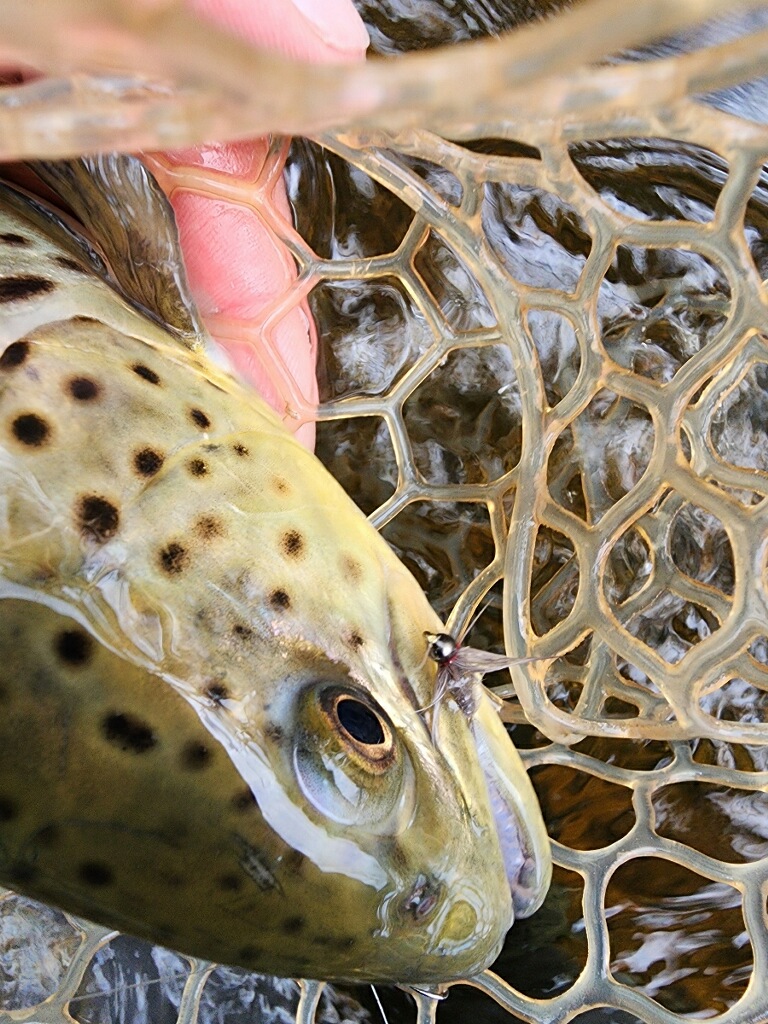
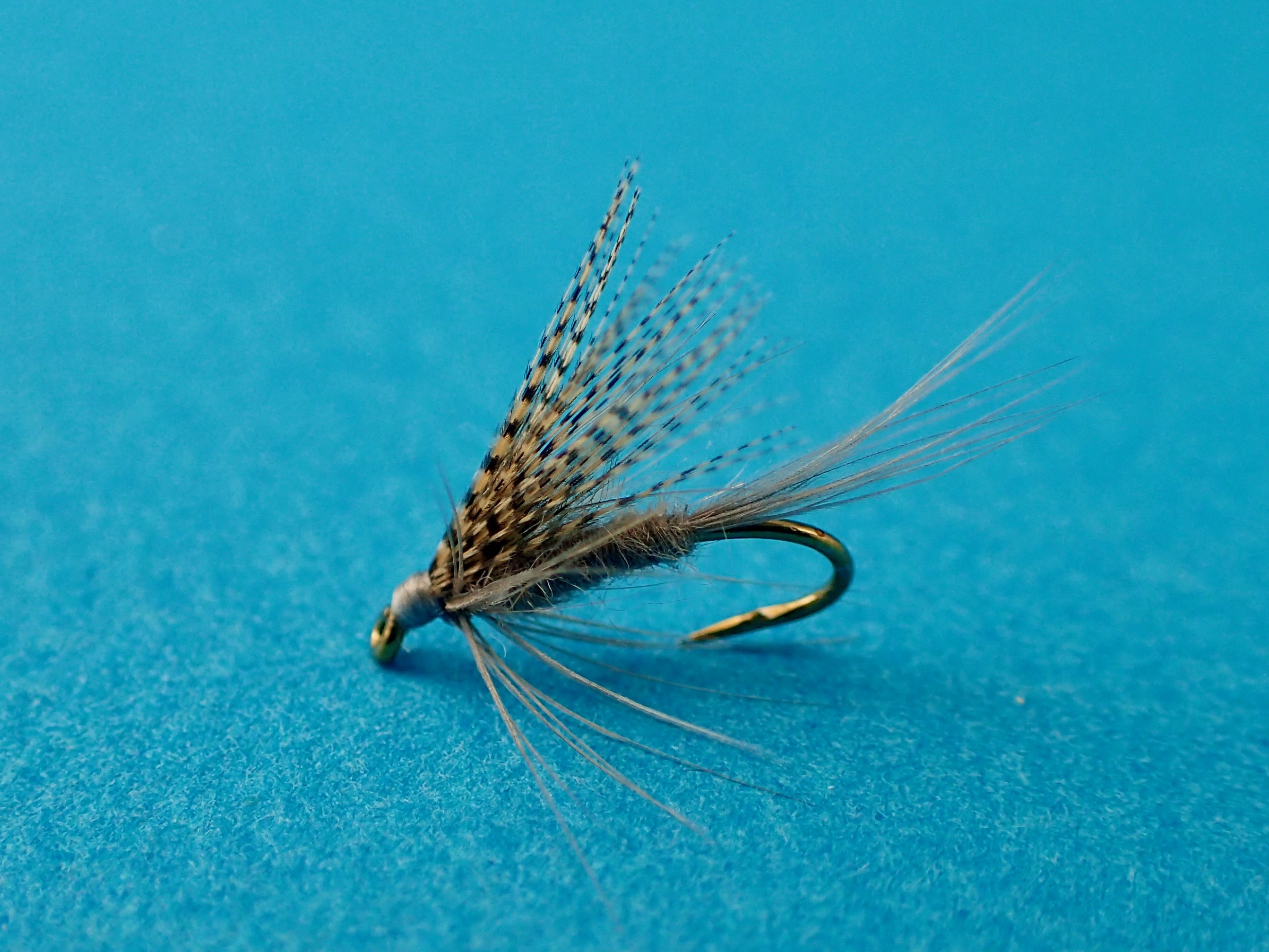
I leave the why to those who are wiser than I, but among my guesses were high pressure, a sudden change in flow, and (most likely) trout eating the caddis larva and emergent pupa near the bottom and at the mid depths. This last scenario manifested when we took our only fish of the day on a tungsten bead head Hendrickson soft hackle fished on point.

It wasn’t just us. We saw or encountered over a half dozen other anglers, and none of them had hooked up. Some days, the fish win. But Alan kept at it, making hundreds of fish-worthy presentations, and there will come the day when he does that and he’s hooking up on every cast. Well done, Alan!

Salvation comes to us in the form of a lovely parr-marked rainbow. She slammed the point fly on the dangle so hard, the Alan never had time to set the hook. Thanks, you beauty, for doing all the work, and to Alan for his positive perseverance.

A brief wet fly outing on private waters and other notes of interest

On Monday I had the opportunity to fish a private stream, so naturally I jumped on it. This is a lovely brook that wants to be a river, and it’s not easy water. Its banks are overgrown, and there’s often a three foot drop from terra firma to water. The first beat we fished was particularly challenging; a lot of the water crawls along, creating glassy pools where any movement sends the fish into flight toward the nearest cut bank. I was instructed to stay out of the water as much as possible, but when did I ever follow directions when I wanted to do my thing? I decided that I needed to get in, summon my inner stealth ninja, and fish downstream.

Sure enough, I crept up on pool that had risers. The hatch was midges and caddis, and there were a few stray Hendrickson spinners. Some of the takes were more emergery, some gentle sips. I had two fish slam the fly the moment it hit the water, and a few more that required a little coaxing. I took six fish, which I was told was pretty darned good, a nice mix of stocked and wild brookies and some chunky rainbows. All three flies were eaten: Squirrel and Ginger (sparkle variant — more on that soon!), Hendrickson spider, and LaFontaine’s diving caddis, tan.

The second beat was not as kind. It began good enough, with my biggest fish of the day, a rainbow with a dramatic pink band (you can see it on Instagram @stevecultonflyfishing) on the second cast. But even though this mark was far better suited for wet flies, I only managed one more trout (do creek chubs count?), and even with that one, I had to wait a half hour and go back after I missed her the first time. I think the lack of activity was due to the hatches being over, and everyone with fins being well fed. Or, maybe I just stunk. Or maybe it was just fishing. No matter. It was just capital to be out fishing. Thank you. Peter G., for your most generous invitation.

It’s almost never a bad idea to swing wet flies when you see feeding fish, especially during an emergence. However, be advised: if the trout aren’t feeding regularly and rhythmically, and you don’t get hit after three good presentations, you may be in for a bit of a wait…

Meanwhile, nose to the grindstone on the book. As far guide trips go, I am not taking any more dates in May. If you see me on the river, please come say hello.

Then, of course, there’s the new house and vegetable garden, which won’t plant itself. What a wonderful collection of obligations.

Farmington River Mini Report 5/1/24: Back in the New Hartford Groove

It’s hard to believe, but yesterday was the first time this year I got out on the Farmington River — and most of the afternoon was dedicated not to fishing, but errands and work. Poor me, having to spend an afternoon in an office that included shirtsleeve weather, sunshine, Hendricksons, trout, and good company!

Besides fishing errands — new boots and two nets on the item list — I spent some time distributing info sheets on gathering fly patterns and photos for the book. Then I hightailed it to the river to get some shots of guide Steve Hogan with his client. Finally, I spent an hour idly swinging a team of three wets. I’d missed the earlier hatch window, but I stuck a pile of juvy Atlantic salmon and then finally a rambunctious stocker rainbow.

I’d given Steve a tungsten bead head soft-hackled Hendrickson, and later in the day he sent me this photo, taken upriver. Well done, Mark! While there were some Hendricksons in the air, the hatch has progressed to north of the PTMA. Church Pool was devoid of anglers at 3pm, so there’s your proof. (Photo by Steve Hogan)

From the Archives: Soft Hackles and Wet Flies on The Orvis Podcast with Tom Rosenbauer

This one’s only about a year old, but in case you missed it, it’s certainly a must-listen — especially if you like to swing wets, if you’re considering learning how to do so, or even if you need a refresher course. Here’s the link to the original post, and within that you’ll find a link to the podcast. Enjoy, and beware: you’re about to start catching more fish.

You should be fishing this pattern, the Dark Hendrickson winged wet, right now.

Mini Steelhead Report: The Last of the Dropbacks

I ventured with #3 Son Gordo to ye olde steelhead mill, AKA Pulaski, NY’s Salmon River, for two days of post-spawn steelhead fishing. Due to an unusually mild winter, the spawn was very early this year. what should have been prime time numbers was picking away and scrapping for every fish. The weather was chilly, but bright and sunny, and predictably the fish were holding in the deepest, fastest, most bubbly water they could find. I was 2-for-3 on Monday and 3-for-4 on Tuesday with a couple skippers in the mix. Gordo, who was spin fishing under a float, put one in the hoop each day. All steelhead are special, so it was a treat to have our hard work and persistence rewarded. See you in November!

This post-spawn hen slammed a size 6 olive Woolly Bugger in a fast-moving slot near the head of the run. Moments before, I’d taken a two-pound skipper on the same fly as I was stripping it in to recast. Thank you both for playing!

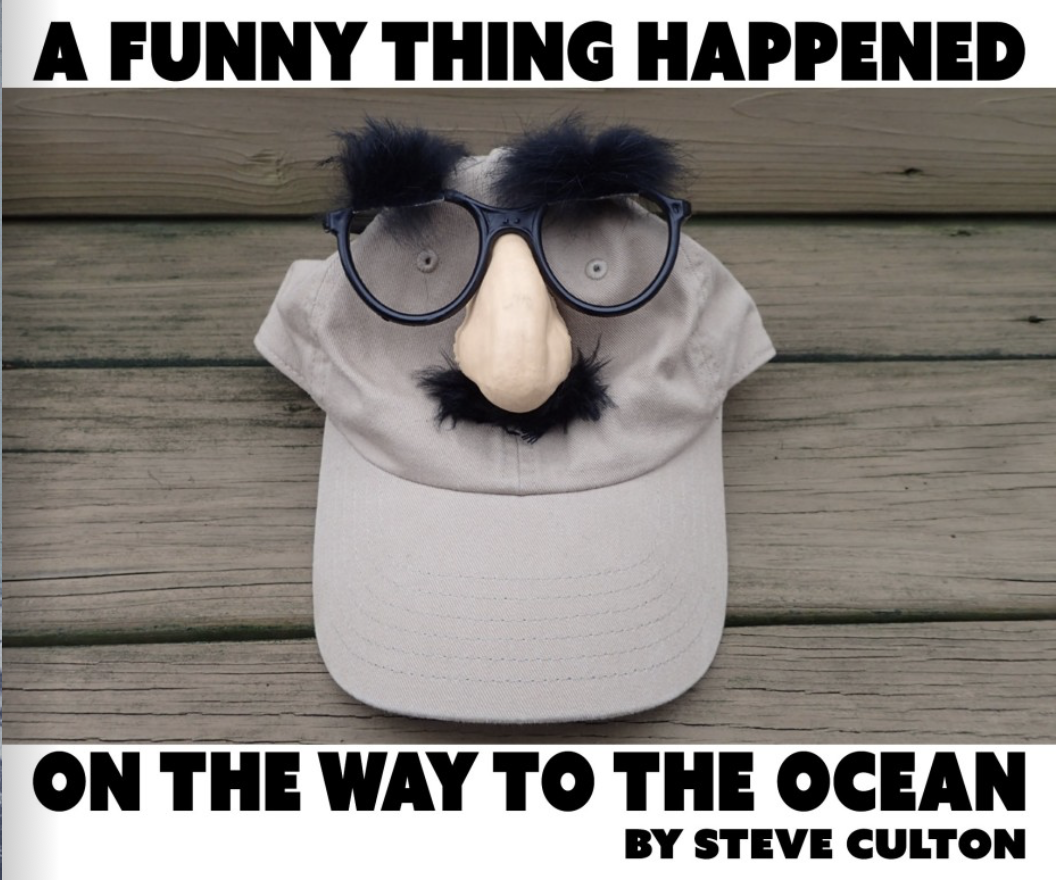
“A Funny Thing Happened on the Way to the Ocean” in Surfcaster’s Journal 83

Fly fishing for striped bass isn’t all steely eyes, fierce focus, and grim countenance. Sometimes the jester shows up, and hilarity ensues. You can read all about it in the newest issue of Surfcaster’s Journal, number 83 to be exact. SJ is an e-zine and you need a subscription, but it’s only 20 bucks for a year. This one’s a good one, folks — cue the laugh track!

From the Archives: “Streamer Kings: Three Big Fly Gurus Explain How to Catch More (and Larger) Trout Using Meaty Patterns”

With all this high water, and some warmer temperatures, it seems like a good time for a refresher course on streamers. I wrote this after interviewing George Daniel, Chad Johnson, and Tommy Lynch, but really, they’re the ones doing the talking. I just showed up and asked good questions!

Read “Streamer Kings”

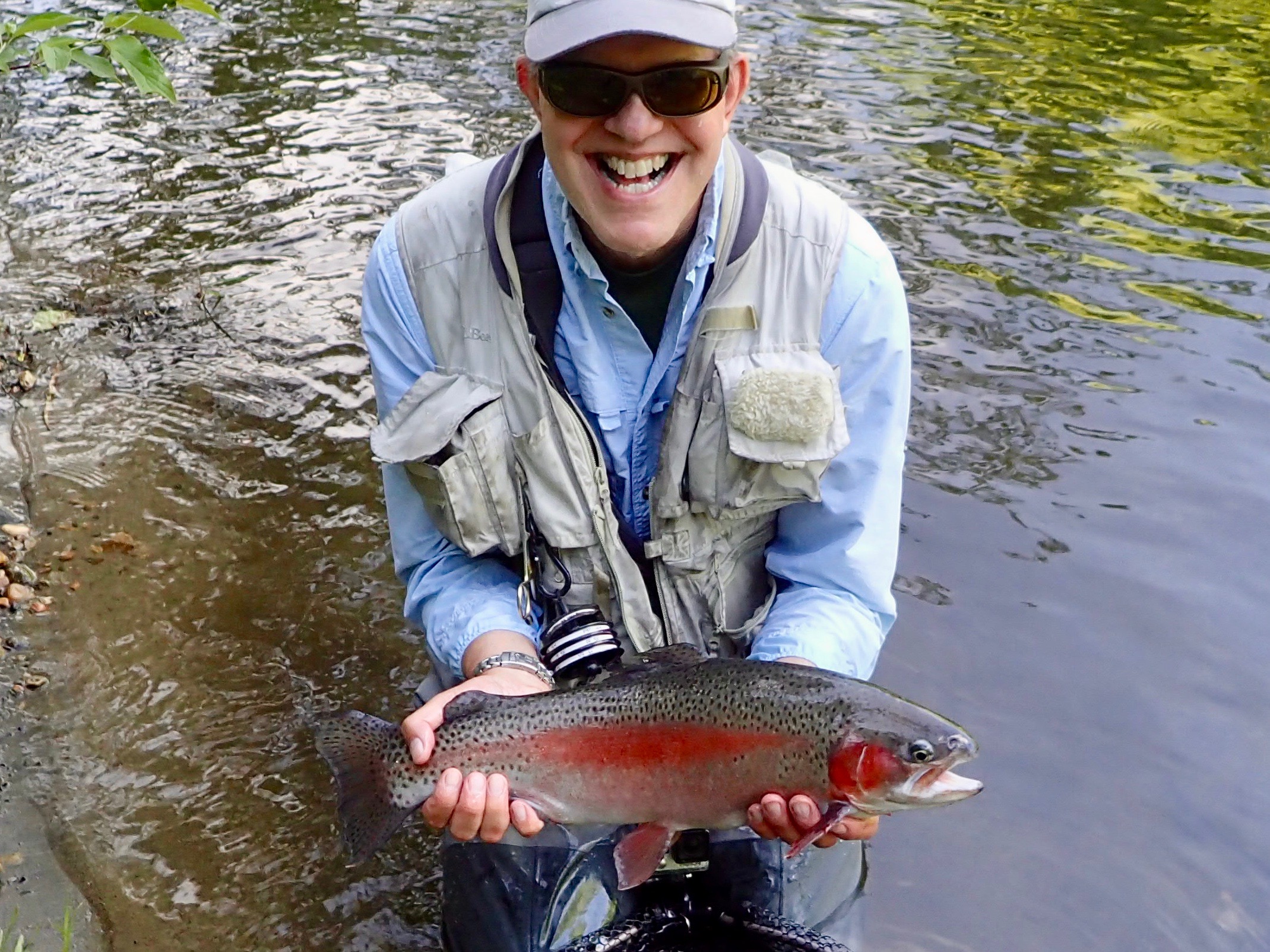
This chunkette took a wet fly, but I often incorporate wet fly tactics into my streamer game. I suppose that’s a whole different article!

Ladies and Gentlemen, Steve Culton is Writing a Book!

I’m super-excited to announce that I just signed a book contract with Stackpole. The working title is Fly Fishing Guide to the Farmington River. This will be a comprehensive resource for the West Branch, from the river to trout to maps to access to hatches to how-to-and-when. I plan on including information from local experts and guides, as well as a selection of must-have fly patterns. If you have any of Stackpole’s “Fly Fishing Guide To” river books, you know the level of detail I’ll be delivering.

The final manuscript isn’t due for over a year, so it’s going to take some time for this to get to press. In the meantime, please wish me luck as I set off on this big adventure. As always, I thank you for your support and readership, and of course I’ll keep you updated as the project progresses.

Coming soon to a bookshelf near you! While this isn’t the working title or cover shot, the description is spot-on.

From the Archives: The best soft hackles and wet flies for the Hendrickson hatch

Yeah, baby, it’s getting to be about that time. OK, maybe not for a couple more weeks. We’ll see what Ma Nature has in mind as far as warmth and rain are concerned. But indeed it is coming. And right now is the perfect time for you to stock the box with your favorite Hendrickson patterns.

If you’re not fishing under the Hendrickson hatch with wet flies, you’re missing out. In fact, you’re missing out on some of the best trout-on-the-fly action of the year. Tie these up, place them over a rise, and hold on. Oh. And be prepared to clip one or two flies off your three-fly team. Such are the travails of the angler getting doubles and triples!

The Best Soft Hackles and Wet Flies for Fishing the Hendrickson Hatch.

Mssr. H awaits your pleasure…

From the Archives: A Wet Fly Hen Hackle Primer

On the surface, you may be unthrilled (rather than enthralled) by this topic. But I think it’s worth your time, especially if you tie soft hackles. I get a lot of questions about hen hackle types, and this article covers the subject nicely.

A Wet Fly Hen Hackle Primer.

There’s something very satisfying about finding a top-shelf hen cape. While the price of both has gone up, you still occasionally see these in deep discount fly shop and show bins..